
July 5, 2026
The Hidden Architecture Behind Russian Oil Revenue
Global crude markets operate within layered pricing hierarchies that most casual observers never fully appreciate. At the centre of this system sits a deceptively simple mechanism: every barrel of Russian Urals crude sold on international markets is priced not in isolation, but as a calculated discount relative to the Brent benchmark. This relationship, combined with rouble exchange rate dynamics and sovereign budget engineering, creates a fiscal architecture far more nuanced than a headline barrel price alone can convey.
Understanding why Urals crude prices below $100 per barrel matter requires stepping back from the daily price ticker and examining how oil revenues flow through Russia's fiscal system, how geopolitical shocks reshape global supply curves, and why Asian refiners have quietly become the arbiters of Russian crude's global pricing power. For broader context on crude oil price trends in 2025 and beyond, the structural forces shaping Urals are deeply intertwined with global benchmarks.
When big ASX news breaks, our subscribers know first
The $100 Per Barrel Level and What It Reveals About Russian Fiscal Design
Why the Budget Baseline Is Set So Conservatively
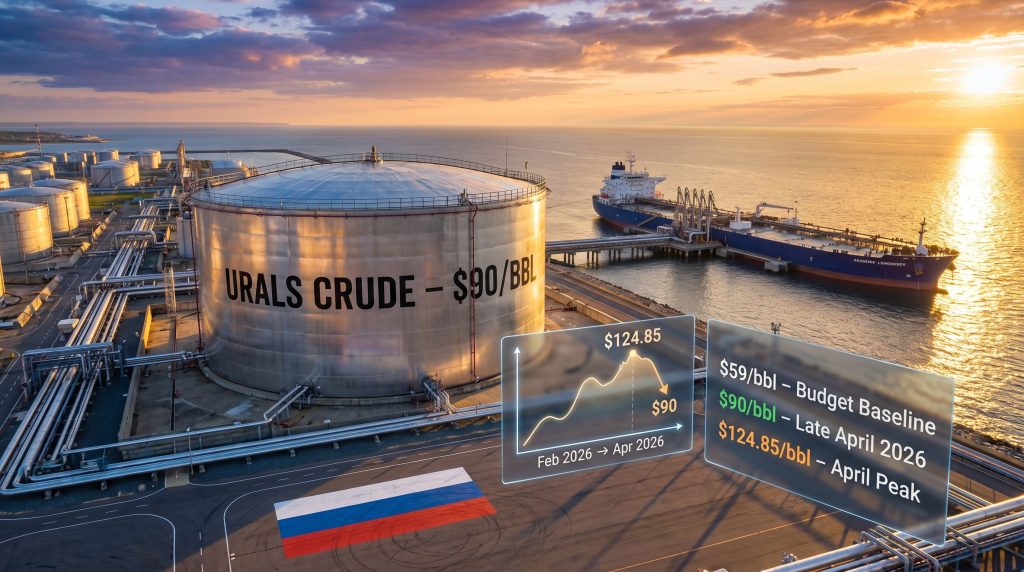
Russia's 2026 federal budget was constructed around an assumed Urals oil price of $59 per barrel, a figure that appears strikingly modest against recent market reality. This conservative anchoring is not an accident. Russian fiscal planners have historically embedded downside protection into budget assumptions, allowing any price above the baseline to generate windfall revenue that flows into sovereign reserve mechanisms.
The practical consequence of this design is significant. When Urals crude traded above $100 per barrel for most of April 2026, the Russian oil price in roubles used for tax calculations exceeded federal budget assumptions by approximately 46% in the first half of that month alone. This created an extraordinary fiscal cushion, one that persists even as prices retreat.
The structural takeaway is that Russia's budget was engineered to remain solvent at prices well below current market levels, meaning the government retains meaningful fiscal flexibility across a wide range of crude price scenarios.
Even a correction toward $90 per barrel, which is where Urals was trading by late April 2026, still places revenues approximately $31 per barrel above the budget baseline. This buffer helps explain why short-term price volatility, while notable, does not immediately translate into Russian fiscal distress. Furthermore, the ongoing Russian oil sanctions impact continues to shape how export revenues are structured and distributed.
From $45 to $124.85: Mapping the Urals Price Surge
A Supply Shock Compressed Into Weeks
Prior to the outbreak of the Iran conflict on February 28, 2026, Urals crude averaged approximately $45 per barrel, a price range shaped by the cumulative weight of Western sanctions, elevated freight costs, and a structurally narrow buyer base concentrated among Asian importers. The geopolitical shock that followed drove one of the sharpest repricing events in the crude market in recent years.
From January 1 through April 24, 2026, the year-to-date average Urals price climbed to $65 per barrel, a figure that masks the true velocity of the move. At its intraday peak, Urals reached approximately $124.85 per barrel, a level the market had not visited in over a decade. For live and historical pricing data, Urals oil trading economics provides ongoing benchmark tracking relevant to these movements.
Urals Price Trajectory: Before and After the Conflict
| Period | Average Urals Price (FOB) | Primary Driver |
|---|---|---|
| Pre-conflict (before Feb 28, 2026) | ~$45/barrel | Sanctions discount, narrow buyer base |
| Jan 1 to Apr 24, 2026 (YTD average) | ~$65/barrel | Escalating geopolitical risk premium |
| Peak (early to mid-April 2026) | ~$124.85/barrel | Full global supply shock |
| Late April 2026 | ~$90/barrel | Fragile U.S.-Iran ceasefire |
| Q2 2026 forecast | ~$101.73/barrel | Residual risk premium persisting |
The speed of this repricing illustrates a dynamic that energy economists describe as inelastic short-run supply response. When a major producing region faces disruption or perceived disruption, the market cannot immediately source replacement barrels, forcing prices upward far beyond what supply-demand fundamentals alone would justify over a longer adjustment horizon.
What Pulled Urals Below $100: Ceasefire Mechanics and the Brent Transmission Effect
How Geopolitical De-escalation Flows Through to Russian Export Prices
The fragile ceasefire between the United States and Iran represented the single most important variable driving Urals crude prices below $100 per barrel. Because Urals is priced structurally as a discount to dated Brent crude, any softening in the Brent benchmark amplifies downward pressure on Russian export prices. In addition, the broader geopolitical trade tensions reshaping global commerce in 2025 and 2026 have played a significant role in how quickly these price movements have materialised.
This transmission mechanism operates in both directions. When global tensions drive Brent higher, Urals benefits proportionally, minus its prevailing discount. When geopolitical risk premiums deflate, Russian crude falls alongside the broader market, and occasionally faster if buyer sentiment shifts simultaneously.
By the week ending April 24, 2026, Urals at Russia's western export terminals of Primorsk and Novorossiisk settled at approximately $90 per barrel on a FOB basis. The retreat below $100 was driven by de-escalation, not by any deterioration in underlying demand for Russian barrels.
The Narrowing Discount: A Structural Signal Worth Watching
Perhaps the more revealing data series is not the absolute Urals price but the evolution of its discount to dated Brent. This spread is determined by a combination of crude quality, geopolitical risk premiums attached to Russian barrels, and the competitive depth of the buyer pool.
| Month | Urals Discount to Dated Brent (FOB, western ports) |
|---|---|
| February 2026 | ~$24 per barrel |
| March 2026 | ~$22 per barrel |
| April 2026 | ~$18 per barrel |
A consistent three-month narrowing of this spread suggests something more than a temporary supply squeeze. It points toward improving Russian export market positioning, whether through more competitive logistics, deepening relationships with price-sensitive refiners, or reduced availability of alternative medium-sour crude grades.
India's Pricing Transformation: From Discount Buyer to Premium Payer
The DES Premium Shift and What It Signals
One of the most structurally significant developments embedded in the April 2026 data involves how Indian port prices for Russian crude moved relative to the Brent benchmark. Urals cargoes delivered to Indian ports on a DES (Delivered Ex-Ship) basis rose by approximately $18 per barrel from end-March 2026. This swing transformed the India-delivered Urals price from a discount of roughly $10 per barrel below Brent into a premium of approximately $8 per barrel above Brent, a $18 repricing within weeks.
This shift carries significant long-term implications. India's transition from a discount buyer to a premium payer is not simply a freight story. It reflects intensifying competition for Russian barrels among Asian refiners who have limited short-term alternatives for medium-sour crude grades.
It is worth understanding the structural distinction between FOB and DES pricing in this context:
- FOB (Free on Board): The seller's price at the loading port, before freight and insurance costs are applied. This is the benchmark used for Russian export revenue calculations.
- DES (Delivered Ex-Ship): The buyer pays a single delivered price that includes freight. For Indian buyers, a DES premium to Brent means the total landed cost has risen above comparable market alternatives.
Higher freight rates did compress exporter margins, but the surge in underlying global crude prices driven by Gulf tensions more than offset logistics costs during this period, per Reuters data published April 25, 2026.
Fiscal Stress Testing: Russian Budget Sensitivity to Price Scenarios
Modelling the Revenue Gap Across Price Ranges
The dual-variable nature of Russian oil taxation creates an important complexity that a simple dollar-per-barrel analysis overlooks. Russian oil revenues are calculated in roubles, meaning the fiscal impact of any crude price movement is simultaneously compounded or cushioned by the rouble-to-dollar exchange rate. A weaker rouble, for example, mechanically increases rouble-denominated oil revenues even if the dollar price of Urals falls.
This dynamic helps explain why Russia's fiscal position can appear more resilient than external observers expect when focusing solely on the Brent price or the Urals headline number. Consequently, the interplay between the oil prices and trade war dynamics between the US and China adds yet another layer of complexity to how Russian export revenues are ultimately valued.
Urals Price Scenarios vs. Budget Assumption
| Urals Price Scenario | Vs. Budget Baseline ($59/barrel) | Fiscal Outlook |
|---|---|---|
| $45/barrel (pre-conflict average) | -$14 below budget | Deficit pressure territory |
| $59/barrel (2026 budget assumption) | On target | Balanced budget scenario |
| $65/barrel (YTD 2026 average) | +$6 above budget | Modest surplus |
| $90/barrel (late April 2026) | +$31 above budget | Substantial windfall revenue |
| $100+ per barrel (peak April 2026) | +$41 above budget | Maximum fiscal windfall |
The table illustrates why the correction below $100 matters at the margin but does not represent an existential fiscal threat in isolation. A sustained correction toward the $65-$70 range would begin to meaningfully erode the windfall buffer, but that scenario requires both ceasefire durability and a broader softening in global crude demand.
The next major ASX story will hit our subscribers first
Three Scenarios for Where Urals Prices Go From Here
Scenario 1: Ceasefire Holds and Prices Normalise
If the U.S.-Iran ceasefire stabilises over coming months, Brent crude would likely drift toward the $80-$85 per barrel range as geopolitical risk premiums deflate. With an approximately $18 per barrel Urals discount, this would place Russian export prices near $62-$67 per barrel, close to the budget baseline but well below recent windfall levels. Russia's fiscal surplus would narrow materially.
Scenario 2: Ceasefire Breaks Down and Supply Risk Returns
A ceasefire collapse would rapidly restore geopolitical risk premiums across global crude benchmarks. Urals would likely re-approach the $100-$120 per barrel range, recreating conditions favourable to Russian fiscal accumulation. Indian and Chinese refiners would face renewed import cost pressure, potentially accelerating longer-term supply diversification planning. However, OPEC market influence would also play a critical role in how quickly any such supply gap could be bridged.
Scenario 3: Asian Buyers Gradually Diversify Away From Russian Crude
Over an extended 12-24 month horizon, normalisation of Middle Eastern supply could reduce the urgency among Asian buyers to compete for Russian barrels. This would structurally widen the Urals-to-Brent discount again, reversing the narrowing trend observed through Q1-Q2 2026. Even if Brent remains firm, Russia's ability to sustain high rouble-denominated oil revenues would diminish as its discount deepens.
Understanding Why Urals Trades at a Persistent Discount to Brent
The Three-Factor Discount Architecture
Many market participants understand that Urals trades below Brent, but fewer appreciate why the discount exists, how it is composed, and what drives changes in its magnitude.
-
Crude quality differential: Urals is a medium-sour blended crude, heavier and with higher sulphur content than the light, sweet Brent benchmark. Refineries processing sour crude require additional treatment steps, creating an inherent quality-linked price penalty.
-
Sanctions-related logistics premium: Western sanctions force Russian exporters to route crude through longer, more complex supply chains, using shadow fleet tankers and non-Western insurance arrangements. These elevated logistics costs are partially borne by the seller in the form of a wider discount to attract buyers.
-
Buyer concentration risk: With Western buyers largely exiting Russian crude markets post-2022, demand for Urals became concentrated among a smaller group of Asian refiners. Reduced buyer competition mechanically supports wider discounts under normal conditions, though the April 2026 environment demonstrated that when supply is globally constrained, even this structural discount can compress rapidly.
Frequently Asked Questions: Urals Crude Prices Below $100 Per Barrel
What caused Urals crude prices to fall below $100 per barrel?
The primary catalyst was a fragile ceasefire between the United States and Iran, which reduced the geopolitical risk premium embedded in global crude benchmarks. As Brent softened in response, Urals, priced as a discount to Brent, declined in tandem. By late April 2026, FOB prices at Primorsk and Novorossiisk settled near $90 per barrel.
How does the current Urals price compare to Russia's budget assumption?
Russia's 2026 federal budget assumes an oil price of $59 per barrel. At $90 per barrel, Urals still exceeds that baseline by approximately $31 per barrel, generating substantial windfall revenues above government spending projections.
What was the peak Urals price during the April 2026 surge?
Trading data placed Urals at approximately $124.85 per barrel at its peak in early-to-mid April 2026, a level not seen in the market for over a decade. For further reference on how wartime conditions affect energy pricing, the CSIS analysis on wartime oil prices offers valuable academic and policy context.
How has the Urals discount to Brent evolved in 2026?
The discount has narrowed consistently across the first four months of 2026, moving from approximately $24 per barrel in February to $22 per barrel in March and approximately $18 per barrel in April, according to Reuters data and trader calculations.
What does the DES premium in Indian ports mean for Russia?
Urals cargoes delivered to Indian ports rose from a discount of roughly $10 per barrel below Brent to a premium of approximately $8 per barrel above Brent between end-March and late April 2026. This $18 repricing reflects intensifying competition for Russian barrels among Asian refiners and marks a structural shift in the Russia-India crude trade relationship.
Key Takeaways for Understanding the Urals Price Correction
The retreat of Urals crude prices below $100 per barrel represents a geopolitical de-escalation event rather than a demand-driven collapse. Several structural conclusions emerge from the April 2026 price dynamics:
- Russia's fiscal position remains robust relative to its $59 per barrel budget assumption, even at the current $90 per barrel level
- The consistent narrowing of the Urals-to-Brent discount from $24 to $18 per barrel across Q1-Q2 2026 reflects improving Russian export market conditions
- India's transformation from a discount buyer to a Brent-premium payer signals a fundamental shift in how Asian refiners are valuing Russian crude access
- The rouble denomination of Russian oil tax calculations adds a second variable that can cushion or amplify the fiscal impact of dollar-denominated price moves
- The durability of the U.S.-Iran ceasefire now functions as the dominant swing factor in determining whether Urals stabilises near $90, corrects toward the $65-$70 range, or re-approaches the $100-$120 band
Disclaimer: This article contains forward-looking scenarios and price projections based on reported market data as of late April 2026. Crude oil prices are subject to rapid change driven by geopolitical developments, supply decisions, and macroeconomic conditions. Nothing in this article constitutes financial advice. Readers should conduct independent research before making investment or trading decisions.
Want To Stay Ahead Of The Next Major Commodity Discovery?
While geopolitical forces reshape global energy markets and crude pricing, significant mineral discoveries on the ASX can emerge just as rapidly — and just as profitably. Discovery Alert's proprietary Discovery IQ model delivers real-time alerts the moment a significant ASX mineral discovery is announced, turning complex data across 30+ commodities into clear, actionable insights. Explore historic discovery returns to understand the scale of opportunity, or start your 14-day free trial today to ensure you're positioned before the broader market moves.