
May 15, 2026
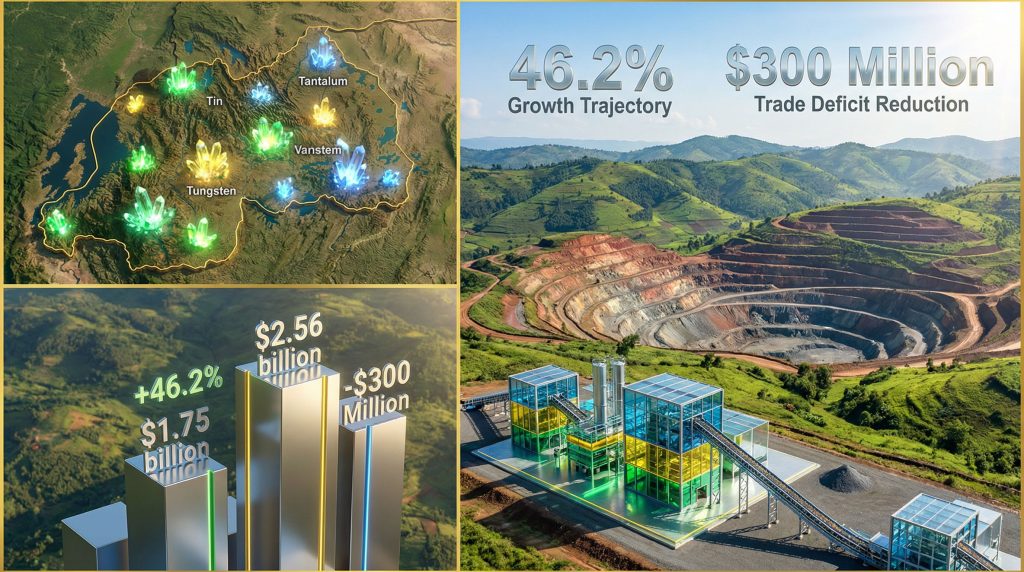
Rwanda mineral exports trade deficit patterns have undergone a transformative shift in 2025, with the nation's strategic mineral portfolio delivering unprecedented growth that fundamentally altered its external economic balance. The remarkable 46% surge in mineral export revenues, primarily driven by 3T minerals (tin, tungsten, and tantalum), demonstrates how focused sector development can reshape national economic trajectories.
Understanding Rwanda's Strategic Mineral Portfolio Performance
Rwanda's mineral sector has evolved into a sophisticated economic engine that extends far beyond traditional commodity extraction. The transformation reflects fundamental shifts in global supply chain dynamics, where strategic minerals have become essential components of technological advancement and energy transition minerals. Furthermore, the sector's evolution aligns with broader trends in mining industry evolution that prioritise sustainability and strategic value creation.
When big ASX news breaks, our subscribers know first
The 3T Minerals Complex: Rwanda's Economic Anchor
The three primary minerals driving Rwanda's export success—tin, tungsten, and tantalum—represent critical inputs for modern industrial applications. These materials serve as essential components in electronics manufacturing, aerospace engineering, and renewable energy technologies. The sector's 46.2% year-over-year growth demonstrates not merely cyclical pricing benefits but systematic improvements in production capacity and market positioning.
| Mineral Type | Primary Applications | Market Characteristics |
|---|---|---|
| Tin | Electronics, soldering, coatings | High liquidity, established markets |
| Tungsten | Aerospace, defence, industrial tools | Specialised applications, price volatility |
| Tantalum | Capacitors, medical devices, superalloys | Limited supply sources, premium pricing |
Rwanda's mineral export value growth from approximately $1.75 billion in 2024 to $2.56 billion in 2025 illustrates the compound effects of production optimisation combined with favourable market conditions. This expansion reflects strategic positioning within global value chains where supply chain security has become increasingly prioritised by industrial buyers.
The underlying geological advantages of Rwanda's mineral deposits include relatively high ore grades and accessible extraction locations. Unlike many competing producers, Rwanda's mines benefit from established infrastructure connections and proximity to processing facilities, reducing transportation costs and delivery timelines for international customers.
Global Market Context for Strategic Minerals
International demand for critical minerals has intensified as industrial economies prioritise supply chain resilience and technological sovereignty. The transition toward renewable energy systems requires substantial quantities of specialised metals, creating sustained demand pressure that extends beyond traditional economic cycles.
Geopolitical considerations have fundamentally altered mineral procurement strategies among major consuming nations. Supply chain diversification initiatives in the United States, European Union, and Asia have created opportunities for politically stable producers like Rwanda to capture market share previously dominated by larger but less reliable suppliers.
Critical Insight: The convergence of technological advancement and geopolitical fragmentation has created structural demand for minerals from stable, compliant sources, positioning Rwanda advantageously despite its smaller production scale.
Industrial policy shifts across major economies have elevated critical minerals to strategic resource status, with governments implementing procurement preferences and financing incentives that favour reliable suppliers. This regulatory environment provides Rwanda with competitive advantages that extend beyond traditional cost considerations. Indeed, recent policy developments, such as the critical minerals order, highlight the strategic importance of secure mineral supply chains.
What Structural Reforms Enabled This Export Breakthrough?
Mining Sector Formalisation Impact Assessment
Rwanda's transformation from artisanal mining operations to formalised extraction systems represents a fundamental restructuring of the sector's operational framework. The transition involved comprehensive regulatory reforms, technological upgrades, and systematic approaches to quality assurance and compliance verification.
The formalisation process addressed critical gaps in traceability systems that previously limited market access. International buyers, particularly those serving regulated industries, require detailed documentation of mineral origins and extraction methods. Rwanda's implementation of comprehensive tracking mechanisms has eliminated barriers to premium market segments.
Key formalisation achievements include:
• Implementation of digital traceability systems linking extraction sites to export documentation
• Establishment of standardised quality control procedures across mining operations
• Development of cooperative structures that provide technical support to artisanal miners
• Integration of environmental and social governance standards into operational requirements
The regulatory framework improvements have created measurable benefits in terms of market access and pricing premiums. Buyers demonstrate willingness to pay higher prices for minerals with verified compliance credentials, particularly in markets with strict conflict-mineral regulations or environmental, social, and governance screening requirements.
Compliance credibility has become a competitive differentiator that enables Rwanda to access markets previously closed to African mineral producers. The systematic approach to regulatory adherence has established trust relationships with international buyers that extend beyond individual transactions to long-term supply agreements.
Export Infrastructure and Market Access Developments
Despite Rwanda's landlocked geographical position, strategic infrastructure investments have minimised traditional logistics disadvantages. The development of efficient transportation corridors and customs facilitation mechanisms has reduced delivery times and transaction costs for international shipments.
Quality standardisation initiatives have addressed historical concerns about African mineral exports. Implementation of internationally recognised testing and certification procedures has eliminated quality uncertainty that previously required price discounts or additional verification steps.
Infrastructure optimisation strategies:
• Development of dedicated mineral processing and packaging facilities
• Implementation of streamlined customs procedures for mineral exports
• Establishment of quality certification laboratories meeting international standards
• Creation of logistics partnerships with regional transportation providers
The market access improvements extend beyond physical infrastructure to include financial and regulatory facilitation. Simplified export licensing procedures and transparent taxation frameworks have reduced administrative burdens that previously complicated international trade relationships.
How Significant Was the $300 Million Trade Deficit Reduction?
Macroeconomic Balance Sheet Analysis
The Rwanda mineral exports trade deficit improvement from $3.0 billion in 2024 to $2.7 billion in 2025 represents a 10% improvement in external balance dynamics. The mineral sector contributed approximately $810 million of the total export expansion, accounting for roughly 44.7% of the deficit improvement achieved during the period.
| Economic Indicator | 2024 Performance | 2025 Performance | Change |
|---|---|---|---|
| Total Trade Deficit | $3.0 billion | $2.7 billion | -$300 million |
| Mineral Export Value | $1.75 billion | $2.56 billion | +$810 million |
| Export Growth Rate | – | 46.2% | Strong expansion |
| Deficit Reduction Rate | – | 10% | Significant improvement |
The macroeconomic implications extend beyond simple trade balance calculations. External balance improvements reduce pressure on foreign exchange reserves and enhance currency stability mechanisms that support broader economic confidence.
For small, open economies like Rwanda, export performance directly influences macro risk perceptions among international investors and financial institutions. The mineral export expansion signals economic diversification and foreign exchange generation capacity that supports overall economic stability.
Balance of Payments Implications
The foreign exchange implications of mineral export expansion create multiplier effects throughout Rwanda's economy. Increased export earnings provide the Central Bank of Rwanda with greater flexibility in managing currency stability and international reserve adequacy.
External debt servicing capacity improvements result from stronger export performance. Higher foreign exchange earnings reduce the relative burden of international debt obligations and enhance creditworthiness assessments by international rating agencies.
Balance of payments benefits include:
• Reduced foreign exchange reserve pressure
• Enhanced currency stability through increased export earnings
• Improved external debt sustainability metrics
• Stronger current account positioning
The cumulative effect strengthens Rwanda's economic resilience against external shocks and provides greater policy flexibility for economic development initiatives. Stable external balances support long-term investment planning and infrastructure development programmes.
Which Global Markets Drive Rwanda's Mineral Export Success?
Export Destination Analysis
Global demand patterns for strategic minerals reflect industrial concentration in advanced manufacturing economies. Asian markets, particularly China, Japan, and South Korea, represent primary consumption centres for electronic components and industrial applications requiring specialised minerals.
European Union markets provide premium pricing opportunities for suppliers meeting strict regulatory compliance standards. The EU's commitment to conflict-mineral regulations and environmental standards creates competitive advantages for certified producers like Rwanda.
United States trade relationships have strengthened as domestic industrial policy prioritises supply chain security for critical materials. According to reports from The East African, the strategic mineral designation of tin, tungsten, and tantalum has created procurement preferences that benefit reliable international suppliers.
Market access achievements:
• Penetration of Asian electronics manufacturing supply chains
• Compliance with EU conflict-mineral regulations enabling premium market access
• Development of strategic supplier relationships with US industrial consumers
• Establishment of long-term supply agreements with international buyers
The geographic diversification of export destinations reduces market concentration risk whilst enabling Rwanda to optimise pricing strategies based on regional demand patterns and regulatory environments.
Commodity Price Dynamics and Revenue Optimisation
Mineral pricing dynamics reflect complex interactions between industrial demand cycles, geopolitical supply considerations, and technological advancement requirements. The Rwanda mineral exports trade deficit improvements benefit from sustained price strength across the primary mineral portfolio.
The pricing environment for critical minerals demonstrates structural support from multiple demand sources. Electronics manufacturing requirements, aerospace applications, and renewable energy infrastructure development create overlapping demand patterns that reduce cyclical volatility.
Market Psychology Insight: Industrial buyers increasingly prioritise supply security over cost optimisation, creating pricing premiums for reliable suppliers with verified compliance credentials.
Global commodity price volatility remains influenced by industrial demand cycles and geopolitical tensions. However, the strategic importance of critical minerals has created greater price stability compared to traditional bulk commodities.
Revenue optimisation factors:
• Premium pricing for certified conflict-free minerals
• Long-term supply agreements providing price stability
• Quality premiums for high-grade mineral concentrates
• Geographic diversification enabling price optimisation strategies
The next major ASX story will hit our subscribers first
What Are Rwanda's Competitive Advantages in Global Mineral Markets?
Global Market Share Positioning
Rwanda has established strategic relevance in global mineral markets despite operating at smaller scales than dominant producers. The country's competitive positioning relies on quality differentiation, compliance reliability, and supply chain stability rather than volume leadership within the broader global mining landscape.
The geological characteristics of Rwanda's mineral deposits provide natural advantages in ore quality and processing efficiency. Higher grade concentrates reduce transportation costs and processing requirements for international buyers, creating cost advantages that offset scale disadvantages.
Competitive differentiation strategies:
• High-quality mineral concentrates exceeding industry standards
• Comprehensive compliance documentation meeting international regulations
• Reliable supply delivery schedules with minimal disruption risk
• Transparent pricing mechanisms and contract terms
Market positioning emphasises Rwanda's role as a strategic supplier for industries requiring supply chain security and regulatory compliance. This positioning creates pricing power and customer loyalty that extends beyond traditional commodity relationships.
Value Chain Integration Opportunities
Rwanda faces strategic choices between maximising raw material export volumes and developing downstream processing capabilities. The current focus on raw mineral exports provides immediate foreign exchange benefits but limits long-term value retention opportunities.
Global competition for critical mineral access has created opportunities for producer countries to capture greater value through processing and beneficiation activities. However, downstream development requires substantial capital investment and technical expertise acquisition.
Strategic Choice Framework: Producer countries increasingly face decisions between export volume maximisation and value chain integration, with implications for long-term economic development trajectories.
Processing and beneficiation opportunities include:
• Development of mineral concentrate upgrading facilities
• Integration of specialised metallurgical processing capabilities
• Establishment of component manufacturing operations using local mineral inputs
• Creation of technology transfer partnerships with international industrial companies
The value chain integration decision involves balancing immediate export revenue benefits against longer-term industrial development objectives. Current strong commodity prices support continued raw export focus whilst building capital for future downstream investments.
How Sustainable Is This Mineral Export Growth Trajectory?
Risk Assessment Framework
The sustainability of Rwanda mineral exports trade deficit improvements depends on multiple variables beyond current market conditions. Global commodity price volatility represents the most immediate risk factor, as industrial demand cycles and geopolitical developments can significantly impact revenue projections.
Supply chain disruption scenarios pose ongoing challenges for mineral exporters. Transportation bottlenecks, infrastructure limitations, and regulatory changes in destination markets could impact delivery reliability and customer relationships.
Primary sustainability risks:
• Global commodity price volatility exposure
• Infrastructure capacity constraints limiting production expansion
• Regulatory compliance cost increases in international markets
• Competition from larger-scale producers with cost advantages
Environmental and social governance requirements continue evolving in international markets, requiring ongoing investment in compliance systems and operational improvements. These requirements create barriers to entry but also competitive advantages for compliant producers.
Strategic Development Pathway Analysis
Rwanda's National Strategy for Transformation provides framework objectives for mineral sector development through 2030. The strategy emphasises sustainable growth, value addition, and economic diversification whilst maintaining environmental and social standards.
Long-term sustainability requires balancing mineral export revenue generation with broader economic development objectives. Over-dependence on commodity exports creates vulnerability to price cycles and limits opportunities for economic sophistication.
Development pathway considerations:
• Optimal balance between raw export revenue and processing investment
• Infrastructure development requirements supporting sector expansion
• Human capital development for technical and management capabilities
• Regulatory framework evolution maintaining international competitiveness
The strategic development pathway must address resource curse risks whilst maximising benefits from current favourable market conditions. Successful navigation requires institutional capacity building and economic diversification initiatives.
What Does This Mean for Rwanda's Economic Diversification Strategy?
Sectoral Balance and Economic Resilience
Rwanda's mineral export success creates opportunities and challenges for broader economic development objectives. Strong commodity revenues provide resources for diversification investments whilst creating incentives to maintain sector focus.
Economic diversification requires balancing mineral sector growth with development of manufacturing, services, and technology industries. The optimal approach leverages mineral revenues to support complementary sector development rather than replacing diversification efforts.
Diversification balance strategies:
• Using mineral export revenues to finance infrastructure supporting multiple industries
• Developing technical expertise applicable across mineral and manufacturing sectors
• Creating linkage industries serving both mineral exports and domestic markets
• Building institutional capacity for economic policy coordination across sectors
Manufacturing sector linkage opportunities include equipment supply, maintenance services, and processing support industries that benefit from mineral sector growth whilst serving broader economic needs.
Investment Climate and Capital Attraction
Strong mineral export performance enhances Rwanda's overall investment attractiveness by demonstrating economic competence and foreign exchange generation capacity. International investors view successful commodity exports as indicators of broader business environment quality.
Foreign direct investment trends increasingly favour countries with stable regulatory environments and reliable infrastructure. As African Leadership Magazine notes, Rwanda's mineral sector success provides evidence of these capabilities whilst generating resources for continued improvements.
Investment climate benefits:
• Enhanced international credit rating prospects
• Increased foreign direct investment interest across sectors
• Strengthened infrastructure financing capacity
• Improved technology transfer partnership opportunities
Capital attraction strategies must leverage mineral sector success to support broader economic development whilst avoiding excessive dependence on commodity performance for investment attraction.
Strategic Outlook: Rwanda's Position in Global Mineral Geopolitics
Future Market Positioning Strategy
Rwanda's strategic positioning in global mineral markets reflects broader geopolitical trends toward supply chain diversification and critical material security. The country's role as a reliable supplier of strategic minerals provides leverage in international economic relationships.
Future positioning strategies must balance current market advantages with evolving global demand patterns and competitive dynamics. Technology advancement and industrial policy changes in consuming countries will influence long-term demand structures and pricing mechanisms.
Strategic positioning elements:
• Maintaining supply reliability and quality standards
• Developing strategic partnerships with consuming nations
• Building technology cooperation frameworks
• Establishing long-term supply agreement structures
The mineral geopolitics environment creates opportunities for smaller producers to gain strategic relevance through reliability and compliance rather than scale. Rwanda's positioning capitalises on these trends whilst building foundations for sustained competitiveness.
Long-term Economic Transformation Implications
The Rwanda mineral exports trade deficit improvements provide resources and credibility for broader economic transformation initiatives. The challenge involves converting commodity revenue into sustainable competitive advantages across multiple economic sectors.
Successful economic transformation requires institutional capacity building, human capital development, and infrastructure investment that extends beyond mineral sector requirements. The mineral export revenues create opportunities to finance these broader development objectives.
Transformation requirements:
• Resource curse avoidance through economic diversification
• Institutional capacity building for complex economic management
• Sustainable development goal alignment across all sectors
• Technology acquisition and adaptation strategies
The long-term implications depend on policy choices regarding revenue utilisation, investment prioritisation, and economic governance structures. Rwanda's current mineral export success creates favourable conditions for transformation if properly managed through comprehensive development planning.
Conclusion: Charting Rwanda's Economic Future
The remarkable transformation of Rwanda mineral exports trade deficit dynamics in 2025 represents more than statistical achievement—it demonstrates the potential for strategic sector development to reshape national economic trajectories. However, the true measure of success lies not merely in current performance but in the foundation this creates for sustained, diversified economic growth.
Readers seeking additional perspectives on African mineral export dynamics and trade policy analysis can explore related educational content from international development organisations and economic research institutions that focus on resource-dependent economies and export diversification strategies.
Disclaimer: This analysis contains forward-looking statements and projections based on current market conditions. Mineral markets are subject to significant volatility, and actual results may differ materially from projections discussed herein. Economic development outcomes depend on multiple factors beyond mineral export performance.
Ready to Capitalise on Africa's Next Mining Success Story?
Discovery Alert's proprietary Discovery IQ model delivers instant notifications on significant ASX mineral discoveries, helping subscribers identify actionable opportunities in the booming critical minerals sector before the broader market catches on. Explore historic examples of exceptional mining returns and begin your 14-day free trial today to position yourself ahead of the market.