
June 20, 2026
Understanding the Critical Minerals Landscape Through Strategic Asset Transfers
The global mining industry continues to witness significant portfolio reshuffling as companies align their assets with evolving market demands and strategic priorities. Within this dynamic environment, SAGA acquires Rio Tinto titanium project in Quebec represents a notable example of how the transfer of exploration-stage projects between major mining corporations and junior explorers has become increasingly common, particularly in sectors deemed critical to future economic security. This trend reflects broader shifts in capital allocation strategies, risk management frameworks, and the growing importance of securing supply chains for essential raw materials.
Mining majors face constant pressure to optimise their portfolios while maintaining focus on tier-one operations that generate consistent returns. Meanwhile, junior mining companies seek opportunities to acquire advanced exploration assets that can accelerate their development timelines and provide access to proven geological terranes. Furthermore, these complementary needs create a dynamic marketplace where strategic asset transfers serve multiple stakeholder interests, particularly as companies navigate the evolving critical minerals strategy landscape.
When big ASX news breaks, our subscribers know first
Quebec's Position as a Strategic Titanium Hub
The Geological Foundation of Quebec's Titanium Sector
Quebec's Havre-Saint-Pierre anorthosite complex represents one of North America's most significant titanium-bearing geological formations. This massive igneous intrusion, formed approximately 1.1 billion years ago, contains extensive deposits of ilmenite and magnetite that have supported decades of mining activity. The complex extends over thousands of square kilometres and hosts multiple titanium deposits at various stages of development, making it an attractive target for companies evaluating mineral deposit tiers.
The geological characteristics of the Havre-Saint-Pierre complex make it particularly attractive for titanium exploration. The anorthosite host rock provides an ideal environment for the concentration of iron-titanium oxide minerals through magmatic processes. However, these deposits typically occur as layered intrusions or massive accumulations that can support large-scale mining operations.
Rio Tinto's Lac Tio mine, operating since 1950, serves as the flagship operation within this geological complex. The mine produces high-grade ilmenite concentrate containing approximately 48% titanium dioxide, which supplies markets across North America and Europe. In addition, this established operation provides critical infrastructure and demonstrates the economic viability of titanium mining in the region.
Infrastructure Advantages and Regional Connectivity
The Havre-Saint-Pierre region benefits from significant infrastructure investments developed over decades of mining activity. The deepwater port at Havre-Saint-Pierre provides year-round shipping access to global markets, handling bulk commodity exports including iron ore, titanium concentrate, and other mineral products. Consequently, the port's specialised facilities can accommodate large vessels and maintain efficient loading operations even during harsh winter conditions.
Transportation networks in the region include both rail and road connections linking mining operations to processing facilities and export terminals. Recent infrastructure development, including road construction projects by Hydro-Québec, has improved access to previously remote exploration areas. For instance, these improvements reduce exploration costs and accelerate project timelines for companies operating in the region.
The availability of low-carbon hydroelectric power from Quebec's extensive grid system provides another competitive advantage. The Romaine hydroelectric complex, located near the mining district, generates clean electricity that can support energy-intensive processing operations while meeting environmental sustainability requirements increasingly demanded by global markets.
Why Mining Majors Divest Early-Stage Assets
Portfolio Optimisation in Diversified Mining Companies
Large mining corporations like Rio Tinto operate under strict capital allocation frameworks that prioritise projects with the highest risk-adjusted returns. These companies typically focus their investment capital on tier-one assets that generate consistent cash flows and offer long-term production visibility. Early-stage exploration projects, while potentially valuable, often fall outside these investment criteria due to their inherent uncertainty and extended development timelines.
The decision to divest early-stage assets reflects sophisticated portfolio management strategies employed by major mining companies. These strategies consider factors including:
- Capital intensity requirements for advancing projects through feasibility stages
- Opportunity costs of deploying capital in unproven assets versus expanding existing operations
- Risk tolerance levels for exploration ventures in competitive commodity markets
- Geographic concentration of assets and desire for operational efficiency
For Rio Tinto, maintaining focus on the producing Lac Tio operation while divesting the nearby Garneau exploration project represents a logical strategic decision. This approach allows the company to retain exposure to the proven titanium district while transferring exploration risk to specialised junior mining companies better positioned to advance early-stage projects, particularly as the industry sees increased mining asset divestments.
Risk Transfer Mechanisms and Value Creation
The structure of the Garneau project transaction illustrates how major mining companies can maintain upside exposure while transferring operational risk. The 2% net smelter return royalty granted to Rio Tinto provides ongoing revenue participation if the project advances to production, while eliminating the company's obligation to fund exploration activities.
This royalty structure aligns with industry best practices for asset divestments, providing the seller with:
- Passive income stream from successful project development
- No ongoing operational responsibilities or capital commitments
- Inflation-protected returns through production-linked payments
- Optionality on future resource discoveries without exploration risk
Moreover, the transaction demonstrates how diversified miners can optimise their joint venture portfolios. By terminating the lithium joint venture with SAGA Metals and transferring the titanium asset, Rio Tinto simplified its partnership structure while maintaining strategic positioning in both commodity sectors.
Technical Assessment of the Garneau Project's Potential
Geophysical Signature and Exploration Targets
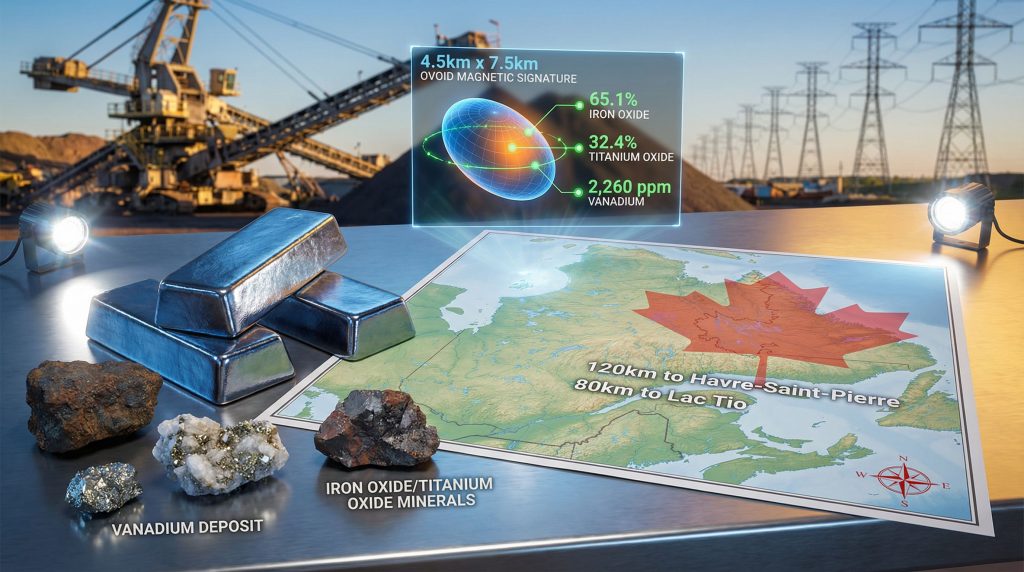
The Garneau project's most significant feature is a large ovoid-shaped magnetic anomaly measuring 4.5 kilometres by 7.5 kilometres. This geophysical signature represents one of the largest undrilled targets in the Havre-Saint-Pierre district and suggests the presence of substantial iron-titanium mineralisation at depth.
Magnetic surveys in the region have proven highly effective at identifying titanium-bearing deposits. The negative magnetic response characteristic of the Garneau anomaly aligns with known signatures of hemo-ilmenite mineralisation, where titanium-rich minerals create distinct geophysical patterns detectable through airborne and ground-based surveys.
The scale of the geophysical anomaly suggests potential for a significant mineralised system. Comparable anomalies in the district have led to the discovery of economic deposits, though each target requires systematic drilling to confirm continuity and grade characteristics. Furthermore, Rio Tinto's previous exploration work positioned the project for immediate drill testing, providing SAGA Metals with a clear pathway for resource definition.
High-Grade Sampling Results and Mineralogy
Surface sampling at Garneau has yielded exceptional results that support the project's exploration potential. A massive ilmenite-rich boulder returned assay results of:
- Iron oxide (Fe₂O₃): 65.1%
- Titanium oxide (TiO₂): 32.4%
- Vanadium (V): 2,260 parts per million
These grades represent high-quality titanium mineralisation comparable to producing operations worldwide. The titanium dioxide content of 32.4% falls within the range of commercial ilmenite concentrates, while the iron oxide component indicates the presence of magnetite-ilmenite assemblages typical of magmatic iron-titanium deposits.
However, the vanadium content of 2,260 ppm adds potential by-product value to the project. Vanadium markets have strengthened significantly due to growing demand from energy storage applications and high-strength steel production. Consequently, recovery of vanadium as a co-product could enhance project economics and provide additional revenue streams during titanium price downturns.
Comparison with Regional Deposit Characteristics
The geological characteristics observed at Garneau show similarities to the nearby Lac Tio deposit, which has supported continuous mining operations for over seven decades. Lac Tio produces high-grade ilmenite concentrate containing approximately 48% titanium dioxide, demonstrating the quality of mineralisation possible within the anorthosite complex.
Nevertheless, each deposit within the complex exhibits unique characteristics that influence mining methods and processing requirements. The Garneau project's surface expression suggests different mineralisation styles that may require distinct development approaches. Systematic drilling will be necessary to determine whether the high-grade surface samples represent broader mineralisation zones or localised concentrations.
Strategic Implications for SAGA Metals' Portfolio Development
Diversification Benefits and Market Positioning
The acquisition of the Garneau project represents a significant strategic shift for SAGA Metals, providing the company with exposure to titanium markets while reducing dependence on lithium sector volatility. This diversification offers several advantages and aligns with current trends in junior mining investments:
Market Stability: Titanium markets typically exhibit less volatility than lithium markets, with demand driven by established aerospace, defence, and industrial applications rather than emerging battery technologies.
Supply Chain Security: Growing emphasis on domestic titanium production in North America creates potential government support for projects that reduce import dependence on overseas suppliers.
Infrastructure Leverage: Access to established mining infrastructure and services in Quebec reduces operational risk compared to greenfield exploration in remote locations.
The termination of SAGA's lithium joint venture with Rio Tinto, while ending a potential development pathway, eliminates ongoing funding obligations and allows the company to focus resources on the titanium opportunity. Consequently, this strategic refocusing may appeal to investors seeking exposure to critical minerals with established market demand.
Value Creation Through Systematic Exploration
SAGA's acquisition of a drill-ready project provides immediate opportunities for value creation through systematic exploration. The company can proceed directly to drilling the defined geophysical targets without conducting additional reconnaissance work, accelerating the timeline for resource definition.
The proximity to Rio Tinto's Lac Tio operation offers potential operational synergies that could reduce development costs and improve project economics. Furthermore, shared infrastructure, processing facilities, and transportation systems could provide cost advantages during eventual development phases.
Key value creation opportunities include:
- Resource definition drilling to quantify tonnage and grade potential
- Metallurgical testing to optimise processing flowsheets and recovery rates
- Environmental baseline studies to support permitting processes
- Community engagement to build stakeholder support for development
Financial Structure and Investment Requirements
Transaction Terms and Royalty Implications
The structure of the Garneau acquisition demonstrates sophisticated transaction design that benefits both parties while managing risk exposure. SAGA obtained 100% ownership interest in the project while granting Rio Tinto a 2% net smelter return royalty that provides ongoing participation in potential success.
Net smelter return royalties represent a common structure in mining transactions where the royalty holder receives a percentage of net proceeds after smelting and refining costs are deducted. For titanium projects, this typically includes costs for:
- Concentration and beneficiation at mine sites
- Transportation to processing facilities
- Smelting or chemical processing to produce titanium products
- Marketing and sales expenses
The 2% royalty rate aligns with industry standards for early-stage exploration projects, providing meaningful participation without creating excessive financial burden during production phases. This structure allows SAGA to retain the majority of project economics while acknowledging Rio Tinto's role in advancing the project to its current status.
Capital Allocation and Exploration Funding
The transaction structure eliminated Rio Tinto's funding obligations on SAGA's lithium projects while transferring a valuable titanium asset. This arrangement allowed both companies to optimise their capital allocation strategies without requiring immediate cash payments, a trend increasingly important as companies pursue effective capital raising strategies.
For SAGA, the acquisition provides access to an advanced exploration project without depleting existing cash resources. The company can now focus its available capital on drilling programmes and technical studies designed to advance the Garneau project toward resource estimation and feasibility assessments.
Estimated capital requirements for initial exploration phases typically include:
- Drilling programmes: $2-5 million for systematic testing of geophysical targets
- Metallurgical studies: $500,000-1 million for processing optimisation
- Environmental baseline: $200,000-500,000 for permitting support
- Engineering studies: $300,000-800,000 for preliminary assessments
The next major ASX story will hit our subscribers first
Market Dynamics in the Global Titanium Sector
Supply Chain Considerations and Strategic Positioning
The global titanium industry faces increasing supply chain pressures as traditional sources become concentrated in politically sensitive regions. Approximately 60% of global titanium feedstock originates from operations in Australia, South Africa, and other international locations, creating potential supply security concerns for North American consumers.
This supply concentration has prompted increased focus on domestic production capabilities, particularly as titanium demand grows in aerospace and defence applications. The aerospace sector alone consumes approximately 7,000 tons of titanium metal annually in North America, with demand projected to increase as aircraft production expands.
Quebec's position within North America provides strategic advantages for titanium producers serving domestic markets. The province's established mining infrastructure, stable regulatory environment, and proximity to major consumption centres create competitive advantages for local production.
Critical Minerals Classification and Policy Support
Both Canadian and United States governments have classified titanium as a critical mineral essential for economic security and national defence applications. This classification has led to increased policy focus on domestic supply chain development, though specific project support varies by jurisdiction and development stage.
The critical minerals designation creates favourable conditions for titanium projects through:
- Streamlined permitting processes for strategically important projects
- Access to government financing programmes and development incentives
- Trade policy protections for domestic production capabilities
- Research and development support for processing technology advancement
However, these policy frameworks typically apply to projects that reach advanced development stages rather than early-stage exploration activities. Companies must still demonstrate technical and economic viability to access most government support programmes.
Investment Evaluation Framework for Mining Transactions
Due Diligence Methodologies for Asset Acquisitions
Evaluating early-stage mining acquisitions requires comprehensive due diligence frameworks that address geological, technical, financial, and regulatory risks. Successful evaluation typically incorporates multiple analytical approaches:
Geological Risk Assessment:
- Independent review of exploration data and interpretations
- Comparison with analogous deposits in similar geological settings
- Assessment of mineralisation continuity and grade variability potential
- Evaluation of structural controls and deposit geometry
Infrastructure Valuation:
- Analysis of transportation access and capacity constraints
- Assessment of power availability and utility infrastructure
- Evaluation of processing facility proximity and capacity
- Review of port facilities and shipping logistics
Regulatory Framework Analysis:
- Permitting timeline and approval probability assessment
- Environmental baseline requirements and compliance costs
- Community engagement status and stakeholder risks
- Indigenous consultation obligations and agreement structures
Comparative Transaction Analysis
Recent transactions in the titanium sector provide benchmarks for evaluating the Garneau acquisition structure and terms. Similar early-stage projects have typically been valued based on exploration potential rather than defined resources, making comparative analysis challenging.
Key metrics for comparison include:
- Enterprise value per hectare for exploration-stage projects
- Royalty rates granted in similar asset transfer transactions
- Proximity premiums for projects near existing operations
- Infrastructure discounts reflecting access and development advantages
The Garneau transaction's structure reflects fair market terms given the project's drill-ready status and strategic location within a proven titanium district. The 2% royalty rate provides appropriate compensation for Rio Tinto's previous investment while allowing SAGA to retain majority economics.
Development Timeline and Critical Milestones
Immediate Exploration Priorities and Programme Design
SAGA's near-term exploration strategy will likely focus on systematic drilling of the large geophysical anomaly to confirm the presence and continuity of titanium mineralisation. A phased drilling approach would typically begin with widely-spaced holes designed to test the anomaly's extent and identify higher-grade zones for detailed follow-up.
Initial drilling programmes usually comprise:
- Reconnaissance drilling: 10-15 holes testing anomaly boundaries and depth extent
- Infill drilling: Detailed testing of mineralised intersections to define continuity
- Metallurgical drilling: Bulk sampling for processing and recovery optimisation
- Geotechnical drilling: Foundation studies for infrastructure planning
Concurrent with drilling activities, SAGA will likely conduct metallurgical testwork to determine optimal processing methods and recovery rates for the Garneau mineralisation. This work becomes critical for economic assessment and provides data necessary for feasibility studies.
Resource Estimation and Economic Assessment Requirements
Following successful exploration drilling, SAGA would typically advance the project through standardised resource estimation and economic assessment phases. These studies require significant technical expertise and substantial capital investment:
Resource Estimation Phase:
- Geological modelling and resource calculation according to international standards
- Independent technical review and validation of resource estimates
- Environmental and geotechnical baseline studies for development planning
- Preliminary economic assessment of development scenarios
Feasibility Study Phase:
- Detailed engineering design for mining and processing operations
- Comprehensive environmental and social impact assessment
- Market analysis and product sales contract development
- Project financing and capital structure optimisation
The timeline from resource definition to production typically spans 5-8 years for titanium projects, depending on project scale, regulatory requirements, and financing availability. However, projects located near existing operations may benefit from accelerated timelines due to established infrastructure and streamlined permitting processes.
Strategic Partnership Opportunities
As the Garneau project advances through development stages, SAGA may seek strategic partnerships to accelerate development and reduce capital requirements. Potential partnership structures could include:
- Joint ventures with established titanium producers seeking feedstock security
- Offtake agreements with downstream processors requiring raw material supply
- Development partnerships with mining companies possessing complementary expertise
- Financial partnerships with commodity trading firms or strategic investors
The project's location within Rio Tinto's operating district may create natural partnership opportunities, though the 2% royalty structure already provides Rio Tinto with economic participation. Alternative partnerships with other regional operators or downstream consumers could provide operational synergies and market access advantages.
Risk Assessment and Success Factors
Geological and Technical Risk Factors
Despite encouraging surface sampling results and geophysical data, the Garneau project remains subject to significant exploration risk until systematic drilling confirms the presence and continuity of economic mineralisation. Key technical risks include:
Resource Definition Risk: The geophysical anomaly may not correspond to continuous mineralisation suitable for large-scale mining operations.
Grade Variability: High-grade surface samples may not represent average grades achievable through mining operations.
Metallurgical Risk: Processing characteristics may differ from established regional operations, requiring modified processing approaches or additional capital investment.
Infrastructure Development: Despite regional advantages, the project may require substantial infrastructure investment to support large-scale operations.
Market and Financial Considerations
Titanium markets, while generally more stable than lithium markets, remain subject to cyclical demand patterns driven by aerospace production cycles and industrial demand. Key market risks include:
- Price volatility during economic downturns affecting aerospace and industrial demand
- Competition from established producers with lower operating costs
- Technology substitution reducing titanium demand in certain applications
- Trade policy changes affecting market access and competitive positioning
According to recent industry reports, SAGA Metals successfully acquired strategic titanium assets from Rio Tinto, representing a significant milestone in the company's diversification strategy. Furthermore, detailed analysis by Northern Miner confirms the strategic importance of the Trapper project within SAGA's expanded portfolio.
Investment Disclaimer: This analysis is based on publicly available information and should not be considered investment advice. Mining exploration involves substantial risk of loss, and investors should conduct independent due diligence before making investment decisions. Past performance of similar projects does not guarantee future results, and commodity prices may fluctuate significantly based on market conditions beyond company control.
The strategic acquisition where SAGA acquires Rio Tinto titanium project in Quebec represents a significant opportunity for SAGA Metals to establish a position in Quebec's established titanium mining district. Success will depend on systematic exploration execution, favourable drilling results, and effective capital allocation during development phases. While the project benefits from exceptional regional advantages and encouraging preliminary data, investors must carefully consider the inherent risks associated with early-stage exploration activities and volatile commodity markets.
Ready to Capitalise on Strategic Mining Asset Transfers?
Discovery Alert's proprietary Discovery IQ model delivers real-time notifications on significant ASX mineral discoveries and strategic transactions, empowering subscribers to identify actionable opportunities before the broader market recognises their potential. Begin your 14-day free trial today and position yourself ahead of major mining developments that could generate substantial returns.