July 23, 2026
Understanding Samarium's Strategic Position in Heavy Rare Earth Markets
The successful production of Lynas first samarium oxide at their Malaysian facility marks a pivotal moment in global rare earth processing capabilities. This achievement represents more than a technical milestone; it demonstrates the viability of establishing sophisticated heavy rare earth separation operations outside China's dominance. Furthermore, this development aligns with broader industry evolution trends that emphasise technological sovereignty and supply chain diversification.
The technical complexity of separating lanthanide elements represents one of the most sophisticated challenges in modern metallurgy. Samarium oxide production requires mastery of intricate chemical processes that few facilities outside China have successfully commercialised.
This manufacturing reality has created a strategic bottleneck that extends far beyond simple supply chain considerations into the realm of technological sovereignty. Heavy rare earth separation fundamentally depends on exploiting minute differences in ionic radii and coordination chemistry between chemically similar elements.
Technical Properties Driving Industrial Demand
Samarium, positioned at atomic number 62, exhibits unique magnetic properties stemming from its 4f electron configuration that make it irreplaceable in high-temperature permanent magnet applications. The magnetic performance characteristics of samarium-based compounds create compelling advantages over lighter rare earth alternatives in demanding operational environments.
SmCo magnets maintain magnetic strength at temperatures approaching 350°C, where neodymium-based alternatives experience catastrophic demagnetisation. These properties make Lynas first samarium oxide production particularly significant for defence and aerospace applications.
Key Performance Characteristics:
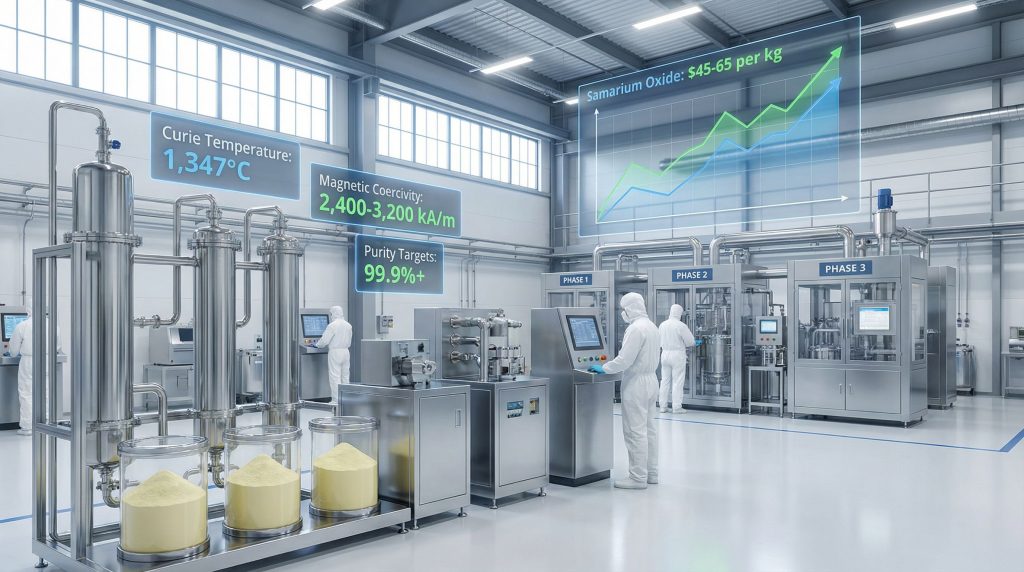
- Curie Temperature: 1,347°C (significantly higher than neodymium-based alternatives)
- Magnetic Coercivity: 2,400-3,200 kA/m in SmCo magnets
- Temperature Coefficient: -0.03%/°C (exceptional thermal stability)
- Corrosion Resistance: Superior oxidation protection compared to NdPr magnets
Aerospace and defence applications particularly value these temperature-stable magnetic properties. Equipment must function reliably in extreme thermal cycling conditions without performance degradation.
When big ASX news breaks, our subscribers know first
Advanced Separation Technology Architecture
Solvent Extraction Process Fundamentals
Commercial heavy rare earth separation employs sophisticated multi-stage solvent extraction cascades utilising carefully selected organic extractants. According to Lynas's official announcement, the process requires maintaining precise pH ranges, temperature controls, and extraction ratios across dozens of mixer-settler stages.
The chemical similarity between adjacent lanthanide elements means separation factors rarely exceed 3:1 for individual extraction stages. Achieving 99.9% purity requires compound separation effects through extended extraction cascades involving 40-80 individual stages.
Critical Separation Parameters:
- pH Range: 1.5-2.8 for optimal samarium extraction
- Temperature Control: ±2°C precision across extraction stages
- Purity Targets: 99.9%+ rare earth oxide content
- Recovery Rates: 95-98% for samarium from mixed heavy rare earth feedstock
Process Engineering Complexity
| Technical Challenge | Complexity Level | Capital Investment Required |
|---|---|---|
| Multi-stage extraction design | Very High | $200-400M for commercial scale |
| Process optimisation | High | $50-100M in R&D and testing |
| Environmental compliance | High | $100-200M in treatment systems |
| Quality control systems | Medium-High | $20-50M in analytical equipment |
Advanced control systems must continuously monitor and adjust extraction parameters across the entire separation cascade. Consequently, minor deviations in pH, temperature, or flow rates can propagate through the system, requiring weeks to reestablish steady-state operations.
In addition, the implementation of effective waste management solutions becomes critical for maintaining environmental compliance throughout the separation process.
Strategic Supply Chain Diversification Drivers
Technology Transfer Limitations
Chinese rare earth processing facilities benefit from decades of accumulated process knowledge, specialized equipment designs, and integrated supply chains that create substantial competitive advantages. Western efforts to establish equivalent capabilities face significant technological hurdles beyond simple capital investment.
The specialised mixer-settler equipment required for heavy rare earth separation demands precise engineering tolerances and corrosion-resistant materials. Few global suppliers possess the technical capability to manufacture this equipment to commercial specifications.
Investment Drivers for Non-Chinese Facilities:
- Defence Applications: Military-grade permanent magnets requiring non-Chinese sourcing
- Technology Transfer Restrictions: Limited access to Chinese separation technologies
- Environmental Standards: Stricter Western regulations driving innovation in clean processing
- Long-term Contracts: Government and industrial buyers seeking supply security
Geopolitical Risk Assessment
Supply chain vulnerability assessments conducted by Western governments consistently identify rare earth processing concentration as a critical strategic weakness. This recognition has driven substantial government investment in domestic processing capabilities, despite economic disadvantages compared to Chinese facilities.
Moreover, the success of Lynas first samarium oxide production demonstrates how sustainability transformation efforts can align with strategic objectives. Industry analysts at MarketWatch noted that this achievement positions Lynas as a key supplier for defence applications requiring non-Chinese sourcing.
Production Capacity Expansion Methodologies
Modular Development Strategies
Successful heavy rare earth facility expansions typically implement phased approaches that minimise capital risk while enabling rapid scaling based on market demand. This strategy proves particularly effective given the volatile pricing environment characteristic of heavy rare earth markets.
Furthermore, modern operations increasingly rely on data-driven mining operations to optimise production efficiency and maintain consistent product quality.
Optimal Expansion Sequence:
- Phase 1: Single product focus (samarium oxide)
- Phase 2: Adjacent product addition (dysprosium, terbium)
- Phase 3: Full heavy rare earth suite (yttrium, gadolinium, lutetium)
- Phase 4: Ultra-high purity specialty products
Financial Performance Metrics
| Development Phase | Typical Investment | Production Timeline | ROI Expectations |
|---|---|---|---|
| Initial separation facility | $300-500M | 24-36 months | 15-20% IRR |
| Capacity doubling | $150-250M | 12-18 months | 20-25% IRR |
| Product diversification | $100-200M | 18-24 months | 18-22% IRR |
The capital efficiency improvements observed in subsequent phases reflect reduced engineering costs, established supplier relationships, and optimised procurement processes. However, these developments also contribute to broader industry consolidation trends as companies seek to establish competitive positions.
Market Dynamics and Production Planning
Price Volatility Management
Heavy rare earth markets exhibit extreme price volatility driven by supply concentration, limited substitution possibilities, and geopolitical factors affecting trade flows. Successful producers implement flexible production systems capable of rapid product mix adjustments based on real-time market conditions.
Recent market analysis indicates samarium oxide prices have fluctuated between $35-85 per kilogram over 18-month periods. This creates substantial challenges for production planning and inventory management.
Market Price Ranges (2025-2026):
- Samarium Oxide: $45-65 per kg (99.9% purity)
- Dysprosium Oxide: $350-450 per kg
- Terbium Oxide: $1,200-1,500 per kg
- Yttrium Oxide: $8-12 per kg
Advanced Demand Forecasting
Sophisticated rare earth producers utilise machine learning algorithms and multi-variable regression analysis incorporating electric vehicle production forecasts. These systems also consider wind turbine installation pipelines and defence procurement cycles to optimise production planning.
These forecasting models must account for the 6-18 month production lead times typical of heavy rare earth processing. Consequently, they require accurate demand prediction across extended time horizons.
Environmental and Regulatory Compliance Framework
Waste Stream Management
Heavy rare earth separation generates multiple hazardous waste streams requiring specialised treatment and disposal protocols. Acidic process waters contain elevated concentrations of dissolved metals, while solid precipitates often exceed radioactive material thresholds due to thorium and uranium impurities.
Environmental compliance costs typically represent 15-25% of total operational expenses. This reflects the complexity of waste treatment systems and ongoing monitoring requirements.
Environmental Management Requirements:
- Radioactive Waste Handling: Licensed storage and disposal systems
- Water Treatment: Multi-stage neutralisation and heavy metal removal
- Air Emissions Control: Acid gas scrubbing and particulate capture
- Soil Monitoring: Continuous groundwater and soil contamination assessment
Regulatory Framework Analysis
| Jurisdiction | Licensing Timeline | Environmental Standards | Operational Restrictions |
|---|---|---|---|
| Malaysia | 18-24 months | Moderate-High | Limited night operations |
| Australia | 24-36 months | Very High | Strict water discharge limits |
| United States | 36-48 months | Very High | Comprehensive monitoring |
The extended permitting timelines reflect the technical complexity of evaluating environmental impact assessments for rare earth processing facilities. In addition, they demonstrate the limited regulatory experience with these operations outside China.
The next major ASX story will hit our subscribers first
Long-term Supply Contract Architecture
Risk Management Mechanisms
Advanced rare earth supply agreements incorporate sophisticated pricing mechanisms that balance supply security with market responsiveness. These contracts typically include price floor provisions, volume commitments spanning multiple years, and quality specifications that protect both buyers and sellers.
Recent supply agreements signed by Western rare earth producers include minimum pricing provisions of $110 per kilogram for key heavy rare earth products. This provides revenue stability during market downturns while maintaining upside participation during price increases.
Financial Risk Management:
- Price Floor Mechanisms: $110/kg minimum pricing for key products
- Volume Commitments: 5,000+ tonnes annually over 10+ year terms
- Currency Hedging: Multi-currency contract structures
- Force Majeure Protection: Comprehensive operational disruption coverage
Contract Performance Metrics
Government-backed supply contracts often include strategic reserve obligations and domestic sourcing preferences that provide additional revenue streams. These arrangements support national security objectives and typically command premium pricing reflecting their strategic value.
Emerging Processing Technologies
What Advanced Separation Methods Are Under Development?
Advanced separation technologies under development promise to revolutionise heavy rare earth processing through improved efficiency, reduced environmental impact, and enhanced product quality. Ion exchange chromatography, selective membrane separation, and biotechnology-based extraction methods show particular promise for commercial implementation.
Technology Development Timeline:
- 2026-2028: Pilot-scale demonstration of advanced ion exchange systems
- 2028-2030: Commercial deployment of hybrid separation processes
- 2030-2035: Potential breakthrough in biotechnology-based extraction
Investment Strategy Implications
Existing heavy rare earth facilities must balance current production optimisation with strategic investments in next-generation technologies to maintain competitive positioning. This requires carefully managed capital allocation between immediate operational improvements and longer-term technology development initiatives.
The successful implementation of Lynas first samarium oxide production represents a significant milestone in Western heavy rare earth processing capabilities. It demonstrates the technical feasibility of competing with established Chinese operations through advanced process engineering and strategic market positioning.
Investors should conduct thorough due diligence and consider consulting with qualified financial advisors before making investment decisions related to rare earth companies. Past performance does not guarantee future results.
Looking for Opportunities in Heavy Rare Earth Supply Chains?
Discovery Alert's proprietary Discovery IQ model delivers real-time notifications on significant rare earth and critical mineral discoveries across the ASX, helping investors identify actionable opportunities in this strategically important sector. Explore how major mineral discoveries have historically generated substantial returns by visiting Discovery Alert's discoveries page, then begin your 14-day free trial to position yourself ahead of the market.