
August 3, 2026
The Economics of Exploration Risk: Why Governments Are Entering Uncharted Waters
Every major energy-importing nation eventually reaches a threshold moment: the point at which the compounding cost of import dependency becomes strategically untenable. For decades, the conventional response has been to sign more supply agreements, diversify trade routes, or build larger strategic reserves. What almost no government has done is write a cheque directly into the riskiest phase of the upstream hydrocarbon cycle: exploration itself.
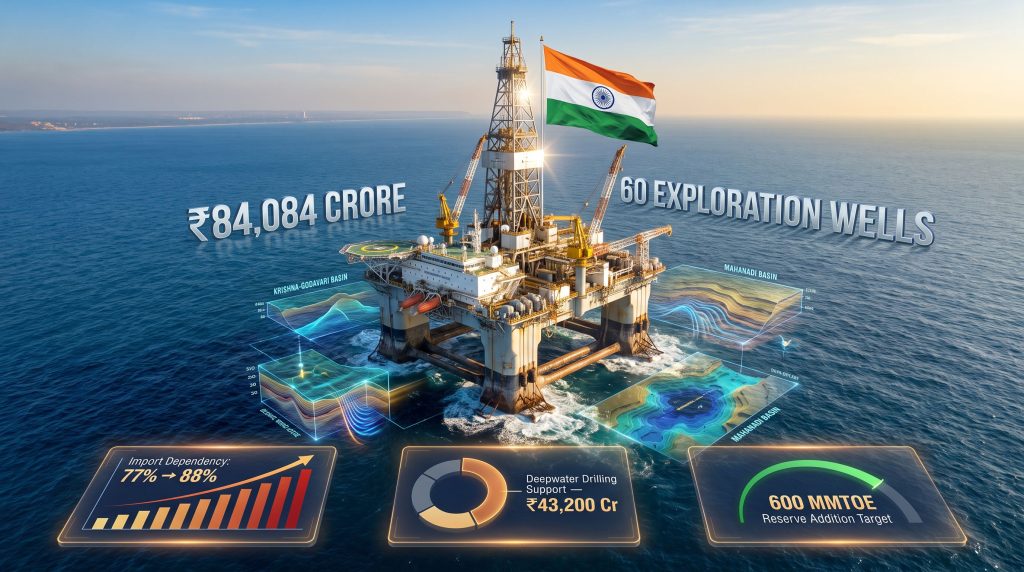
That calculus is now changing. India's Union Cabinet approved the Samudra Manthan offshore exploration scheme in August 2026, committing ₹84,084 crore over five years to directly fund deepwater and ultra-deepwater exploration across its offshore basins. The sheer structural novelty of this programme warrants careful analysis, not just from an energy security perspective, but from the standpoint of what it reveals about how governments are being forced to intervene in markets where private capital has systematically failed to show up.
When big ASX news breaks, our subscribers know first
Understanding the Import Dependency Crisis That Created the Imperative
India's energy vulnerability is not a new story, but its trajectory has steepened sharply. Crude oil import dependency has climbed from 77% to 88% of total national requirement over the past decade, while approximately 50% of the natural gas consumed domestically now comes from overseas sources. That gas supports industries that are deeply embedded in everyday life: fertiliser manufacturing, power generation, CNG distribution networks, and piped cooking gas for households.
What makes this structural dependency particularly difficult to unwind is that it did not happen because India lacks hydrocarbon resources. It happened, however, because of a persistent mismatch between exploration investment and reserve depletion.
Why Did Exploration Investment Stall?
The core problem is straightforward. Domestic upstream companies concentrated capital almost entirely on development drilling — extracting oil and gas from already-established reserves — rather than committing funds to the far riskier process of searching for new ones. Development drilling generates measurable returns on a predictable timeline. Exploration drilling, by contrast, offers no guarantee of return at all. A dry well represents a total write-off.
When exploration investment stalls across an entire upstream sector, proven reserves deplete without replacement. Over a decade or more, that gap becomes a structural dependency on imported energy that no amount of supply-side negotiation can fully resolve.
The geopolitical dimension accelerated the urgency. Supply chain disruptions linked to Middle East instability — compounded further by broader trade war impacts on global energy flows — exposed just how fragile India's energy architecture had become, and the case for domestic reserve development shifted from aspirational to operationally critical.
What the Samudra Manthan Offshore Exploration Scheme Actually Does
The name itself carries deliberate symbolism. Samudra Manthan derives from Hindu cosmological tradition: the churning of the cosmic ocean by gods and demons to extract hidden treasures from its depths. Applied to energy policy, it frames deepwater exploration not as a commercial venture but as a national mission to unlock what already exists beneath Indian territorial waters.
The scheme was formally approved by India's Union Cabinet — you can review the official Cabinet approval on the Prime Minister's website — and is structured across a five-year horizon through FY 2030-31. Its operational centrepiece is a direct government cost-sharing mechanism for deepwater exploration wells.
The Core Financial Mechanism
| Parameter | Detail |
|---|---|
| Government contribution per well | 50% of qualifying well cost |
| Maximum cap per well | ₹650 crore |
| Total wells supported | 60 exploration wells |
| Programme duration | FY 2026-27 through FY 2030-31 |
| Eligible participants | Existing OALP block holders and new round entrants |
The elegance of this structure lies in what it actually redistributes. Rather than a royalty concession or a production tax holiday, the government is absorbing exploration-phase financial risk before any commercial discovery has been made. This is a fundamentally different risk instrument than anything India has deployed before in the upstream sector.
An official statement noted that this may represent the first instance globally of a government directly funding exploration risk from its national budget at this scale, distinguishing it clearly from models involving state equity participation or production entitlement adjustments. Furthermore, this form of government intervention in mining and resource sectors is gaining traction globally as private capital proves increasingly risk-averse in frontier exploration.
Full Budget Breakdown: Where the ₹84,084 Crore Goes
The total allocation is not concentrated solely on drilling. It funds an integrated ecosystem designed to address multiple bottlenecks simultaneously.
| Budget Component | Allocation (₹ Crore) | Strategic Purpose |
|---|---|---|
| Deepwater and ultra-deepwater drilling support | 43,200 | Fund 60 exploration wells at ~₹650 crore each through FY 2031 |
| Offshore seismic and geological surveys | 28,534 | Map prospective basins including former restricted zones |
| Common Hub Infrastructure (CHI) | 10,000 | Shared subsea pipelines and onshore processing facilities |
| Oil and Gas Manufacturing and Services Zone | 2,000 | Build domestic equipment supply chain and services capacity |
| Total | ₹84,084 crore | Integrated offshore exploration ecosystem |
The seismic allocation deserves particular attention. Without high-resolution subsurface data, no company can adequately model geological risk in a prospective offshore block. Historically, significant areas of India's offshore basins have remained unmapped not because they lacked hydrocarbon potential, but because they fell within designated "No-Go" zones — areas restricted from exploration for defence, environmental, or administrative reasons.
The scheme's seismic budget specifically targets data acquisition in these previously inaccessible areas, effectively opening new frontier acreage to commercial assessment for the first time.
Prashant Vashisht, Senior Vice President at ICRA Ltd, identified the seismic data gap as one of two fundamental barriers the scheme addresses, noting that the absence of reliable prospectivity information in former restricted zones has been a primary obstacle to commercial exploitation of potential reserves in those areas. (PTI, August 2026)
The Common Hub Infrastructure Model: A Structural Innovation for Deepwater Commercialisation
One of the least-discussed but potentially most impactful components of the Samudra Manthan offshore exploration scheme is the ₹10,000 crore Common Hub Infrastructure (CHI) allocation.
In deepwater basin development, infrastructure duplication is one of the dominant sources of project uneconomics. Each operator building its own subsea pipeline network, its own processing terminal, and its own evacuation logistics creates enormous fixed-cost burdens that make smaller or marginal discoveries commercially unviable on a standalone basis.
The CHI model addresses this directly by funding shared assets that multiple operators can access collectively.
CHI is designed to deliver:
- Shared subsea pipeline networks accessible across multiple operator concessions
- Common onshore oil and gas receipt and processing terminals
- Reduced capital expenditure per individual discovery through asset pooling
- More efficient hydrocarbon evacuation logistics across the offshore basin
- Faster commercialisation timelines for smaller, marginal discoveries
- Improved project economics for deepwater and ultra-deepwater developments
- Simplified offshore logistics and optimised marine engineering resources
This model effectively transforms the economics of marginal discoveries. A subsea find that cannot justify the capital expenditure of standalone infrastructure may become commercially viable when connected to a shared network. This is particularly relevant in India's context because deepwater exploration portfolios almost always include a range of discovery sizes, and the commercial case for developing smaller finds underpins the long-term viability of the broader basin.
How India's Approach Compares Globally
India's direct budget-funded risk subsidy model is structurally distinct from comparable international frameworks. Most governments that participate in offshore exploration do so through state ownership or equity co-investment rather than outright grants. For context, the broader commodity outlook for resource-dependent nations underscores just how differentiated India's approach is.
| Country | Government Exploration Support Model | Mechanism Type |
|---|---|---|
| India (Samudra Manthan) | 50% well cost subsidy, capped at ₹650 crore per well | Direct budget grant |
| Norway | State participation via Equinor and PETORO | Equity co-investment |
| Brazil | Pre-salt licensing with Petrobras mandatory participation | State NOC co-participation |
| United States | Offshore lease royalty relief programmes | Revenue concession |
| United Kingdom | Ring-fence tax allowances for exploration | Tax expenditure mechanism |
The distinction matters because each model distributes risk differently. In Norway's framework, the state participates in both the upside and downside of exploration through its equity position. In India's model, the government accepts a defined financial loss on each dry well drilled under the scheme with no production entitlement attached. This places the commercial upside entirely with the exploring company while the government absorbs a fixed proportion of the downside. It is, in effect, an exploration insurance mechanism funded from the national budget.
The next major ASX story will hit our subscribers first
The Regulatory Architecture: Decades of Reform Converging
The Samudra Manthan offshore exploration scheme did not emerge in a policy vacuum. It represents the culmination of a reform trajectory stretching back to 1997, when India began moving away from production-sharing contracts.
The Hydrocarbon Exploration and Licensing Policy (HELP), introduced in 2016, was the most significant intermediate step. It introduced Revenue Sharing Contracts, established the Open Acreage Licensing Policy (OALP), created a uniform licensing structure, and granted companies marketing and pricing freedom for their production — a critical commercial concession that had been absent under earlier frameworks.
A subsequent hybrid allocation model gave greater weight to work programme commitments in under-commercialised basins, incentivising actual drilling rather than acreage holding. These reforms were then consolidated under the Oilfields (Regulation and Development) Amendment Act, 2025, which came into force in April 2025 and provided the legislative foundation for 50 exploration blocks offered across OALP, small-field, and coal-bed methane bidding rounds in December 2025.
The Samudra Manthan scheme layers government risk-sharing on top of this reformed framework, addressing the final structural barrier that policy reform alone could not resolve: the capital intensity and technical complexity of deepwater drilling in an environment where domestic operators have limited prior experience.
Production Targets, Reserve Additions, and the Limits of Optimism
India's government projects that the scheme will add more than 600 million metric tonnes of oil equivalent (MMTOE) to national hydrocarbon reserves over the long term, with incremental annual production estimated at 10-15 million tonnes of oil equivalent (MTOE) once discoveries are commercialised.
That output level would reduce import dependency by an estimated 3-5% — a meaningful contribution but one that must be contextualised against an import dependency baseline of approximately 88% for crude oil. Consequently, the scheme should be understood as a structural repositioning rather than an immediate supply fix.
Analysts at ICRA Ltd have framed the scheme explicitly as a long-term structural investment rather than a near-term supply solution, noting that the projected import dependency reduction of 3-5% reflects the fundamental scale of India's consumption relative to domestic production capacity. (PTI, August 2026)
Several structural realities constrain more optimistic projections:
- Geological success rates in deepwater exploration are inherently variable. Not every well in the 60-well programme will yield a commercial discovery, and the government has explicitly acknowledged this uncertainty.
- Lead times from discovery to production in deepwater environments typically range from 7 to 12 years, meaning the scheme's production outcomes will not appear in near-term energy supply metrics regardless of exploration success.
- India's domestic upstream sector has limited deepwater technical experience, creating dependency on international contractors, drilling rigs, and subsurface expertise that will need to be mobilised from global markets.
- Indian offshore acreage competes for international exploration capital against frontier basins in Guyana, Namibia, Brazil, and East Africa, all of which have generated significant commercial discoveries in recent years.
In addition, global energy price dynamics — including the recent oil price rally driven by geopolitical pressures — may influence the pace at which international operators commit to Indian deepwater blocks over the scheme's five-year duration.
India's Deepwater Target Geography
India's offshore sedimentary basins span both continental margins, offering geologically diverse exploration targets.
Key deepwater and ultra-deepwater target areas include:
- Krishna-Godavari (KG) Basin on the eastern margin, where significant gas discoveries have already established commercial precedent
- Mahanadi Basin in the Bay of Bengal, relatively underexplored at deepwater depths
- Andaman Basin, a frontier area with limited existing data but potentially significant prospectivity
- Western offshore zones in the Arabian Sea, including areas adjacent to established producing fields
The seismic survey component of the scheme will extend into former restricted zones across several of these basins, potentially revealing prospective structures that have never previously been mapped at commercial resolution. Shifts in natural gas price trends globally will also shape how commercially attractive any gas-weighted discoveries in these basins ultimately prove to be.
What Investors and Industry Observers Need to Watch
For those tracking India's upstream oil and gas sector, the Samudra Manthan offshore exploration scheme introduces several dynamics worth monitoring closely. The Times of India provides a detailed breakdown of the scheme's implications for those seeking further context on its potential as a game-changer.
The scheme's effectiveness will ultimately be measured by four outcomes:
- The number of eligible companies that actually submit claims under the cost-sharing mechanism
- The quality of seismic data generated in former No-Go zones and whether it attracts international operator interest
- The commercial discovery rate across the 60-well programme relative to statistical deepwater exploration benchmarks
- Whether the Common Hub Infrastructure builds out on schedule and at the designed capacity to support multiple concurrent operators
The broader policy signal is also significant. India is demonstrating a willingness to treat hydrocarbon reserve development as a public good investment rather than a purely commercial activity. Whether that framing proves durable across political cycles will influence the long-term credibility of India's upstream investment environment.
Disclaimer: This article contains forward-looking projections and production estimates sourced from government officials and sector analysts. Deepwater exploration outcomes are subject to significant geological, technical, and commercial uncertainty. Nothing in this article constitutes investment advice. Readers should conduct independent due diligence before making any investment decisions related to India's upstream oil and gas sector.
Want to Stay Ahead of Significant Resource Discoveries as They Happen?
Discovery Alert's proprietary Discovery IQ model delivers real-time alerts on major ASX mineral discoveries, transforming complex geological data into actionable investment insights for both short-term traders and long-term investors — explore historic examples of exceptional discovery returns to understand the potential, then begin your 14-day free trial to position yourself ahead of the broader market.