August 14, 2026
Global energy markets face unprecedented structural transformations as traditional hydrocarbon exporters confront evolving geopolitical landscapes and technological disruptions. The intersection of sanctions regimes, infrastructure constraints, and fiscal dependency creates complex vulnerabilities that extend beyond immediate supply considerations. Understanding these macro-economic forces requires examining how isolated energy systems adapt to external pressures while maintaining domestic stability.
Iran's distressed oil sector exemplifies these broader challenges, where decades of international isolation have created a fundamentally compromised revenue architecture. The country's petroleum industry operates through mechanisms that systematically erode value capture, creating sustainability questions that transcend short-term production metrics. These structural weaknesses illuminate how sanctions-adapted economies face compounding disadvantages that intensify over time.
How Sanctions Architecture Undermines Revenue Efficiency
The fundamental economics of Iran's distressed oil sector reflect structural inefficiencies embedded throughout the value chain. Current production maintains stability at approximately 3.2 million barrels per day, yet this apparent operational success masks severe revenue capture problems that distinguish Iran from conventional petroleum exporters.
Iran's petroleum sales generate only about two-thirds of benchmark oil prices due to cumulative costs associated with sanctions-evading operations. This revenue haircut persists regardless of global price movements, representing a structural rather than cyclical challenge that compounds over time as operational costs escalate. Furthermore, the OPEC oil market influence demonstrates how traditional price coordination mechanisms become ineffective for isolated producers.
Shadow Fleet Economics and Operational Premiums
Operating under sanctions requires sophisticated logistics networks that extract substantial value before oil receipts reach government treasuries. Shadow fleet operations demand specialised insurance arrangements, maintenance protocols, and crew compensation packages that far exceed conventional shipping costs.
Key Revenue Leakage Mechanisms:
- Specialised vessel insurance premiums for sanctioned cargo handling
- Enhanced maintenance requirements for ships avoiding port inspections
- Premium compensation for crews willing to operate sanctioned vessels
- Ship-to-ship transfer costs in international waters
- Cargo documentation fraud and blending operation fees
These operational requirements create fixed costs that consume progressively larger revenue shares during periods of weaker crude prices. Unlike conventional producers who benefit from economies of scale, Iran's sanctions-adapted infrastructure becomes less efficient as volumes or prices decline.
Financial Channel Inefficiencies
Iran's reliance on alternative financial mechanisms creates additional systematic value erosion. Yuan-denominated accounts, barter arrangements, and circuitous money-laundering pathways each extract commissions that reduce net receipts compared to conventional banking channels available to non-sanctioned producers.
The country's 90% export dependence on Chinese buyers eliminates pricing negotiation leverage, creating monopsony conditions where purchasing terms become increasingly unfavourable. Consequently, this concentration risk extends beyond immediate revenue concerns to strategic vulnerability regarding quota adjustments and refinery maintenance schedules that directly impact Iranian cash flows.
When big ASX news breaks, our subscribers know first
What Capital Allocation Crisis Threatens Production Sustainability
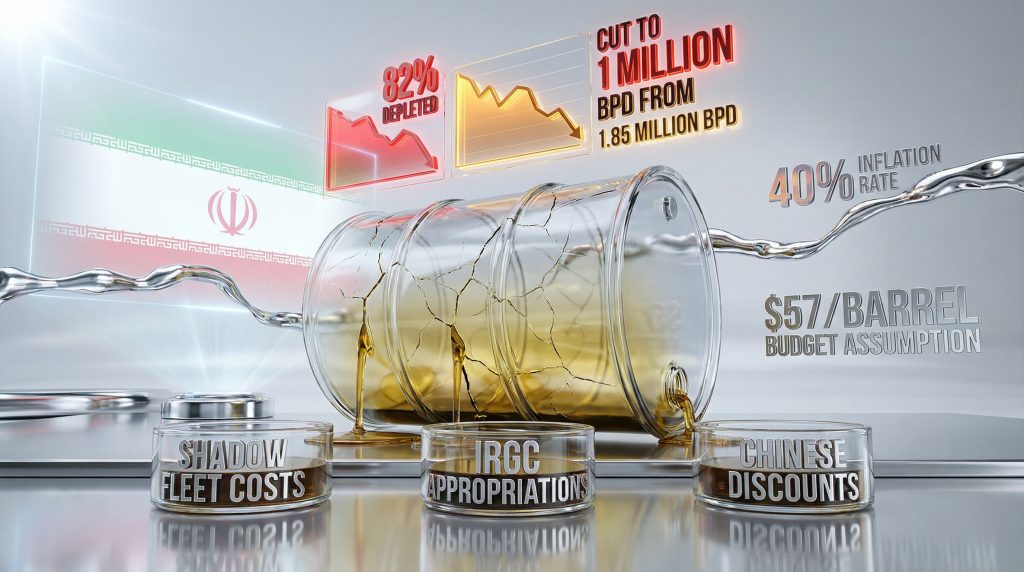
Iran's distressed oil sector faces acute capital allocation problems that threaten long-term production sustainability. The National Iranian Oil Company (NIOC) officially receives 14.5% of total oil and gas export revenues, but Islamic Revolutionary Guard Corps appropriations reduce this effective share to approximately 10%.
This funding shortfall occurs precisely when aging infrastructure requires intensive capital investment for maintenance and pressure support systems. Export volume projections have been dramatically reduced from 1.85 million barrels per day to 1 million barrels per day in official budget planning, representing a 46% decline in fiscal revenue assumptions. Moreover, oil price rally dynamics suggest that global price movements may not translate into proportional revenue benefits for sanctioned producers.
Infrastructure Investment Challenges
| Challenge Category | Specific Issues | Impact on Operations |
|---|---|---|
| Late-Life Field Management | Natural decline acceleration | 10-15% annual production losses |
| Gas Field Complexity | Low recovery rates, complex structures | Technical capacity limitations |
| Local Contractor Constraints | Limited equipment access, skilled workforce gaps | Deferred maintenance programmes |
| Import Restrictions | Essential equipment unavailability | Technological obsolescence |
Many of Iran's core producing assets experience steep natural declines requiring enhanced recovery techniques such as polymer flooding, surfactant injection, or gas injection. These capital-intensive technologies demand technical expertise and financial resources that exceed current allocation levels.
Fiscal Buffer Depletion
The National Development Fund, designed to preserve oil and gas revenues for future generations, has been systematically depleted to address short-term fiscal needs. 82% of the fund was spent by 2024, with no oil revenue deposits since early 2023.
Parliamentary reporting indicates that 28% of remaining National Development Fund resources are currently being lent back to the government, essentially converting what should be a wealth preservation mechanism into a short-term loan facility. This represents complete abandonment of intergenerational wealth preservation principles.
Macroeconomic Context Affecting Capital Allocation:
- 40% inflation rate eroding real purchasing power
- Government budget nominal increase from $98 billion to $111 billion represents -28.7% real contraction
- Oil price assumptions reduced to $57 per barrel from $63 per barrel
- Currency devaluation affecting import costs for essential equipment
How Geopolitical Dependencies Create Strategic Vulnerabilities
Iran's distressed oil sector operates within geopolitical constraints that create multiple strategic vulnerabilities. China's role as purchaser of 90% of Iranian crude exports establishes monopsony market conditions that eliminate price negotiation leverage and create dependency on Chinese policy decisions.
The Trump administration's announcement of 25% tariffs on countries trading with Iran represents escalating pressure on this critical relationship. However, Chinese crude buying patterns are expected to remain relatively stable due to established practices of sourcing discounted barrels from sanctioned producers. Additionally, the broader US-China trade impacts create complex market dynamics affecting global energy flows.
Market Concentration Risk Analysis
Single-buyer market concentration creates vulnerability beyond immediate revenue considerations. Chinese quota changes, refinery run modifications, and maintenance schedules directly affect Iranian cash flows without any diversification buffer available to conventional producers.
Even cargoes initially booked for unknown destinations ultimately end up in China, confirming the complete market concentration that characterises Iran's export strategy. This dependency structure means that any shift in Chinese energy policy or geopolitical positioning immediately impacts Iranian revenue streams.
Scenario Modelling for Sector Resilience
Three Primary Economic Pathways emerge for Iran's oil sector:
-
Status Quo Maintenance Scenario
- Continued reliance on discounted Chinese sales
- Progressive degradation of upstream assets
- Fiscal buffer exhaustion within current trajectory
-
Diplomatic Normalisation Scenario
- Market access restoration enabling price recovery
- Infrastructure investment resumption with international partnerships
- Fiscal stabilisation through diversified buyer base
-
Regime Transition Scenario
- Potential for rapid sanctions relief and market reintegration
- Massive infrastructure rehabilitation requirements
- Competitive positioning challenges against regional producers
Expert analysis characterises the diplomatic normalisation scenario as the least likely to materialise, suggesting limited near-term probability of sanctions relief through negotiation. According to Iran International, the current political climate indicates increasing rather than decreasing pressure on Iran's economic sectors.
What Technical Constraints Limit Recovery Potential
Iran's distressed oil sector faces significant technical constraints that compound financial limitations. Many gas fields possess complex geological structures and low recovery rates that challenge local contractors lacking financial and technical resources to address sophisticated completion requirements.
Late-life field management demands enhanced recovery techniques that require specialised equipment and expertise currently unavailable under sanctions restrictions. Natural decline rates accelerate under chronic underinvestment conditions, with fields potentially experiencing 10-15% annual declines compared to 5-7% under normal maintenance regimens.
Contractor Capacity Limitations
Local Iranian contractors operate under multiple constraints that limit their effectiveness in maintaining aging infrastructure:
Operational Constraint Categories:
- Access to specialised equipment for complex interventions
- Availability of trained personnel with advanced technical skills
- Import restrictions on essential materials and chemicals
- Financial resources to fund major workover programmes
- Technology transfer limitations affecting operational efficiency
These constraints become critical as fields age and require increasingly sophisticated interventions. Brownfield redevelopment of mature fields has provided incremental volumes but at escalating capital costs per barrel of incremental production that are 2-3 times higher than greenfield development.
Upstream Economics Under Pressure
While Iran maintains relatively low upstream breakeven costs estimated at $20 to $25 per barrel, this analysis excludes substantial costs of sanctions evasion that occur downstream from wellhead operations. The gap between extraction costs and realised revenues continues widening as shadow operation expenses escalate.
Comparative analysis with regional competitors reveals compounding disadvantages. While other producers enhance operational efficiency through international partnerships and technology access, Iran's operations become progressively more expensive and technically constrained.
How Domestic Economic Pressures Amplify Systemic Risks
Iran's distressed oil sector operates within broader economic conditions that amplify operational and financial risks. Nationwide protests reflect deeper economic grievances that create operational disruption potential and highlight the interconnection between fiscal constraints and social stability.
The relationship between energy subsidies, public services deterioration, and social unrest creates feedback loops that can rapidly escalate operational risks. Energy subsidies consume disproportionate budget resources whilst public sector employment reductions affect the skilled technical workforce essential for complex petroleum operations. Furthermore, tariffs affecting investments create additional economic pressures that compound existing challenges.
Economic-Social Risk Interconnections
Critical Vulnerability Assessment Points:
- Power grid instability affecting upstream operations
- Skilled workforce emigration reducing operational capacity
- Equipment import restrictions limiting maintenance capabilities
- Financial system isolation preventing normal commercial operations
- Infrastructure investment deferrals impacting both energy and social systems
Long-term Competitiveness Erosion
Iran's distressed oil sector faces a fundamental competitiveness crisis where the cost structure for bringing barrels to market increasingly exceeds regional benchmarks. This erosion occurs through multiple channels: higher operational costs, reduced efficiency, technology gaps, and market access limitations.
The sector's ability to generate meaningful economic returns depends not only on global oil prices but on resolving structural inefficiencies created by sanctions adaptation. Regional competitors maintain access to international capital markets, advanced technology partnerships, and diversified customer bases that provide cumulative advantages intensifying over time.
The economics of isolation create a sustainability crisis that transcends short-term geopolitical considerations. Every barrel produced under current sanctions conditions generates significantly less net revenue than regional competitors, establishing an unsustainable long-term trajectory for fiscal stability.
The next major ASX story will hit our subscribers first
What Supply Chain Vulnerabilities Threaten Operational Continuity
Iran's current production stability masks underlying structural fragilities that could trigger supply disruptions across multiple failure points. The intersection of domestic unrest, infrastructure aging, and financial constraints creates systemic vulnerabilities that extend beyond immediate production considerations.
Supply chain vulnerability extends throughout the operational ecosystem, from power generation affecting upstream operations to specialised equipment imports essential for maintenance programmes. Each constraint point represents potential cascade failure risks that could rapidly impact production levels. In addition, inflation and tariff pressures create additional strain on operational budgets and equipment procurement.
Infrastructure Interdependency Risks
The petroleum sector's dependency on broader infrastructure systems creates vulnerability to disruptions that appear unrelated to oil operations. Power grid instability, transportation network constraints, and communication system limitations all directly impact operational capacity.
These interdependencies mean that Iran's distressed oil sector faces risks from multiple vectors simultaneously. Unlike conventional producers who operate within stable infrastructure environments, Iran must manage compound risk scenarios where multiple systems could fail concurrently.
Investment Requirement Projections
Addressing accumulated infrastructure deficits would require massive capital investments that exceed current financial capacity. Conservative estimates suggest that restoring Iran's petroleum infrastructure to regional competitive standards would require investments exceeding available fiscal resources by multiple factors.
Investment Priority Categories:
- Pressure support systems for aging fields
- Enhanced recovery technology implementation
- Power generation capacity for upstream operations
- Transportation and logistics infrastructure upgrades
- Skilled workforce development and retention programmes
Without addressing these fundamental economic constraints, Iran's energy sector risks transitioning from its traditional role as the primary fiscal anchor toward becoming a diminishing contributor to national economic stability. According to Fitch Ratings analysis, global oil markets may be able to absorb Iranian supply disruptions more easily than in previous decades.
The structural challenges facing Iran's distressed oil sector illustrate broader vulnerabilities that emerge when energy systems operate under prolonged isolation. These constraints create compounding disadvantages that intensify over time, establishing sustainability questions that extend well beyond immediate geopolitical considerations.
This analysis reflects current market conditions and regulatory frameworks. Future developments may significantly alter the dynamics discussed herein. Readers should consider multiple perspectives when evaluating complex geopolitical and economic situations affecting global energy markets.
Are You Looking for Market-Leading Insights in Energy and Commodities Trading?
Discovery Alert's proprietary Discovery IQ model delivers real-time alerts on significant ASX mineral discoveries, transforming complex market data into actionable insights for both short-term traders and long-term investors. Explore how historic discoveries have generated substantial market returns, then begin your 30-day free trial today at Discovery Alert to position yourself ahead of evolving global energy and commodities markets.