
July 21, 2026
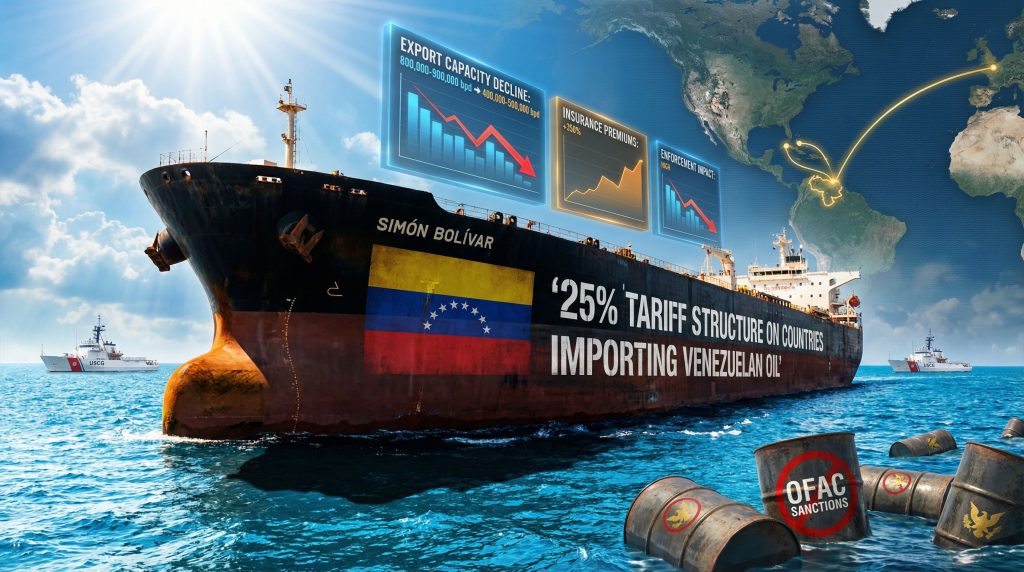
Understanding Sanctions Enforcement Architecture
The maritime enforcement of Venezuelan oil sanctions operates through a complex legal framework that extends far beyond simple trade restrictions. At its foundation lies the International Emergency Economic Powers Act (IEEPA) of 1977, which grants the U.S. Treasury's Office of Foreign Assets Control (OFAC) broad authority to impose economic sanctions on foreign governments and designated entities. This statutory framework enables enforcement actions in international waters when transactions involve U.S. persons, entities, or dollar-denominated payments.
The enforcement mechanism relies heavily on federal district court warrant processes that follow established maritime law precedents. When probable cause exists that a vessel carries sanctioned cargo, federal authorities can obtain seizure warrants under civil asset forfeiture statutes. This legal architecture has proven particularly effective against Venezuela's oil exports enforcement, as the majority of international crude oil transactions still flow through dollar-based payment systems.
Maritime Jurisdiction and Interdiction Powers
U.S. jurisdiction over maritime commerce creates enforcement opportunities that extend well beyond territorial waters. Under current legal interpretations, vessels become subject to U.S. enforcement action when their cargo, financing, or operational structure touches the American financial system. This expansive reach has transformed how shipping companies evaluate risk when considering Venezuelan crude contracts.
The Coast Guard's interdiction capabilities have evolved significantly since Iranian sanctions enforcement began in earnest during the 2010s. Furthermore, lessons learned from tracking Iranian shadow fleet operations now inform Venezuelan enforcement strategies, particularly regarding vessel identification and cargo verification procedures.
Insurance Market Dynamics and Risk Calculation
Protection and Indemnity (P&I) clubs form the backbone of maritime insurance, providing mutual coverage for ship operators against collision, pollution, and cargo loss risks. When sanctions enforcement intensifies, these clubs face a fundamental choice: maintain coverage for high-risk trade routes or withdraw to protect their broader membership from secondary sanctions exposure.
Lloyd's of London, operating through numerous syndicates since 1688, serves as the world's leading marine insurance marketplace. Historical precedent from Iranian sanctions shows that once reinsurance costs multiply beyond economically viable levels, coverage effectively disappears for sanctioned trade routes. Current market intelligence suggests similar patterns emerging for Venezuelan crude carriers, though specific premium multipliers cannot be verified without access to current syndicate pricing data.
The financial mathematics driving operator behaviour become clear when examining potential losses. A seized Suezmax tanker represents $40-120 million in vessel value, plus cargo worth tens of millions at current prices, plus legal fees and reputational damage that can affect future charter opportunities. These calculations explain why vessels increasingly reverse course mid-transit when enforcement risk materialises.
When big ASX news breaks, our subscribers know first
Economic Disruption Patterns Under Enforcement Pressure
Tanker Operator Risk Assessment Framework
Flag state compliance requirements create additional layers of enforcement risk that extend beyond U.S. jurisdiction. Vessels flagged to nations cooperating with American sanctions face potential de-flagging if they violate sanctions, which effectively removes their legal status for international maritime trade. This mechanism has proven particularly powerful because it creates enforcement leverage through allied nations rather than requiring direct U.S. action.
Port access restrictions compound these risks through mechanisms like Section 230 of the Countering America's Adversaries Through Sanctions Act (CAATSA). However, vessels with documented sanctions violations can find themselves blocked from Western ports, creating operational constraints that extend far beyond the original sanctioned trade.
The shipping industry's interconnected nature means that sanctions exposure affects vessel employment prospects across multiple trade routes. Consequently, operators must weigh immediate contract value against potential exclusion from more lucrative legitimate trades, creating powerful economic incentives for compliance even when enforcement probability appears low.
Export Capacity Analysis and Infrastructure Constraints
Venezuelan oil production has declined dramatically from peak levels of 3.2 million barrels per day in 2008 to approximately 750,000 barrels per day by 2023, according to OPEC Monthly Oil Market Reports. This decline reflects multiple factors including sanctions pressure, infrastructure degradation, and operational challenges within state oil company PDVSA.
Current export capacity faces additional constraints as enforcement actions target specific vessel categories. While exact percentages of sanctioned vessel utilisation cannot be verified without access to current OFAC enforcement databases, industry observers note increasing reluctance among international carriers to accept Venezuelan crude contracts.
Storage infrastructure becomes critical when export restrictions tighten. Venezuela's PDVSA operates storage capacity of approximately 50-75 million barrels distributed across multiple port facilities and tank farms. When storage approaches capacity due to export disruptions, production curtailment becomes necessary to prevent operational complications and environmental risks.
Regional Supply Chain Vulnerabilities
Cuban Energy Security Dependencies
Cuba's energy security remains heavily dependent on Venezuelan crude imports, which historically provided approximately 70% of the island's petroleum requirements under preferential ALBA (Bolivarian Alliance) agreements. This dependency creates particular vulnerability when Venezuelan exports face enforcement pressure, as Cuba lacks both spare financial capacity and alternative supplier relationships at comparable terms.
The Cuban refining sector operates with limited capacity of approximately 115,000 barrels per day across ageing facilities that were designed primarily for Venezuelan heavy crude grades. Technical compatibility between Venezuelan Merey crude and Cuban refinery specifications creates additional constraints on alternative supplier options, as most global producers offer lighter crude grades that require different processing configurations.
Alternative supplier options for Cuba remain severely constrained by both financial and logistical factors. In addition, Russian crude imports face their own sanctions complications and maritime logistics challenges. Mexican exports are prioritised for domestic consumption and North American markets. African suppliers typically demand higher prices and different payment terms than Cuba can readily accommodate.
Chinese Import Patterns and Sanctions Effectiveness
Chinese state-owned enterprises, particularly China National Petroleum Corporation (CNPC) and Sinopec, have historically represented 25-35% of Venezuelan crude exports according to International Energy Agency reports. These relationships create potential circumvention pathways through yuan-based payment systems that partially avoid dollar-denominated sanctions exposure.
However, sanctions evasion through Chinese channels faces practical limitations. International shipping, insurance, and refined product markets remain heavily dependent on dollar-based systems and Western financial infrastructure. Even when crude purchases use alternative currencies, the broader oil supply chain retains multiple exposure points to U.S. jurisdiction.
Strategic petroleum reserve policies in China add complexity to enforcement effectiveness calculations. While specific inventory levels and purchasing decisions remain largely undisclosed by Chinese authorities, the strategic reserve system provides buffer capacity that can absorb supply disruptions and moderate immediate price impacts.
Comparative Sanctions Enforcement Models
Iranian Shadow Fleet Precedents
Iranian sanctions enforcement beginning in the 2010s established operational templates that now inform Venezuelan enforcement strategies. Iranian actors developed sophisticated evasion techniques including vessel re-flagging, transponder manipulation, and ship-to-ship transfers in remote locations. These methods required years to develop and significant coordination between multiple facilitator networks.
The Iranian shadow fleet ultimately comprised 40-100 vessels using deceptive practices that included frequent name changes, flag switching, and disabled tracking systems. Third-party facilitator networks spanning UAE-based front companies, Singapore and Malaysia trading entities, and Indian refiners provided operational support for these activities.
Technology transfer between sanctioned jurisdictions has accelerated the development of evasion capabilities. For instance, Iranian expertise in deceptive shipping practices has influenced Russian and North Korean sanctions evasion efforts, suggesting that Venezuelan operations may benefit from similar knowledge transfer.
Geographic and Infrastructure Constraints
Venezuelan enforcement faces unique geographic factors that distinguish it from Iranian precedents. While Iran maintained approximately 8,000 nautical miles distance from U.S. naval enforcement bases, Venezuelan operations occur within 1,000 nautical miles of U.S. Caribbean installations. This proximity enables more frequent interdiction opportunities and sustained surveillance capabilities.
Infrastructure limitations further constrain Venezuelan evasion options compared to Iranian capabilities. Iran developed numerous ship-to-ship transfer locations in remote offshore areas with limited surveillance coverage. Venezuelan geography provides fewer such alternatives, concentrating transfer operations in more observable locations.
The established nature of Venezuelan export infrastructure creates additional enforcement leverage. Unlike Iran's more distributed export network, Venezuelan crude exports concentrate through specific port facilities and pipeline systems that enable targeted monitoring and interdiction efforts.
Policy Implementation Complexity
Tariff Mechanisms and Trade Enforcement
Complementary trade measures expand enforcement impact beyond direct maritime interdiction. While specific current tariffs impacting investments rates require verification against U.S. Trade Representative schedules, the framework for imposing tariffs on third-country imports of Venezuelan crude exists under national security provisions of trade law. Furthermore, broader concerns about U.S. tariffs and inflation influence policy calculations.
World Trade Organisation compliance considerations require careful structuring of any tariff measures under Most Favoured Nation obligations and national security exceptions. The Trade Expansion Act of 1962 provides statutory authority for national security-based trade restrictions, though such measures face potential challenge through WTO dispute resolution mechanisms.
Enforcement monitoring for indirect imports presents significant technical challenges. Tracking transshipment through third countries requires sophisticated intelligence capabilities and international cooperation to identify cargo origins and ownership structures. Current monitoring mechanisms cannot be detailed without access to U.S. Customs enforcement databases.
Special Licensing Complications
Chevron's General License for limited Venezuelan operations creates enforcement complexity by establishing legitimate parallel channels alongside sanctioned activities. The license permits specific production and sales activities under strict OFAC oversight, including quarterly reporting requirements and revenue allocation restrictions.
Revenue sharing mechanisms under Chevron's arrangement involve debt repayment structures and compensation for historical claims rather than traditional profit-sharing agreements. These arrangements require careful monitoring to ensure compliance with licensing terms while maintaining operational effectiveness.
Compliance violations or licensing modifications can significantly impact overall Venezuelan export capacity. Any reduction in licensed operations would further constrain legitimate export channels and potentially accelerate storage capacity limitations that drive production curtailment decisions.
Market Structure Adaptation Mechanisms
Infrastructure Response to Export Restrictions
Venezuelan storage utilisation patterns reflect the mechanical relationship between export constraints and production decisions. Historical storage levels typically operated at 80-90% capacity during normal export periods, leaving limited buffer capacity for extended export disruptions.
Production curtailment becomes necessary when storage approaches critical levels to prevent operational spillage and environmental complications. The Venezuelan production decline from 3.2 million barrels per day in 2008 to current levels reflects multiple factors including infrastructure constraints, sanctions pressure, and storage limitations.
Domestic consumption patterns provide some buffer for production that cannot be exported. However, Venezuelan refinery capacity and domestic demand cannot absorb significant production volumes that would normally flow to export markets, creating pressure for rapid production adjustments when exports face disruption.
Global Oil Price Dynamic Responses
Venezuelan heavy crude grades typically trade at significant discounts to international benchmarks due to their lower API gravity and higher processing requirements. Merey crude with API gravity of 16-17 requires specialised refining capabilities that limit the number of potential buyers and processing locations globally.
Supply disruptions in heavy crude markets create specific impacts on refiners configured for these grades, particularly in the U.S. Gulf Coast region where Venezuelan crude historically supplied significant volumes. Alternative heavy crude sources include Canadian oil sands production and other Latin American producers, though logistical and contractual factors affect substitution speed. Furthermore, oil price rally under tariffs demonstrates broader market dynamics.
OPEC+ production coordination mechanisms provide some offset to Venezuelan supply disruptions, though the organisation's spare capacity is primarily configured for lighter crude grades. Strategic petroleum reserve release policies in consuming nations can moderate immediate price impacts, but these measures address symptoms rather than underlying supply constraints.
The next major ASX story will hit our subscribers first
Long-term Regulatory and Strategic Implications
Maritime Enforcement Precedent Establishment
Venezuela's oil exports enforcement represents an evolution from regulatory warnings to active maritime interdiction, establishing new precedents for international sanctions implementation. These precedents may influence future enforcement approaches against other sanctioned jurisdictions and expand the toolkit available for economic pressure campaigns.
Multilateral coordination requirements for effective maritime enforcement create diplomatic challenges and opportunities. Successful interdiction often requires cooperation from flag states, port authorities, and allied nations, building enforcement networks that can apply to future sanctions programmes.
Intelligence and technology sharing frameworks developed for Venezuelan enforcement provide infrastructure that can be adapted for other sanctions targets. Investment in maritime surveillance capabilities and vessel tracking systems creates lasting enforcement capacity beyond the current Venezuelan context.
Regional Stability and Escalation Dynamics
Military asset deployment for sanctions enforcement affects regional power balance in the Caribbean and broader Latin American context. Sustained enforcement operations require significant naval and intelligence resources that signal U.S. commitment levels to regional allies and potential adversaries.
Humanitarian impact considerations may affect long-term policy sustainability, particularly as enforcement pressure affects Cuban energy security and broader regional economic conditions. These factors create political pressures that may influence enforcement duration and intensity over time. Additionally, developments like the Senate uranium ban illustrate broader sanctions strategies.
Negotiation leverage creation through economic pressure represents the ultimate policy objective, but effectiveness depends on maintaining pressure while preserving diplomatic channels for eventual resolution. The sustainability of current enforcement levels may determine whether economic pressure translates into meaningful political outcomes, particularly considering US‑China trade strategies.
Industry Response and Risk Assessment Framework
Due Diligence and Compliance Requirements
Know Your Customer protocols for oil trading have expanded significantly in response to Venezuela's oil exports enforcement. Energy companies must implement enhanced screening procedures to identify potential sanctions exposure through supply chain relationships, financing arrangements, and joint venture partnerships.
Sanctions screening technology and compliance costs represent significant operational expenses for companies with potential Venezuelan exposure. Legal liability assessment requires ongoing monitoring of sanctions designation updates, enforcement actions, and regulatory guidance that can change rapidly as enforcement priorities evolve.
Third-party risk assessment extends beyond direct contractual relationships to encompass vessel operators, insurance providers, and financial institutions that may create indirect sanctions exposure. This expanded due diligence scope increases transaction costs and lengthens approval timelines for international oil trades.
Post-Sanctions Market Entry Evaluation
Political risk assessment frameworks for potential Venezuelan market re-entry must consider enforcement precedents, asset protection mechanisms, and regulatory approval requirements that may persist beyond current sanctions. Investment decisions require evaluation of both immediate sanctions relief scenarios and longer-term political stability factors.
Infrastructure rehabilitation cost estimates reflect years of sanctions pressure, operational constraints, and deferred maintenance across Venezuelan oil production and export facilities. These costs may influence the speed and scope of international re-engagement even after sanctions relief.
Regulatory approval timelines for international operations in post-sanctions environments typically extend beyond initial policy changes due to licensing procedures, compliance verification, and political risk evaluation by various stakeholders. Early planning for these requirements may determine competitive positioning when market access resumes.
Venezuelan enforcement measures continue to evolve as regional tensions persist, affecting maritime operations and commercial relationships. Moreover, as enforcement mechanisms expand, companies must adapt their risk management strategies accordingly.
Key Takeaways
Venezuela's oil exports enforcement demonstrates the evolution from regulatory frameworks to active maritime interdiction, creating precedents for international economic pressure while highlighting the cascading effects across regional energy supply chains and global market dynamics. The comprehensive nature of these enforcement mechanisms affects not only direct participants but also creates ripple effects throughout the international energy sector.
Disclaimer: This analysis involves forecasts and speculation about sanctions enforcement effectiveness, market responses, and geopolitical outcomes that remain subject to rapidly changing political and economic conditions. Readers should verify current sanctions requirements and enforcement actions through official government sources before making business or investment decisions.
Ready to Navigate the Complex World of Energy Investments?
Discovery Alert provides instant notifications on significant ASX mineral discoveries, powered by its proprietary Discovery IQ model, helping investors identify actionable opportunities in the evolving energy and commodities landscape. Understand why major mineral discoveries can lead to substantial market returns by exploring Discovery Alert's dedicated discoveries page, showcasing historic examples of exceptional outcomes whilst you begin your 30-day free trial today to position yourself ahead of the market.