
August 6, 2026
Sanctions-Driven Market Restructuring in Global Energy Trade
Structural sanctions regimes have fundamentally reshaped global energy trading patterns, creating new commercial pathways while severing established supply relationships. The evolution of energy security frameworks demonstrates how geopolitical pressure translates into market restructuring, forcing importing nations to balance diplomatic alignment with economic optimization. This transformation reveals the complex interplay between sanctions enforcement, strategic partnerships, and energy procurement strategies in an increasingly multipolar world, particularly affecting India Iran oil trade relationships.
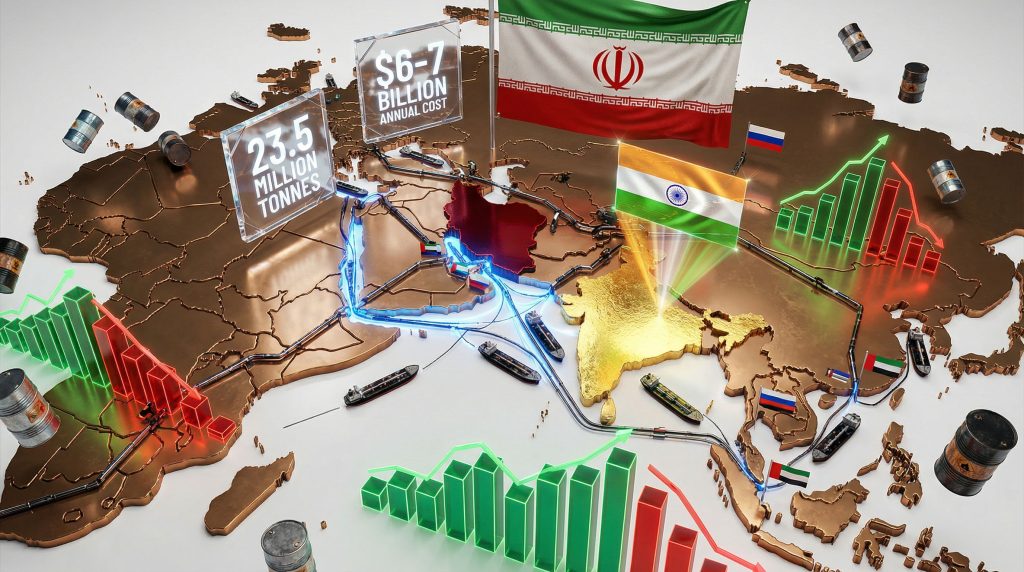
The reimposition of comprehensive sanctions against Iranian energy exports fundamentally altered India's energy procurement matrix. Before November 2018, Iran functioned as India's fourth-largest crude oil supplier, delivering approximately 23.5 million tonnes annually through well-established commercial relationships. This partnership offered strategic advantages including geographic proximity, competitive pricing through discount mechanisms, and crude oil specifications optimised for Indian refinery configurations.
The sanctions enforcement mechanism operated through multiple channels. The U.S. Office of Foreign Assets Control (OFAC) imposed secondary sanctions targeting non-U.S. entities facilitating Iranian oil transactions, effectively pressuring Indian shipping companies, financial institutions, and insurance providers operating within U.S. dollar-denominated systems. Furthermore, Indian compliance with these measures resulted in a 99% collapse in oil imports from Iran between 2018 and 2019.
Economic Impact Assessment:
- Additional procurement costs: $6-7 billion annually
- Price premium absorption: 15-20% above historical Iranian crude discounts
- Transportation cost increases: Extended supply chains from alternative sources
- Refinery adaptation expenses: Processing parameter modifications for different crude qualities
The total bilateral trade relationship between India and Iran declined dramatically from $17 billion in 2018 to approximately $1.68 billion by 2025, representing an 87% contraction. This decline reflected not only oil trade elimination but broader commercial relationship disruption across multiple sectors.
When big ASX news breaks, our subscribers know first
Critical Maritime Chokepoint Dependencies
The Strait of Hormuz controls approximately 21% of global petroleum liquids transit, positioning it as a critical vulnerability for energy-importing nations worldwide. India's energy security strategy must account for potential disruption scenarios affecting this essential maritime corridor, given that primary suppliers including Saudi Arabia, Iraq, and the UAE predominantly route shipments through the Strait when serving Indian markets.
Recent developments have highlighted the strategic importance of maintaining diplomatic channels for ensuring continued transit rights. Iran has provided assurances regarding safe passage for Indian vessels through the Strait of Hormuz, demonstrating how bilateral relationships create alternative security arrangements beyond formal international frameworks. For instance, analysts examining oil price rally insights note how geopolitical tensions continue to influence energy pricing mechanisms.
Maritime security analysts emphasise that chokepoint vulnerabilities represent asymmetric risks for energy-importing nations. The strait's geographical characteristics include a minimum width of 21 miles at the narrowest transit point, with established shipping channels governed by international maritime law. During periods of elevated tension, insurance markets impose increased premiums on tankers transiting the region, effectively raising energy transport costs through risk premium mechanisms.
Strait Transit Specifications:
- Channel width: 34 kilometres at narrowest point
- Primary vessel types: Large crude carriers (250,000-325,000 DWT)
- Insurance premium variations: 15-40% increases during tension periods
- Alternative route costs: 10-15 days additional transit time via Cape of Good Hope
Strategic Energy Diversification Framework
India's post-sanctions energy strategy demonstrates sophisticated risk management through multi-supplier diversification rather than direct replacement of Iranian volumes with a single alternative source. This approach reflected lessons learned from over-dependence vulnerability and recognition that strategic autonomy requires maintaining flexible procurement relationships.
Russian energy partnerships emerged as the most significant component of India's diversification strategy. Russian crude imports peaked at over 2 million barrels per day in mid-2024, though volumes declined in late 2025 due to intensifying secondary sanctions pressure from Western allies. Specific transactions included a 30 million barrel purchase arrangement negotiated through U.S. waiver mechanisms in late 2025, with March 2026 shipments commanding $2-8 premiums over Brent crude benchmarks.
Russian Energy Deal Structure (2025-2026):
| Transaction Type | Volume | Pricing Mechanism | Delivery Schedule |
|---|---|---|---|
| Spot Purchases | 30 million barrels | Brent +$2-8 premium | March 2026 |
| Term Contracts | 1.8 million bpd | Urals discount formula | Ongoing |
| LNG Arrangements | 2.5 million tonnes | Asian spot pricing | Q2-Q4 2026 |
Middle Eastern supplier relationships expanded significantly to compensate for Iranian volume reductions. Trade with the United Arab Emirates demonstrated remarkable growth, with exports to UAE reaching $36.6 billion and imports from UAE totalling $63.4 billion by 2024-25. In addition, Saudi Arabia supplier trends indicate the kingdom emerged as a crucial alternative supplier, with annual oil imports increasing to approximately $30 billion. Iraq gained prominence as a key replacement source, leveraging its production capacity expansion and established shipping infrastructure.
Technical considerations influenced supplier selection decisions. Russian crude grades, particularly Urals blend from Western Siberian fields and ESPO (Eastern Siberia-Pacific Ocean) crude, required refinery parameter adjustments compared to Iranian crude specifications. Indian refineries, including Reliance Industries' Jamnagar complex and Indian Oil Corporation facilities, invested in processing optimisation to accommodate different crude qualities while maintaining operational efficiency margins.
Sanctions Enforcement Escalation Mechanisms
The U.S. Treasury Department's enforcement actions against Indian entities facilitating India Iran oil trade intensified significantly during the October-November 2025 period. OFAC targeted 8-10 Indian nationals and sanctioned 9-10 companies, including RN Ship Management and TR6 Petro India, for their roles in shipping networks and petrochemical trade facilitation.
These enforcement measures employed sophisticated tracking mechanisms to identify sanctions violations. Financial intelligence units monitored U.S. dollar-denominated transactions, while maritime surveillance systems tracked vessel movements and cargo transfers. The sanctions framework targeted not only direct oil purchases but also ancillary services including shipping, insurance, and financial intermediation.
In February 2026, Indian authorities seized three U.S.-sanctioned oil tankers linked to Iran off Mumbai, demonstrating governmental alignment with international enforcement while protecting domestic commercial interests. This action illustrated India's strategy of compliance with sanctions frameworks while maintaining diplomatic flexibility for future relationship restoration.
Enforcement Action Categories:
- Individual sanctions: Targeting shipping executives and trade facilitators
- Corporate designations: Petrochemical companies and vessel operators
- Asset freezing: Bank accounts and commercial properties
- Vessel interdiction: Physical seizure of sanctioned tankers
Geopolitical Risk Assessment and Strategic Hedging
Escalating tensions in the Middle East have created additional complexity layers for India's energy procurement strategy. U.S. military strikes on Iran's Kharg Island and threats to Strait of Hormuz navigation have prompted acceleration of diversification efforts beyond traditional supplier relationships.
Current geopolitical dynamics reveal asymmetric policy implementation challenges. Iranian Foreign Minister Seyed Abbas Araghchi has criticised U.S. sanctions policy, noting policy inconsistencies regarding Russian energy purchases. According to recent diplomatic statements, Washington previously pressured India to reduce Russian oil imports while subsequently encouraging global purchases of Russian crude during Middle East conflict periods.
India's response demonstrates strategic hedging through multi-alignment approaches. However, the country maintains diplomatic channels with Iran for regional connectivity projects, strengthens partnership frameworks with the United States through sanctions compliance, expands Russian energy relationships despite Western pressure, and diversifies Middle Eastern supplier networks to reduce concentration risk. Moreover, understanding tariffs economic implications becomes crucial as trade relationships evolve.
This strategic positioning reflects India's commitment to energy security optimisation while managing complex geopolitical relationships. The approach recognises that energy security requires balancing multiple considerations including supply reliability, cost optimisation, diplomatic relationships, and strategic autonomy preservation.
Will Energy Transition Changes Impact India's Strategy?
The broader context of global energy transition challenges affects how India approaches its energy diversification strategy. As renewable energy capacity expands and fossil fuel dependencies gradually shift, India must balance short-term energy security needs with long-term sustainability objectives.
Consequently, policymakers are increasingly incorporating climate commitments into energy procurement decisions. This integration means that future supplier relationships will need to account for carbon intensity considerations alongside traditional factors like price competitiveness and supply reliability.
Non-Energy Trade Relationship Evolution
With oil trade eliminated through sanctions enforcement, India-Iran commercial relationships have shifted toward alternative sectors. Current trade composition includes Indian exports to Iran totalling $1.24 billion, primarily comprising rice, pharmaceutical products, and chemical compounds. Iranian exports to India reached $0.44 billion, consisting of non-oil goods and petrochemical products.
Several major energy projects remain suspended due to sanctions constraints. ONGC Videsh's development of the Farzad B gas field, potentially containing significant natural gas reserves, has been indefinitely delayed pending sanctions resolution. This project suspension represents foregone opportunities for both countries in terms of energy infrastructure development and commercial partnership expansion.
Banking and financial infrastructure challenges have severely constrained trade facilitation mechanisms. Traditional banking channels have been severed through sanctions enforcement, forcing both nations to explore alternative payment mechanisms including barter arrangements and third-country financial intermediation systems.
Current Trade Structure (2025):
| Trade Direction | Volume | Primary Commodities |
|---|---|---|
| India to Iran | $1.24 billion | Rice, pharmaceuticals, chemicals |
| Iran to India | $0.44 billion | Non-oil goods, petrochemicals |
| Suspended Projects | $8+ billion | Gas field development, infrastructure |
The next major ASX story will hit our subscribers first
Regional Competitive Dynamics and Market Capture
China has emerged as the primary beneficiary of India's withdrawal from Iranian energy markets, capturing approximately 80% of Iranian oil exports at significant discount rates. This market repositioning represents a strategic loss for India's energy diversification objectives while strengthening China's regional energy influence and commercial relationships.
The competitive implications extend beyond simple market share considerations. China's preferential access to discounted Iranian crude provides manufacturing cost advantages in petrochemical and refined products sectors. These advantages potentially affect regional competitiveness in industries dependent on energy-intensive production processes.
Chinese energy companies have also expanded infrastructure investments in Iranian energy sectors, including refinery upgrades and pipeline development projects. These investments create long-term commercial relationships that may persist beyond current sanctions regimes, potentially limiting India's ability to restore previous market positions even following sanctions resolution.
Future Scenario Analysis and Strategic Planning
Multiple potential scenarios could reshape India Iran oil trade relationships over the next three to five years. Each scenario presents distinct implications for energy procurement strategy and regional relationship management.
Scenario 1: Comprehensive Sanctions Relief
Nuclear agreement restoration could enable rapid resumption of energy trade relationships. However, rebuilding commercial infrastructure and reestablishing supply chain relationships would require 12-18 months of reconstruction effort. Indian refineries would need to readjust processing parameters for Iranian crude specifications, while shipping and insurance relationships would require renegotiation.
Scenario 2: Extended Sanctions Maintenance
Prolonged sanctions enforcement may permanently alter India's energy procurement patterns, making current alternative supplier relationships permanent features of energy strategy. This scenario could result in Iran losing market share to competitors including Russia, Saudi Arabia, and Iraq on a structural basis. Furthermore, the natural gas forecast suggests that alternative energy sources will continue gaining importance.
Scenario 3: Regional Conflict Escalation
Further Middle East instability could force India to prioritise energy security considerations over sanctions compliance requirements. This might involve limited Iranian energy imports through third-party arrangements or alternative payment mechanisms designed to minimise direct sanctions exposure.
Each scenario requires distinct strategic preparation including supply chain flexibility maintenance, diplomatic relationship cultivation, and financial mechanism development for various contingencies.
Market Psychology and Investment Implications
The India Iran oil trade relationship transformation reveals broader patterns in sanctions-driven market restructuring that affect investor decision-making and commercial relationship planning. Energy market participants must account for geopolitical disruption risks when developing long-term supply strategies and infrastructure investments.
Investment flows have shifted significantly toward alternative energy infrastructure projects including pipeline connections to non-sanctioned suppliers and renewable energy capacity expansion. These investments reflect recognition that diversification requirements extend beyond simple supplier substitution to encompass infrastructure resilience and energy mix optimisation.
The experience demonstrates how quickly established commercial relationships can be disrupted through sanctions enforcement, highlighting the importance of maintaining flexible supplier networks and alternative payment mechanisms in an increasingly multipolar global energy system. Additionally, energy market analysis shows how quickly market conditions can change during geopolitical crises.
For portfolio managers and institutional investors, the case illustrates the integration of geopolitical risk assessment into energy sector investment analysis. Traditional financial metrics must be supplemented with diplomatic relationship monitoring and sanctions risk evaluation when assessing energy company valuations and commodity price projections.
This analysis is based on publicly available information and should not be considered investment advice. Energy market participants should conduct independent research and consult qualified professionals before making investment decisions. Sanctions regulations are subject to frequent changes, and compliance requirements should be verified with legal counsel.
Looking to Capitalise on Energy Market Disruptions?
Discovery Alert's proprietary Discovery IQ model instantly identifies significant ASX mineral discoveries across the energy and commodities sectors, helping subscribers navigate market volatility by spotting emerging opportunities ahead of broader market awareness. Start your 14-day free trial with Discovery Alert today to gain actionable insights into the next wave of energy and resource discoveries.