August 25, 2026
The Infrastructure Leverage Thesis: Why Near-Mine Copper Exploration Is Winning the Capital Allocation War
Across the global copper mining industry, a quiet but consequential reorientation has been taking place. The era of betting exploration budgets on remote greenfield discoveries, years from infrastructure and requiring hundreds of millions in upfront capital, is gradually giving way to a more disciplined, return-focused approach. Producers with established processing hubs are increasingly directing their exploration dollars inward, targeting mineralisation that can feed existing mills rather than justify building new ones. For ASX-listed mid-tier copper producers operating within proven geological belts, this shift is not merely strategic — it is arithmetically compelling.
Sandfire Resources near-mine exploration success at MATSA and Motheo represents one of the clearest expressions of this capital allocation logic currently visible on the ASX. With two operating hubs spanning two continents, and a third project in Australia waiting in the wings, Sandfire's intensified focus on near-infrastructure discovery programs is generating a growing body of geological evidence that the company's reserve base can be meaningfully extended without exposing shareholders to the execution risk of standalone greenfield development.
When big ASX news breaks, our subscribers know first
What Makes the Iberian Pyrite Belt and Kalahari Copper Belt Exceptional Exploration Addresses
The Iberian Pyrite Belt: A VMS System Built for Continuous Discovery
The Iberian Pyrite Belt, stretching across southwestern Spain and into Portugal, is widely regarded as one of the largest accumulations of volcanogenic massive sulphide deposits on the planet. The belt's geological architecture is defined by stacked lens geometries, strong plunge continuity, and polymetallic zonation that typically delivers copper, zinc, lead, gold, and silver within the same mineralised system. These characteristics are not incidental — they are structural features of the VMS deposit model that make individual mines within the belt inherently amenable to resource growth through systematic near-mine drilling.
Volcanic-hosted massive sulphide deposits form at ancient seafloor hydrothermal vents, where metal-rich fluids precipitate sulphide minerals in stacked, lens-shaped bodies. Critically, these systems frequently contain multiple mineralised lenses stacked vertically or arranged along the same structural corridor, meaning a mine that has been exploiting one lens for years may have additional lenses sitting immediately adjacent, above, or below the mined volume, awaiting the right drill hole.
MATSA's position within the Huelva Province of southwestern Spain places it at the geological centre of this belt. The historical discovery density across the Huelva Province is among the highest for any VMS-producing region globally, and that track record functions as a probabilistic argument for continued exploration success rather than a signal that the belt has been exhausted.
The Kalahari Copper Belt: Strike Extent as a Structural Advantage
The Kalahari Copper Belt operates under a fundamentally different geological model. Rather than stacked volcanic lenses, the KCB hosts sediment-hosted copper-silver mineralisation, a deposit style that tends to exhibit exceptional lateral continuity along strike. Systems within sediment-hosted belts can extend for kilometres along the same stratigraphic horizon, making extensional drilling along strike one of the most reliable tools for resource growth in this geological setting.
The KCB extends for thousands of kilometres across Botswana and into Namibia, and while only a fraction of that strike has been systematically explored, the producing operations that have been developed along its length have consistently demonstrated the belt's capacity to host economically significant copper-silver deposits. Sandfire's Motheo hub occupies a well-positioned segment of this belt, with access to Botswana's relatively stable regulatory environment and established infrastructure corridors.
Key Geological Insight: Both the Iberian Pyrite Belt and the Kalahari Copper Belt share a critical characteristic that makes them ideal candidates for near-mine reserve growth strategies. Mineralisation systems within both belts consistently remain open at depth and along strike, meaning the geological argument for continued drilling success does not diminish as existing mines mature.
How Sandfire Has Restructured Its Exploration Engine
From Centralised Management to Hub-Integrated Geological Teams
One of the less-discussed but operationally significant changes Sandfire made in the period leading up to its most recent exploration results was a deliberate restructure of its global exploration team. Rather than managing exploration centrally from a head office removed from the day-to-day realities of each operating environment, the company realigned accountability so that geological teams are embedded within each operational hub.
This structural shift has practical implications for discovery pace and targeting precision. Geologists working within an operating mine environment have direct access to underground exposures, ongoing blast hole sampling data, and real-time operational geology that simply cannot be replicated from a remote management position. Hub-integrated teams can update geological models continuously rather than episodically, and they can pivot drilling programs in response to underground observations far more rapidly than a centralised structure permits.
The model reflects a broader trend among mid-tier producers who have concluded that exploration productivity — measured in discovery rate per dollar spent — is materially higher when geological accountability sits within the hub rather than above it.
The Six-Stage Near-Mine Exploration Workflow
Understanding how Sandfire converts geological prospectivity into confirmed mineralisation requires familiarity with the systematic workflow the company applies across both belts. Each stage builds on the last, creating a progressive reduction in geological uncertainty before significant capital is committed to extension drilling.
- Target generation — geological mapping, geochemical sampling, and three-dimensional structural modelling identify priority zones within the known mineral system.
- Priority ranking — targets are ranked based on proximity to processing infrastructure, interpreted grade potential, and geological confidence derived from existing data.
- Initial drill testing — oriented core drilling with systematic assay programs and geophysical logging establishes whether mineralisation is present and characterises its geometry.
- DHEM survey deployment — the CCM-90 downhole geophysics system is lowered into completed drill holes to detect conductive bodies, potentially mineralised sulphide lenses, in the surrounding rock volume that the physical drill hole did not intersect.
- Extension drilling — confirmed mineralisation and off-hole DHEM conductors are followed up with drill holes targeting strike, dip, and plunge continuity.
- Resource modelling — new intercepts are integrated into the existing geological block model, advancing the mineralised volume toward Mineral Resource classification.
The CCM-90 DHEM technology deserves particular attention. Downhole electromagnetic surveys work by transmitting an electromagnetic pulse from within the drill hole and measuring the response of conductive bodies in the surrounding rock. Sulphide mineralisation, which conducts electricity efficiently, produces a distinctive response that allows geophysicists to model the geometry and orientation of mineralised plates that the drill hole passed near but did not physically penetrate. In VMS exploration environments like MATSA, where mineralised lenses can be steeply dipping and relatively narrow, a drill hole that misses the lens by several metres might still detect it via DHEM, effectively multiplying the information value of every metre drilled.
MATSA Drilling Results: Magdalena West and La Juliana in Detail
Magdalena West: Sustained Drilling Momentum at the Top-Ranked MATSA Prospect
Magdalena West holds the highest priority ranking of any near-mine exploration target within the MATSA operating hub, a status that reflects both its geological characteristics and the cumulative body of evidence generated by systematic drilling. The most recently completed program added 46 drill holes to the prospect's database, and the key geological finding is that mineralisation continues to extend down plunge with no indication of the system closing off.
In VMS geology, the phrase "open down plunge" carries specific significance. Plunge refers to the direction in which a mineralised lens is trending through the subsurface, often steeply inclined relative to the horizontal. When a deposit remains open down plunge, it means drilling has confirmed mineralisation extends in that direction but has not yet reached the point where grades diminish or the system terminates. Each drill hole that confirms continued mineralisation down plunge extends the known resource envelope and increases the probability that the total contained metal inventory is larger than currently modelled.
| Metric | Detail |
|---|---|
| Total drill holes completed (recent program) | 46 at Magdalena West |
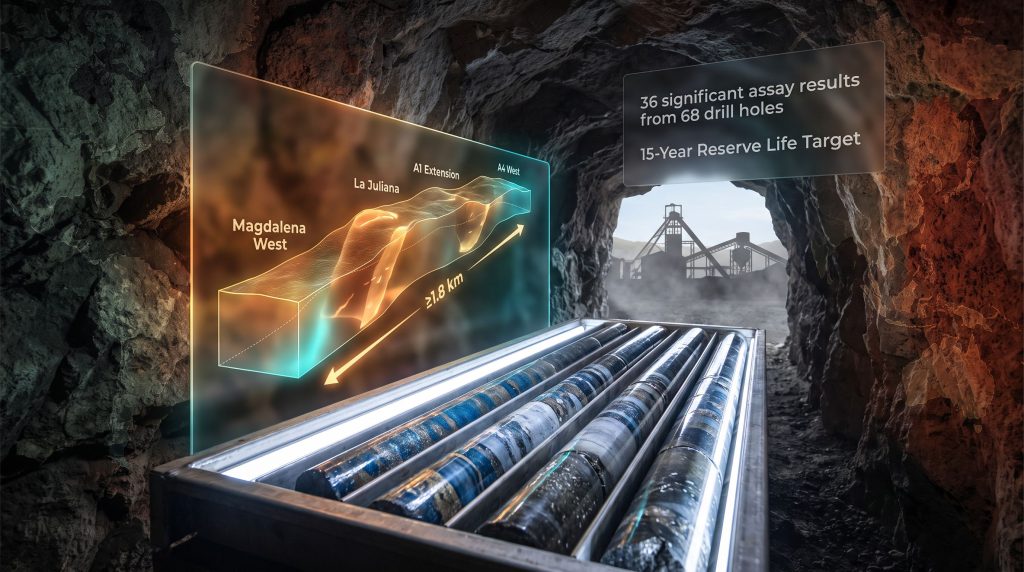
| Significant assay results (five-year program, first nine months) | 36 from 68 drill holes |
| Mineralisation status | Open down plunge |
| Priority ranking within MATSA | Highest-rated prospect |
| Planned follow-up timing | H1 FY27 |
The five-year drilling program context is equally instructive. Within just the first nine months of that program, 36 of 68 drill holes returned significant assay results. A hit rate of approximately 53% across a systematic program of this scale is a strong indicator of geological confidence and targeting quality.
La Juliana: A High-Priority New Discovery East of Aguas Teñidas
While Magdalena West represents the maturation of an established exploration target, La Juliana introduces an entirely different dynamic. Located east of the Aguas Teñidas mine within the MATSA hub, La Juliana was tested through only four dedicated drill holes but returned an outcome that materially elevates its exploration significance: the intersection of high-grade polymetallic massive sulphide mineralisation combined with the identification of an off-hole DHEM conductor plate.
Technical Note: An off-hole electromagnetic conductor plate identified during downhole geophysical surveying indicates the presence of a conductive body — potentially a mineralised sulphide lens — that was not physically intersected by the drill hole. In VMS exploration, this is regarded as a high-priority follow-up signal because it suggests the drill hole passed close to but not through the mineralised zone. The geometry of the conductor plate informs the direction and inclination of the follow-up drill hole required to intersect it.
The combination of actual mineralisation intersection and a proximal off-hole conductor at a newly identified prospect is a particularly compelling early-stage outcome. It suggests La Juliana may host more than a single mineralised lens, a characteristic entirely consistent with the multi-lens stacking geometry that defines many of the Iberian Pyrite Belt's most productive deposits. Furthermore, interpreting drill results at this stage suggests follow-up work involving CCM-90 DHEM surveys and extension drilling targeting strike, down-dip, and down-plunge continuity is planned for H1 FY27, with the explicit objective of determining the system's scale and its potential contribution to future Mineral Resource growth at MATSA.
Motheo Drilling Results: A1 Extension and A4 West
A1 Extension: Defining a Multi-Kilometre Copper-Silver System
At Motheo in Botswana, the exploration results tell a story of a mineralised system that is significantly larger than early drilling suggested. The A1 Extension prospect has now been shown to host copper-silver mineralisation extending across at least 1.8 kilometres of strike length, and critically, the system remains open to the northeast and down-dip. In sediment-hosted copper belt geology, strike-continuous mineralisation of this scale within haulage distance of an operating processing hub represents exactly the type of discovery that exploration teams are designed to find.
The operational logic is straightforward. If A1 Extension can be converted to a Mineral Resource and ultimately to an Ore Reserve, the ore feed it delivers to Motheo's processing hub does not require a new mill, new tailings facility, or new power supply. The infrastructure already exists. The capital question becomes one of mining method and materials handling — costs that are orders of magnitude lower than the capital required to establish a standalone operation.
A4 West: Building a Dual-Vector Growth Strategy Within the Motheo Footprint
A4 West has been identified as a significant exploration success within haulage distance of the Motheo hub, complementing A1 Extension to create what amounts to a dual-vector growth strategy for the Motheo production platform. Rather than depending on a single exploration target to extend mine life, the combination of A1 and A4 West provides redundancy in the near-mine growth pipeline, reducing the risk that a single drilling program disappoints and leaves the hub without a clear reserve extension pathway.
Both prospects have been designated as primary targets for Sandfire's FY27 drilling program at Motheo.
| Prospect | Belt | Mineralisation Style | Strike Extent | Status | FY27 Priority |
|---|---|---|---|---|---|
| A1 Extension | Kalahari Copper Belt | Copper-silver, sediment-hosted | 1.8 km minimum (open NE and down-dip) | Drilling complete, follow-up planned | Primary |
| A4 West | Kalahari Copper Belt | Copper-silver, sediment-hosted | Within haulage distance of Motheo | Significant result confirmed | Primary |
| Magdalena West | Iberian Pyrite Belt | VMS polymetallic | Open down plunge | 46 holes completed, extensions open | Highest-rated MATSA prospect |
| La Juliana | Iberian Pyrite Belt | High-grade polymetallic massive sulphide | Newly identified, DHEM conductor confirmed | 4 holes drilled, follow-up H1 FY27 | Significant new target |
Reserve Life Extension: The 15-Year Target and Why It Defines Investment Returns
What 15 Years of Reserve Life Actually Means for a Processing Hub
Sandfire has articulated a clear strategic objective: identifying enough mineralisation to support 15 years of reserve life at both MATSA and Motheo. This threshold is not arbitrary. Mine planners, project financiers, and infrastructure engineers consistently use a 15-year mine life horizon as the minimum justification period for major capital investment decisions. Below that threshold, the economics of sustaining capital expenditure, workforce development, and community relationships become increasingly difficult to defend.
The mathematical relationship between this target and current exploration activity is worth understanding. Annual ore throughput rates at each hub, combined with the current reserve base, define the gap that near-mine exploration must fill. Each discovery at Magdalena, La Juliana, A1, and A4 West contributes incrementally toward closing that gap, and the compounding effect of systematic near-mine success across multiple prospects simultaneously accelerates the trajectory toward the 15-year objective.
The Infrastructure Leverage Advantage in Quantitative Terms
The capital cost differential between a near-mine discovery and a comparable standalone greenfield development is one of the most underappreciated value drivers in the mid-tier copper producer universe. A deposit that can be mined and trucked to an existing processing hub requires capital for mine development and materials handling equipment. However, a deposit of equivalent size and grade that requires a new processing facility, power generation, water management system, and tailings storage facility requires capital that is typically several multiples higher per tonne of contained copper.
Consequently, understanding copper market trends is essential context for appreciating why near-mine exploration success translates so directly into shareholder value for producers like Sandfire. The tightening supply environment amplifies the premium placed on discoveries that can be brought into production quickly and cheaply via existing infrastructure.
Strategic Framing: For a mid-tier copper producer operating two processing hubs across two continents, the highest-return exploration dollar is the one spent within haulage distance of an existing mill. Sandfire Resources near-mine exploration success at MATSA and Motheo does not merely extend mine life — it leverages billions of dollars of already-deployed infrastructure capital, converting geological prospectivity into incremental production without the execution risk, financing burden, or permitting timeline of a greenfield development.
The next major ASX story will hit our subscribers first
Kalkaroo: Applying the Same Framework to Australia's Next Potential Hub
Sandfire's Kalkaroo copper-gold project in South Australia represents the application of the same hub-integrated exploration philosophy to a project that the company's management has described as among the best undeveloped projects of its type in Australia. While Kalkaroo is at a different stage of development maturity than MATSA or Motheo, the underlying strategic logic is consistent: establish a processing hub, then systematically explore the surrounding geological environment to identify the near-mine resource additions that extend operating life and maximise the return on infrastructure investment.
A definitive feasibility study will ultimately be required to advance Kalkaroo toward a construction decision, and the proven methodology being deployed across the Iberian Pyrite Belt and Kalahari Copper Belt — from hub-integrated geological teams to systematic DHEM geophysics — is being applied at Kalkaroo as part of the same disciplined, long-game exploration philosophy. In addition, Sandfire's broader exploration strategy outlines how the company intends to increase reserves across all operating regions, reinforcing the coherence of the approach being applied at Kalkaroo.
Frequently Asked Questions: Sandfire's Near-Mine Exploration at MATSA and Motheo
What is near-mine exploration and why does it matter for Sandfire Resources?
Near-mine exploration refers to drilling programs conducted within or immediately adjacent to an existing mining operation's footprint — close enough to utilise existing processing infrastructure if new mineralisation is discovered. For Sandfire, this strategy is central to extending the operating lives of MATSA and Motheo without the capital burden of building new processing facilities from scratch.
What makes the La Juliana discovery significant at this early stage?
La Juliana represents a newly identified polymetallic massive sulphide prospect located east of the Aguas Teñidas mine within MATSA. The combination of high-grade mineralisation intersected in just four drill holes, alongside a confirmed off-hole DHEM conductor plate, suggests the system may be larger than initial drilling has defined. In VMS belt exploration, this early-stage signal pattern is considered high-priority because it indicates the drill program passed near, but not through, a separate mineralised body requiring follow-up.
How much of the A1 Extension prospect at Motheo has been defined?
Drilling at A1 has confirmed copper-silver mineralisation across at least 1.8 kilometres of strike, but the system remains open to the northeast and down-dip, meaning the total extent of the mineralised body has not yet been determined by drilling.
What is CCM-90 downhole electromagnetic geophysics and why is it used?
The CCM-90 is a downhole electromagnetic instrument deployed within completed drill holes. It transmits electromagnetic pulses and measures the response of conductive bodies — such as sulphide mineralisation — in the surrounding rock volume. This technology allows geophysicists to identify mineralised lenses that the physical drill hole did not intersect, significantly extending the information value of each drill hole and guiding follow-up drilling toward the most likely target positions.
When is follow-up drilling at La Juliana and the Motheo prospects expected?
Follow-up work at La Juliana, incorporating CCM-90 DHEM surveys and extension drilling, is planned for H1 FY27. The A1 Extension and A4 West prospects at Motheo have both been confirmed as primary drilling targets within the FY27 program. Sandfire Resources near-mine exploration success at MATSA and Motheo, consequently, positions the company well for a sustained period of reserve growth across both operating hubs.
This article is for informational purposes only and does not constitute financial or investment advice. Forward-looking statements regarding exploration outcomes, resource growth, and mine life extension involve inherent uncertainty. Readers should conduct their own research and consult a licensed financial adviser before making any investment decisions.
Want to Capitalise on the Next Major Copper Discovery Before the Broader Market?
Discovery Alert's proprietary Discovery IQ model instantly identifies significant ASX mineral discoveries — including copper exploration breakthroughs — delivering real-time, actionable alerts to subscribers ahead of the crowd. Explore historic examples of major mineral discoveries and their market returns, then begin your 14-day free trial at Discovery Alert to position yourself at the forefront of the next significant find.