June 23, 2026
Why Underground Mining Has Always Left Productivity on the Table
The physics of underground mining have always imposed constraints that surface operations simply do not face. Narrow drives, unpredictable ground conditions, limited visibility, and the constant need to remove personnel from active zones during blasting create a productivity rhythm defined by interruption rather than continuity. Every shift change represents a gap. Every blast clearance represents idle equipment. Every hazard detection failure represents compounding downtime across a production cycle.
For mines extracting high-value metals such as copper and gold, those gaps carry direct revenue consequences. An underground loader sitting idle for 45 minutes during a shift transition in a producing gold operation is not merely an operational inconvenience; it is measurable lost revenue at prevailing commodity prices. Multiply that loss across hundreds of shifts per year and the financial case for rethinking the fundamental operating model becomes straightforward.
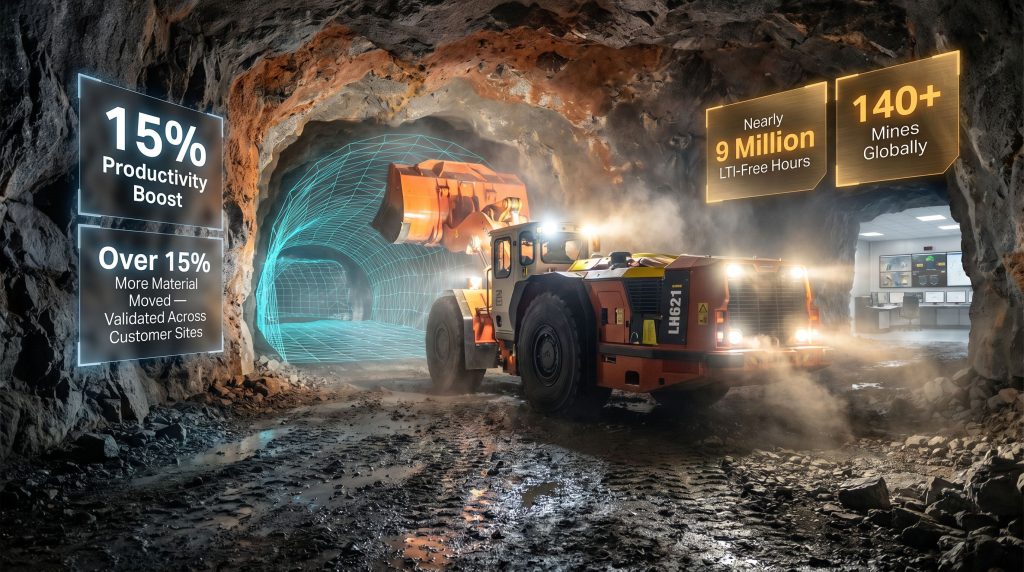
This is the context in which the Sandvik AutoMine Aura productivity boost of more than 15% in material movement needs to be understood. The figure is not the result of incremental software refinement. It reflects a structural change in how underground equipment operates, perceives its environment, and maintains productive uptime through conditions that previously forced machines to stop.
When big ASX news breaks, our subscribers know first
From Two Decades of Iteration to a Ground-Up Platform Rebuild
The Limits of Version-Based Improvement
Sandvik has invested more than 20 years developing and deploying the AutoMine platform across underground mining operations globally. That long development history produced genuine advances in autonomous navigation and remote supervision, but it also created an architecture that, by the mid-2020s, had reached the ceiling of what iterative improvement could deliver.
The broader mining automation trends had moved on considerably. Sensor fusion capabilities, real-time 3D environmental mapping, and adaptive intelligence systems had matured to the point where a version-based upgrade path could no longer capture the productivity and safety gains that a rebuilt platform could achieve.
Sandvik's response was to rebuild rather than revise. David Hallett, Vice President of Automation at Sandvik, has described AutoMine Aura as an entirely new platform rather than a successor version, with its 3D perception navigation system representing a first-of-its-kind capability in the underground mining industry.
What a Platform Rebuild Actually Means in Practice
The distinction between a software update and a platform rebuild matters enormously in operational terms. An update modifies behaviour within an existing architectural framework. A rebuilt platform redefines the framework itself, enabling capabilities that were structurally impossible in the previous system.
For AutoMine Aura, that architectural shift is most visible in three areas:
- The transition from legacy navigation approaches to full 3D perception with real-time environmental mapping
- The redesign of the operator interface to support multi-machine supervision from above-ground locations
- The integration architecture that allows deployment without infrastructure upgrades or production pauses
Each of these changes individually would represent a meaningful improvement. Together, however, they constitute a fundamentally different operational model.
How AutoMine Aura's 3D Perception System Works
Full Situational Awareness in Zero-Visibility Conditions
Underground mining environments are among the most perceptually challenging spaces that autonomous systems can operate in. Dust, darkness, irregular surfaces, narrow clearances, and constantly changing ground conditions create a navigation problem that 2D sensor arrays and traditional proximity-based systems struggle to solve reliably.
AutoMine Aura's 3D perception system addresses this through real-time environmental mapping that generates a continuously updated three-dimensional model of the machine's immediate surroundings. The practical result is full situational awareness with no blind spots, even in the harshest underground conditions.
This matters operationally because the majority of unplanned equipment downtime in underground loader operations is caused by hazard detection failures. When a machine cannot reliably perceive an obstacle, a ground irregularity, or a clearance constraint, the default response is to stop. In a conventional system, those stops accumulate. Furthermore, in a 3D perception-equipped system, the machine identifies, classifies, and navigates around hazards rather than halting in response to uncertainty.
Adaptive Intelligence and Dynamic Route Management
Beyond static hazard avoidance, AutoMine Aura incorporates an adaptive intelligence layer that adjusts machine routing and operational behaviour in response to changing underground conditions. Underground environments are not static. Rock fall events, equipment movements, and blast preparation activities all alter the navigable space within a drive in real time.
A system that relies on pre-mapped routes without the ability to dynamically recalculate will accumulate stoppages whenever conditions deviate from the mapped baseline. Consequently, adaptive intelligence reduces this vulnerability by treating the underground environment as a continuously evolving space rather than a fixed reference framework. This approach aligns closely with the broader shift toward data-driven mining that is reshaping how operations are managed and optimised.
Breaking Down the 15% Productivity Improvement
Where the Gain Actually Comes From
The Sandvik AutoMine Aura productivity boost of more than 15% in material movement, validated across customer sites during live underground loader production cycles, is driven by two distinct but reinforcing mechanisms.
The first mechanism is direct: the 3D perception system reduces the frequency of equipment stalls caused by hazard detection failures. Fewer stalls mean more continuous operating time per shift, which translates directly into more material moved.
The second mechanism is structural: autonomous operation allows machines to continue working through human-exclusion periods. Shift changes, blast clearances, and other events that require personnel to be removed from underground environments do not require the equipment to stop. Machines continue operating under remote supervision from above-ground stations, converting previously idle time into productive uptime.
The compounding effect of these two mechanisms is what produces a validated 15% floor rather than an isolated improvement under specific conditions. Every shift, both mechanisms are active simultaneously.
Contextualising the Productivity Data
Understanding what the published productivity figures actually represent is important for operators evaluating the technology.
| Productivity Claim | Source | Context |
|---|---|---|
| Over 15% more material moved | Sandvik validated launch data | Cross-site measurement during live underground loader production cycles |
| Up to 70% productivity increase | Single customer testimonial | Site-specific result reflecting high baseline inefficiency; not a cross-site benchmark |
| Comparable autonomous haulage gains | IMARC Group research on Rio Tinto Pilbara | Measured across approximately 400 autonomous trucks in open-cut iron ore haulage |
The 15% figure represents a conservative, cross-site validated baseline. The 70% testimonial figure reflects conditions at a specific operation where baseline inefficiency was unusually high, making the relative improvement proportionally larger. Neither figure should be applied universally without accounting for site-specific variables including ore body geometry, drive configuration, existing equipment age, and baseline downtime rates.
For context, Rio Tinto's deployment of autonomous haulage systems across approximately 400 trucks at its Pilbara iron ore operations produced broadly comparable productivity improvements, according to IMARC Group research. This consistency across different commodities, geographies, and equipment types strengthens the credibility of the 15% benchmark as a representative outcome for well-structured autonomous deployments.
The Revenue Mathematics for High-Value Metal Operations
For underground copper and gold producers, the revenue implications of a 15% productivity improvement compound significantly over a full production cycle. Consider an operation moving 500 tonnes per operating hour across two 10-hour productive shifts per day. A 15% improvement adds approximately 150 additional tonnes per day.
At gold prices above US$3,000 per ounce and copper prices above US$4.50 per pound, the revenue value of consistently recovered additional tonnes accumulates rapidly across a 250-day production year. Advances in underground copper mining technology are making it increasingly possible to extract maximum value from every tonne moved.
Safety Performance as a Productivity Multiplier
Nearly Nine Million Hours Without a Lost Time Injury
The AutoMine platform has accumulated nearly nine million operational hours without a lost time injury across its two-decade deployment history. This record is significant not only as a safety achievement but as a technical validation. It demonstrates that autonomous navigation systems operating in live underground production environments can maintain reliable, consistent performance at scale across extended timeframes.
For regulatory purposes, this operational history provides a credible evidence base for autonomous system approvals in jurisdictions with stringent underground safety compliance requirements. The Aura platform inherits and extends this foundation.
The Three Primary Occupational Health Benefits
Remote supervision fundamentally alters the occupational health profile of underground mining operations by removing personnel from the three primary chronic exposure risks inherent in conventional underground work:
- Dust exposure, including respirable silica and other fine particulates generated by drilling, blasting, and material movement
- Noise exposure from heavy equipment operation in confined underground drives
- Vibration exposure from operating heavy loaders and haul trucks over irregular underground surfaces
All three carry documented long-term occupational disease risks that conventional underground mining operations have historically struggled to manage within acceptable exposure limits. Remote operation from above-ground supervisory stations eliminates these exposure pathways entirely for operators.
How Remote Operation Reduces Human-Exclusion Frequency
There is a less obvious safety-productivity interaction embedded in the AutoMine Aura operating model. Conventional underground operations require periodic human-exclusion events not only for blasting but for equipment inspections, hazard assessments, and incident responses. Each exclusion event represents lost productive time.
When personnel are already operating remotely, the frequency and duration of formal human-exclusion events required for safety compliance decreases. Fewer exclusion events therefore mean fewer production interruptions, creating an additional productivity benefit that is not fully captured in the primary 15% material movement figure.
The Deployment Architecture That Removes Adoption Barriers
No Infrastructure Upgrades Required
One of the most commercially significant aspects of AutoMine Aura's design is its integration architecture. The platform is engineered to work with existing mine networks and access control systems without requiring infrastructure upgrades prior to deployment.
This matters because infrastructure upgrade requirements have historically been a major barrier to autonomous system adoption in operating mines. The capital cost, planning complexity, and production disruption involved in upgrading underground communications networks before deploying new technology creates a friction point that delays or prevents adoption decisions. By removing this requirement, Sandvik has reduced the time-to-value pathway for AutoMine Aura considerably.
Zero-Production-Pause Deployment
Complementing the infrastructure compatibility design, AutoMine Aura supports deployment without pausing active production cycles. Mining operations can commission, test, and optimise the system while continuing to produce, rather than accepting a production holiday as the price of technology adoption.
For operations under production targets or commodity price pressure, this deployment model significantly lowers the cost of the adoption decision. In addition, the improved ore sorting benefits that accompany better material movement efficiency further strengthen the financial case for adoption.
The next major ASX story will hit our subscribers first
Workforce Evolution in the Autonomous Mining Era
Reframing the Automation Narrative
The workforce implications of autonomous underground mining technology are frequently framed as a displacement narrative. The operational reality, however, is more nuanced. AutoMine Aura enables a single operator to supervise multiple autonomous machines simultaneously from an above-ground station. This changes the nature of the role rather than eliminating it.
The skill profile required shifts from physical underground equipment operation toward technology management, remote systems supervision, and real-time decision support. These are roles with better occupational health profiles, more sustainable long-term employment conditions, and greater scope for skills development. This shift mirrors what is being observed across AI in mining operations more broadly, where human roles are evolving rather than disappearing.
The Long-Term Human Capital Argument
Underground mining operations globally are facing intensifying labour market pressure. Deeper ore bodies, more demanding safety compliance environments, and growing competition for skilled workers from other sectors are all making it harder to staff conventional underground operations at required levels.
Autonomous systems that enable remote supervision reduce the headcount required for direct underground operation whilst creating technology-focused roles that are more attractive to a broader labour market pool. This workforce evolution dimension is a structural long-term driver for autonomous underground mining adoption that operates independently of short-term productivity calculations.
Evaluating Whether AutoMine Aura Is the Right Fit
Operational Profiles That Maximise the Sandvik AutoMine Aura Productivity Boost
Not all underground operations will capture the same productivity improvement. The conditions under which the 15% validated gain is most likely to be matched or exceeded include:
- Operations with above-average baseline downtime from hazard-related navigation stalls
- High-value metal mines where the revenue weight of additional tonnes per shift is greatest
- Sites with established network infrastructure capable of supporting Aura's integration requirements without significant modification
- Operations with high shift change frequency or extended blast clearance durations that currently idle equipment
Key Questions for Deployment Planning
Operators evaluating AutoMine Aura adoption should work through several structured assessment questions before committing to deployment:
- What is the current baseline downtime rate for underground loaders, and what proportion is attributable to hazard detection failures versus other causes?
- What is the estimated revenue value of a 15% improvement in material throughput at current commodity prices and ore grades?
- Does existing underground network infrastructure meet the integration requirements for Aura deployment, and if not, what is the cost and timeline of bringing it to that standard?
- What is the workforce transition plan for moving existing underground operators into remote supervision roles?
- How does the commissioning timeline align with current production cycle targets?
Frequently Asked Questions: Sandvik AutoMine Aura Productivity
What productivity improvement does AutoMine Aura deliver?
Sandvik has validated a material movement improvement of more than 15% compared to previous AutoMine versions, measured during live production cycles at customer sites using underground loaders. This figure represents a cross-site validated baseline rather than a single-site result.
How does 3D perception improve underground mining productivity?
The 3D perception navigation system generates a continuous real-time three-dimensional map of the machine's operating environment, enabling full situational awareness with no blind spots. This reduces the frequency of equipment stalls caused by hazard detection failures, which are among the primary drivers of unplanned downtime in conventional underground loader operations.
Can AutoMine Aura be deployed without stopping production?
Yes. The platform integrates with existing mine networks and access control infrastructure, removing the requirement for pre-deployment upgrades and supporting adoption without pausing active production cycles.
Is the 70% productivity figure a realistic general expectation?
The 70% figure originates from a single customer testimonial reflecting site-specific conditions, likely including a high baseline inefficiency rate. Sandvik's cross-site validated claim is a productivity improvement of more than 15%, which is the appropriate benchmark for general planning purposes.
What equipment does AutoMine Aura currently support?
AutoMine Aura is currently available on underground loaders, with Sandvik confirming a planned rollout to additional product lines as the platform scales.
How does autonomous operation improve mine safety?
Remote supervision removes operators from underground environments, eliminating direct exposure to dust, noise, vibration, and proximity hazards associated with active underground equipment operation. The AutoMine platform has accumulated nearly nine million operational hours without a lost time injury across its deployment history.
Key Takeaways
- More than 15% validated productivity gain in material movement, driven by 3D perception navigation and continuous autonomous operation through human-exclusion periods
- Zero blind spot situational awareness represents a first-of-its-kind navigation capability for underground autonomous loaders, directly reducing equipment stall frequency
- No infrastructure upgrade required for deployment, enabling adoption without production interruption and reducing time-to-value
- Nearly nine million LTI-free operational hours across the AutoMine platform establishes a credible safety foundation for the Aura generation
- More than 140 global mine deployments provide the scale and data foundation for ongoing adaptive intelligence refinement
- Expansion beyond underground loaders signals a broadening productivity impact across the full underground mining equipment ecosystem
- Workforce transition, not displacement, is the operational reality: remote supervision roles carry better occupational health profiles and broader skills development pathways than conventional underground operation
This article contains references to productivity improvement claims published by Sandvik and third-party research organisations. Productivity outcomes at specific sites will vary based on ore body geometry, existing infrastructure, baseline downtime rates, and operational configuration. The figures cited should not be treated as guaranteed outcomes for any individual operation. Readers should conduct independent due diligence before making technology adoption or investment decisions.
Want to Know Which ASX Mining Companies Are Adopting Game-Changing Technologies?
As automation reshapes underground mining productivity, the companies embracing these advances could represent significant investment opportunities — and Discovery Alert's proprietary Discovery IQ model scans ASX announcements in real time, delivering instant alerts on significant mineral discoveries so subscribers can act before the broader market. Explore why major discoveries have historically generated extraordinary returns on Discovery Alert's dedicated discoveries page, and begin a 14-day free trial today to secure a market-leading edge.