June 24, 2026
Underground Mining's Quiet Revolution: Why Battery Chemistry Is Finally Ready for the Face
For decades, the economics of underground hard-rock mining rested on a straightforward trade-off: diesel powered everything because it worked, even as ventilation costs ballooned, heat loads climbed, and diesel particulate matter regulations tightened around the world. Battery-electric equipment was theoretically appealing long before it was practically viable. The gap between theory and operational reality was not a matter of engineering ambition but of energy density. Lithium iron phosphate chemistry, as it has matured through the 2020s, has begun closing that gap with measurable consequences for how OEMs design their product roadmaps and how mine operators sequence fleet replacement decisions.
The Sandvik DD423iE battery drill is one of the clearest expressions of that shift reaching commercial maturity. It is worth understanding not simply as a product launch, but as a signal about where the technology threshold now sits and what that means for underground development drilling as a discipline.
When big ASX news breaks, our subscribers know first
What Is a Twin-Boom Development Drill and Why Does Electrification Matter Here?
Underground development drilling is distinct from production drilling. Development drills advance the access drives, cross-cuts, and tunnel profiles that create the physical infrastructure of a mine. They work in confined headings, often in demanding rock conditions, and their productivity directly governs how quickly a mine can expand its operational footprint underground.
Twin-boom development drills run two drilling arms simultaneously, allowing a single machine to cover a wider tunnel profile in a single setup. The DD423iE targets tunnel cross-sections ranging from 4×4 metres to 5×5 metres, which covers the majority of hard-rock underground development applications globally.
Electrifying this machine class has historically been more challenging than electrifying loaders or haulage equipment because:
- Development drills operate continuously across long shifts with minimal idle time, creating sustained energy demand.
- They need to tram between headings, often across significant underground distances, demanding range as well as power density.
- The confined spaces in which they operate make thermal management of battery systems a genuine engineering constraint rather than a secondary consideration.
LFP chemistry addresses these constraints more effectively than earlier lithium-ion formulations. Its thermal stability profile makes it better suited to confined underground environments where heat dissipation is limited and the consequences of thermal events are severe. However, understanding the broader lithium-ion battery risks in underground environments remains important context for any fleet electrification decision.
Core Technical Specifications of the Sandvik DD423iE Battery Drill
Battery Architecture and the Case for LFP Chemistry
The DD423iE uses a three-unit lithium iron phosphate battery configuration, representing a 50% increase in total battery capacity compared to predecessor battery-electric configurations. LFP was not selected arbitrarily. Its lower energy density relative to NMC chemistry is offset by substantially superior cycle life, better performance under high-discharge conditions, and a significantly reduced thermal runaway risk — all of which matter considerably in underground mining environments where safety incidents carry amplified consequences.
Instant torque delivery is an additional benefit often underappreciated in discussions of battery-electric mining equipment. Unlike diesel drivetrains, which require engine speed to build before maximum torque is available, electric motors deliver peak torque from standstill. In a drilling context, this translates to more consistent penetration rates, reduced shock loading on drill steels, and more predictable machine behaviour during the start of each drilling cycle.
Performance Metrics at a Glance
The DD423iE's performance improvements against its predecessor generation are substantial across every measurable parameter:
| Performance Metric | Improvement vs. Previous Generation |
|---|---|
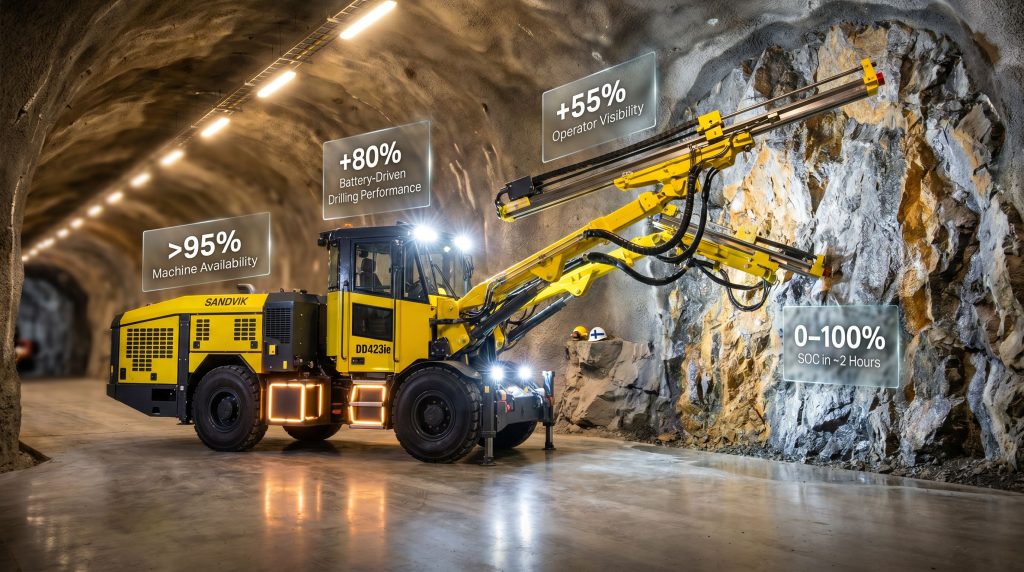
| Battery-driven drilling performance | +80% |
| Tramming speed | +30% |
| Battery capacity and tramming range | +50% |
| Charging power while drilling | >3x increase |
| Full charge cycle (0-100% SOC) | ~2 hours |
| Machine availability | >95% |
| Operator visibility | +55% |
| Drilling coverage vs. comparable class | +34.5% |
| Cross-cut performance | +48% |
The 80% improvement in drilling performance under battery power is perhaps the headline figure, but the 55% gain in operator field of view deserves equal attention. In confined underground headings, where proximity to personnel is a constant hazard, improved sightlines directly reduce the probability of collision incidents.
Boom System and Mechanical Configuration
The SB75i boom system incorporated into the DD423iE features integrated double roll-over capability, which allows the boom to reposition without the machine tramming to a new location. This geometric flexibility is responsible for the 34.5% drilling coverage advantage over comparable machines in the same class and the 48% improvement in cross-cut performance — the latter being particularly significant because cross-cut development is typically one of the more time-intensive elements of underground mine expansion.
Sandvik maintained structural continuity with the diesel DD423i platform in the transition to battery-electric power. This is a deliberate design decision with practical operational implications: operators familiar with the diesel variant require minimal retraining, and maintenance personnel can apply existing competencies to servicing the electric machine's mechanical systems.
How the DD423iE's Charging System Reframes Underground Energy Management
Opportunity Charging During Active Drilling
The most operationally transformative feature of the DD423iE's energy architecture is its capacity to restore charge during active drilling cycles. The machine delivers more than three times the charging power during drilling compared to previous battery-electric development drill generations. This means the battery is not simply depleting through a shift and then requiring a long recovery period. Instead, it is actively recovering energy during every drilling round.
This changes the fundamental operational calculus for battery-electric drills in multi-heading environments. Rather than scheduling machine downtime around charging requirements, operators can structure workflows so that tramming and setup time between headings coincides with incremental charge recovery. Furthermore, this capability aligns well with broader mining electrification trends pushing towards more efficient and integrated energy management underground.
Full Cycle Charge Time: Two Hours
When a full 0–100% state of charge cycle is required, the DD423iE achieves it in approximately two hours under standard charging conditions.
A full underground drilling round, including setup, drilling, and cleanup, typically runs longer than two hours. This means the DD423iE can be brought from fully depleted to fully charged within the duration of a single complete drilling cycle, effectively eliminating battery state of charge as a constraint on shift scheduling.
In practice, a two-heading operation allows the following workflow without any unproductive downtime:
- Complete a full drilling round in Heading A.
- Tram to Heading B while Heading A resets for blasting.
- Complete the drilling round in Heading B.
- Return to Heading A fully recharged through a combination of opportunity charging and fixed charging during the inter-heading period.
This workflow architecture was not reliably achievable with previous generations of battery-electric development drills, whose charge times and lower charge-while-drilling capacity created scheduling constraints that eroded productivity gains.
Safety Enhancements and Operator Environment Improvements
Battery Management and Underground Thermal Safety
LFP chemistry's reduced thermal runaway risk is the foundation of the DD423iE's underground safety profile, but the machine's battery management system adds a further layer of protection. The BMS monitors cell-level temperature, voltage, and state of charge continuously, applying protective interventions before conditions that could compromise safety develop. This architecture is consistent with underground mining safety standards for battery-electric mobile equipment, which have become progressively more stringent as battery-electric machinery has proliferated across deep hard-rock operations.
Visibility and Ergonomics as a Safety Investment
The 55% improvement in operator field of view is achieved through a redesigned cab and boom architecture that reduces visual obstructions in the tunnel profile. This is not a cosmetic enhancement. In underground headings where ground support personnel may be working in proximity to the drill, improved operator sightlines function as a primary risk control, reducing reliance on proximity detection and collision avoidance systems as compensating measures.
Machine Availability as a Reliability Benchmark
A stated machine availability of greater than 95% positions the DD423iE at the upper end of what is achievable in underground hard-rock development. Availability in this context accounts for planned maintenance downtime but excludes unplanned breakdowns. Sustaining greater than 95% availability in demanding underground conditions requires a maintenance architecture that supports rapid access to service points and predictable consumable replacement intervals.
Real-World Validation: Kittilä Underground Mine
Why the Kittilä Validation Matters
Field validation at Agnico Eagle Finland's Kittilä underground mine in Finnish Lapland provides an important credibility layer to the DD423iE's performance claims. Kittilä is one of Europe's largest gold mines by reserve base, operating in subarctic conditions with challenging geology. The selection of this site for validation testing is significant for several reasons:
- Subarctic underground environments impose thermal stresses on battery systems that differ from temperate or tropical conditions, providing a more demanding test environment.
- Kittilä's operational intensity means validation data reflects real production conditions rather than controlled test scenarios.
- Agnico Eagle is a Tier 1 operator with sophisticated technical evaluation capabilities, lending independent credibility to the performance outcomes confirmed during trials.
The validation confirmed OEM-stated performance figures for drilling coverage, tramming speed, and charge cycle data, giving prospective fleet customers a basis for capital expenditure modelling that goes beyond manufacturer specifications.
The next major ASX story will hit our subscribers first
Battery-Electric vs. Diesel: A Direct Operational Comparison
The DD423iE competes directly against the diesel DD423i in fleet replacement decisions. The comparison across key operational dimensions reveals where the value proposition is strongest:
| Operational Factor | Diesel DD423i | Battery-Electric DD423iE |
|---|---|---|
| Emissions underground | Diesel exhaust present | Zero direct emissions |
| Ventilation requirement | High | Substantially reduced |
| Heat load underground | High | Substantially lower |
| Tramming speed | Baseline | +30% faster |
| Drilling coverage | Baseline | +34.5% above class |
| Refuelling and charging | Diesel refill required | Opportunity charge while drilling |
| Operator visibility | Baseline | +55% improvement |
| Battery capacity | N/A | 50% increase vs. prior BEV models |
Total Cost of Ownership Beyond the Sticker Price
The ventilation cost reduction associated with eliminating underground diesel combustion is frequently the decisive factor in total cost of ownership analysis for battery-electric mining equipment. Underground ventilation infrastructure is capital-intensive to install and energy-intensive to operate. Fresh air volumes required for diesel particulate matter dilution are determined by the combined diesel power of the fleet operating in each section.
Replacing a diesel development drill with a battery-electric equivalent can materially reduce the ventilation volume requirement for that heading, with flow-on reductions in fan energy consumption and potentially in the scale of ventilation infrastructure needed for mine expansion. In addition, renewable power for mining operations increasingly complements battery-electric fleets by reducing the carbon footprint of the electrical supply feeding surface and underground charging infrastructure.
Lifecycle cost analysis must also account for the elimination of diesel fuel costs, engine oil, filters, and the maintenance cycles associated with diesel powertrains — including fuel injection system servicing, exhaust aftertreatment, and periodic engine overhauls. These cost lines are removed entirely in a battery-electric machine, replaced by battery replacement at end-of-cycle-life as the primary lifecycle cost driver.
Strategic Implications for Underground Mine Fleet Electrification
The Sequencing Problem in Underground Electrification
Underground mine electrification programs face a sequencing challenge that surface operations do not. Every piece of diesel equipment replaced reduces ventilation demand, which in turn reduces the economic burden of operating remaining diesel equipment. This creates a positive feedback loop that accelerates the return on investment for each successive battery-electric machine added to the fleet.
Development drills are often a logical early target in electrification sequencing because they operate in the mine's development headings, where ventilation infrastructure for new sections is being designed and sized. Building new headings with battery-electric development drills from the outset allows ventilation systems to be designed for lower airflow volumes, embedding the cost savings into the capital structure of the new workings rather than retrofitting them later. Consequently, the shift towards electric mining transport and battery-electric machinery is increasingly viewed as a structural imperative rather than an optional upgrade.
Key Site Parameters for BEV Drill Suitability
Not all underground operations are equally suited to battery-electric development drills at their current state of technology. Site evaluation should consider:
- Power infrastructure: Fixed charging station installation requires reliable underground electrical supply at adequate capacity. Older operations with limited underground electrical infrastructure may face higher transition costs.
- Heading count and layout: Multi-heading operations benefit most from the opportunity-charging workflow. Single-heading operations with long continuous cycles may push battery systems harder.
- Depth and tramming distances: Greater depth increases tramming distances, which affects energy consumption per shift and should be modelled against the DD423iE's stated range improvements.
- Ambient underground temperature: Subarctic and high-altitude operations with cooler underground temperatures generally favour battery performance, while deep operations with elevated rock temperatures require careful thermal management assessment.
What the DD423iE Signals for the Broader Market
Sandvik's decision to extend the DD423i platform into a battery-electric configuration signals that twin-boom development drills have reached a level of battery-electric maturity sufficient for mainstream commercial deployment. The performance parity with diesel across every key metric, combined with operational advantages in speed, visibility, and emissions, removes the historic productivity penalty that constrained battery-electric drill adoption.
For competing OEMs, this raises the bar considerably. A machine that merely matches diesel performance is now arguably insufficient for differentiation. Furthermore, understanding the wider battery metals landscape is increasingly relevant for mine operators considering long-term fleet electrification strategies, given how supply chain dynamics for LFP and NMC chemistries affect equipment procurement timelines and costs.
Frequently Asked Questions About the Sandvik DD423iE
What tunnel profile sizes is the Sandvik DD423iE designed for?
The machine is optimised for tunnel cross-sections from 4×4 metres to 5×5 metres in underground hard-rock applications, covering the majority of development heading profiles used in global hard-rock mining.
How long does it take to fully charge the DD423iE battery system?
A complete charge from zero to 100% state of charge takes approximately two hours under standard fixed charging station conditions.
What type of batteries does the DD423iE use?
Three lithium iron phosphate (LFP) battery units are fitted, selected for thermal stability, extended cycle life, and compliance with underground mining safety requirements.
What is the DD423iE's machine availability rating?
Sandvik rates the machine at greater than 95% availability, targeting the upper threshold of what is achievable in high-intensity underground development operations.
How does eliminating diesel combustion reduce ventilation requirements?
Diesel engines require large volumes of fresh air to dilute exhaust gases — including nitrogen oxides, carbon monoxide, and diesel particulate matter — to safe working concentrations. Removing diesel combustion from the heading eliminates these dilution requirements, substantially reducing the mandated airflow volume and the energy cost of delivering it.
Where was the DD423iE validated before commercial launch?
Operational validation was completed at Agnico Eagle Finland's Kittilä underground mine, confirming OEM performance specifications under real production conditions in a subarctic hard-rock environment.
Five Reasons the DD423iE Represents a Genuine Step Change
Battery-electric mining equipment has been approaching commercial maturity for years. The Sandvik DD423iE battery drill represents the point at which that maturity is confirmed across multiple performance dimensions simultaneously. The five most significant contributions it makes to the underground drilling equipment landscape are:
- Charging while drilling: Opportunity charging at more than three times previous generation rates fundamentally changes shift planning for battery-electric development drills.
- Two-hour full charge cycle: Bringing full charge recovery within the duration of a single drilling round eliminates battery state of charge as a production constraint.
- 80% drilling performance improvement: Closing the historic performance gap with diesel equivalents makes battery-electric the technically competitive choice, not merely the environmentally compliant one.
- 55% operator visibility improvement: Combining productivity and safety gains in a single design change demonstrates that battery-electric platforms are not constrained to matching diesel configurations but can actively improve on them.
- Tier 1 field validation: Kittilä confirmation data gives mine operators an independently validated performance baseline for capital planning.
Disclaimer: Performance figures cited in this article are based on Sandvik's stated specifications and field validation data from the Kittilä mine trial. Actual performance outcomes in other operating environments will vary based on site-specific geological, thermal, and infrastructure conditions. This article does not constitute financial or investment advice.
For further industry coverage of underground drilling technology and equipment innovation, GeoDrilling International provides ongoing reporting across the global drilling sector.
Ready to Capitalise on the Mining Sector's Shift Towards Electrification?
As battery-electric technology transforms underground mining operations and drives demand for critical minerals like lithium, Discovery Alert's proprietary Discovery IQ model delivers real-time alerts on significant ASX mineral discoveries, turning complex data into actionable investment insights the moment they hit the market. Explore Discovery Alert's dedicated discoveries page to see how historic mineral discoveries have generated substantial returns, and begin your 14-day free trial today to position yourself ahead of the broader market.