July 28, 2026
The Hidden Bottleneck Holding Back the Autonomous Mining Revolution
For decades, the mining industry has pursued a deceptively simple goal: remove people from dangerous environments while simultaneously extracting more material at lower cost per tonne. Autonomous haulage trucks captured most of the headlines throughout the 2010s, but a quieter transformation has been unfolding at the drill bench. Surface drilling, often treated as a supporting act to blasting and haulage, is now emerging as one of the most technically complex and strategically significant frontiers in mine automation. The reason is not the machines themselves but the stubborn problem of making them work together.
Furthermore, Sandvik and Rio Tinto autonomous open-pit drilling collaboration, announced in mid-2026, sits at exactly this intersection of hardware capability and systems integration. Understanding why this partnership matters requires stepping back from the announcement itself and examining the structural forces that have made interoperability the defining challenge of the autonomous mining era. In many respects, broader mining automation trends have set the stage for precisely this kind of co-development model to emerge.
When big ASX news breaks, our subscribers know first
Why Open-Pit Drilling Is Harder to Automate Than It Looks
Surface drilling occupies a deceptively unglamorous position in the mine value chain. Blast holes must be positioned with millimetre-level accuracy across terrain that shifts with every blast, experiences variable rock hardness transitions within a single hole, and accumulates dust at rates that defeat conventional sensor systems. Unlike an autonomous haul truck following a fixed road network, an autonomous drill rig must navigate constantly changing working surfaces, verify ground stability before committing weight to a collar position, and adapt its penetration parameters in real time as lithology changes below the surface.
The spectrum from human-operated to fully autonomous drilling covers several distinct operational modes:
- Teleoperation: A human operator controls the rig remotely but remains in the control loop for every decision.
- Semi-autonomous operation: The machine executes defined sequences such as rod handling or tramming between positions independently, but a human monitors and approves key transitions.
- Full autonomy: The rig plans, positions, collars, drills, completes, and repositions without human input during normal operation, escalating only genuine anomalies to a remote controller.
Most commercially deployed systems today operate somewhere in the semi-autonomous range. True full autonomy at production scale is what Rio Tinto's Pilbara operations have been progressively building toward, and it is what the Sandvik partnership is designed to accelerate.
Sandvik's Autonomous Platform: Engineering Depth Behind the AutoMine Brand
The i-Series Hardware Foundation
Sandvik's i-series surface drill rig lineup was engineered from the outset with autonomous operation as a design requirement rather than an afterthought. This distinction matters more than it might initially appear. Rigs retrofitted with autonomous control systems frequently encounter physical constraints in sensor placement, cable routing, and actuator response characteristics that limit the reliability of autonomous functions under production conditions. Purpose-built autonomous capability, by contrast, allows sensor arrays, positioning hardware, and machine intelligence to be integrated into the structural design of the rig itself.
AutoMine Surface Fleet: Fleet-Scale Intelligence
The software layer that enables genuine fleet-scale autonomous operation is Sandvik's AutoMine Surface Fleet platform. Sandvik's autonomous surface fleet capabilities represent a considerable step forward in open-pit drilling technology. Its operational envelope is substantial:
| Capability | AutoMine Surface Fleet Specification |
|---|---|
| Simultaneous rig management | More than 15 i-series surface drill rigs |
| Control location flexibility | Any connected location, including remote operations centres |
| Automated drilling functions | Collaring, drilling execution, rod handling, tramming, hole finishing |
| Operational continuity | Continuous production through shift changes with minimal human intervention |
| Data integration | Real-time telemetry output feeding mine planning and geological modelling systems |
The platform's ability to manage more than 15 rigs from a single connected location is not merely a marketing specification. It represents a genuine architectural commitment to centralised fleet intelligence, where the system maintains situational awareness across an entire drill pattern simultaneously rather than managing rigs as isolated units.
Telemetry as a Value Multiplier
One aspect of autonomous drilling that receives insufficient attention in mainstream coverage is the downstream value of the data these systems generate. Every autonomous hole drilled by an i-series rig produces a continuous stream of penetration rate, rotational torque, pulldown pressure, and positioning data. When properly integrated with geological modelling software, this supports data-driven mining operations that can dramatically improve blast design accuracy.
This matters economically because over-drilled or mis-positioned holes waste explosive energy, generate excessive fines that reduce downstream processing efficiency, and create fragmentation profiles that slow crusher throughput. The telemetry from autonomous drilling systems, when fed into mine planning platforms in real time, creates a feedback loop that improves the entire mine-to-mill value chain, not just the drilling operation itself.
"Autonomous drilling should be understood as a data generation infrastructure as much as a production technology. The value compounds across every downstream process that depends on blast fragmentation quality."
Rio Tinto's Pilbara Deployment: What Production-Scale Autonomy Actually Looks Like
The Numbers Behind One of Mining's Largest Autonomous Drill Fleets
Rio Tinto's autonomous drilling program in the Pilbara region of Western Australia represents one of the most mature and extensively deployed examples of autonomous surface drilling anywhere in the global mining industry. Rio Tinto's commitment to automation has been a cornerstone of their operational strategy for many years. The operational scale is significant:
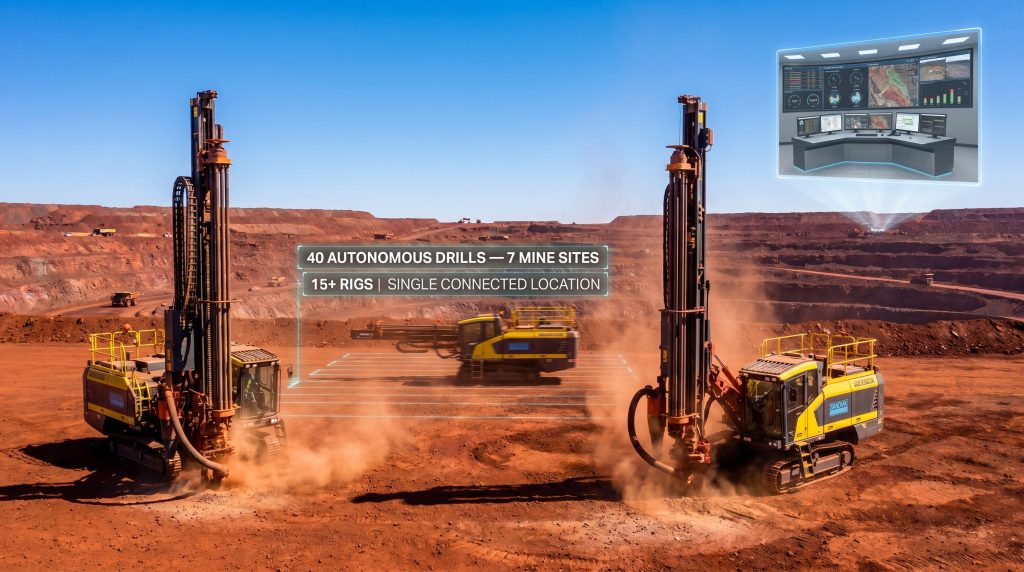
- 40 autonomous drills operating across production environments
- 7 mine sites in the Pilbara region currently running autonomous drill operations
- A single remote controller at Rio Tinto's Remote Operations Centre (ROC) in Perth can plan and manage up to 8 drills operating across multiple geographically separate mine sites simultaneously
These figures are not projections or pilot programme statistics. They represent the current operational baseline of a system that has been running at production scale for multiple years. This is a critical distinction when evaluating autonomous mining technology, where pilot deployments are common but sustained production-scale operation remains relatively rare.
The Remote Operations Centre Model: Centralising Expertise Across Distance
The Perth ROC is arguably Rio Tinto's most consequential infrastructure investment in workforce transformation. Rather than deploying skilled drilling specialists across seven geographically dispersed and remote mine sites, the ROC model concentrates expertise in a single urban location where controllers manage multiple autonomous systems simultaneously.
The workforce implications extend well beyond simple headcount reduction. Controllers operating from the ROC require a fundamentally different skill profile than traditional drill operators: systems monitoring capability, pattern recognition across multiple simultaneous data streams, and the judgement to distinguish genuine anomalies requiring intervention from normal operational variation that the autonomous system can handle independently.
This shift from manual operator to autonomous systems controller represents one of the more profound workforce transitions in surface mining's history, and Rio Tinto's Pilbara operations provide the most detailed real-world evidence of how that transition can be structured at scale.
Operational Benefits Documented Across the Pilbara Programme
Rio Tinto's autonomous drilling programme has demonstrated measurable improvements across several dimensions:
- Personnel safety: Workers are no longer required to be physically present in blast hole environments or high-dust drilling zones during production drilling
- Positional accuracy: Autonomous systems execute drill patterns with greater hole-positioning precision than manually operated rigs, reducing blast design deviation and improving fragmentation consistency
- Production continuity: Autonomous rigs continue operating through shift changes without the downtime associated with crew transitions, contributing to improved utilisation rates
- Subsurface data quality: Richer, more consistent telemetry data from autonomous drilling feeds into downstream blasting optimisation and processing plant feed planning
The Sandvik-Rio Tinto Partnership: Solving the Interoperability Problem
What the Collaboration Is Actually Designed to Achieve
The core technical objective of the Sandvik and Rio Tinto autonomous open-pit drilling collaboration is the integration of Sandvik's i-series surface drill rigs with Rio Tinto's proprietary Autonomous Drilling System (Rio Tinto ADS). This framing is important because it reveals the nature of the challenge: Rio Tinto has already developed its own autonomous control layer, and the question is not whether autonomous drilling is possible but whether it can work seamlessly across equipment from different manufacturers under a unified operational framework.
Most large mining operations run mixed-vendor fleets. Procurement decisions made over decades result in drill benches that may include equipment from Sandvik, Epiroc, Caterpillar, and other manufacturers operating side by side. If autonomous systems cannot communicate across these OEM boundaries, the practical ceiling for autonomous fleet management is constrained to whichever single vendor's equipment currently dominates a given site.
What True Interoperability Requires
Achieving genuine interoperability between OEM autonomous systems and operator-developed autonomous platforms is technically demanding across several layers:
- Communication protocol standardisation: Rig control systems from different manufacturers must exchange commands and status data in formats that a unified fleet management system can interpret without translation errors.
- Positioning and collision avoidance alignment: Different OEM systems may use incompatible spatial referencing frameworks, creating potential safety gaps when mixed fleets operate in close proximity.
- Telemetry format compatibility: Mine planning systems need to ingest drilling data from multiple rig types in consistent formats to generate useful geological and blast design outputs.
- Safety architecture consistency: Autonomous operating rules, emergency stop protocols, and geofencing logic must enforce consistent behaviour across all rig types in a mixed fleet.
"The absence of standardised interoperability frameworks is not a minor technical inconvenience. It is the primary structural barrier preventing mixed-vendor autonomous fleets from being managed as unified systems, and it has historically forced major miners to make suboptimal procurement decisions based on autonomy compatibility rather than machine performance."
Why Co-Development Is Replacing Traditional Procurement
The traditional model of mining equipment procurement treated autonomy as a software feature to be bolted onto hardware purchases after the fact. Miners bought capable machines from established OEMs, then either licensed the OEM's autonomy software stack or attempted to integrate third-party autonomous control systems with varying degrees of success.
The Sandvik-Rio Tinto collaboration reflects a more sophisticated understanding of how autonomous systems actually need to be developed. By embedding operational requirements directly into Sandvik's product development cycle, Rio Tinto ensures that the autonomous capabilities of future i-series rigs are shaped by real production experience from one of the world's largest autonomous drill fleets. Sandvik, in return, gains access to production-scale testing environments and operational data that no laboratory or pilot site can replicate.
Consequently, similar co-development frameworks are now emerging across autonomous haulage, underground navigation systems, and AI in drilling and blasting, suggesting this model is becoming the preferred structure for OEM-operator collaboration in mining technology development.
Competitive Context: The Autonomous Surface Drilling Landscape in 2026
Key Players and Their Positions
| Company | Role | Current Autonomous Drilling Capability |
|---|---|---|
| Sandvik | OEM and Technology Provider | AutoMine Surface Fleet managing 15+ rigs; purpose-built i-series autonomous hardware |
| Rio Tinto | Major Operator and Co-Developer | 40 autonomous drills across 7 Pilbara sites; Perth ROC remote management |
| Epiroc | OEM Competitor | Autonomous surface drilling solutions for open-pit environments |
| Caterpillar / MineStar | OEM and Fleet Management | Autonomous drill integration within the broader MineStar ecosystem |
| Komatsu | OEM and Autonomous Systems | Autonomous drilling and haulage solutions for large open-pit operations |
Cybersecurity: The Emerging Autonomous Mining Imperative
A dimension of autonomous mining systems that rarely receives adequate attention is cybersecurity. Connected autonomous systems that communicate across site networks and remote operations centres represent a significant attack surface. Sandvik Mining's recent receipt of dedicated cybersecurity accreditation for its autonomous systems signals that the industry is beginning to treat cybersecurity not as an afterthought but as a foundational requirement for autonomous system deployment. For miners considering large-scale autonomous fleet investments, the cybersecurity posture of OEM systems will increasingly become a procurement criterion alongside more familiar metrics like production rate and maintenance cost.
The next major ASX story will hit our subscribers first
Challenges That Will Determine the Pace of Autonomous Drilling Adoption
Technical Barriers That Remain Unsolved
Despite the maturity of Rio Tinto's Pilbara deployment, significant technical challenges continue to constrain broader autonomous drilling adoption:
- Ground condition variability remains the most difficult problem for autonomous collaring systems. Unexpected transitions between competent rock and weathered or fractured material within a single hole can cause collar instability that autonomous systems are not yet reliably equipped to anticipate and manage.
- Blast-induced ground disturbance creates surface irregularities that challenge autonomous tramming and positioning systems designed around stable terrain assumptions.
- Dust infiltration of sensor systems, particularly in high-silica iron ore environments, degrades positioning accuracy and sensor reliability over time in ways that require ongoing maintenance investment.
Workforce and Organisational Barriers
The human dimensions of autonomous drilling adoption are frequently underestimated. Experienced drill operators who have built careers around manual drilling expertise represent both a challenge and an asset in the transition to autonomous operations. Their deep understanding of how rigs behave under varying ground conditions is precisely the experiential knowledge that needs to be encoded into autonomous system design, but capturing that knowledge systematically requires structured programmes that most mining companies have not yet developed at scale.
Change management at the site level also presents genuine resistance. The professional identity of skilled equipment operators is not easily redirected toward remote monitoring roles, and the industry's workforce development infrastructure has not kept pace with the speed of autonomous technology deployment. Advances in AI-powered mining efficiency tools may, however, help bridge this skills transition gap over time.
Economic Barriers and ROI Complexity
The capital cost of autonomous-capable drill rigs, supporting digital infrastructure, and remote operations centre establishment is substantial. The economic case for autonomous drilling is strongest in high-volume, repetitive blast hole environments with well-mapped geology and existing digital connectivity, which is precisely why the Pilbara iron ore operations have been the proving ground of choice.
For mines with more complex geology, smaller production volumes, or limited digital infrastructure, the ROI timeline for full autonomous drilling implementation extends considerably, and the intermediate semi-autonomous configurations may represent the practical ceiling for years to come.
Scenario Analysis: What Autonomous Drilling Looks Like at Full Integration
A Fully Integrated Autonomous Drill Shift
In a mature autonomous drilling environment built on the Sandvik-Rio Tinto model, a shift might unfold as follows:
- A remote controller at a centralised operations centre loads an approved drill pattern into the fleet management system at the start of the shift.
- Multiple i-series rigs autonomously tram to their assigned collar positions, using onboard positioning and ground verification systems to confirm surface stability before committing to collar.
- Drilling proceeds autonomously across the entire pattern, with real-time telemetry flagging hardness transitions, positioning deviations, or rod handling anomalies to the controller.
- The controller monitors the entire fleet simultaneously, intervening only when the system escalates a genuine anomaly requiring human judgement.
- At shift completion, rigs autonomously move to designated safe parking zones, and completed hole data uploads automatically to mine planning systems for blast design refinement.
The Mixed-Fleet Interoperability Scenario
Without the interoperability framework being developed through the Sandvik and Rio Tinto autonomous open-pit drilling partnership, a mine site operating equipment from multiple OEMs faces a fragmented autonomous environment where:
- Different rig types cannot receive unified commands from a single fleet management layer
- Telemetry data arrives in incompatible formats that require manual translation before mine planning systems can use it
- Safety zone management must be administered separately for each OEM's equipment, creating coordination gaps when rigs from different manufacturers operate in adjacent areas
The partnership's work on integrating Sandvik's i-series with the Rio Tinto ADS addresses this fragmentation directly, and the protocols developed through the collaboration have the potential to influence how interoperability standards evolve across the broader industry.
Frequently Asked Questions
What is the Sandvik and Rio Tinto autonomous open-pit drilling collaboration?
Sandvik and Rio Tinto are jointly developing the integration of Sandvik's i-series surface drill rigs with Rio Tinto's proprietary Autonomous Drilling System. The collaboration targets both technical interoperability between OEM hardware and operator autonomous platforms, and the broader advancement of autonomous capability in open-pit drilling environments.
How many autonomous drills does Rio Tinto currently operate in the Pilbara?
Rio Tinto operates 40 autonomous drills across 7 mine sites in the Pilbara region of Western Australia, managed remotely from the company's Remote Operations Centre in Perth.
How many rigs can a single Sandvik AutoMine Surface Fleet installation manage?
The AutoMine Surface Fleet platform supports simultaneous management of more than 15 i-series surface drill rigs from a single connected location.
Why is interoperability considered the primary challenge in autonomous mining?
Most large mining operations run mixed-vendor equipment fleets. Without standardised communication protocols between different OEM autonomous systems, fleet management software cannot issue unified commands or receive consistent telemetry across all rig types, limiting the operational efficiency gains that autonomous systems can deliver.
What cybersecurity measures are relevant to autonomous mining systems?
Connected autonomous mining systems present significant cybersecurity exposure through their network connectivity to remote operations centres and mine planning platforms. Sandvik Mining has recently received dedicated cybersecurity accreditation for its autonomous systems, reflecting the industry's growing recognition that cybersecurity is a foundational requirement for autonomous fleet deployment rather than an optional consideration.
The Structural Shift This Partnership Represents
The Sandvik and Rio Tinto autonomous open-pit drilling collaboration is best understood not as a technology announcement but as evidence of a structural maturation in how the mining industry approaches autonomous system development. The era of OEMs developing autonomous capabilities in isolation and selling them as self-contained product features is giving way to a more integrated model where the operational knowledge of major miners is embedded directly into the technology development process.
The longer-term trajectory points toward fully integrated, remotely managed open-pit drill fleets where equipment from multiple manufacturers operates under unified autonomous management frameworks, coordinated from centralised operations centres that aggregate expertise previously scattered across dozens of remote site locations. Rio Tinto's Pilbara operations already approximate this vision at meaningful scale, and the Sandvik collaboration is designed to extend it. In addition, understanding the wider Australia mining technology trends provides essential context for appreciating how significant this development truly is.
For the broader mining industry, the interoperability standards and integration architectures developed through this partnership will carry significance well beyond the two companies involved. The technical frameworks established in the Pilbara for making heterogeneous autonomous fleets work as unified systems may ultimately define how autonomous surface drilling is deployed industry-wide for the decade ahead.
This article contains forward-looking analysis based on publicly available information regarding Sandvik and Rio Tinto's autonomous drilling programmes. Readers should note that autonomous system performance, deployment timelines, and technology development outcomes are subject to operational, technical, and commercial uncertainties. Nothing in this article constitutes investment advice.
Want to Invest in the Companies Driving the Next Wave of Mining Innovation?
Discovery Alert's proprietary Discovery IQ model delivers real-time alerts on significant ASX mineral discoveries, helping investors identify actionable opportunities the moment they are announced — explore the historic returns major discoveries have generated to understand the potential at stake, then begin your 14-day free trial at Discovery Alert to position yourself ahead of the broader market.