
June 19, 2026
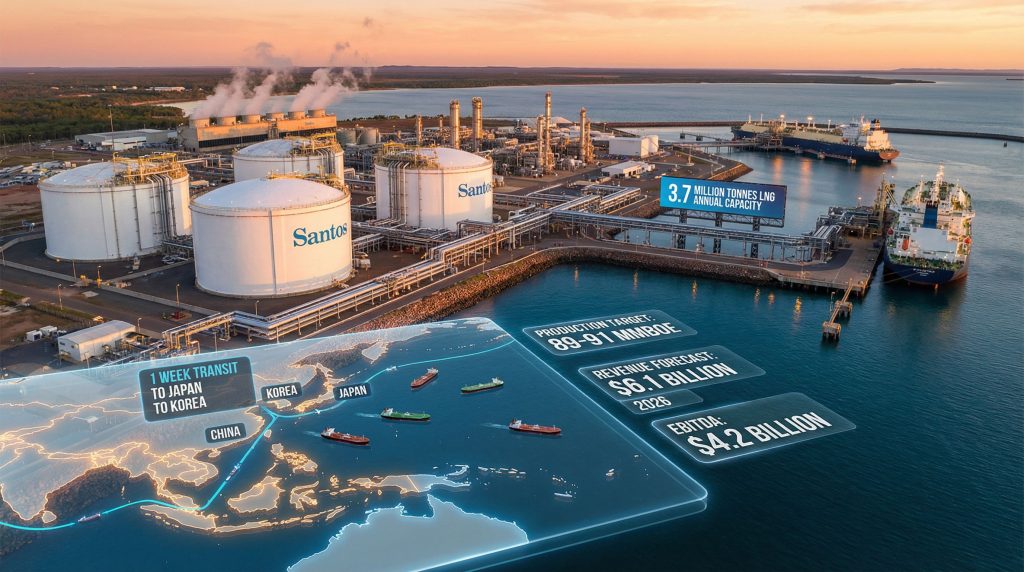
Santos' strategic positioning in the Asia-Pacific LNG markets presents compelling growth prospects as regional energy demand continues expanding. The Santos LNG future fundamentally relies on leveraging Australia's geographic advantages and established infrastructure networks to serve the world's largest LNG consumption zone with reduced transportation costs and emissions.
Strategic Infrastructure Networks Across Asia-Pacific LNG Markets
Australia's geographic positioning creates unparalleled advantages for liquefied natural gas exports to the rapidly expanding Asian markets. While energy transition dynamics accelerate globally, the Santos LNG future depends heavily on leveraging proximity-based competitive advantages that reduce both transportation costs and carbon emissions compared to distant supply sources.
Geographic Positioning Advantages in Regional Supply Chains
The Asia-Pacific region represents the world's largest LNG consumption zone, with developing economies increasingly viewing natural gas as a transitional fuel supporting decarbonisation objectives. Furthermore, Santos benefits from Australia's strategic location, enabling delivery to major Asian markets within seven days compared to 14-21 days from competing regions like Qatar or North America.
This transportation efficiency creates multiple competitive advantages:
- Reduced shipping emissions: Shorter transit distances lower the carbon footprint before LNG reaches destination markets
- Lower transportation costs: Reduced fuel consumption and vessel time requirements
- Supply chain reliability: Shorter routes minimise weather-related delays and geopolitical transit risks
- Market responsiveness: Faster delivery times enable more flexible supply contract arrangements
Integrated Processing Infrastructure and Strategic Partnerships
Santos operates diversified processing capabilities across multiple jurisdictions, creating operational flexibility and market access redundancy through established facilities at Darwin and Gladstone. These processing hubs connect to key Asian markets through long-term supply agreements with major energy companies including Mitsubishi, Korea Gas Corporation, and Petronas.
The company's infrastructure network spans several strategic locations:
Darwin LNG Facility
- Processing capacity serving Asian markets
- Connected to offshore gas fields via subsea pipeline networks
- Established export terminal with deep-water port access
Gladstone LNG Operations
- Queensland-based processing and export capabilities
- Integration with domestic gas pipeline networks
- Multi-train facility design supporting scalable production
When big ASX news breaks, our subscribers know first
Production Capacity Transformation Through Major Project Development
The Santos LNG future centres on three major development projects that will significantly expand production capacity and geographic diversification. These projects represent different stages of development, from near-term commissioning to final investment decisions expected within the next 18 months.
What Makes the Barossa LNG Project Critical for Santos' Growth?
The Barossa project represents Santos' most advanced development initiative, targeting first gas delivery in the third quarter of 2025. This offshore gas field development will connect to existing Darwin LNG infrastructure through a 262-kilometre undersea pipeline system, adding significant production capacity without requiring new export terminal construction.
Project Specifications:
- Annual LNG production capacity: 3.7 million tonnes
- Condensate production: 2.7 million barrels oil equivalent
- Infrastructure investment: Subsea pipeline to Darwin processing facility
- Market impact: Approximately 4% of Australia's total LNG export capacity
The ownership structure reflects international market access strategies:
| Stakeholder | Ownership Share | Strategic Contribution |
|---|---|---|
| Santos (Operator) | 50% | Project management and operational control |
| SK Innovation E&S | 37.5% | Korean market access and financing |
| JERA | 12.5% | Japanese utility market integration |
Papua LNG Development Timeline and Investment Framework
The Papua New Guinea LNG expansion project, led by TotalEnergies with Santos as a key partner, targets a final investment decision in early 2026. This development leverages existing PNG LNG infrastructure to minimise capital expenditure while accessing proven gas reserves in the Elk-Antelope field complex.
Development Parameters:
- Annual production target: 4 million tonnes LNG
- Infrastructure approach: Utilisation of existing PNG LNG processing facilities
- Cost optimisation: Shared infrastructure reduces per-unit development costs
- Market focus: Direct supply to Asian utility companies and trading houses
Alaska Pikka Phase 1 Geographic Diversification Strategy
The Alaska Pikka development represents Santos' expansion into North American energy markets, providing geographic diversification beyond traditional Asia-Pacific operations. Consequently, this oil-focused project contributes to cash flow generation supporting LNG development initiatives while accessing different commodity pricing environments.
Production Targets:
- Peak daily production: 80,000 barrels per day
- Annual production capacity: 29 million barrels
- Development timeline: First production expected in 2025
- Market access: North American crude oil and refined product markets
Financial Strategy and Balance Sheet Optimisation
Santos has implemented comprehensive financial management strategies to support LNG expansion while maintaining operational flexibility. The company's approach emphasises debt reduction, liquidity preservation, and strategic capital allocation across multiple development projects.
Debt Management and Liquidity Enhancement
In December 2025, Santos eliminated the PNG LNG project finance facility six months ahead of schedule, demonstrating strong cash flow generation and financial discipline. This early debt retirement enhances the company's financial flexibility for future project investments and reduces financing costs.
Current Financial Position:
- Available liquidity: $4.0 billion
- Scheduled debt maturities in 2026: Zero
- Credit facility access: Multiple undrawn facilities for operational flexibility
- Cash flow allocation: Balanced approach between growth investment and shareholder returns
Production Growth Projections and Revenue Forecasting
Santos has provided updated guidance reflecting operational realities while maintaining growth trajectory expectations. However, the company's production targets account for weather-related disruptions in the Cooper Basin while highlighting near-term capacity additions from new project commissioning.
2025 Operational Guidance:
- Production target: 89-91 million barrels oil equivalent
- Sales forecast: 93-95 million barrels oil equivalent
- Capital expenditure: $1.3-1.3 billion
- Unit production costs: $7.00-7.40 per barrel oil equivalent
Analyst Revenue Projections:
| Financial Metric | 2025 Estimate | 2026 Forecast | Growth Rate |
|---|---|---|---|
| Total Revenue | $5.1 billion | $6.1 billion | +19.6% |
| EBITDA | $3.4 billion | $4.2 billion | +23.5% |
| Net Income | $941 million | $1.3 billion | +38.2% |
These projections reflect expected production increases from Barossa LNG commissioning and improved commodity pricing environments, though actual results depend on oil price dynamics and project execution timelines.
Carbon Management and Environmental Strategy Integration
Environmental considerations increasingly influence LNG market dynamics, with customers seeking lower-carbon energy supplies to support decarbonisation objectives. Santos has developed comprehensive carbon management capabilities that differentiate its LNG portfolio while creating potential new revenue streams.
Carbon Capture and Storage Development Programme
Santos is advancing carbon capture and storage projects targeting 30 million tonnes per annum storage capacity. For instance, this initiative supports both operational emissions reduction and third-party carbon storage services, creating diversified revenue opportunities beyond traditional hydrocarbon production.
Carbon Management Capabilities:
- Geological storage assessment: Proven reservoir formations suitable for CO2 injection
- Infrastructure development: Capture, transport, and storage facility networks
- Commercial arrangements: Third-party storage services for industrial customers
- Regulatory compliance: Alignment with emerging carbon pricing mechanisms
Emissions Reduction Timeline and Operational Targets
The company has established specific emissions reduction targets aligned with customer expectations and regulatory requirements across multiple jurisdictions. In addition, these commitments support market positioning for lower-carbon LNG sales while reducing operational environmental impacts.
Decarbonisation Roadmap:
- 2030 Target: 30% reduction in Scope 1 and 2 emissions from current levels
- 2040 Goal: Net zero emissions achievement across all operations
- Technology Integration: Carbon capture, renewable energy, and operational efficiency improvements
- Product Positioning: Lower carbon intensity compared to coal and traditional oil products
Asia-Pacific Energy Market Dynamics and Growth Drivers
The Santos LNG future directly correlates with energy transition patterns across developing Asian economies. Regional demand growth reflects multiple factors including economic development, energy security concerns, and gradual transitions away from higher-emission fuel sources.
Regional Energy Transition Requirements
Asian economies face complex energy transition challenges requiring balanced approaches between economic growth, energy security, and environmental objectives. Natural gas increasingly serves as a "bridge fuel" supporting renewable energy integration while providing reliable baseload power generation capabilities.
Market Growth Drivers:
- Economic development in Southeast Asian nations
- Energy security diversification following global supply disruptions
- Coal-to-gas switching in power generation and industrial applications
- Renewable energy intermittency requiring flexible backup power sources
Asia-Pacific LNG demand is projected to grow 69% over the next decade, with China currently driving consumption increases while emerging markets are expected to account for expanding market share through 2035.
Supply Chain Competitive Positioning Analysis
Santos benefits from transportation and logistics advantages that become increasingly important as carbon pricing mechanisms influence energy procurement decisions. Shorter transportation distances reduce both costs and emissions compared to alternative supply sources, which strengthens positioning as global market impacts evolve.
Regional Supply Competition:
| Supply Source | Transit Time | Transport Emissions | Infrastructure |
|---|---|---|---|
| Australian LNG | 1 week | Lower due to proximity | Established terminals |
| Middle East LNG | 2-3 weeks | Moderate transport impact | Mature infrastructure |
| North American LNG | 3+ weeks | Highest transport emissions | Emerging capacity |
This positioning advantage strengthens as carbon border adjustment mechanisms and emissions trading systems influence energy procurement decisions across major Asian economies.
Operational Risk Assessment and Market Exposure Factors
LNG project development involves significant execution risks that can impact both timelines and financial returns. Santos faces multiple risk categories ranging from technical challenges to commodity price volatility and regulatory changes across its operating jurisdictions.
Project Development and Technical Execution Challenges
Large-scale LNG developments require complex coordination across multiple technical disciplines, from subsea engineering to processing facility construction. Santos has experienced both successes and challenges in project delivery, highlighting the importance of conservative planning and contingency management according to Santos' project reports.
Key Operational Risks:
- Cost overruns: Material and labour cost inflation affecting project economics
- Timeline delays: Weather, technical, and regulatory factors impacting commissioning schedules
- Technical performance: Processing efficiency and equipment reliability affecting production rates
- Regulatory compliance: Environmental and safety requirements across multiple jurisdictions
The company's 2025 production guidance revision from 90-95 million barrels oil equivalent to 89-91 million barrels oil equivalent reflects operational realities including Cooper Basin flooding impacts and conservative project scheduling.
Commodity Price Volatility and Financial Exposure
LNG pricing mechanisms expose Santos to global energy market fluctuations despite long-term supply contract arrangements. Commodity price cycles directly influence revenue, cash flow generation, and investment capacity for future development projects, as highlighted by US natural gas forecasts.
Price Exposure Factors:
- Oil-indexed pricing formulas linking LNG sales to crude oil benchmarks
- Spot market transactions subject to short-term supply and demand imbalances
- Currency exchange rate impacts on international sales and cost structures
- Regional pricing differentials affecting market access strategies
Regulatory and Environmental Compliance Requirements
Operating across Australia, Papua New Guinea, Alaska, and East Timor exposes Santos to varying regulatory frameworks and environmental standards. Climate policy evolution could significantly impact long-term LNG demand assumptions and operational requirements, particularly affecting energy export challenges.
Regulatory Risk Categories:
- Environmental permitting and compliance costs
- Carbon pricing mechanisms and emissions trading systems
- Indigenous land rights and community consultation requirements
- International trade policy affecting export market access
The next major ASX story will hit our subscribers first
Competitive Positioning Within ASX Energy Sector
Santos ranks as the second-largest oil and gas company listed on the Australian Securities Exchange following its 2021 merger with Oil Search. The company's market positioning reflects both operational scale and strategic focus on LNG development compared to diversified competitors.
Market Valuation and Analyst Expectations
Santos trades at approximately 11 times price-to-earnings ratio for 2025, reflecting market expectations of earnings growth from new project commissioning. Furthermore, analyst consensus targets suggest potential upside based on successful project execution and commodity price assumptions.
Valuation Metrics:
- Current share price: $6.14
- Analyst consensus target: $7.58 (23% upside potential)
- 2025 P/E ratio: Less than 11x estimated earnings
- Market capitalisation: Approximately $13 billion
Strategic Differentiation Through Asset Portfolio
Santos benefits from near-term production growth visibility through Barossa LNG commissioning, contrasting with competitors facing longer development timelines and greater execution uncertainty. This positioning supports more predictable cash flow generation and financial planning.
Competitive Advantages:
- Established infrastructure reducing development capital requirements
- Geographic diversification across multiple producing regions
- Balanced portfolio of oil and gas production supporting cash flow stability
- Strategic partnerships providing market access and financing capabilities
Long-Term Scenario Analysis and Strategic Outlook
The Santos LNG future depends on multiple interconnected factors ranging from energy transition pathways to geopolitical developments and technology advancement. Scenario planning reveals both opportunities and risks that could significantly influence company performance over the next decade.
Energy Transition Pathway Dependencies
Santos' LNG strategy assumes natural gas maintains its role as a "bridge fuel" during renewable energy transitions. Alternative scenarios involving accelerated renewable adoption or breakthrough energy storage technologies could compress the LNG demand window, affecting long-term project economics.
Transition Scenarios:
- Base case: Gradual renewable adoption with LNG supporting grid stability
- Accelerated transition: Faster renewable deployment reducing gas demand growth
- Technology breakthrough: Advanced storage or alternative fuels displacing LNG applications
- Policy-driven change: Carbon pricing making LNG less competitive versus alternatives
Geopolitical Supply Chain Resilience Factors
Regional energy security concerns following global supply disruptions favour Australian LNG suppliers with established infrastructure and reliable delivery capabilities. Santos' geographic positioning and strategic partnerships provide advantages in supply chain reliability scenarios.
Geopolitical Considerations:
- Energy security prioritisation by Asian governments
- Supply route diversification reducing dependency on traditional sources
- Political stability in Australia compared to alternative supply regions
- Trade relationship continuity supporting long-term contract arrangements
Technology Integration and Operational Excellence Requirements
Future competitiveness requires continued cost reduction through operational efficiency, digital technology integration, and carbon management capabilities. In addition, Santos' infrastructure investments position the company for long-term operational optimisation while adapting to evolving market requirements according to Barossa project details.
Technology Development Areas:
- Digital optimisation: Data analytics and artificial intelligence for operational efficiency
- Carbon management: Advanced capture and storage technologies for emissions reduction
- Process automation: Reduced operating costs through automated facility operations
- Logistics optimisation: Supply chain efficiency improvements reducing delivered costs
Disclaimer: This analysis is for educational purposes only and should not be considered investment advice. Energy market investments carry significant risks including commodity price volatility, regulatory changes, and project execution uncertainties. Past performance does not guarantee future results, and investors should conduct their own research and consult qualified financial advisors before making investment decisions. All financial projections and analyst estimates are subject to change based on market conditions and company performance.
The Santos LNG future represents a complex investment proposition balancing near-term production growth, strategic geographic positioning, and evolving energy market dynamics. Success depends on successful project execution, favourable commodity pricing environments, and the company's ability to maintain cost competitiveness in an increasingly complex global energy landscape.
Want to Capitalise on Australia's Next Major Energy Discovery?
Discovery Alert's proprietary Discovery IQ model delivers real-time alerts on significant ASX mineral discoveries, instantly empowering subscribers to identify actionable opportunities ahead of the broader market. Understand why major mineral discoveries can lead to substantial market returns by exploring Discovery Alert's dedicated discoveries page, showcasing historic examples of exceptional outcomes, then begin your 30-day free trial today to position yourself ahead of the market.