
July 23, 2026
The Governance Architecture Behind Africa's Mining Ownership Revolution
Across the Sahel, a structural shift in how sovereign governments relate to subsoil resources has been unfolding for several years. This is not simply a story of political volatility or opportunistic seizures. It reflects a deeper ideological repositioning, one in which post-coup administrations across West Africa have systematically recast foreign mining licenses as instruments of colonial-era dependency rather than legitimate commercial arrangements. For foreign junior miners in particular, this shift has created a category of investment risk that traditional geological or commodity-price modelling cannot adequately capture.
The Sarama Resources Burkina Faso gold project seizure sits at the centre of this transformation, offering one of the most instructive case studies in how resource nationalism, international arbitration law, and junior mining investment landscape intersect in the current geopolitical cycle.
When big ASX news breaks, our subscribers know first
Burkina Faso's Economic Sovereignty Framework: Ideology Meets Mining Policy
Post-Coup Governance and the Redefinition of Resource Ownership
When Captain Ibrahim Traoré consolidated power following Burkina Faso's second military takeover in 2022, the restructuring of the country's extractive industries was positioned not merely as economic policy but as a statement of national identity. The ideological foundation draws heavily from pan-African resource sovereignty movements, which frame foreign-controlled mining operations as perpetuating wealth extraction rather than contributing meaningfully to domestic development.
This framing resonated powerfully within Burkina Faso's population. The widespread anti-Western sentiment that accompanied the junta's consolidation of power meant that the seizure of foreign mining assets was received, domestically, as a long-overdue correction rather than an expropriation. That popular legitimacy gave the military administration significant latitude to act without the political accountability that democratic governments would typically face.
The Scale of Restructuring: Numbers That Define the Shift
The structural change underway in Burkina Faso's mining sector is measurable and significant. According to specialty portal Mines Actu Burkina, the following ownership transformation was projected by year-end 2025:
| Metric | Figure |
|---|---|
| Total operating industrial gold mines in Burkina Faso | 15 |
| Mines projected to be majority Burkinabe-owned by end 2025 | 6 |
| Mines under direct state management via SOPAMIB | 3 |
| Foreign operators affected by permit restructuring | Multiple |
SOPAMIB, the Burkina Faso Mining Participation Company, functions as the state vehicle for direct mine management. Its emergence as an operational entity, rather than simply a passive equity participant, signals a more aggressive form of state insertion than passive local-content mandates typically employed by other African governments.
Critical Policy Distinction: Burkina Faso's approach does not follow a single nationalization statute. Instead, it relies on selective permit revocation, retroactive denial of renewal applications, and insertion of SOPAMIB as a direct operator, creating a legally fragmented environment where each foreign operator faces a uniquely constructed set of risks.
The Sahel in Comparative Context
Burkina Faso does not stand alone. The ideological alignment between Mali, Niger, and Burkina Faso, all now governed by military administrations with overlapping pan-African sovereignty rhetoric, has created a corridor of elevated geopolitical mining risks across the central Sahel. Mali forced renegotiation of mining codes and increased state equity mandates, most visibly demonstrated through its dispute with Barrick Gold. Niger restructured its uranium sector following its own coup, with French operator Orano among those most affected. The consistency of this pattern across three jurisdictions suggests a coordinated ideological orientation rather than isolated policy experimentation.
What Happened to the Sanutura Project: From Discovery to Dispute
A Thirteen-Year Investment Eliminated Through Retroactive Permit Denial
Sarama Resources spent approximately thirteen years building its presence in West Africa, accumulating exploration data, developing geological models, and advancing the Sanutura Project within the Houndé Greenstone Belt in southwestern Burkina Faso. The Houndé Belt is one of West Africa's most geologically productive gold corridors, hosting multiple large-scale deposits across its strike length. Sarama's flagship asset within this system was the Tankoro Deposit, described as a multi-million-ounce gold resource that formed the operational and financial foundation of the broader Sanutura Project.
The project was in early-stage development when Burkina Faso's Ministry of Energy, Mines, and Quarries notified Sarama that the Tankoro 2 Exploration Permit, which had been authorised approximately two years prior, was being retroactively denied. The critical legal subtlety here is the retroactive character of the denial. The permit was not revoked on the basis of non-compliance or operational failure. It was effectively erased from the past, which carries profoundly different implications under international investment law.
Timeline of the Dispute
| Date | Event |
|---|---|
| c. 2010 | Sarama Resources commences West African gold exploration |
| August 2023 | Tankoro 2 permit retroactively denied by Burkina Faso's mining ministry |
| Late November 2023 | Sarama formally notifies Burkina Faso of the investment dispute |
| December 2024 | Sarama files Request for Arbitration with ICSID |
| July 2025 | Procedural hearing held before the ICSID tribunal |
| October 2025 | Sarama submits written Memorial claiming US$242 million plus interest |
| 2025 onward | Written submissions from both parties continue |
Retroactive Cancellation Versus Expropriation: Why the Legal Distinction Matters
The framing of an action as a permit withdrawal versus expropriation is not merely semantic. Under international investment law, expropriation, particularly indirect expropriation achieved through regulatory measures that effectively destroy an investment's value, triggers treaty-based protections including compensation obligations. A routine permit revocation, by contrast, may fall within a state's legitimate regulatory discretion and carry no such obligations.
Sarama characterises the Tankoro 2 denial as unlawful expropriation, and its legal strategy through ICSID is built on establishing that characterisation. According to Mining Weekly, Burkina Faso's government frames the same action as a legitimate exercise of sovereign resource governance.
Understanding the ICSID Arbitration Process
How International Investment Arbitration Works
ICSID, the International Centre for Settlement of Investment Disputes, is a World Bank-affiliated arbitration institution specifically designed to adjudicate claims between foreign private investors and sovereign states. Its jurisdiction in the Sarama case derives from the Canada-Burkina Faso Bilateral Investment Treaty, which provides Canadian investors with access to neutral international dispute resolution when host-state actions breach treaty-protected investment standards.
ICSID awards are binding and enforceable under the ICSID Convention in more than 150 signatory countries, providing significantly stronger enforcement mechanisms than many other international arbitration frameworks.
The Nine-Stage Arbitration Sequence
-
Dispute Notification – The investor formally notifies the host state of the alleged treaty breach. Sarama completed this step in late November 2023.
-
Cooling-Off Period – A treaty-mandated negotiation window during which parties attempt to resolve the dispute without formal arbitration.
-
Request for Arbitration – Filed by Sarama with ICSID in December 2024 after the cooling-off period produced no resolution.
-
Tribunal Constitution – Three-person arbitral tribunal assembled, with arbitrators appointed by both parties and the ICSID institution.
-
Procedural Hearing – Establishes timelines, document submission protocols, and procedural rules. Held in July 2025.
-
Written Memorial – Sarama's comprehensive legal argument and damages claim submitted in October 2025, quantifying the claim at US$242 million plus interest.
-
Counter-Memorial – Burkina Faso's formal written response to Sarama's legal arguments and damages assessment.
-
Hearing on the Merits – Oral arguments presented before the tribunal.
-
Award – The tribunal issues its binding decision on liability and quantum of damages.
The Damages Claim and Its Evolution
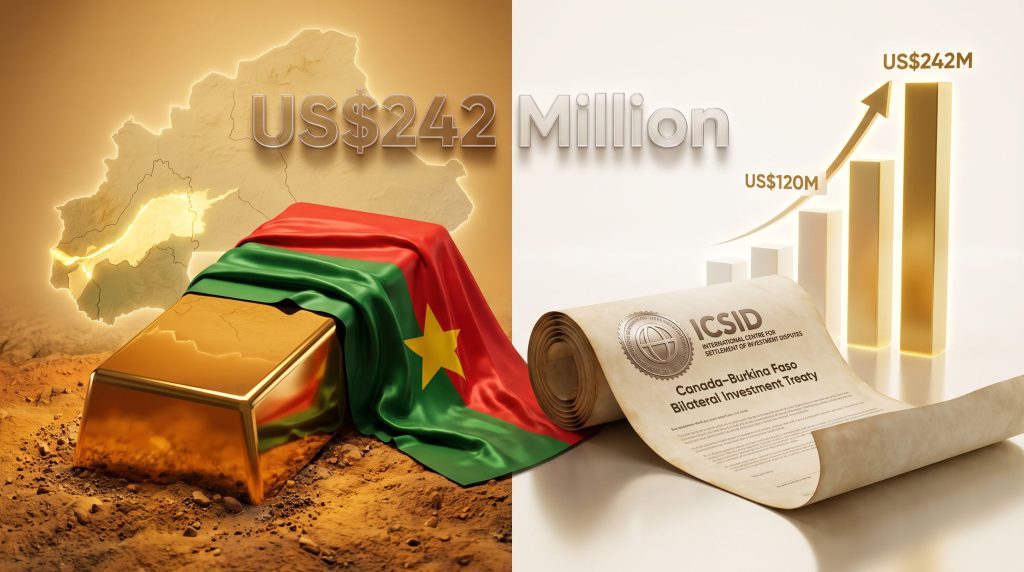
The escalation of Sarama's claimed damages is itself analytically revealing. Early estimates referenced at least US$120 million. Revised figures cited approximately A$180 million. The formal Memorial submitted in October 2025 landed at US$242 million plus interest. This escalation reflects the standard methodology for quantifying expropriation losses under international investment law, incorporating compounded interest from the date of the wrongful act, lost opportunity costs, the destruction of going-concern value, and sunk exploration expenditure accumulated over more than a decade.
Investor Warning: ICSID awards, even when issued in a claimant's favour, do not guarantee rapid payment. Enforcement against non-cooperative sovereign states requires identifying and attaching state-owned assets in foreign jurisdictions, a process that can itself take years and consume significant legal capital.
The Strategic Logic of Selling Australian Assets
Why Sarama Monetized the Laverton Projects
The decision to sell the Laverton Gold Projects to Riedel Resources Limited was driven by a clear capital preservation imperative. With the Sanutura Project locked in arbitration and generating no revenue, Sarama faced a compounding financial problem: the arbitration process itself is expensive, multi-year, and unpredictable in outcome, while equity dilution through repeated capital raises would progressively erode the per-share value of any eventual arbitration award.
Sarama's Executive Chairman Andrew Dinning publicly characterised the transaction as central to the company's strategy of minimising further dilution of the ICSID claim against Burkina Faso's government, while simultaneously ensuring the Laverton assets receive dedicated funding and management focus. This dual objective, protecting the arbitration claim's per-share value while enabling the Australian assets to be advanced, is a textbook application of mining risk management for a company in a prolonged dispute scenario.
What Was Transferred and What Was Retained
| Asset | Post-Transaction Status |
|---|---|
| Laverton Gold Projects (majority shareholding) | Sold to Riedel Resources Limited |
| Cosmo Gold Project | Transferred to Riedel; Sarama retains upside via Riedel shareholding |
| Mt Venn Gold Project | Transferred to Riedel; Sarama retains upside via Riedel shareholding |
| Sanutura Project (Burkina Faso) | Operationally frozen; subject to ICSID arbitration |
| ICSID Claim vs. Burkina Faso | Retained fully by Sarama; US$242 million plus interest |
Critically, Sarama retained ongoing exposure to the Laverton assets through its shareholding position in Riedel Resources. This structure avoids a clean disposal and allows Sarama to participate in any upside from future exploration success at Cosmo and Mt Venn, without carrying the operational costs of advancing those projects independently.
The Laverton Gold Projects: Geological Context and Exploration Potential
Why the Laverton District Matters to Junior Gold Explorers
The Laverton Gold District in Western Australia occupies a unique position in global junior mining capital allocation. It sits within the broader Eastern Goldfields Superterrane, which is part of the Yilgarn Craton, one of Earth's oldest and most gold-endowed Archean cratons. The district has produced millions of ounces of gold from multiple deposits, and its greenstone belts remain meaningfully under-explored at depth and along strike relative to their prospectivity.
For Riedel Resources, the acquisition creates a geographically diversified exploration portfolio spanning two Tier 1 jurisdictions.
Cosmo Gold Project
- Situated within under-explored greenstone belts in the Laverton Gold District
- Primary exploration target is gold mineralisation within structurally controlled systems
- Secondary potential exists for nickel-cobalt mineralisation linked to an ultramafic unit near the western greenstone margin
- Combined strike length across both Laverton projects exceeds 100 kilometres, covering approximately 1,000 square kilometres of tenure
Mt Venn Gold Project
- Covers a 42-kilometre segment of the Jutson Rocks Greenstone Belt
- Gold discovery history within the Jutson Rocks system extends back to the 1890s, establishing the geological prospectivity of the system over more than a century of historical activity
- Classified as a large-scale, structurally significant greenstone system with substantial modern exploration upside at depth
- The historical discovery record, combined with modern geophysical and geochemical techniques unavailable to earlier explorers, creates a genuinely differentiated exploration opportunity
Riedel Resources: Portfolio Construction Logic
The Laverton acquisition complements Riedel's existing Kingman Gold Project in Arizona, creating cross-jurisdictional gold exposure across Western Australia and North America. The addition of drill-ready prospects with defined geological targets meaningfully reduces the early-stage concept-generation burden that characterises the earliest phases of exploration investment. Furthermore, this distinction matters significantly to institutional and sophisticated retail investors allocating capital within the junior mining sector, particularly those conducting a definitive feasibility study assessment prior to commitment.
The next major ASX story will hit our subscribers first
Broader Implications for Foreign Mining Investment Across West Africa
The Risk Recalibration Spreading Across the Sahel Corridor
The Sarama Resources Burkina Faso gold project seizure is not an isolated incident that can be contained within a single company's risk narrative. It forms part of a discernible pattern affecting multiple operators across Burkina Faso, Mali, and Niger. Foreign mining companies active across this corridor are now conducting substantially more rigorous political risk assessments, integrating scenario modelling for retroactive regulatory action that would previously have been considered outside the reasonable range of outcomes in bilateral treaty environments.
Comparative Sovereign Risk Across West African Mining Jurisdictions
| Country | Primary Mechanism | Foreign Investor Impact |
|---|---|---|
| Burkina Faso | Retroactive permit cancellations; SOPAMIB state insertion | High; multiple arbitration cases initiated |
| Mali | Forced mining code renegotiation; increased state equity mandates | Moderate to high; Barrick Gold dispute prominent |
| Niger | Post-coup uranium sector restructuring | High; French operator Orano significantly affected |
| Ghana | Regulatory reform; local content requirements | Moderate; largely within established legal frameworks |
| Senegal | New petroleum and mining code under review | Low to moderate; investor-friendly posture largely maintained |
The Bilateral Investment Treaty as the Last Line of Defence
For foreign mining investors operating in elevated-risk jurisdictions, bilateral investment treaties represent the primary legal architecture protecting capital. However, a BIT is only as effective as the enforcement mechanisms available when a state refuses to honour an adverse award. Junta-led governments with reduced integration into international financial systems may be structurally less sensitive to the reputational and financial consequences of non-compliance with ICSID awards than democratically accountable administrations managing relationships with multilateral lenders.
This creates an asymmetric risk dynamic that is not yet fully priced into junior mining valuations across the Sahel corridor. Furthermore, asset sales and joint ventures are increasingly being deployed alongside political risk insurance instruments, including coverage available through the World Bank's Multilateral Investment Guarantee Agency, as tools for companies considering entry into jurisdictions where this trajectory of governance change has already been demonstrated.
Speculative but Plausible: If Burkina Faso and similar Sahel administrations continue to demonstrate non-compliance with ICSID awards over the medium term, it is plausible that the bilateral investment treaty framework will itself face pressure for structural reform, with investors and capital-exporting governments seeking stronger enforcement pre-conditions before committing capital to the region.
Frequently Asked Questions
What was the Sanutura Project and why did it matter?
The Sanutura Project was a large-scale gold development situated within the Houndé Greenstone Belt in southwestern Burkina Faso, anchored by the multi-million-ounce Tankoro Deposit. Sarama spent over a decade advancing this asset from initial exploration through resource definition to early development planning, making it the company's primary long-term value driver before the dispute began.
Why did Burkina Faso retroactively deny the Tankoro 2 permit?
Burkina Faso's military administration framed the action within its broader economic sovereignty policy, which aims to transfer majority control of the country's mining sector to Burkinabe enterprises. The permit denial occurred against a backdrop of widespread anti-Western sentiment and a governance ideology that treats foreign mining rights as incompatible with genuine resource independence.
How much is Sarama claiming in its ICSID arbitration?
Sarama submitted its formal Memorial to ICSID in October 2025, claiming US$242 million in damages plus interest under the Canada-Burkina Faso Bilateral Investment Treaty. As reported by African Law Business, this figure incorporates the full destruction of project value, compounded interest from the date of the wrongful act, and lost opportunity costs accumulated over the period of the dispute.
Is the Sarama case unique among Burkina Faso mining disputes?
No. By the end of 2025, six of Burkina Faso's fifteen operating industrial gold mines were projected to be majority-held by Burkinabe enterprises, with three under direct state management via SOPAMIB. The Sarama Resources Burkina Faso gold project seizure is among the most advanced in terms of formal international arbitration proceedings, but the broader pattern of permit restructuring has, however, affected multiple foreign operators across the country.
This article contains analysis of publicly available information, timeline data, and geopolitical trends. It is intended for informational purposes only and does not constitute financial advice. Statements regarding ICSID arbitration outcomes, award enforcement, and future geological exploration results are inherently uncertain and should not be relied upon as predictive of actual outcomes. Readers should conduct independent due diligence before making any investment decisions related to companies or jurisdictions discussed in this article.
Want to Stay Ahead of Significant ASX Mineral Discoveries Before the Broader Market?
Discovery Alert's proprietary Discovery IQ model delivers real-time alerts on high-potential ASX mineral discoveries, transforming complex geological and commodity data into clear, actionable investment insights for both short-term traders and long-term investors. Start your 14-day free trial today and explore how historic discoveries have generated substantial returns for those who acted early.