June 3, 2026
What Makes Saskatchewan's Dual Nuclear Approach Strategically Different?
Saskatchewan's nuclear reactor evaluation framework represents precisely this convergence of strategic energy markets, establishing parallel assessment pathways that could fundamentally reshape Canada's energy transition dynamics over the next two decades. This dual-track approach creates strategic optionality that competitors across North America cannot replicate.
The Economic Logic Behind Parallel Technology Evaluation
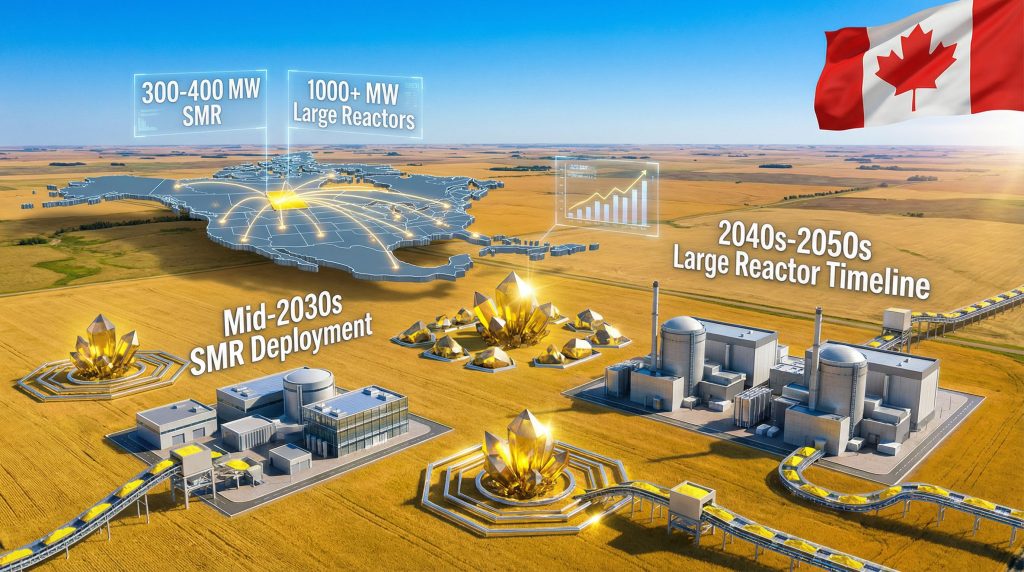
Saskatchewan's dual-track nuclear strategy operates through simultaneous Small Modular Reactor deployment targeting the mid-2030s alongside comprehensive large reactor feasibility studies extending through the 2040s. This approach creates strategic optionality that competitors across North America cannot replicate due to resource and regulatory constraints.
Furthermore, the province's energy security framework, released in October 2025, establishes clear deployment timelines that recognize technology maturation cycles while maintaining market positioning advantages. SaskPower has announced its formal evaluation process, acknowledging that large reactor deployment requires 15-20 year development cycles, necessitating immediate planning initiation despite SMR projects already underway.
Cost-benefit modelling encompasses several strategic elements:
• Technology diversification reducing single-vendor dependency
• Market timing optimisation through phased capacity additions
• Export revenue maximisation via graduated nuclear deployment
• Risk mitigation through multiple reactor technology pathways
Financial structuring through Crown utility ownership enables coordinated infrastructure planning that private utilities cannot achieve. Consequently, SaskPower's governance model allows synchronised transmission upgrades, site preparation, and regulatory engagement across multiple technology platforms simultaneously.
Geographic Advantages That Competitors Cannot Replicate
Saskatchewan's position as home to the world's largest and highest-grade uranium mines creates vertical integration opportunities unavailable to other Canadian provinces or American states pursuing nuclear expansion. The McArthur River and Cigar Lake mining operations provide domestic fuel supply security that eliminates international market exposure for reactor operations.
Transportation infrastructure benefits extend beyond simple proximity advantages. Saskatchewan's nuclear fuel cycle integration encompasses:
• Direct mine-to-reactor supply chains reducing logistics costs
• Reduced transportation security requirements for domestic fuel movement
• Strategic positioning for North American nuclear fuel export markets
• Integration potential with Cameco's existing uranium processing capabilities
The province's location within western Canada's electrical grid provides unique export market access to Alberta's industrial demand and potential interconnection opportunities with American regional transmission systems. Unlike eastern Canadian nuclear facilities serving primarily provincial demand, Saskatchewan's nuclear capacity targets interprovincial and international energy markets from initial deployment phases.
When big ASX news breaks, our subscribers know first
How Do Small Modular Reactors Compare to Large-Scale Nuclear in Saskatchewan's Context?
SMR Deployment Timeline and Commercial Viability Assessment
GE Vernova Hitachi Nuclear Energy's BWRX-300 technology represents Saskatchewan's selected SMR platform for mid-2030s commercial deployment. The 300-400 MW capacity range targets provincial demand growth while establishing operational precedent for larger reactor programmes.
Site selection within the Estevan area of southeastern Saskatchewan reflects strategic considerations beyond simple geography. In addition, two identified potential locations provide deployment flexibility whilst concentrating nuclear infrastructure development within established industrial corridors. Final site selection announcements are anticipated throughout 2026, enabling construction timeline optimisation.
Regulatory pathway advantages emerge through Saskatchewan's participation in the four-province SMR strategic plan alongside Ontario, New Brunswick, and Alberta. This coordinated approach accelerates Canadian Nuclear Safety Commission licensing processes through shared technical documentation and standardised safety assessment protocols.
| Technology Type | Deployment Timeline | Capacity Range | Primary Market |
|---|---|---|---|
| Small Modular Reactors | Mid-2030s | 300-400 MW | Provincial demand + industrial |
| Large Nuclear Reactors | 2040s-2050s | 1000+ MW | Export markets + heavy industry |
Commercial viability assessments for BWRX-300 deployment incorporate construction timeline advantages over traditional large reactor projects. For instance, modular fabrication reduces on-site construction duration while standardised design elements minimise regulatory approval complexity compared to first-of-kind large reactor licensing.
Large Reactor Economics: 15-20 Year Investment Horizon Analysis
Westinghouse AP1000 and AP300 technologies form the foundation of Saskatchewan's large reactor evaluation framework through memorandum agreements with Cameco and Westinghouse. This technology assessment process recognises that gigawatt-scale generation requires different economic modelling than SMR deployment.
Capital expenditure considerations encompass extended development timelines that begin with current feasibility studies extending through the 2040s for operational deployment. However, large reactor economics depend heavily on export market development and industrial demand growth that may not materialise within SMR deployment timeframes.
Grid integration requirements for 1000+ MW generation capacity necessitate substantial transmission infrastructure upgrades beyond current intertie expansion plans. Export market potential depends on sustained demand growth across western Canada and potential American market access through enhanced interconnection agreements.
Investment horizon analysis reveals several critical factors:
• Extended regulatory approval processes requiring 15-20 year planning cycles
• Capital cost scaling advantages for gigawatt-class generation
• Export revenue optimisation through large-scale capacity additions
• Industrial heat application potential for resource processing integration
What Regulatory and Financial Frameworks Enable This Nuclear Expansion?
Federal-Provincial Coordination Mechanisms
Saskatchewan's nuclear expansion operates within established interprovincial coordination frameworks developed through the 2022 Strategic Plan on SMRs. This four-province partnership with Ontario, New Brunswick, and Alberta creates standardised regulatory approaches and shared technical resources that accelerate individual provincial deployment timelines.
Canadian Nuclear Safety Commission licensing pathway optimisation benefits from coordinated documentation development and standardised safety assessment protocols. Furthermore, Saskatchewan's participation in multi-provincial planning reduces regulatory uncertainty whilst establishing precedent for western Canadian nuclear development.
Indigenous consultation protocols represent mandatory engagement requirements before construction authorisation. Consequently, SaskPower's formal stakeholder engagement framework encompasses Indigenous Rightsholders, community representatives, and business stakeholders through structured consultation processes extending throughout project development phases.
"Saskatchewan's approach represents a calculated hedge against technology uncertainty whilst maximising natural resource advantages, potentially creating the most integrated nuclear-uranium value chain in North America."
Investment Structure and Risk Distribution Models
Crown utility ownership through SaskPower provides unique financing advantages unavailable to private utility operators. Provincial ownership enables coordinated infrastructure investment, synchronised transmission upgrades, and integrated energy policy implementation across multiple technology platforms.
Public-private partnership opportunities emerge through vendor collaboration agreements with Westinghouse, GE Vernova Hitachi Nuclear Energy, and Cameco. These partnerships distribute technology risks whilst maintaining provincial control over strategic infrastructure development.
Export revenue projections depend on sustained interprovincial and international demand growth throughout 2030s-2040s deployment timelines. Energy security calculations incorporate reduced fossil fuel dependency alongside enhanced grid stability through nuclear baseload generation.
Financial framework elements include:
• Provincial Crown utility financing eliminating private investor return requirements
• Technology vendor risk-sharing through multi-year development agreements
• Export market revenue diversification reducing provincial energy cost exposure
• Infrastructure investment coordination with transmission and distribution upgrades
How Does Saskatchewan's Uranium Resource Base Impact Nuclear Economics?
Vertical Integration Opportunities in Nuclear Fuel Cycles
Saskatchewan's position as home to the world's largest and highest-grade uranium mines creates unprecedented vertical integration potential across the complete nuclear fuel cycle. McArthur River and Cigar Lake operations provide domestic uranium supply that eliminates international market exposure for reactor fuel requirements.
However, ongoing uranium market volatility in global markets highlights the strategic value of domestic supply security. Cameco's strategic partnership role through memorandum agreements with SaskPower and Westinghouse establishes institutional frameworks for mine-to-reactor supply chain optimisation.
This integration encompasses uranium production, potential fuel fabrication development, and long-term fuel supply assurance for both SMR and large reactor deployment. Fuel cycle economics benefit from eliminated transportation costs, reduced security requirements for domestic fuel movement, and price stability through direct producer-consumer relationships.
Strategic advantages include:
• Direct mine-to-reactor supply chains eliminating intermediary costs
• Domestic uranium price stability reducing operational cost uncertainty
• Technology transfer opportunities through integrated vendor partnerships
• Export market positioning for North American nuclear fuel supply
Global Supply Chain Positioning and Export Advantages
Saskatchewan's uranium resource base positions the province as a strategic supplier within North American nuclear expansion scenarios. Current uranium production capabilities, combined with reactor deployment timelines, create potential export opportunities for nuclear fuel services alongside electricity generation.
International nuclear fuel markets increasingly prioritise supply security and political stability following recent geopolitical disruptions. For instance, the US uranium import ban has created new opportunities for reliable suppliers, whilst uranium market disruption has highlighted supply chain vulnerabilities.
Technology transfer potential emerges through integrated partnerships encompassing uranium production, reactor deployment, and fuel cycle services. Intellectual property development opportunities span reactor operations, fuel handling, and nuclear waste management across multiple technology platforms.
What Are the Grid Integration and Energy Export Implications?
Interprovincial Transmission Infrastructure Requirements
Saskatchewan's nuclear expansion strategy explicitly links reactor deployment with expanded intertie capacity targeting energy export markets. Current transmission infrastructure requires substantial upgrades to accommodate gigawatt-scale nuclear generation whilst maintaining grid stability across western Canadian electrical systems.
Load balancing across interprovincial connections enables nuclear baseload optimisation whilst providing peak demand management for neighbouring jurisdictions. Consequently, Alberta's industrial demand and potential American market access through enhanced interconnection create export revenue opportunities justifying transmission infrastructure investment.
Intertie capacity expansion encompasses several strategic elements:
• Enhanced interconnection with Alberta's industrial electricity demand
• Potential American market access through cross-border transmission upgrades
• Grid stability improvement through nuclear baseload generation
• Peak demand management capabilities across western Canadian systems
Industrial Heat Applications and Process Integration
High-temperature reactor applications create opportunities for direct industrial process integration beyond electricity generation. Saskatchewan's resource processing industries could benefit from nuclear-powered heat applications, reducing carbon intensity whilst improving operational economics.
Hydrogen production potential through nuclear-powered electrolysis represents emerging market opportunities aligned with clean energy security trends. Nuclear hydrogen production could serve domestic industrial applications whilst creating export products for regional energy markets.
Carbon-intensive industry decarbonisation applications include:
• Mining operations powered by nuclear electricity
• Resource processing industries using nuclear process heat
• Hydrogen production for industrial applications and export markets
• Agricultural processing powered by clean nuclear energy
What Competitive Advantages Does This Strategy Create?
First-Mover Benefits in Canadian Nuclear Renaissance
Saskatchewan's dual-technology approach establishes market positioning advantages relative to Ontario's established nuclear sector and other provinces pursuing single-technology strategies. Early technology selection and site development create vendor relationship optimisation opportunities unavailable to later market entrants.
Regulatory precedent establishment for western Canadian nuclear development positions Saskatchewan as the technical leader for interprovincial coordination and standardised licensing approaches. This regulatory leadership creates competitive advantages for subsequent project phases and technology expansion.
Technology selection timing benefits encompass:
• Preferential vendor partnership agreements through early commitment
• Regulatory approval precedent establishment reducing future project uncertainty
• Skilled workforce development creating regional expertise concentration
• Supply chain optimisation through integrated vendor relationships
Energy Security and Export Revenue Projections
Nuclear deployment eliminates fossil fuel price volatility exposure whilst creating predictable operational cost structures over 60-80 year reactor operating lifespans. This price stability enables long-term electricity export contract development with neighbouring jurisdictions seeking clean energy supply.
Economic diversification beyond traditional resource extraction creates provincial revenue stability through electricity export markets. Nuclear export revenue provides economic base diversification reducing dependency on commodity price cycles affecting mining and petroleum sectors.
Strategic market advantages include reduced dependence on volatile fossil fuel markets, enhanced energy security through domestic nuclear fuel supply, and export revenue potential exceeding traditional resource extraction activities over extended timeframes.
The next major ASX story will hit our subscribers first
What Timeline Challenges and Risk Factors Must Be Addressed?
Regulatory Approval Complexity and Community Engagement
Multi-year licensing processes through Canadian Nuclear Safety Commission oversight require extensive documentation, environmental assessment, and safety analysis before construction authorisation. Saskatchewan's regulatory engagement must address both SMR licensing for mid-2030s deployment and large reactor preparation for 2040s implementation.
Indigenous consultation timelines encompass mandatory engagement protocols with Indigenous Rightsholders throughout project development phases. Benefit-sharing negotiations and rights recognition frameworks require sustained consultation extending throughout regulatory approval processes.
Community engagement challenges include:
• Public acceptance campaigns addressing nuclear safety concerns
• Local economic benefit demonstration for affected communities
• Environmental impact communication and mitigation planning
• Workforce development and training programme implementation
Technology Selection Risks and Vendor Performance Dependencies
SMR commercial demonstration requirements create deployment uncertainty until BWRX-300 technology achieves proven operational performance. Saskatchewan's Saskatchewan nuclear reactor evaluation depends on successful technology demonstration and regulatory approval completion within projected mid-2030s timeframes.
Large reactor technology maturity presents different risk profiles with AP1000 representing established technology versus AP300 requiring additional development. Furthermore, construction timeline uncertainties affect export market development and revenue projection accuracy throughout 15-20 year deployment horizons.
Critical risk factors encompass supply chain resilience, skilled workforce availability, and vendor performance consistency across multiple technology platforms. Technology selection decisions made during current evaluation phases determine operational success throughout 2030s-2050s deployment timelines.
How Does This Position Saskatchewan in North America's Energy Transition?
Strategic Market Positioning Analysis
Saskatchewan's nuclear strategy competes directly with hydroelectric exports from Quebec and Manitoba whilst targeting different market segments through baseload generation capabilities. Nuclear power provides grid stability advantages and capacity factor superiority compared to renewable energy alternatives.
Clean energy certificate markets and carbon pricing mechanisms create additional revenue opportunities for nuclear generation beyond standard electricity sales. Nuclear power qualifies for premium pricing in jurisdictions implementing carbon reduction mandates or clean energy requirements.
Industrial competitiveness benefits from stable, low-carbon electricity pricing that attracts energy-intensive manufacturing and processing operations. Nuclear-powered industrial development could position Saskatchewan as a preferred location for clean manufacturing across North American markets.
Long-Term Economic Impact Modelling
GDP contribution projections from nuclear sector development encompass direct employment, supply chain development, and induced economic activity across construction and operational phases. High-skilled employment creation in engineering, operations, and maintenance provides sustainable career opportunities exceeding traditional resource extraction.
However, evaluating large-scale nuclear technology options requires comprehensive economic analysis spanning multiple decades. Technology export potential emerges through operational experience, technical expertise development, and intellectual property commercialisation.
Economic impact elements include:
• Direct employment in nuclear construction and operations
• Supply chain development supporting multiple reactor projects
• Induced economic activity from high-wage nuclear sector employment
• Technology export and consulting service development opportunities
Saskatchewan's nuclear reactor evaluation represents more than provincial energy planning; it establishes the foundation for North America's most integrated nuclear-uranium value chain whilst creating competitive advantages that extend across decades of clean energy market development.
Disclaimer: This analysis contains forward-looking projections and strategic assessments that involve inherent uncertainties. Nuclear project timelines, technology performance, and market conditions may vary significantly from current projections. Regulatory approval processes and community engagement outcomes cannot be guaranteed. Investment decisions should consider multiple scenarios and seek professional financial guidance.
Further Exploration: Readers interested in learning more about nuclear energy developments in Canada can explore related educational content through World Nuclear News and the Government of Saskatchewan's energy strategy publications for additional perspectives on provincial nuclear planning initiatives.
Ready to Capitalise on Canada's Nuclear Energy Transformation?
Saskatchewan's nuclear expansion represents a massive shift in North America's energy landscape, creating significant opportunities for investors tracking uranium and nuclear technology developments. Discovery Alert's proprietary Discovery IQ model delivers instant alerts on major mineral discoveries across the ASX, helping subscribers identify actionable uranium and energy sector opportunities before broader market recognition drives prices higher.