June 27, 2026
The Refinery as a Decarbonisation Asset: How Existing Industrial Infrastructure Is Reshaping the Global Low-Carbon Fuels Race
The conventional assumption in energy transition narratives is that decarbonisation requires building entirely new infrastructure from scratch. Green hydrogen plants, dedicated biorefineries, solar-to-liquid facilities: the prevailing image is one of construction, not conversion. Yet some of the most commercially viable pathways to low-carbon fuel production are emerging not from greenfield developments but from within the walls of ageing crude oil refineries. The economics are compelling, the timelines are compressed, and the technology is already certified. What is unfolding at Sasol Natref sustainable aviation fuel and renewable diesel production in South Africa's Free State province illustrates precisely why the refinery gate has become one of the most strategically significant frontiers in the global energy transition.
When big ASX news breaks, our subscribers know first
Why Global Mandates Are Forcing Industrial Asset Repurposing
Aviation and heavy industry are entering a period of intensifying carbon compliance pressure that is reshaping procurement strategies across the global economy. The European Union's ReFuelEU Aviation regulation mandates SAF blending requirements of 2% by 2025, scaling progressively to 70% by 2050, creating a legally binding demand trajectory that airlines cannot ignore. The International Civil Aviation Organization's CORSIA framework, covering approximately 90% of international aviation emissions, is now in its mandatory phase, obligating carriers to offset or reduce lifecycle carbon intensity on international routes.
The United Kingdom has committed to a 10% SAF blending mandate by 2030 for all jet fuel supplied at UK airports. Beyond aviation, the EU's Carbon Border Adjustment Mechanism (CBAM), which entered its transitional phase in October 2023, is extending carbon pricing pressure into industrial supply chains. CBAM creates direct financial exposure for carbon-intensive export industries operating in countries without equivalent carbon pricing regimes, including South Africa's mining and processing sectors.
These converging regulatory frameworks are not creating abstract policy risk. They are generating hard financial incentives for airlines, mining companies, logistics operators, and industrial exporters to actively seek certified low-carbon fuel alternatives at competitive prices. The critical question is where those certified fuels will come from, and at what cost. That question is increasingly pointing toward existing industrial infrastructure as the most capital-efficient answer.
Understanding HEFA: The Commercial Backbone of Certified SAF Production
What Hydroprocessed Esters and Fatty Acids Technology Actually Does
Before evaluating Natref's specific approach, understanding the HEFA production pathway is essential. HEFA technology converts biological oils and fats into hydrocarbon fuels that are chemically indistinguishable from their crude-derived equivalents. The process involves hydroprocessing triglyceride feedstocks, typically at temperatures between 150 and 250 degrees Celsius and pressures of 20 to 100 bar, in the presence of catalysts and hydrogen.
The process saturates double bonds within feedstock molecules and removes oxygen through hydrodeoxygenation, yielding paraffinic hydrocarbons that meet aviation fuel and diesel specifications.
The strategic advantage of this chemistry is its drop-in compatibility. HEFA-derived SAF can be blended with conventional jet fuel at ratios up to 50% without any engine or infrastructure modification, certified under ASTM D7566. HEFA renewable diesel meeting the EN-15940 specification is compatible at blending ratios from 0% to 100% with fossil diesel. This eliminates retrofit costs for end-users and removes the technical adoption barriers that constrain alternative SAF pathways.
How the SAF Production Pathways Compare
| SAF Pathway | Feedstock | Commercial Maturity | GHG Reduction vs. Conventional Jet Fuel | Capital Intensity |
|---|---|---|---|---|
| HEFA | UCO, vegetable oils | High (commercial scale) | Up to 80%+ | Low to Medium |
| Fischer-Tropsch (FT) | Coal, biomass, gas | Medium | Variable | High |
| Power-to-Liquid (PtL/eSAF) | Green hydrogen + CO2 | Low to Medium | Up to 90%+ | Very High |
| Alcohol-to-Jet (ATJ) | Sugarcane ethanol, waste | Medium | 50 to 70% | Medium |
HEFA's position as the most commercially mature pathway globally reflects decades of investment by producers including Neste, Chevron Renewable Energy Group, and TotalEnergies. It is the pathway that currently accounts for the overwhelming majority of certified SAF volumes delivered to commercial aviation worldwide.
The Co-Processing Model and Its Capital Efficiency Advantage
What distinguishes Natref's approach is not simply the use of HEFA technology, but the co-processing architecture through which it is deployed. Rather than constructing a dedicated biorefinery alongside existing crude processing infrastructure, Natref integrates biological feedstocks directly into existing refinery streams. Used cooking oil (UCO) and non-edible vegetable oils are introduced into the refinery's existing hydroprocessing units alongside conventional crude-derived streams.
This co-processing model is economically significant. Sarushen Pillay, Sasol's Business Building, Strategy and Technology Executive VP, has confirmed that up to 15% of Natref's nameplate capacity of 108,500 barrels per day could be deployed for HEFA fuel production with no or low capital investment. For context, 15% of Natref's capacity represents approximately 16,275 barrels per day of potential HEFA throughput, a substantial production base without the capital expenditure burden typically associated with dedicated biorefinery construction, which industry benchmarks place at $200 million to $500 million or more for standalone facilities.
Africa's First: What the ISCC Plus Certification Actually Means
Breaking Down the Certification Framework
The International Sustainability and Carbon Certification Plus (ISCC+) standard is a globally recognised framework for verifying the sustainability of biomass and biofuel production across the full value chain. It covers land and soil carbon accounting, greenhouse gas balance calculations using lifecycle assessment methodology consistent with ISO 14040 and ISO 14044, social criteria including labour rights and food security, environmental criteria covering water, soil, air, and biodiversity impacts, and mass balance tracking for feedstock supply chains.
Critically, ISCC+ is not a self-declared standard. It requires independent third-party audit by an accredited certification body. At Natref, that audit was conducted onsite by TÜV SÜD, one of the world's most widely recognised technical inspection and certification organisations. The audit confirmed that Natref's production processes meet ISCC+ requirements for both sustainable aviation fuel and renewable diesel produced from used cooking oil.
This makes Natref the first crude-oil refinery on the African continent to achieve product sustainability certification for SAF and renewable diesel, a distinction with direct commercial implications for market access and premium pricing.
The GHG Intensity Numbers That Define the Value Proposition
The certified GHG intensity figures established through the TÜV SÜD audit are the quantitative foundation of Natref's commercial case. Vimal Bhimsan, Sasol's Asset Transformation VP, has confirmed the following benchmarks:
| Fuel Type | GHG Intensity (gCO2eq/MJ) | Reduction vs. Crude-Derived Equivalent |
|---|---|---|
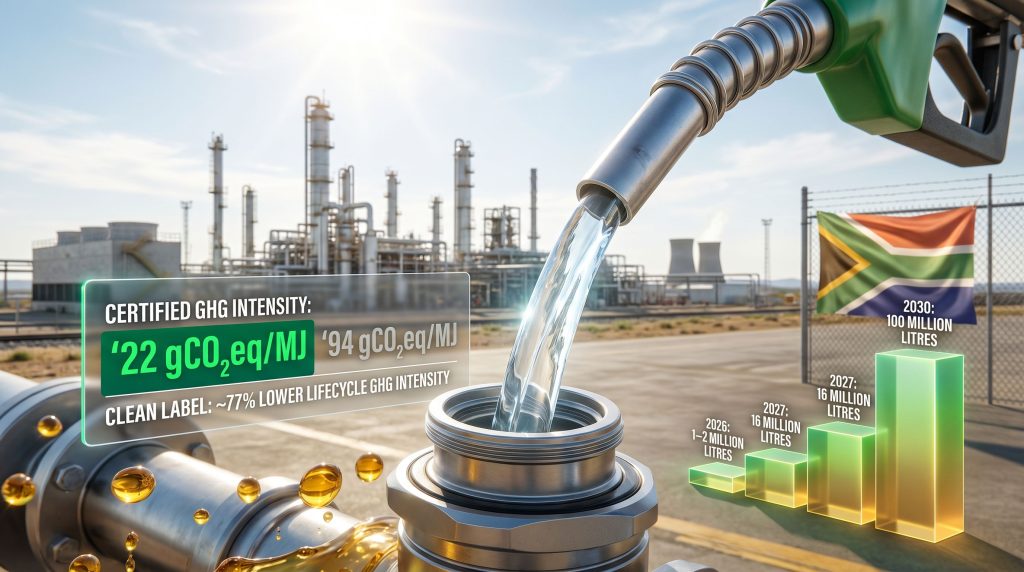
| SAF from used cooking oil (Natref, certified) | 22 | Approximately 77% lower than conventional jet fuel |
| Conventional jet fuel (crude-derived) | 94 | Baseline |
| Renewable diesel from UCO (Natref, certified) | 23 | Approximately 76% lower than fossil diesel |
| Fossil diesel (crude-derived) | 94 | Baseline |
A certified GHG intensity of 22 gCO2eq/MJ for SAF derived from used cooking oil represents a reduction of more than 76% compared to the 94 gCO2eq/MJ lifecycle intensity associated with conventional crude-derived jet fuel, as confirmed by independent TÜV SÜD onsite audit at Natref.
What makes these figures particularly credible is the scope of the certification. Bhimsan has emphasised that the measurement encompasses the full value chain, including water use in crop cultivation, agricultural land use, crop cultivation inputs, and logistics emissions. This is not a combustion-only carbon accounting approach; it is a comprehensive lifecycle measurement that addresses the most common criticisms levelled at biofuel sustainability claims.
Why Certification Matters Beyond Marketing
ISCC+ certification is not merely a branding tool. It is a market access prerequisite in the most commercially significant SAF demand pools. Airlines seeking to comply with EU ReFuelEU Aviation mandates or generate CORSIA-eligible carbon credits require certified fuel with verified lifecycle GHG intensity. Without third-party certification, fuel producers cannot access these premium-priced compliance markets regardless of the actual carbon performance of their product.
Similarly, the EU's Renewable Energy Directive (RED II and its successor frameworks) specifies minimum GHG savings thresholds that certified renewable fuels must meet to qualify for statutory compliance. ISCC+ certification provides the audit trail and documentation that regulatory bodies and airline procurement teams require to verify compliance claims. Furthermore, green steel pricing dynamics in adjacent industrial sectors illustrate how certification infrastructure consistently underpins premium market access across decarbonising industries.
Production Scale-Up: From First Batches to Continental Ambition
The Phased Ramp-Up Roadmap
Natref's production trajectory reflects a deliberate sequencing strategy that prioritises market demand validation over speculative capacity expansion. The ramp-up progression is structured as follows:
- 2024: First demonstration batch of renewable diesel produced from UCO, approximately 1,000 litres, establishing proof-of-concept for the co-processing model.
- 2025 (June): First commercial batch, approximately 30,000 litres of renewable diesel from UCO, transitioning from demonstration to initial commercial operations.
- 2026: Target production of approximately 2 million litres of SAF, representing the first meaningful commercial volumes available to airline customers at OR Tambo International Airport.
- 2027: Scaled production target of approximately 16 million litres, the first significant volume capable of servicing multiple airline customers on an ongoing basis.
- 2030: Production ambition of up to 100 million litres from Natref alone, with a combined Natref and Secunda potential reaching up to 200 million litres.
Pillay has been explicit that the pace of this ramp-up is determined primarily by market demand rather than technical or capital constraints. This is a strategically important signal: the production infrastructure can scale faster than the market demand signal currently warrants, meaning the ceiling on near-term volume growth is commercial, not operational.
What Controls the Rate of Scale-Up
Several interconnected factors govern how quickly production volumes can expand beyond the initial ramp-up trajectory:
- Feedstock aggregation: Domestic UCO collection infrastructure exists in South Africa, but a significant proportion of collected UCO is currently exported to European reprocessing markets rather than directed toward domestic biorefinery production. Redirecting this supply toward Natref represents the most immediate feedstock lever.
- Airline offtake commitments: OR Tambo International Airport is identified as the primary SAF distribution point for international airline customers. South Africa's geographic position as a major international aviation hub, with eight of the world's top ten SAF-consuming airlines transiting through the country, creates substantial potential demand.
- Premium pricing dynamics: Certified SAF and renewable diesel trade at a premium over fossil fuel alternatives. The premium is justified by carbon credit value, regulatory compliance savings, and ESG reporting benefits, but price sensitivity remains a factor in commercial negotiation.
- Carbon credit market access: The ability for airlines to claim certified carbon credits against SAF purchases under CORSIA and airline-specific sustainability commitments directly affects the economic value of the premium over conventional jet fuel.
Target Markets: Who Buys Certified Low-Carbon Fuels and Why
Aviation: Compliance-Driven Procurement
International airlines refuelling at OR Tambo International Airport represent the primary target market for Natref's SAF output. These carriers face a compounding set of compliance obligations across CORSIA, EU ReFuelEU Aviation, and country-specific mandates. Purchasing ISCC+-certified SAF from Natref allows them to generate verified carbon credits, reduce their CORSIA offset liability, and meet statutory blending requirements at a major Southern Hemisphere hub.
The geographic logic is significant. South Africa sits on major long-haul aviation corridors between Europe, Asia, and the Americas. International carriers refuelling at OR Tambo are precisely the operators with the greatest regulatory exposure under EU and ICAO frameworks, making them natural customers for certified SAF available at this specific location. According to Reuters reporting on Sasol's export ambitions, the company is actively targeting EU markets for green jet fuel exports from 2026 onwards.
Mining and Heavy Industry: Scope 1 Reduction and CBAM Protection
Renewable diesel certified under ISCC+ and meeting EN-15940 specification offers a distinct value proposition for South Africa's mining sector. The drop-in compatibility at blending ratios from 0% to 100% means mining operators can introduce renewable diesel into existing diesel-powered equipment fleets without modification, enabling immediate Scope 1 emissions reductions without capital expenditure on fleet replacement.
The CBAM dimension adds a second layer of financial incentive. South African mining and processing companies exporting carbon-intensive products to EU markets face growing tariff exposure as CBAM's full liability phase approaches. Demonstrably reducing Scope 1 emissions through certified renewable diesel consumption provides documented evidence of carbon intensity reduction that can support CBAM compliance claims and potentially reduce tariff liability. In this context, decarbonisation in mining has become as much a financial imperative as an environmental one.
The next major ASX story will hit our subscribers first
Feedstock Innovation: Beyond Used Cooking Oil
The Solaris and Moringa Pilot Programme
UCO provides the immediate feedstock foundation for Natref's certified production, but the long-term scalability of the programme depends on diversifying beyond waste oil streams. A joint pilot initiative under a February 2025 Joint Development Agreement among Sasol, Anglo American, and De Beers is exploring the cultivation of Solaris and Moringa crops on degraded mining land.
This programme addresses two environmental challenges simultaneously. Post-mining landscapes that are otherwise economically and ecologically compromised become productive agricultural land for high-oil-yield energy crops. Additionally, treated acid mine drainage (AMD), a significant environmental liability for mining operations, is repurposed as irrigation water for these plantations. The integration of AMD management with feedstock cultivation represents a genuinely innovative circular economy approach that adds environmental co-benefits beyond the fuel production itself.
Bhimsan has confirmed that the ISCC+ certification framework applied at Natref already encompasses the measurement parameters relevant to crop-derived feedstocks, including water use in cultivation, meaning that future vegetable oil from Solaris and Moringa crops can be incorporated into certified production pathways without requiring new certification architecture.
South Africa's Broader Feedstock Landscape
The feedstock diversity available to Sasol's broader low-carbon fuels strategy extends well beyond UCO and dedicated energy crops:
| Feedstock Source | Availability | Scalability | Certification Status | Key Risk |
|---|---|---|---|---|
| Used cooking oil (UCO) | Medium | Limited | ISCC+ Certified | Export competition to Europe |
| Solaris and Moringa crops | Pilot stage | High (long-term) | Under development | Agronomic scale-up timeline |
| Invasive vegetation | High | High | Pathway under review | Processing infrastructure |
| Bioethanol (sugar industry) | Medium | Medium | Certified at Secunda | Coordination complexity |
| Wood chips (Richards Bay) | Medium | Medium | Under assessment | Logistics and cost economics |
South Africa's invasive vegetation resources represent a particularly underappreciated feedstock opportunity. Estimates suggest that invasive plant biomass across South Africa could theoretically support between 3.2 and 4.5 billion litres per year of SAF production, though realising this potential would require substantial investment in collection, processing, and conversion infrastructure. The scale of this resource, if commercialised, would position South Africa as a globally significant SAF exporter rather than a regional supplier. Furthermore, energy transition minerals and low-carbon fuels are increasingly viewed as complementary pillars of South Africa's broader export diversification strategy.
Secunda's Role: The Longer-Term Green Hydrogen Pathway
Certified Chemical Production Today
While Natref leads on near-term certified SAF and renewable diesel production, Secunda is developing a parallel low-carbon chemicals and fuels strategy. Chemicals produced at Secunda using bioethanol as an input, notably monomers used in plastics, acrylates, and solvents, have already achieved certification. Sasol has identified potential to significantly expand bioethanol sourcing from South Africa's distressed sugar industry, though Bhimsan has acknowledged that achieving this at meaningful scale requires a coordinated national investment effort that goes beyond Sasol's unilateral control.
Sasol is also assessing whether wood chips currently exported through Richards Bay could serve as a gasifier feedstock at Secunda to support lower-carbon chemical production, an option that would leverage existing export logistics infrastructure in reverse.
The Hyshift Consortium and Power-to-Liquid SAF
Sasol's participation in the Hyshift Consortium targets SAF production via green hydrogen within Secunda's existing Fischer-Tropsch reactor infrastructure. This power-to-liquid (PtL) pathway offers the highest theoretical lifecycle GHG reduction potential of any SAF production route, potentially exceeding 90% reduction versus conventional jet fuel.
However, a critical regulatory barrier currently prevents Secunda-produced eSAF from accessing EU markets. The EU's Renewable Fuels of Non-Biological Origin (RFNBO) compliance framework requires strict additionality rules and temporal matching between renewable electricity generation and hydrogen production. Secunda's current renewable electricity supply and hydrogen production configuration does not meet these temporal matching requirements, meaning green-hydrogen-derived SAF from Secunda cannot currently qualify for EU compliance purposes.
Ongoing diplomatic engagement between South Africa and the EU is exploring whether a flexible allocation methodology framework could be incorporated in future rule-making, but this remains unresolved. Renewable mining solutions and green hydrogen infrastructure are developing in parallel, and progress on one front is increasingly likely to benefit the other.
The strategic sequencing is therefore clear: Natref's HEFA pathway generates near-term revenue and establishes market credibility, while Secunda's green hydrogen pathway develops toward a more complex but higher-impact long-term position.
Addressing the Greenwashing Question Directly
The reuse of existing fossil fuel infrastructure to produce low-carbon fuels inevitably attracts scrutiny. Critics question whether co-processing at a crude oil refinery constitutes genuine decarbonisation or a rebranding exercise that preserves fossil fuel infrastructure under a sustainability narrative.
Pillay has engaged with this challenge directly, arguing that the ISCC+ certification process, conducted by an independent third party through onsite audit, provides a verifiable and auditable basis for the emissions reduction claims associated with Natref's certified fuel production. The certification is not a self-declaration; it is an independent finding based on documented evidence of feedstock provenance, process inputs, and lifecycle GHG intensity calculated against recognised LCA methodology.
The social and employment co-benefits argument also carries weight. Repurposing an existing industrial asset with an established workforce for low-carbon fuel production preserves employment and community economic activity that would be lost if the asset were decommissioned. The alternative to co-processing at Natref is not a green hydrogen plant employing the same workforce; it is more likely partial or full closure as fossil fuel refining economics deteriorate.
The certification framework applied at Natref measures sustainability across the entire value chain, from water use in crop cultivation through to the carbon intensity of the final fuel, providing a verifiable, auditable basis for emissions reduction claims that extends well beyond combustion-focused carbon accounting.
A near-80% lifecycle GHG reduction, independently certified, against a baseline of zero change if the refinery continues conventional crude processing, represents a substantive rather than cosmetic decarbonisation outcome. The relevant comparison is not between ISCC+-certified HEFA-SAF and a hypothetical perfect zero-carbon fuel; it is between certified HEFA-SAF and the conventional jet fuel or fossil diesel it directly displaces. In addition, mining electrification trends demonstrate that industrial asset repurposing, rather than wholesale replacement, is increasingly accepted as a legitimate and effective decarbonisation strategy across heavy industry.
Frequently Asked Questions: Sasol Natref Sustainable Aviation Fuel and Renewable Diesel
What is sustainable aviation fuel and how does it differ from conventional jet fuel?
Sustainable aviation fuel is a certified low-carbon alternative to conventional crude-derived jet fuel. HEFA-SAF produced at Natref can be blended with conventional jet fuel at ratios up to 50% without any engine or infrastructure modification. Its lifecycle GHG intensity of 22 gCO2eq/MJ compares to 94 gCO2eq/MJ for conventional jet fuel, representing a reduction of approximately 77%.
What feedstocks does Natref use to produce SAF and renewable diesel?
The primary certified feedstocks are used cooking oil and non-edible vegetable oils. Future feedstock development under the Joint Development Agreement with Anglo American and De Beers includes vegetable oils from Solaris and Moringa crops grown on degraded mining land irrigated with treated acid mine drainage.
What does ISCC Plus certification mean for Natref's fuels?
ISCC+ certification, awarded following an independent onsite audit by TÜV SÜD, confirms that Natref's SAF and renewable diesel meet internationally recognised sustainability standards across the full value chain. This certification is a prerequisite for accessing premium-priced compliance markets under EU ReFuelEU Aviation, CORSIA, and other regulatory frameworks.
How much SAF can Natref produce and when will full-scale production begin?
Production is being ramped up progressively: approximately 2 million litres in 2026, scaling to 16 million litres in 2027, with a long-term target of up to 100 million litres from Natref alone by 2030. The pace of ramp-up is driven by market demand rather than technical or capital constraints.
Can renewable diesel from Natref be used in mining equipment without modification?
Yes. Natref's certified renewable diesel meets the EN-15940 specification, enabling blending at any ratio from 0% to 100% with conventional fossil diesel. No engine or equipment modifications are required, making it a genuinely drop-in decarbonisation option for mining fleet operators.
How does the EU Carbon Border Adjustment Mechanism affect demand for renewable diesel?
CBAM creates financial exposure for South African export industries with high carbon intensities selling into EU markets. By reducing Scope 1 emissions through certified renewable diesel consumption and documenting that reduction through ISCC+-certified fuel purchases, mining and processing companies can build an evidence base for lower carbon intensity that may reduce their CBAM tariff exposure as the mechanism's full liability phase takes effect.
What Natref's Certification Signals for Africa's Industrial Decarbonisation
The Sasol Natref sustainable aviation fuel and renewable diesel programme represents more than a single facility's product certification. It establishes a replicable model for converting existing African refining infrastructure into certified low-carbon fuel production assets without the capital burden of greenfield construction.
The capital efficiency of co-processing, the commercial maturity of the HEFA pathway, the drop-in compatibility of certified output, and the now-demonstrated achievability of full ISCC+ certification at an African crude oil refinery collectively constitute a template that other African refinery operators could potentially adapt to their own infrastructure. South Africa's combination of geographic proximity to major international aviation corridors, diverse feedstock resources, and existing industrial-scale refining capacity gives the country a structural advantage in the emerging global SAF supply chain.
The risks that remain are real. UCO feedstock supply faces competition from European reprocessing markets. EU RFNBO temporal matching rules constrain Secunda's green hydrogen pathway. Domestic SAF blending mandates in South Africa have not yet been implemented, limiting the pull-through demand that would accelerate offtake. And commodity price dynamics can compress the premium that makes certified low-carbon fuels economically attractive relative to fossil alternatives.
But the certification milestone achieved at Natref removes the single most important barrier to commercial market entry: the absence of independently verified sustainability credentials. With that credential now established, the trajectory from 2 million litres in 2026 to the 200-million-litre combined ambition by 2030 depends not on technology or capital, but on the speed at which market demand for Sasol Natref sustainable aviation fuel and renewable diesel continues to accelerate. Given the regulatory frameworks already in force across Europe and the compliance timelines now embedded in international aviation, that demand acceleration appears to be a question of pace rather than direction.
This article contains forward-looking statements and production targets as reported by Sasol executives. Actual outcomes may differ materially from projections depending on market conditions, feedstock availability, regulatory developments, and other factors. This article does not constitute financial advice.
Want to Identify the Next Major Commodity Discovery Before the Market Does?
Discovery Alert's proprietary Discovery IQ model delivers real-time ASX alerts on significant mineral discoveries spanning over 30 commodities — including those driving the energy transition and industrial decarbonisation — instantly translating complex data into actionable investment insights. Explore how historic discoveries have generated substantial returns and begin your 14-day free trial today to position yourself ahead of the market.