June 15, 2026
Understanding Saudi Arabia's Energy Transition Revolution
The global battery storage market represents one of the most dramatic sectoral transformations since the advent of commercial electricity generation. Current industry projections indicate installed capacity could expand ninefold between 2024 and 2040, creating unprecedented demand for lithium, cobalt, nickel, and copper. Within this explosive growth scenario, an unexpected competitor has emerged to challenge established supply chains as Saudi Arabia trades oil barrels for batteries, leveraging hydrocarbon revenues to build battery material dominance while maintaining crude production at maximum capacity.
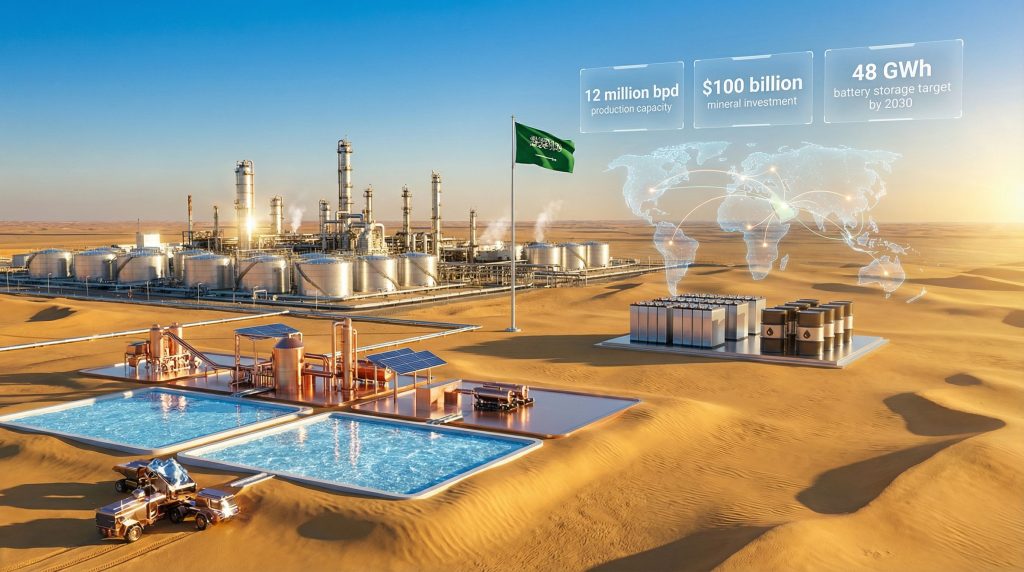
Traditional energy transition narratives assume oil-producing nations must choose between hydrocarbon revenues and renewable energy investments. Furthermore, Saudi Arabia's approach defies this binary framework through simultaneous resource maximization across multiple energy vectors. The Kingdom maintains 12 million barrels per day production capacity while deploying $100 billion toward mineral extraction infrastructure targeting battery-critical materials.
This dual-track methodology transforms apparent sector competition into complementary revenue optimization. Rather than reducing oil output, Saudi exploration strategy demonstrates how Saudi Arabia uses renewable energy development to decrease domestic consumption, freeing additional crude volumes for export markets. The strategy becomes particularly valuable during supply disruptions when oil price surge dynamics enable prices to surge above $100 per barrel, providing capital for accelerated mineral sector development.
When big ASX news breaks, our subscribers know first
Strategic Resource Optimization Framework
Current Strategic Metrics:
| Sector | 2025 Baseline | 2030 Target | Revenue Impact |
|---|---|---|---|
| Oil Production Capacity | 12.0 million bpd | 12.0 million bpd | Maintained maximum flexibility |
| Daily Export Volume | 6.19 million barrels | 7.5+ million barrels | Domestic consumption reduction |
| Battery Storage Capacity | 8 GWh | 48 GWh | Grid optimization for oil export |
| Renewable Energy Share | 15% | 50% | Hydrocarbon export liberation |
How Does Oil Field Brine Extraction Transform Infrastructure?
Saudi Arabia's partnership with Pure Lithium demonstrates innovative infrastructure repurposing that maximizes existing asset utilization. Oil field brines contain elevated lithium concentrations of 50-200 mg/L, substantially higher than seawater sources typically used for lithium extraction insights. This hypersaline solution, extracted as a petroleum production byproduct, provides direct access to battery materials without requiring separate mining operations.
The extraction process leverages solar evaporation techniques particularly suited to Saudi Arabia's desert climate:
- Evaporation Phase: 6-12 months in solar concentration ponds
- Precipitation Processing: Chemical separation of lithium compounds
- Purification Stage: Battery-grade material refinement
- Integration Advantage: 40-60% cost reduction versus hard-rock lithium mining
Consequently, this methodology transforms petroleum infrastructure into dual-purpose facilities, generating revenue from both crude oil production and lithium extraction simultaneously. According to recent oil industry analysis, the approach provides significant economic advantages compared to traditional lithium mining, which requires substantial capital expenditure for ore extraction, crushing, and chemical leaching processes.
Breaking China's Processing Monopoly Through Technological Innovation
China's dominance in battery supply chains centers not on raw material extraction but on processing infrastructure controlling 80% of global refining capacity. This bottleneck forces even mineral-rich countries like Australia to export lithium concentrates to Chinese facilities for purification to battery-grade specifications. However, Saudi Arabia's strategy targets this critical chokepoint through vertical integration and next-generation technology adoption.
What Makes Lithium Metal Technology a Game Changer?
While established manufacturers compete within lithium-ion supply chains dominated by Chinese processors, Saudi Arabia trades oil barrels for batteries by pursuing lithium metal battery technology that bypasses existing infrastructure dependencies. According to Pure Lithium CEO Emilie Bodoin, this approach circumvents Chinese supply chain control by developing processing capabilities for next-generation battery chemistries where manufacturing infrastructure hasn't yet been monopolized by existing players.
In addition, Chinese battery recycling breakthrough technologies demonstrate the competitive landscape that Saudi Arabia must navigate. Lithium metal batteries offer several performance advantages over conventional lithium-ion systems:
- Energy Density: 2-3x improvement in storage capacity per unit weight
- Charging Speed: Potential for rapid charging capabilities
- Cycle Life: Extended operational lifespan reducing replacement frequency
- Manufacturing Independence: Reduced dependence on Chinese processing facilities
Supply Chain Vulnerability Analysis
Current battery material supply chains demonstrate critical geographic concentration risks that create market manipulation opportunities and supply disruption vulnerabilities. For instance, the processing monopoly structure reveals specific chokepoints where alternative capacity could provide substantial market advantages:
Supply Chain Concentration by Stage:
- Raw Material Mining: 20% China (globally distributed)
- Concentrate Production: 40% China (some international capacity)
- Refining/Purification: 80% China (critical bottleneck)
- Battery Material Manufacturing: 70% China (emerging alternatives)
- Cell Production: 60% China (expanding globally)
Furthermore, Saudi Arabia's focus on stages 3-4 targets the highest-value processing segments while avoiding direct competition in raw material extraction where margins are typically lower and geographic advantages less significant.
Geographic Advantages in Alternative Supply Route Development
Saudi Arabia's strategic location provides access to three major market regions through established maritime corridors developed during regional conflicts that disrupted traditional Asian shipping routes. The Kingdom's western export infrastructure offers European and American battery manufacturers alternative sourcing options that reduce dependence on Asian supply chains and potential maritime chokepoints.
Export Corridor Optimization
Recent supply chain disruptions validate the strategic value of geographic diversification. Headlines from March 2026 documented significant maritime disruptions including 28 oil and gas ships stranded near the Strait of Hormuz and extensive damage to major LNG projects, demonstrating vulnerability in traditional energy supply routes.
Comparative Transit Times and Risk Assessment:
- Red Sea/Suez Route to Europe: 28-32 days transit time
- Asian Route through Malacca: 35-40 days with chokepoint exposure
- Risk Reduction: 7-10 day advantage plus alternative pathway security
- Market Access: Direct shipping to European, North American, and African battery manufacturers
These alternative corridors become particularly valuable during geopolitical tensions that threaten traditional Asian maritime routes. According to industry research, these pathways provide supply chain resilience that commands price premiums from manufacturers seeking sourcing security.
Processing Capacity Competitive Positioning
European battery manufacturers currently source processed lithium, cobalt, and nickel exclusively from Chinese refiners due to lack of alternative processing capacity. This single-source dependency creates supply security risks and limits negotiating leverage in pricing agreements. Consequently, Saudi Arabian processing facilities would provide European manufacturers with non-Chinese sourcing alternatives, potentially commanding premium pricing for supply chain diversification benefits.
The Kingdom's processing strategy encompasses complete vertical integration from raw material extraction through battery-grade purification, eliminating intermediary costs and reducing Chinese processing dependency at each value-added stage.
Financial Transformation Through Revenue Diversification
Saudi Arabia's mineral sector development represents a calculated hedge against long-term hydrocarbon demand uncertainty while capitalizing on current elevated oil prices to fund alternative revenue stream development. The Kingdom's mining sector is projected to contribute $64 billion in annual revenue by 2030, creating meaningful diversification from oil-dependent economic structure.
Investment Return Scenarios and Market Capture
The $100 billion mineral sector investment commitment requires careful analysis of potential returns across different market scenarios. Global battery storage capacity growth projections indicate demand for lithium could increase ninefold by 2040, creating substantial market opportunities for new suppliers capable of achieving competitive production costs.
Scenario Analysis Framework:
Optimistic Scenario: Battery material prices remain elevated due to supply constraints and geopolitical tensions, delivering 15-20% annual returns on mineral investments while Saudi Arabia captures 15% global market share in key materials.
Conservative Scenario: Increased global production moderates prices but Saudi Arabia's cost advantages and strategic location enable capture of 8-12% market share with stable 10-15% returns.
Risk Scenario: Technological breakthroughs reduce traditional battery material demand, requiring pivot to alternative energy storage solutions or next-generation battery chemistries.
Oil Market Impact Through Domestic Consumption Reduction
The Kingdom's 50% renewable energy target by 2030 creates substantial opportunities for crude export optimization. Current domestic oil consumption for electricity generation represents approximately 0.8-1.0 million barrels daily that could be redirected to export markets through renewable energy substitution.
Export Volume Enhancement Through Energy Transition:
- Current Domestic Consumption: ~1.0 million bpd for power generation
- Renewable Substitution Potential: ~0.6-0.8 million bpd freed for export
- Export Revenue Enhancement: $18-24 billion annually at $80/barrel oil prices
- Infrastructure Utilization: Maximum crude production capacity maintained
This approach maximizes revenue extraction from existing petroleum infrastructure while building alternative income sources, creating financial flexibility to compete aggressively in battery material markets during initial market penetration phases.
Technology Disruption Risks and Competitive Response Analysis
Saudi Arabia trades oil barrels for batteries through a strategy that faces several technological and competitive challenges that could affect investment returns and market positioning. Understanding these risks enables more accurate assessment of strategic outcomes and alternative scenario planning.
Alternative Battery Chemistry Development
Rapid advancement in solid-state batteries, sodium-ion technologies, and other alternative chemistries could reduce demand for traditional lithium-ion materials, potentially affecting long-term investment returns. However, Saudi Arabia's focus on lithium metal technology positions the Kingdom for next-generation battery applications that may require different material specifications.
Technology Risk Mitigation Factors:
- Diversified Material Portfolio: Investment in zinc, copper, and nickel provides exposure to multiple battery chemistries
- Infrastructure Flexibility: Processing facilities designed for multiple material types
- Research Investment: Technology development partnerships enabling adaptation to emerging chemistries
- Market Timing: Entry during growth phase when multiple technologies create sustained demand
Chinese Competitive Response Strategies
China's established battery material processing companies possess significant advantages including technological expertise, established customer relationships, and operational scale economies. Furthermore, the critical minerals energy transition creates additional competitive dynamics. Potential Chinese responses to Saudi competition could include:
- Price Competition: Leveraging scale economies to reduce processing costs
- Capacity Expansion: Accelerated investment in processing facility development
- Technology Advancement: Research investment in next-generation processing techniques
- Supply Chain Integration: Vertical integration securing raw material sources
Saudi Arabia's competitive advantages include oil revenue subsidization capabilities, geographic proximity to alternative markets, and strategic government support for market entry during initial phases when profitability may be limited.
The next major ASX story will hit our subscribers first
Investment Implications and Market Transformation Potential
Saudi Arabia trades oil barrels for batteries in a strategy that creates several investment themes and market dynamics that could affect various sectors and geographic regions. Understanding these implications provides insight into potential portfolio adjustments and sector rotation opportunities.
Traditional Energy Sector Valuation Impact
Oil Company Diversification Effects:
- Pure-Play Oil Stocks: Potential valuation pressure as investors adjust for reduced hydrocarbon dependence
- Integrated Energy Companies: Premium valuation for companies with battery material exposure
- Middle Eastern Oil Exporters: Competitive pressure to develop alternative revenue sources
- Geopolitical Risk Assessment: Reduced concentration risk in traditional oil supply regions
Battery Supply Chain Investment Opportunities
Saudi Arabia's market entry creates opportunities across the battery materials value chain, particularly in sectors supporting supply chain diversification and processing capacity development.
Infrastructure Development Sectors:
- Mining Equipment Suppliers: Increased demand for extraction and processing equipment
- Logistics and Transportation: New shipping routes and storage facility requirements
- Processing Technology: Equipment and expertise for battery-grade material purification
- Joint Venture Partnerships: Technology transfer agreements and strategic alliances
Electric Vehicle Manufacturing Cost Implications
Increased battery material supply competition could reduce input costs for EV manufacturers, improving unit economics and potentially accelerating adoption rates. However, initial market entry phases may involve price volatility as supply chains adjust to new sourcing alternatives.
The Kingdom's battery material strategy represents a sophisticated approach to energy transition that maintains current revenue sources while building future market positions. Success depends on execution capabilities, technological development, and competitive response from established players, but the strategic positioning provides multiple pathways for positive investment outcomes across various market scenarios.
Disclaimer: This analysis contains forward-looking statements and projections that involve significant uncertainties. Investment decisions should be based on thorough due diligence and professional financial advice. Battery material markets are subject to technological disruption, regulatory changes, and competitive dynamics that may affect projected outcomes.
Ready to Invest in the Next Major Mineral Discovery?
Discovery Alert instantly alerts investors to significant ASX mineral discoveries using its proprietary Discovery IQ model, turning complex mineral data into actionable insights. Understand why historic discoveries can generate substantial returns by visiting Discovery Alert's dedicated discoveries page, and begin your 14-day free trial today to position yourself ahead of the market.