June 11, 2026
The Hidden Architecture of Global Oil Stability
Every time a supply disruption rattles commodity markets, traders, importers, and policymakers instinctively scan the same horizon for reassurance. That reflex is not accidental. It reflects decades of structural conditioning built around a single geographic reality: the Arabian Peninsula holds a disproportionate share of the world's accessible, flexible, and rapidly deployable oil production capacity. No diversification agenda, no strategic reserve policy, and no alternative producer coalition has yet displaced the foundational role that Saudi Arabia plays as the world's de facto energy shock absorber.
Understanding why that role persists, and how it is exercised under pressure, requires looking beyond production volumes to something less visible but far more consequential: the intersection of operational resilience, financial architecture, and multilateral governance that together define what it means to function as a Saudi Arabia global energy anchor.
When big ASX news breaks, our subscribers know first
Three Pillars That Define an Energy Anchor
The concept of an energy anchor is frequently misunderstood. Volume alone does not create anchoring capacity. Russia produces enormous quantities of crude oil, yet its geopolitical conduct has repeatedly destabilised rather than stabilised markets. The United States has surged to record production levels but lacks both the spare capacity discipline and the multilateral coordination mandate that anchoring requires.
A true energy anchor must simultaneously satisfy three structural criteria:
- Deployable spare capacity that can be activated within weeks, not years, to offset supply disruptions elsewhere in the global system.
- Multilateral coordination authority within a recognised governance framework capable of calibrating collective output decisions across multiple sovereign producers.
- Financial resilience sufficient to fund crisis response, sustain capital investment, and absorb revenue volatility without compromising operational continuity.
Saudi Arabia is the only sovereign energy producer that credibly satisfies all three criteria simultaneously. This is not a matter of historical reputation. It is a structural reality validated repeatedly by observable market outcomes. Furthermore, crude oil price trends consistently reflect how central this anchoring function is to global pricing stability.
Infrastructure Under Attack: What the Recovery Metrics Reveal
Recent attacks on critical Saudi energy infrastructure created a multi-node disruption scenario that stress-tested every dimension of the Kingdom's resilience framework. The scale of what was disrupted is worth examining carefully, because it contextualises the significance of what was subsequently restored.
The Scope of Disruption
- Pumping capacity losses of approximately 700,000 barrels per day (bpd) were recorded across the East-West pipeline corridor
- Production at both the Manifa and Khurais oil fields was reduced by approximately 300,000 bpd each
- Major downstream refining operations were affected, including SATORP in Jubail, Ras Tanura, SAMREF in Yanbu, and the Riyadh refinery complex
- Processing facilities at Juaymah sustained fire damage, directly disrupting exports of liquefied petroleum gas (LPG) and natural gas liquids (NGLs) to international buyers
The downstream dimension of this disruption deserves particular attention. Attacks that reach refining infrastructure are materially more complex to absorb than upstream field outages, because refined product supply chains serve specific end-use markets with limited substitution flexibility. LPG disruptions, for instance, carry direct household and industrial energy consequences across Asia and parts of Europe that import Gulf-origin product.
Recovery Speed as a Market Signal
| Infrastructure Component | Disruption Scale | Recovery Outcome |
|---|---|---|
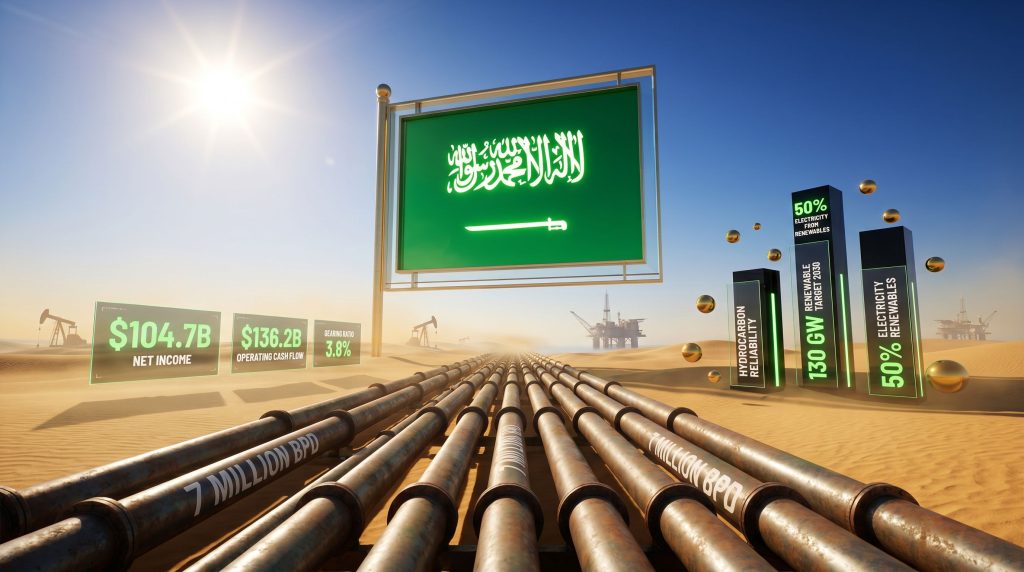
| East-West Pipeline | ~700,000 bpd capacity loss | Restored to ~7 million bpd |
| Manifa Oil Field | ~300,000 bpd production loss | Fully recovered |
| Khurais Oil Field | ~300,000 bpd production loss | Operations restored |
| SATORP, Ras Tanura, SAMREF, Riyadh Refinery | Refined product export disruption | Operational continuity restored |
| Juaymah Processing Facilities | LPG/NGL shipment disruption | Fire damage addressed |
The restoration of the East-West pipeline's pumping capacity to approximately 7 million bpd following these disruptions was completed through a combination of technical interventions and rapid operational mobilisation. Manifa field production of approximately 300,000 bpd was recovered within a timeframe that energy analysts characterised as exceptionally fast given the severity of the damage sustained.
Recovery speed is a critical pricing variable in global oil markets. Every week of delayed restoration at this scale translates into measurable upward pressure on futures pricing, drawdown of strategic petroleum reserves in importing nations, and erosion of the market confidence that underpins stable trade financing conditions.
The economic value of rapid restoration therefore extends well beyond the barrels recovered. It functions as a forward-looking credibility signal that suppresses the speculative risk premium embedded in oil futures markets for months after the disruption event itself.
OPEC+ Leadership: Coordination as Strategic Infrastructure
Saudi Arabia's governance role within the OPEC+ alliance represents a form of strategic infrastructure that is just as consequential as its physical pipeline network. The ability to coordinate production decisions across a coalition of more than twenty sovereign producers, each with distinct fiscal priorities and political constraints, is an exercise in continuous multilateral diplomacy rather than simple administrative management.
What OPEC+ Coordination Actually Involves
The common public perception of OPEC+ is of a cartel that periodically votes on production quotas. However, the operational reality is considerably more complex:
- Quota calibration requires continuous assessment of demand trajectories, competitor production trends, inventory levels, and macroeconomic conditions across major consuming regions
- Alliance cohesion maintenance involves managing competing national fiscal needs, particularly among members whose breakeven oil prices diverge by as much as $40 to $50 per barrel
- Crisis response deployment requires the ability to override consensus-based processes and move unilaterally when market stability demands speed over collective agreement
- Diplomatic capital management sustains the trust relationships with Russia, the UAE, Iraq, and other key members that make coordinated action credible to markets
OPEC's market influence is therefore not simply a function of collective volume but of the institutional architecture that makes coordinated behaviour predictable and credible. Saudi Arabia's willingness to absorb short-term revenue reductions to preserve market equilibrium is a defining feature of its anchor function. Purely profit-maximising producers increase output when prices rise and contract when prices fall, amplifying rather than dampening volatility. The Kingdom's historical pattern runs counter to this.
Furthermore, OPEC production decisions carry outsized weight precisely because Saudi Arabia has repeatedly demonstrated its willingness to act as the alliance's fiscal backstop, accepting disproportionate production cuts to enforce collective discipline.
Saudi Aramco's Financial Architecture: Balance Sheet as Energy Security Asset
The financial metrics that Saudi Aramco reported for 2025 are not simply commercial outcomes. They represent the underlying balance sheet strength that makes the anchor role operationally sustainable rather than merely aspirational.
2025 Financial Performance at a Glance
| Financial Metric | 2025 Value |
|---|---|
| Adjusted Net Income | $104.7 billion |
| Operating Cash Flow | $136.2 billion |
| Free Cash Flow | $85.4 billion |
| Capital Investment | $52.2 billion |
| Total Shareholder Distributions | $85.5 billion |
| Gearing Ratio | 3.8% |
Several dimensions of this financial profile carry strategic significance that extends beyond investor relations:
- A gearing ratio of 3.8% positions Aramco among the least leveraged major energy companies globally, a critical structural advantage when capital markets tighten during geopolitical stress cycles
- Free cash flow of $85.4 billion aligns almost precisely with total shareholder distributions of $85.5 billion, demonstrating that investor returns are being funded from operational cash generation rather than debt accumulation
- Operating cash flows of $136.2 billion create a substantial buffer for crisis-response capital expenditure without requiring external financing that could be disrupted by market conditions
A highly leveraged Aramco would face constrained capacity to fund rapid infrastructure restoration, maintain spare production capacity, and invest in long-cycle upstream development. The current balance sheet structure is therefore as important to global energy stability as the production volumes it supports.
This is a factual assessment of publicly reported financial metrics. Investors should note that past financial performance does not guarantee future results, and energy sector financials are materially sensitive to commodity price movements and geopolitical conditions.
The Dual-Track Strategy: Maintaining the Anchor While Building the Transition
One of the less commonly understood dimensions of Saudi Arabia's energy positioning is the coherence of its dual-track approach: simultaneously defending its hydrocarbon anchor role and pursuing an ambitious domestic renewable energy agenda. These two objectives are not in tension. They are structurally complementary.
The Renewable Buildout Target
The Kingdom has set a target of generating 50% of its domestic electricity from renewable sources by 2030, supported by a planned renewable capacity buildout of approximately 130 gigawatts (GW). This programme represents one of the most ambitious energy transition agendas in the Middle East and North Africa region by absolute installed capacity targets. According to the Columbia University Energy Policy Centre, these initiatives carry significant geopolitical implications that extend well beyond the Kingdom's borders.
The Current Reality Gap
Despite these stated ambitions, energy tracking data from Ember's Saudi Arabia profile indicates that approximately 99% of Saudi electricity generation was still derived from fossil fuels as recently as 2023. This gap between transition targets and current energy mix reflects both the scale of the buildout required and the long lead times inherent in large-scale renewable infrastructure development.
The strategic logic of domestic renewable deployment, however, is directly connected to the anchor role rather than separate from it:
- Every megawatt-hour of domestic electricity generated from solar or wind displaces an equivalent volume of oil or gas previously burned for domestic power generation
- Freed barrels can be redirected to export markets, increasing the volume available for supply flexibility deployment
- A lower domestic consumption intensity strengthens the Kingdom's spare capacity position relative to its total production capacity
Scenario Analysis: Three Pathways That Could Test the Anchor Role
Scenario A: Sustained Multi-Node Infrastructure Attacks
The critical variable is not whether individual disruptions can be recovered from, but whether the frequency of attacks can outpace the speed of restoration. At sufficient attack frequency, even world-class recovery capabilities face cumulative degradation risks. Strategic petroleum reserve adequacy in importing nations becomes the primary buffer mechanism in this scenario.
Scenario B: OPEC+ Alliance Fracture
A breakdown in Saudi-Russia coordination would dissolve the primary mechanism for collective supply management. Without multilateral governance, individual producer incentives shift toward volume maximisation, creating conditions for price wars that destabilise both producer fiscal positions and consumer inflation dynamics simultaneously. In addition, OPEC demand forecasts would lose much of their credibility as a forward-guidance mechanism without Saudi Arabia's stabilising presence.
Scenario C: Accelerated Energy Transition Demand Erosion
A faster-than-projected structural decline in global oil demand driven by electric vehicle penetration, industrial electrification, and policy-driven fuel switching would gradually erode the structural value of the anchor role. However, IEA and other forecasting bodies have consistently revised oil demand decline timelines outward as actual adoption curves lag initial projections. Saudi Arabia's domestic renewable investments represent a partial hedge against this long-run scenario.
The next major ASX story will hit our subscribers first
Why the Anchor Concept Matters More Now Than a Decade Ago
The compounding of geopolitical fragmentation, climate-driven infrastructure vulnerability, and post-pandemic supply chain reconfiguration has made the global energy system structurally more fragile than it was in the early 2010s. Strategic petroleum reserves in major consuming nations have been drawn down and not fully replenished. Alternative producer regions carry higher political risk premiums. Energy trade financing operates under greater sanctions-related uncertainty.
Against this backdrop, the existence of a credible, financially robust, and operationally tested Saudi Arabia global energy anchor becomes more valuable to global economic stability, not less. The recent infrastructure disruption and recovery cycle did not simply demonstrate that Saudi Arabia could absorb a shock. It demonstrated, under live conditions and at material scale, that the anchor function remains intact and operational when the global energy system needs it most.
That validation carries an economic value that no production quota announcement or diplomatic statement can replicate.
This is a factual assessment based on publicly available information. It does not constitute financial or investment advice.
Want To Stay Ahead Of The Next Major Commodity Market Shift?
Discovery Alert's proprietary Discovery IQ model delivers real-time alerts on significant ASX mineral discoveries, translating complex mineral data into actionable investment insights for both short-term traders and long-term investors. Explore historic examples of exceptional discovery returns or visit the Discovery Alert home page to begin your 14-day free trial and secure your market-leading advantage today.