May 22, 2026
When Pricing Formulas Become Demand Killers
There is a well-understood tension in commodity markets between value maximisation and volume preservation. Producers who price aggressively during periods of scarcity can extract significant short-term revenue, but they also risk accelerating demand destruction and, in doing so, training buyers to seek alternatives. This tension rarely manifests as cleanly or as visibly as it has in the Asian crude oil market during the first half of 2026, where the question of why Saudi Arabia is losing Asia's oil buyers has become one of the defining stories in global energy.
The answer is not primarily about geography, logistics, or geopolitical alignment. It is about the mechanics of a pricing system that was built to capture value in tight markets and has now produced an output that many of the world's largest refiners simply cannot afford to absorb. Furthermore, crude oil price volatility has amplified these pressures in ways that compound the underlying structural challenges.
When big ASX news breaks, our subscribers know first
The OSP Mechanism: How Saudi Arabia Prices Its Crude
Differentials, Benchmarks, and the Dubai Forward Curve
Saudi Aramco does not sell crude at a spot price negotiated deal by deal. Instead, it publishes an Official Selling Price (OSP) each month, structured as a differential added to or subtracted from the Dubai benchmark's monthly average. This differential is not set arbitrarily. It is heavily shaped by the Dubai M1-M3 spread, which measures the price gap between the nearest futures contract month and the contract three months forward.
When the front month trades at a significant premium to later months, a condition known as backwardation, the market is signalling intense near-term scarcity. Saudi Aramco's formula interprets this signal as an instruction to widen the differential, capturing as much of that scarcity premium as possible. In normal market conditions, this is a commercially rational mechanism. However, in the context of 2026's Hormuz disruption, it produced differentials that fundamentally broke the commercial logic for Asian buyers.
The trajectory tells the story clearly:
| Month | Arab Light OSP Differential | Dubai Benchmark (approx.) | Estimated All-In Price |
|---|---|---|---|
| Jan-Feb 2026 (pre-crisis) | ~$1/bbl | ~$80-85/bbl | ~$81-86/bbl |
| March 2026 | ~$2/bbl | $97-102/bbl | ~$99-104/bbl |
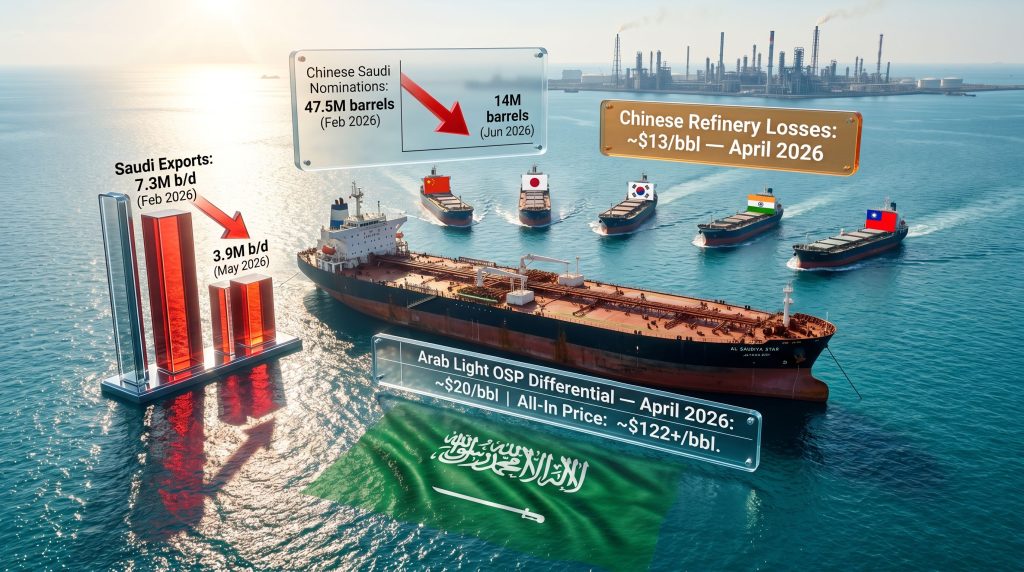
| April 2026 | ~$20/bbl | $102+/bbl | ~$122+/bbl |
| May 2026 | ~$16/bbl | $102+/bbl | ~$118+/bbl |
The Dubai M1-M3 spread averaged approximately $37/bbl in March 2026, reflecting extreme near-term tightness. By April it had compressed to around $13/bbl, and by May it was averaging approximately $8/bbl. As this spread normalises, the mechanical output of the formula should push differentials back toward $7-8/bbl. However, the demand damage inflicted during the high-differential months does not automatically reverse when the formula corrects.
The Hormuz Disruption and the Export Bottleneck
Infrastructure That Cannot Fully Replace a Blocked Chokepoint
Saudi Arabia's primary crude export route historically passed through the Arabian Gulf and the Strait of Hormuz. The US-Iran conflict has severely constrained Hormuz transit, forcing a reroute through the East-West Pipeline to Yanbu on the Red Sea coast. This pipeline carries an operational capacity of approximately 5 million b/d, with reported maximum capacity closer to 7 million b/d.
The challenge is that this capacity is not entirely available for export. Five refineries situated along Saudi Arabia's Red Sea coast absorb a significant portion of that pipeline throughput:
- SAMREF (Yanbu)
- YASREF (Yanbu)
- Yanbu Refinery
- Petro Rabigh
- Jazan Refinery
Together, these facilities consume approximately 1.8 million b/d of pipeline capacity, leaving a meaningfully constrained export window through Yanbu. Consequently, Saudi Arabia faces simultaneous constraints on both its physical ability to move barrels and on buyer willingness to purchase them at prevailing prices. According to reporting from OilPrice.com, the war-related chokepoint has sharply reduced Saudi Arabia's options for maintaining volume commitments to Asian customers.
The Grade Problem That Compounds the Pricing Problem
A less-discussed but commercially important consequence of the Yanbu reroute is the narrowing of the available crude grade offering. Rerouting operations through a single terminal has concentrated Saudi export flows predominantly in Arab Light. Many Asian refineries, however, are configured to process a broader spectrum of medium-sour grades, meaning the restricted supply slate gives buyers both an economic reason and a technical reason to source elsewhere.
This grade mismatch represents a structural commercial disadvantage that pricing adjustments alone cannot fully resolve. In addition, geopolitical trade tensions across the broader region have made alternative routing strategies more difficult to implement at short notice.
A tanker routing strategy can bypass a chokepoint, but it cannot replace the full range of grades that a major exporter has historically delivered through multiple terminals. Grade flexibility matters to complex refineries as much as price.
Saudi Export Volume Collapse: The Data in Context
Saudi crude exports stood at approximately 7.3 million b/d in February 2026, before the crisis escalated. The decline since then has been rapid:
- March 2026: approximately 4.4 million b/d (a drop of nearly 3 million b/d in a single month)
- April 2026: approximately 4.1 million b/d
- May 2026: approximately 3.9 million b/d, approaching historic lows
According to data published by JODI, Saudi crude exports have sunk to record low levels, a development that reflects not only the Hormuz logistics constraint but the growing unwillingness of Asian buyers to nominate cargoes at prevailing OSP levels. OPEC's market influence has also been called into question as member states struggle to align production policy with a rapidly shifting demand landscape.
Country-by-Country: How Asia's Biggest Buyers Are Responding
China: The Sharpest Contraction From the Largest Customer
China was receiving approximately 1.6 million b/d of Saudi crude in February 2026. By April, arrivals had fallen to approximately 1.2 million b/d, with May arrivals expected closer to 1.1 million b/d. By June, intake is projected to fall to approximately 600,000 b/d, roughly half of April's volume. Understanding the China demand outlook is therefore central to understanding why Saudi Arabia is losing Asia's oil buyers at such a rapid pace.
The nomination data from major Chinese buyers illustrates the scale of the retreat:
| Buyer | Feb 2026 Nominations | May 2026 Nominations | June 2026 Nominations |
|---|---|---|---|
| Sinopec | ~10 million barrels | ~2 million barrels | ~2 million barrels |
| Rongsheng | ~7 million barrels | Not reported | ~1 million barrels |
| All Chinese buyers (total) | ~47.5 million barrels | Not reported | ~14 million barrels |
| All Chinese buyers (b/d equiv.) | ~1.7 million b/d | Not reported | ~460,000 b/d |
The macroeconomic backdrop in China has amplified the price sensitivity of these buyers. Chinese refinery runs fell to approximately 13.3 million b/d in April 2026, the lowest throughput since August 2022. Chinese oil product exports dropped to a decade low of approximately 3.1 million tonnes in April, collapsing crack spreads across the barrel. Chinese refiners were reportedly losing approximately $13/bbl on crude processed in April 2026.
Higher domestic fuel prices have also suppressed end-user demand. China has additionally begun drawing on its own strategic crude reserves, further reducing the urgency to purchase expensive imported barrels. China's total seaborne crude imports have declined sharply:
| Month | Estimated Chinese Seaborne Crude Imports | Month-on-Month Change |
|---|---|---|
| February 2026 | ~11.5 million b/d | Baseline |
| March 2026 | ~10.1 million b/d | ~-12% |
| April 2026 | ~7.9 million b/d | ~-22% |
| May 2026 (projected) | ~6.7 million b/d | ~-17% |
When refiners are operating at a loss of $13 per barrel processed, the commercial calculus is unambiguous: source the cheapest secure supply available, not the most geographically reliable supply at a premium price.
Japan, South Korea, and India: Regional Defection Across the Board
The pullback is not confined to China. Japan historically imported between 1.0 and 1.2 million b/d of Saudi crude before the crisis. By March and April 2026, arrivals had fallen to approximately 202,000 b/d, and by May only two Saudi cargoes had sailed to Japan, equivalent to roughly 130,000 b/d. Japan's broader Middle East crude imports have fallen to their lowest level on record.
South Korean loadings from Saudi Arabia in May 2026 are projected to fall approximately 35% from April, dropping from around 780,000 b/d to approximately 530,000 b/d. India, despite its structural need for medium-sour grades that would ordinarily make it a natural Saudi customer, is projected to receive approximately 450,000 b/d in May, down roughly 30% from April's ~670,000 b/d. India has been actively exploring direct Gulf loading arrangements and alternative routing strategies. Furthermore, the broader trade war impact on Asian economies has compressed refinery margins region-wide, making expensive Saudi barrels even harder to justify commercially.
Taiwan has also reduced forward Saudi nominations, completing a picture in which every major Asian Saudi customer has simultaneously cut volumes for May and June 2026.
Who Is Filling the Gap Saudi Arabia Has Left Behind
The Beneficiaries of a Pricing Disadvantage
When the world's largest crude exporter becomes temporarily non-competitive on price, market participants move quickly to identify alternatives. Several producers have benefited from Saudi Arabia's reduced commercial attractiveness in Asian markets:
- Brazil has emerged as a notable emergency supplier to Asian markets, offering competitively priced long-haul barrels at a time when Atlantic Basin alternatives have become more attractive than usual. Brazilian crude exports to Asia have expanded materially during this period.
- West African producers, including Nigeria and Angola, have been able to offer medium-gravity alternatives at pricing more compatible with current Asian refinery economics. Nigeria has separately announced targets to increase output by 100,000 b/d to capitalise on the supply disruption.
- US crude exports to Asia have expanded as American producers seek to fill the gap created by constrained Middle Eastern flows.
- Russian crude, where accessible under prevailing sanctions frameworks, continues to attract price-sensitive Asian buyers due to its persistent discount structure.
The Critical Distinction Between Opportunistic and Structural Diversification
Most analysts treat the current shift as primarily cyclical rather than structural, driven by a logistics-and-pricing shock rather than a permanent reorientation of Asian energy strategy. However, there is a meaningful risk embedded in this assumption. The longer Asian refiners operate on alternative supply chains, the more institutionally embedded those relationships become.
Procurement teams develop familiarity with new grade specifications, shipping arrangements are renegotiated, and long-term supply agreements are evaluated. According to analysis from the Financial Post, Saudi oil sales to top Asian buyers are set to drop markedly as Hormuz disruptions deepen, a development that risks becoming self-reinforcing if alternative procurement channels solidify.
If Chinese refinery margins remain deeply negative through Q3 2026, even a mechanically corrected Saudi OSP differential may prove insufficient to restore pre-crisis nomination volumes. The pricing trap can persist beyond the logistics disruption that initially triggered it.
The next major ASX story will hit our subscribers first
The IEA Warning and the July-August Risk Window
An additional layer of urgency surrounds the near-term outlook. The International Energy Agency has flagged the potential for oil markets to enter a critical supply-demand imbalance by July-August 2026, suggesting that the current pricing environment may intensify before it resolves. Goldman Sachs has separately sounded fresh alarms on the trajectory of global oil stockpiles.
This creates a paradoxical situation: a supply tightness that would ordinarily support Saudi pricing power is occurring simultaneously with a demand destruction event in Saudi Arabia's core market. The physical tightness elevates benchmark prices, which feeds into OSP differentials, which erodes buyer appetite in Asia at precisely the moment when global markets are tightest. The pricing mechanism is working as designed, but it is operating in a demand environment where its outputs are commercially untenable for the buyers it most needs to retain.
Can Saudi Arabia Recover Its Asian Market Share?
The Recovery Case
Saudi Arabia's structural advantages in Asian crude markets remain intact. Geographic proximity relative to Atlantic Basin suppliers, decades of established refinery configuration relationships, and deep long-term supply contract networks provide a resilient foundation. As the Dubai forward curve flattens and the M1-M3 spread compresses toward the $7-8/bbl range, OSP differentials should mechanically decline.
If Hormuz transit conditions stabilise, Saudi Arabia's full export infrastructure — including its Gulf loading terminals — would become available again, substantially expanding both volume capacity and grade optionality.
The Prolonged Loss Case
The counterargument centres on the persistence of negative refinery economics in China and the accumulation of alternative supply relationships across the region. Several compounding factors support the view that recovery will be slower than the pricing mechanism alone would suggest:
- Refiners that have reconfigured procurement strategies around alternative grades face switching costs when returning to Arab Light.
- China's government restrictions on product exports have structurally impaired refinery economics in ways that are not immediately resolved by cheaper crude input costs.
- Strategic reserve drawdowns in China have reduced the urgency of import resumption regardless of price normalisation.
- The broader geopolitical risk premium now attached to Middle Eastern crude may encourage some buyers to structurally diversify their supply base beyond the duration of the current crisis.
The Strategic Dilemma for Saudi Aramco
The kingdom faces a dilemma that has no comfortable resolution in the short term. Reducing OSP differentials proactively to recover demand would sacrifice revenue per barrel at a time when fiscal requirements remain elevated. Maintaining premiums preserves per-barrel margin but accelerates volume loss and potentially deepens the supply relationships that Asian buyers are building with alternative producers.
The pricing formula did exactly what it was designed to do. It successfully captured the scarcity premium during a period of extreme market tightness. The difficulty is that the buyers on the other end of the transaction were simultaneously losing money, drawing down reserves, and actively searching for cheaper alternatives. In that environment, the most expensive reliably available barrel is not the most commercially compelling option — and why Saudi Arabia is losing Asia's oil buyers may ultimately be less about geopolitics than about the unintended consequences of a pricing system that captured maximum value at precisely the wrong moment.
Disclaimer: This article is for informational purposes only and does not constitute financial or investment advice. Forecasts and projections referenced herein involve inherent uncertainty and should not be relied upon as predictions of future market conditions.
Want To Stay Ahead Of The Next Major Commodity Market Shift?
Discovery Alert's proprietary Discovery IQ model scans ASX announcements in real time, instantly identifying significant mineral discoveries and turning complex commodity data into actionable investment insights — whether you're tracking energy, metals, or emerging resource plays. Explore historic discoveries and their market returns, then start your 14-day free trial at Discovery Alert to position yourself ahead of the market.