May 19, 2026
The Global Mining Paradigm Shift: How Strategic Resource Positioning Drives Economic Transformation
The mineral extraction landscape undergoes fundamental realignments when nations recognise their geological endowments as engines for economic diversification. Saudi Arabia mining expansion represents one of the most ambitious attempts to restructure a petroleum-dependent economy through strategic resource development. Throughout history, resource-rich territories have navigated complex transitions from single-commodity dependencies toward integrated mining ecosystems that support broader industrial development.
Modern mining expansion initiatives emerge from intersection points where geological opportunity meets economic necessity. Countries possessing significant untapped mineral resources increasingly develop comprehensive strategies that extend beyond traditional extraction models toward value-added processing, technology integration, and international partnership structures. These approaches reflect recognition that mineral wealth alone provides insufficient foundation for long-term economic transformation without accompanying infrastructure, regulatory frameworks, and human capital development.
When big ASX news breaks, our subscribers know first
Vision 2030: Architecting Mining-Led Economic Diversification
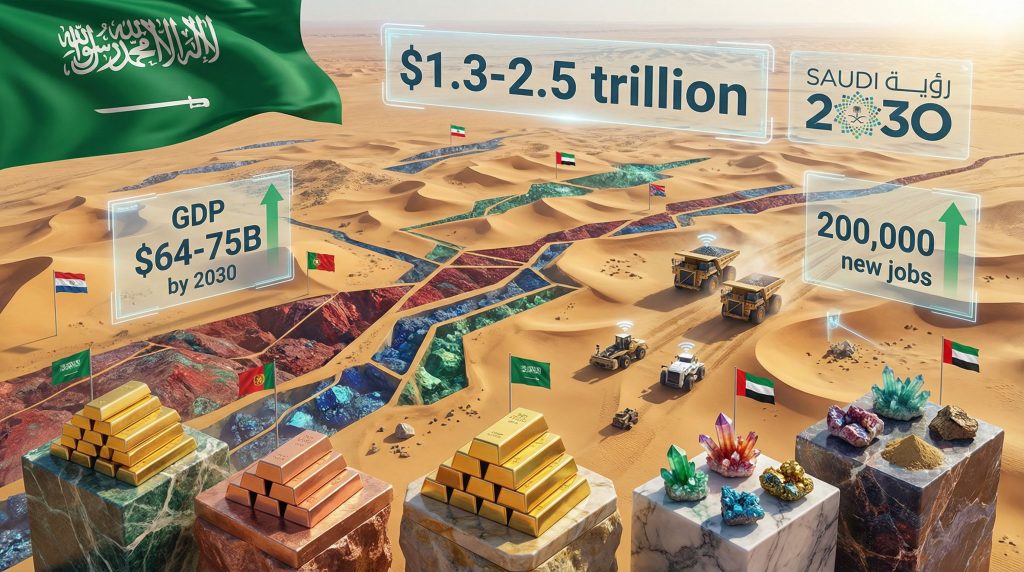
The Kingdom's mineral sector transformation represents one of the most ambitious attempts to restructure a petroleum-dependent economy through Saudi Arabia mining expansion. Central to this initiative stands the recognition that the nation's geological formations contain mineral wealth potentially valued between $1.3 trillion and $2.5 trillion, representing untapped resources that could fundamentally alter regional economic dynamics.
The gold market surge has created favourable conditions for precious metals development initiatives. Furthermore, global demand for critical minerals for energy transition strengthens the strategic positioning of mineral-rich nations seeking economic diversification.
Key Economic Transformation Targets:
• GDP contribution expansion from current $17 billion baseline to projected $64-75 billion by 2030
• Employment generation of approximately 200,000 positions across direct mining operations and supporting industries
• Integration of mining revenues into broader economic diversification portfolio
• Development of mineral processing capabilities to capture value-added manufacturing opportunities
The ambitious timeline reflects understanding that mineral resource development requires extended lead times for exploration, permitting, construction, and operational ramp-up phases. Success depends on simultaneous advancement across multiple fronts including regulatory reform, infrastructure development, international partnership cultivation, and domestic capability building.
This diversification strategy acknowledges global energy transition trends that may reduce long-term petroleum demand while simultaneously creating expanded demand for critical minerals essential to renewable energy technologies, electric vehicle manufacturing, and advanced battery systems.
Strategic Mineral Portfolio Development: Critical Resources for Global Markets
The mineral resource development strategy encompasses multiple commodity categories positioned to serve both domestic industrial development and international export markets. This diversified approach provides risk mitigation against commodity price volatility while establishing multiple revenue streams from different geological formations and processing pathways.
Gold and Precious Metals Infrastructure
Gold mining operations anchor the precious metals development strategy, with the Mansourah Massarah operations serving as the flagship project demonstrating commercial viability and operational excellence in desert mining conditions. Current production capabilities provide baseline for expansion into additional gold-bearing geological formations throughout the Arabian Shield region.
Operational Considerations:
• Desert mining technology adaptation for extreme temperature conditions
• Water management systems optimised for arid environment operations
• Remote location logistics coordination for equipment and personnel transport
• Integration with existing industrial infrastructure for processing and export
The precious metals strategy extends beyond gold to encompass silver, platinum group metals, and other valuable minerals that command premium pricing in international markets while requiring sophisticated extraction and processing technologies.
Battery Metals: Positioning for Energy Transition
Lithium, cobalt, nickel, and related battery metals represent strategic priorities aligned with global electric vehicle adoption and energy storage system deployment. Development of a battery-grade lithium refinery demonstrates the technological sophistication required for value-added processing capabilities.
Technology Integration Priorities:
• Advanced lithium extraction technologies suitable for desert geological conditions
• Integrated refinery development for battery-grade lithium production
• Copper smelting partnerships with established international operators
• Quality control systems meeting automotive industry specifications
Battery metals development requires particularly sophisticated processing capabilities, as automotive and electronics manufacturers demand precise chemical compositions and purity levels that exceed traditional industrial applications. Moreover, AI in drilling & blasting technologies enhance operational efficiency whilst reducing environmental impact.
Industrial Minerals and Base Metals
Phosphate production supports agricultural sector development whilst providing export opportunities to regional markets experiencing growing food security concerns. The integration of phosphate mining with domestic fertiliser production creates downstream value capture whilst supporting agricultural productivity improvements.
Bauxite reserves enable aluminium value chain development, from ore extraction through alumina refining to aluminium smelting operations. This vertical integration approach maximises value capture whilst reducing dependence on imported aluminium products for domestic construction and manufacturing industries.
Competitive Licensing Framework: Attracting International Investment Through Transparent Bidding
The mining sector development strategy employs competitive bidding rounds designed to attract experienced international operators whilst ensuring optimal terms for national resource development. This approach balances investment attraction with strategic control over mineral resource development pace and direction. Additionally, Saudi exploration licenses demonstrate the Kingdom's commitment to transparent resource allocation mechanisms.
| Bidding Round | Area Coverage | Participating Companies | Investment Commitments | Strategic Significance |
|---|---|---|---|---|
| 9th Round | 172 exploration sites | 24 international companies | SAR 671 million ($179 million) | Largest participation to date |
| 10th Round (Planned) | 13,000 square kilometres | Multiple international bidders | Target: $27-200 billion range | 2026 announcement timeline |
| Future Rounds | Expanding coverage | Growing international interest | Multi-billion dollar projections | 2026-2027 development window |
Bidding Process Innovation Elements:
• Performance-based evaluation criteria emphasising technical capability and financial commitment
• Transparent scoring systems reducing regulatory uncertainty for international investors
• Geographic diversification ensuring balanced exploration across different geological formations
• Technology transfer requirements promoting domestic capability development
The competitive framework addresses historical concerns among international mining companies regarding regulatory predictability and investment security in emerging mining jurisdictions. Clear evaluation criteria and transparent processes reduce political risk perceptions whilst ensuring competitive terms for resource access rights.
How Does Regulatory Reform Transform Investment Climate?
Comprehensive regulatory reforms target key barriers that previously limited international mining investment interest. These changes reflect systematic analysis of competitive mining jurisdictions and adoption of global best practices adapted to local conditions and strategic objectives.
Tax Structure Optimisation
The corporate tax framework underwent substantial revision to enhance competitiveness relative to established mining jurisdictions. Previous tax burdens approaching 45% created significant disadvantages compared to competing locations, whilst reformed rates of 20% align with global standards for mining investment attraction.
Enhanced Investment Incentives:
• Exploration phase tax exemptions encouraging early-stage investment
• Development phase deferrals supporting project construction financing
• Accelerated depreciation schedules for specialised mining equipment purchases
• Performance bonuses for exceeding production or employment targets
These incentive structures recognise the extended timelines and capital intensity characteristic of mining project development whilst providing measurable benefits for companies meeting strategic development objectives.
Foreign Investment Facilitation
Streamlined permitting processes address previous concerns regarding regulatory complexity and approval timeline uncertainty. Standardised procedures with defined review periods provide investors with predictable development schedules essential for project financing and partnership agreements.
Ownership Structure Flexibility:
• Joint venture frameworks accommodating various partnership structures
• Foreign ownership permissions aligned with international investment patterns
• Profit repatriation guarantees protecting investor capital recovery rights
• Dispute resolution mechanisms providing legal certainty for international operations
These reforms reflect recognition that mining projects require substantial upfront capital investment with extended payback periods, necessitating strong legal protections for international investor interests.
Technology Integration: Advanced Mining Solutions for Desert Conditions
The harsh desert environment demands specialised technological approaches that exceed standard mining industry practices. Extreme temperatures, water scarcity, and remote locations create operational challenges requiring innovative solutions and equipment adaptations.
Digital Mining Infrastructure Development
Artificial intelligence applications in geological analysis enable more precise resource modelling whilst reducing exploration costs and timeline requirements. Machine learning algorithms analyse geological survey data, satellite imagery, and historical exploration results to identify high-potential target areas for detailed investigation.
Autonomous Equipment Deployment:
• Self-driving haul trucks adapted for desert navigation and dust conditions
• Automated drilling systems reducing human exposure to extreme temperatures
• Remote-controlled processing equipment enabling centralised operation centres
• Predictive maintenance systems minimising equipment downtime in remote locations
Autonomous systems provide particular advantages in desert mining environments where human safety concerns, accommodation costs, and transportation logistics create significant operational challenges for traditional mining approaches.
What Drives Operational Excellence Through Innovation?
Advanced geophysical survey techniques enable deeper exploration capabilities whilst reducing surface disturbance in environmentally sensitive areas. Three-dimensional seismic analysis, electromagnetic surveys, and satellite-based gravity measurements provide detailed subsurface information without extensive physical exploration activities.
Skills Development Integration:
• International training partnerships with established mining education institutions
• Technology localisation programmes encouraging domestic innovation development
• Apprenticeship programmes combining theoretical education with practical experience
• Safety protocols specifically adapted for desert mining operational conditions
These capability development initiatives address the limited domestic mining expertise whilst building sustainable human capital foundations for long-term sector growth.
The next major ASX story will hit our subscribers first
International Strategic Partnerships: Global Mining Integration
Major international mining companies and technology providers view the Saudi Arabia mining expansion as an opportunity to participate in large-scale resource development whilst accessing strategic mineral supplies for their global operations. These partnerships combine international expertise with domestic resources and development capital.
According to S&P Global Market Intelligence, the Kingdom's mining ambitions could position it as a significant player in global mineral markets. Furthermore, the strategic focus on critical minerals aligns with global mining industry trends toward supply chain diversification.
Major Investment Commitments
"International mining companies are committing substantial capital to Saudi Arabian operations, with Vedanta's $2 billion copper smelting facility representing the scale of confidence in the Kingdom's mineral development potential. These investments signal major commodity trader validation of Saudi Arabia's strategic mineral positioning."
Key Partnership Categories:
• European Technology Integration: Specialised equipment suppliers providing desert-adapted mining solutions with technology transfer agreements
• Asian Processing Partnerships: Battery technology collaboration with Japanese and South Korean manufacturers seeking secure mineral supply chains
• North American Expertise: Canadian geological consulting and mining engineering services supporting exploration and development phases
• Resource Group Collaborations: Eurasian Resources Group's $50 million exploration commitment demonstrating international confidence in geological potential
These partnerships provide access to proven mining technologies whilst ensuring knowledge transfer to domestic operators and supporting local content development requirements.
Infrastructure Development: Enabling Mining Sector Growth
Large-scale mining operations require substantial infrastructure investments extending beyond individual mine sites to encompass regional transportation, energy, and logistics systems. This infrastructure development creates economic benefits extending throughout surrounding regions whilst supporting future mining project development.
Transportation and Logistics Networks
Rail network extensions connect remote mining regions with processing facilities and export terminals, reducing transportation costs whilst enabling larger-scale operations. Desert highway construction provides reliable access for equipment transport and personnel movement between mining sites and urban centres.
Specialised Infrastructure Requirements:
• Port facility upgrades accommodating bulk mineral export volumes
• Pipeline systems for mineral slurry transport reducing trucking requirements
• Equipment maintenance facilities positioned strategically throughout mining regions
• Communication networks enabling remote monitoring and operational coordination
This infrastructure development creates positive spillover effects for other economic activities whilst establishing foundations for additional mining project development in surrounding areas.
Energy and Water Management Systems
Renewable energy integration reduces operational costs whilst supporting national sustainability objectives. Solar power systems provide particular advantages in desert locations with abundant solar resources and proximity to mining operations requiring substantial electricity consumption.
Water Resource Management:
• Desalination facilities providing process water for mineral processing operations
• Water recycling systems minimising freshwater consumption requirements
• Underground water resource assessment ensuring sustainable extraction practices
• Wastewater treatment enabling discharge compliance with environmental standards
These utilities represent essential enabling infrastructure for mining operations whilst demonstrating environmental responsibility and operational sustainability.
Global Commodity Market Implications: Strategic Supply Chain Positioning
Saudi Arabia mining expansion has potential to influence global commodity markets through increased supply availability and alternative supplier options for major industrial consumers. This market positioning provides strategic advantages whilst creating new competitive dynamics in established commodity trading relationships.
Supply Chain Diversification Impact
International manufacturers increasingly seek supplier diversification to reduce concentration risk and enhance supply security. Saudi Arabian mineral production provides alternative sourcing options for companies concerned about geopolitical stability in traditional mining regions.
Market Dynamics Influence Factors:
• Critical Mineral Supply Security: Reduced dependence on traditional supplier countries for key manufacturing inputs
• Price Discovery Mechanisms: Planned metals exchange development providing regional commodity pricing benchmarks
• Long-term Supply Contracts: Guaranteed delivery agreements with international buyers reducing market volatility exposure
• Technology-Driven Cost Advantages: Innovation in desert mining potentially creating competitive production cost structures
These market developments could reshape existing supplier relationships whilst providing new options for companies seeking stable, long-term mineral supply agreements.
Environmental and Social Governance Framework: Sustainable Mining Development
Mining operations in environmentally sensitive desert ecosystems require comprehensive environmental management systems addressing water consumption, habitat protection, and community impact considerations. These frameworks align with international sustainability standards whilst supporting social licence for long-term operations.
Sustainability Integration Strategies
Net-zero emissions targets by 2060 drive adoption of renewable energy systems, electric vehicle fleets, and carbon capture technologies in mining operations. Water conservation technologies address the critical challenge of operating in water-scarce environments whilst maintaining production requirements.
Community Development Priorities:
• Local employment preferences creating economic opportunities for regional communities
• Infrastructure development benefiting surrounding populations through improved transportation and utilities access
• Cultural heritage protection ensuring mining activities respect archaeological and cultural sites
• Revenue sharing mechanisms providing direct community benefits from mining operations
These governance frameworks address stakeholder concerns whilst building social support for mining sector expansion among local communities and international observers.
Implementation Challenges: Managing Complex Development Requirements
Large-scale mining development in challenging environmental conditions creates multiple implementation risks requiring sophisticated management approaches. Technical, economic, and social challenges must be addressed simultaneously to ensure successful project outcomes.
Technical and Operational Complexities
Extreme desert conditions affect equipment performance, maintenance requirements, and operational efficiency in ways that exceed standard mining industry experience. Temperature extremes, sand infiltration, and equipment wear patterns require specialised solutions and maintenance protocols.
Resource Management Challenges:
• Water Scarcity: Limited freshwater availability requiring innovative conservation and recycling systems
• Remote Location Logistics: Transportation costs and scheduling complexities for equipment, supplies, and personnel
• Skilled Workforce Development: Limited domestic mining experience necessitating extensive training programmes and international expert recruitment
• Technology Adaptation: Proven mining technologies requiring modification for desert operational conditions
These operational challenges require substantial upfront investment in specialised equipment, training programmes, and operational procedures that may exceed initial project estimates.
Market and Economic Risk Factors
Global commodity price volatility creates uncertainty for long-term project economics, particularly given the extended development timelines characteristic of large-scale mining operations. Currency exchange rate fluctuations affect international partnership arrangements and equipment procurement costs.
Competitive Positioning Risks:
• Established Mining Jurisdictions: Competition from countries with proven mining sectors and established infrastructure
• Technology Learning Curves: Initial operational inefficiencies whilst adapting technologies and developing expertise
• Market Entry Timing: Commodity cycle positioning affecting project profitability during operational phases
• Regulatory Evolution: Potential policy changes affecting long-term operational conditions and investment returns
These risk factors require comprehensive scenario planning and adaptive management strategies capable of responding to changing market conditions.
Success Measurement Framework: 2030 Strategic Outcomes
Comprehensive performance indicators track progress across economic, social, and environmental dimensions whilst providing accountability mechanisms for strategic objective achievement. These metrics enable course corrections and adaptive management approaches as implementation progresses.
Economic Performance Indicators
Mining sector GDP contribution growth provides primary measurement of economic diversification success, whilst employment creation demonstrates social impact achievement. Export revenue diversification beyond petroleum products indicates successful mineral market penetration and commodity portfolio development.
Strategic Development Metrics:
• International Investment Attraction: Foreign direct investment levels and partnership quality indicators
• Domestic Mineral Processing Capacity: Value-added manufacturing development and technology transfer achievement
• Exploration Success Rates: Resource discovery efficiency and reserve replacement performance
• Infrastructure Development: Transportation, energy, and utilities capacity creation supporting sector growth
These performance indicators provide measurable benchmarks for evaluating strategic objective achievement whilst identifying areas requiring additional focus or policy adjustment.
Long-term Strategic Positioning Outcomes
Regional mining hub establishment requires sustained competitive advantages in cost, quality, and reliability relative to alternative suppliers. Critical mineral supply chain integration provides strategic influence in global manufacturing networks whilst supporting domestic industrial development objectives.
Innovation Leadership Development:
• Desert Mining Technology Centre: Innovation hub development for arid region mining solutions applicable globally
• Sustainable Mining Practices: Environmental leadership in water conservation and renewable energy integration for mining operations
• Regional Industry Integration: Cross-border partnerships and supply chain coordination throughout Middle Eastern markets
• Knowledge Economy Transition: Research and development capabilities supporting continued technological advancement and competitive positioning
These strategic outcomes extend beyond immediate economic benefits toward sustainable competitive advantages supporting long-term mineral sector leadership and regional economic influence.
This analysis provides comprehensive examination of Saudi Arabia's mining expansion strategy within global industry context. Readers seeking additional perspectives on regional mining development initiatives and Vision 2030 implementation progress may explore supplementary industry publications and governmental resources for continued analysis.
Disclaimer: This article presents analysis based on publicly available information and industry reports. Mining investments involve substantial risks including commodity price volatility, regulatory changes, and operational challenges. Readers should conduct independent research and consult qualified professionals before making investment decisions.
Ready to Capitalise on the Next Major Mineral Discovery?
Discovery Alert's proprietary Discovery IQ model delivers instant notifications on significant ASX mineral discoveries, empowering subscribers to identify actionable opportunities ahead of the broader market. Understand why major mineral discoveries can lead to substantial market returns by exploring Discovery Alert's dedicated discoveries page, showcasing historic examples of exceptional outcomes, and begin your 14-day free trial today to position yourself ahead of the market.