June 27, 2026
Strategic Mining Expansion Reshapes Middle Eastern Resource Landscape
The global minerals sector stands at an inflection point where traditional resource powers face mounting competition from emerging mining jurisdictions. Across commodity markets, supply chain vulnerabilities exposed during recent geopolitical tensions have accelerated the search for alternative sourcing strategies. Against this backdrop, the Saudi Arabia mining tender initiative and strategic mineral discoveries are fundamentally altering the competitive dynamics that have defined resource extraction for decades.
Resource-rich nations are increasingly leveraging advanced digital platforms and streamlined regulatory frameworks to attract international mining capital. This technological transformation of traditional tender processes reflects broader industry shifts toward transparency, efficiency, and competitive accessibility. The convergence of geological potential with institutional modernisation creates unprecedented opportunities for both host countries and international exploration companies.
When big ASX news breaks, our subscribers know first
Mining Tender Specifications and Strategic Framework
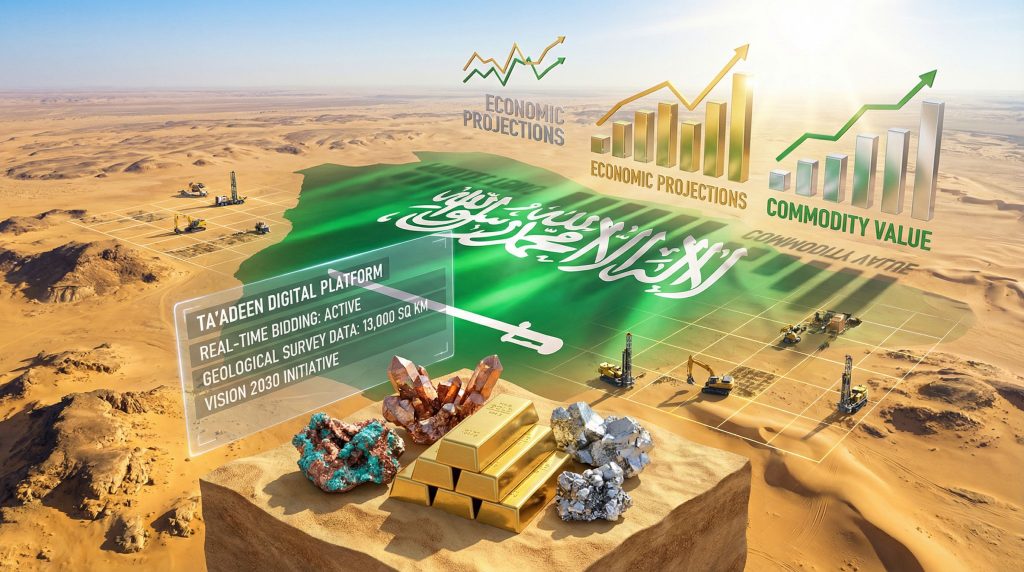
Saudi Arabia's latest exploration initiative encompasses 13,000 square kilometres of prospective mineral terrain, representing one of the most significant mining opportunities in the Middle East. The tender process operates through sophisticated digital infrastructure designed to facilitate international participation while maintaining rigorous technical and financial qualification standards.
The geographical scope of available exploration areas spans multiple geological formations within the Arabian Shield, a Precambrian crystalline basement complex known for hosting significant mineral deposits. This geological province contains proven mineralisation patterns that have supported existing operations, including the Mansourah Massarah gold mine operated by Maaden, Saudi Arabia's national mining company.
Key tender characteristics include:
- Comprehensive geological datasets provided to qualified bidders
- Multi-stage evaluation processes emphasising technical capability and financial capacity
- Performance milestone frameworks ensuring exploration commitment levels
- Local content requirements promoting domestic capacity building
- Environmental compliance standards aligned with international best practices
The competitive landscape attracts diverse participant categories, from established multinational mining corporations to specialised exploration companies with regional expertise. Understanding mining permitting fundamentals proves essential for navigating these complex qualification requirements whilst technical requirements favour operators with relevant geological experience in similar terranes.
This strategic initiative aligns directly with Vision 2030's economic diversification objectives, targeting substantial expansion of the Kingdom's non-oil revenue streams. Furthermore, mining sector development represents a cornerstone of this transformation, with ambitious targets for mineral production growth and export diversification.
Geological Potential and Commodity Opportunities
The Arabian Shield's geological characteristics present compelling exploration targets across multiple commodity categories. However, mineral exploration importance cannot be overstated when considering gold mineralisation patterns throughout the region, which demonstrate significant potential for both large-scale operations and smaller, high-grade deposits suitable for specialised extraction methods.
Primary commodity opportunities include:
| Commodity Category | Geological Setting | Market Position |
|---|---|---|
| Gold and Silver | Volcanic-hosted deposits, quartz-carbonate veins | High-value, established production |
| Base Metals | Copper-zinc-lead systems, porphyry environments | Industrial demand growth |
| Industrial Minerals | Phosphate, feldspar, limestone formations | Downstream processing potential |
| Strategic Materials | Rare earth elements, lithium-bearing pegmatites | Critical mineral security |
Exploration success within the tender areas could significantly impact global supply chains for several strategic commodities. The region's geological complexity suggests potential for polymetallic deposits containing multiple valuable elements, enhancing project economics and reducing exploration risk through diversified revenue streams.
Processing infrastructure requirements vary considerably across commodity types, with gold operations typically requiring more specialised metallurgical facilities compared to bulk mineral extraction. The Kingdom's strategic location provides advantageous access to both European and Asian markets, reducing transportation costs and improving project economics.
Recent geological surveys and historical exploration data indicate particularly promising zones for epithermal gold systems and volcanogenic massive sulphide deposits. These deposit types have proven highly successful in similar geological settings across other Arabian Shield exposures in neighbouring regions.
Digital Platform Innovation and Competitive Mechanisms
Modern mining tender systems increasingly rely on sophisticated digital infrastructure to manage complex bidding processes while ensuring transparency and competitive fairness. Saudi Arabia's approach incorporates real-time auction capabilities, comprehensive data room access, and streamlined communication protocols between regulators and prospective operators.
The platform architecture supports international accessibility while maintaining robust security protocols for sensitive geological and commercial information. Pre-qualification processes evaluate technical capability, financial capacity, and regulatory compliance history before granting full tender participation rights.
Digital system advantages include:
- Real-time bid monitoring ensuring competitive transparency
- Comprehensive geological databases accessible to qualified participants
- Automated compliance checking streamlining regulatory review processes
- Multi-language support facilitating international participation
- Mobile accessibility enabling global participation regardless of location
Comparative analysis with established mining jurisdictions reveals significant technological advancement over traditional paper-based systems. Furthermore, examining how Saudi Arabia exploration licenses compare with Australian mineral exploration licensing, Canadian competitive bidding processes, and Chilean concession systems provides instructive benchmarks for evaluating platform effectiveness and participant satisfaction.
Risk mitigation features address common concerns regarding exploration timeline extensions, force majeure events, and changing regulatory requirements. Consequently, performance bonds and staged financial commitments ensure serious exploration efforts while protecting government interests in resource development.
The system's analytical capabilities generate valuable market intelligence regarding bidder behavior, geological preferences, and commodity focus areas. This data informs future tender design and helps optimise the balance between government revenue generation and exploration success rates.
How Do Modern Mining Platforms Compare to Traditional Systems?
Digital transformation has revolutionised the accessibility and efficiency of mining tender processes. In addition to streamlined applications, modern platforms offer features such as automated document verification and real-time communication channels, significantly reducing administrative burden.
The mining industry innovation trend demonstrates how technology adoption accelerates evaluation timelines whilst improving transparency standards. Traditional paper-based systems often required months for basic qualification verification, whereas digital platforms can process applications within weeks.
Economic Impact Modelling and Development Scenarios
Large-scale mining development generates substantial economic multiplier effects extending far beyond direct extraction activities. Capital expenditure requirements for successful exploration and development create significant employment opportunities across skilled and semi-skilled categories while driving demand for supporting services and infrastructure.
Direct economic impacts typically include:
- Construction phase employment ranging from geological specialists to heavy equipment operators
- Operational workforce development requiring specialised technical training programmes
- Infrastructure investment in transportation, power generation, and communications systems
- Supply chain expansion creating opportunities for local and regional service providers
Regional development benefits extend to community infrastructure improvements, educational facility enhancement, and healthcare system expansion. Mining operations often become anchor tenants for broader industrial development, attracting complementary industries and creating sustainable economic growth beyond the mine life cycle.
Technology transfer opportunities represent particularly valuable long-term benefits, as international mining companies typically introduce advanced exploration techniques, processing technologies, and operational methodologies. Local capacity building initiatives ensure knowledge retention and skill development within the domestic workforce.
Revenue projections must account for commodity price volatility, operational cost inflation, and evolving environmental compliance requirements. Sensitivity analysis across various commodity price scenarios helps establish realistic expectations for government revenue generation and economic impact magnitude.
Export diversification benefits reduce economic vulnerability to oil price fluctuations while establishing new trade relationships and market channels. For instance, mineral exports often command premium pricing for high-quality products, particularly in specialised industrial applications requiring specific material characteristics.
What Are the Long-term Economic Benefits?
The Saudi Arabia mining tender initiative extends beyond immediate resource extraction, creating lasting economic transformation. However, successful implementation requires comprehensive planning across multiple development phases, from initial exploration through operational maturity.
Sustainable economic development models demonstrate how mining operations can anchor regional growth centres. Furthermore, successful projects often catalyse complementary industries such as equipment manufacturing, logistics services, and specialised engineering consultancy.
International Operator Positioning and Competitive Dynamics
Successful participation in large-scale mining tenders requires comprehensive evaluation across technical capability, financial capacity, and regional operational experience. Companies with proven track records in similar geological settings and regulatory environments typically demonstrate higher success rates and lower execution risk.
Critical evaluation criteria include:
- Geological expertise in Arabian Shield or comparable terranes
- Financial capacity for multi-year exploration commitments exceeding $50 million
- Regulatory compliance history in emerging market jurisdictions
- Environmental management systems meeting international standards
- Local partnership capabilities facilitating community engagement and workforce development
Large multinational mining corporations possess significant advantages in financial capacity and technical resources but may face challenges in operational flexibility and local market understanding. Mid-tier mining companies often demonstrate superior execution capability in specific geological settings while maintaining competitive cost structures.
Specialised exploration companies with regional expertise represent attractive partners for larger operators seeking local knowledge and established relationships. Joint venture structures frequently combine financial strength with operational expertise, reducing risk while optimising resource allocation across exploration portfolios.
Recent market trends favour operators with demonstrated environmental, social, and governance (ESG) performance records. Regulatory authorities increasingly evaluate broader sustainability commitments alongside traditional technical and financial qualifications.
Technology adoption capabilities influence competitive positioning as mining operations become increasingly digitised and automated. Companies investing in advanced exploration technologies, data analytics platforms, and remote monitoring systems demonstrate higher success rates and improved operational efficiency.
Understanding junior mining investment strategies becomes crucial for smaller operators seeking competitive positioning within this landscape. In addition, strategic partnerships often provide access to larger exploration budgets and technical expertise.
The next major ASX story will hit our subscribers first
Global Supply Chain Integration and Market Dynamics
New mining regions entering established commodity markets create significant supply chain disruption potential while offering strategic diversification benefits for consuming industries. Middle Eastern mineral production expansion could fundamentally alter existing trade flows and pricing dynamics across multiple commodity categories.
Strategic mineral security concerns increasingly influence international trade relationships and sourcing strategies. Countries heavily dependent on limited supplier bases actively seek alternative sources to reduce supply vulnerability and ensure continued access to critical materials.
Market impact scenarios include:
- Supply concentration reduction improving market resilience and price stability
- Transportation route optimisation creating new trade corridors and logistics networks
- Processing capacity expansion driving downstream industrial development
- Strategic partnership formation between producing and consuming nations
Geopolitical considerations increasingly influence mineral sourcing decisions as countries prioritise suppliers offering stable, long-term availability guarantees. The Middle East's strategic location provides advantageous access to major consuming markets in Europe, Asia, and Africa whilst maintaining political stability and regulatory predictability.
Price discovery mechanisms for newly produced commodities typically require several years to establish stable trading relationships and market acceptance. Quality specifications, delivery reliability, and payment terms significantly influence market penetration success and pricing premium achievement.
Downstream processing opportunities within producing countries can capture additional value while reducing transportation costs and improving supply chain efficiency. Integrated mining and processing operations often achieve superior economics compared to raw material export strategies.
Regional trade agreement provisions increasingly favour mineral-producing countries offering preferential access terms and reduced tariff barriers. Strategic trade relationships can provide long-term stability and premium pricing for high-quality mineral products.
What Role Does Technology Play in Modern Mining Operations?
The current mining industry innovation wave encompasses automation, artificial intelligence, and remote sensing technologies. These advances significantly improve operational efficiency whilst reducing environmental impact and safety risks.
Modern mining operations increasingly integrate IoT sensors, predictive analytics, and autonomous equipment systems. Furthermore, these technologies enable real-time monitoring of ore grades, equipment performance, and environmental parameters, optimising production whilst minimising resource consumption.
Regulatory Evolution and Institutional Development
Modern mining jurisdictions require sophisticated regulatory frameworks balancing resource development objectives with environmental protection, community benefit, and long-term sustainability goals. Regulatory evolution typically follows international best practices whilst adapting to local geological, environmental, and social conditions.
Key regulatory development areas include:
- Environmental permitting processes incorporating impact assessment and mitigation requirements
- Community consultation frameworks ensuring local stakeholder participation in development decisions
- Taxation and royalty structures optimising government revenue whilst maintaining investment attractiveness
- Technology adoption incentives encouraging operational efficiency and environmental performance improvements
- Skills development requirements promoting local workforce capacity building
International standards alignment facilitates foreign investment whilst ensuring operational practices meet global sustainability expectations. Mining law modernisation typically addresses exploration rights security, operational flexibility, and performance monitoring requirements.
Revenue optimisation strategies must balance immediate government income with long-term development objectives. Progressive royalty structures based on commodity prices or project profitability often achieve superior outcomes compared to fixed-rate systems.
Environmental compliance frameworks increasingly emphasise continuous monitoring, adaptive management, and restoration bonding requirements. Advanced monitoring technologies enable real-time environmental performance tracking whilst reducing compliance costs and regulatory uncertainty.
Technology adoption incentives encourage investment in advanced exploration techniques, processing efficiency improvements, and environmental impact reduction systems. Tax credits, accelerated depreciation schedules, and performance bonuses can effectively promote desired operational outcomes.
Educational infrastructure development ensures sustainable workforce availability whilst creating broader economic development benefits. Mining-related engineering programmes, technical training facilities, and research institutes provide long-term human capital development supporting industry growth.
Access to comprehensive tender information becomes essential for international operators seeking participation opportunities. Furthermore, understanding regulatory frameworks ensures compliance whilst maximising operational efficiency and community benefit delivery.
Disclaimer: This analysis is for informational purposes only and should not be considered investment advice. Mineral exploration and mining operations involve significant risks including geological uncertainty, commodity price volatility, regulatory changes, and operational challenges. Potential investors should conduct comprehensive due diligence and consult qualified professionals before making investment decisions. Past performance and geological indicators do not guarantee future exploration success or project profitability.
Looking for the Next Major Mineral Discovery?
Discovery Alert's proprietary Discovery IQ model delivers instant notifications on significant ASX mineral discoveries, transforming complex geological data into actionable trading insights that give subscribers a critical market advantage. Explore how historic mineral discoveries have generated exceptional returns and begin your 14-day free trial today to position yourself ahead of the market.