August 2, 2026
The global energy landscape stands at a critical juncture where traditional supply-demand equations face unprecedented disruption. For decades, oil markets operated under relatively predictable patterns where major producers could influence prices through coordinated output adjustments. However, 2026 has revealed a fundamentally altered market structure where oversupply conditions persist despite production management efforts, forcing even the world's largest oil exporter to recalibrate its pricing strategy.
This transformation reflects broader macro-economic forces reshaping energy markets. The emergence of diverse production sources, evolving consumer demand patterns, and shifting geopolitical dynamics have created conditions where traditional pricing power mechanisms no longer function as effectively. Understanding these changes provides crucial insights into the future direction of global energy economics and the strategic responses required from market participants.
Understanding the Strategic Context Behind Saudi Arabia's Pricing Decisions
The Macro-Economic Framework Driving Oil Price Adjustments
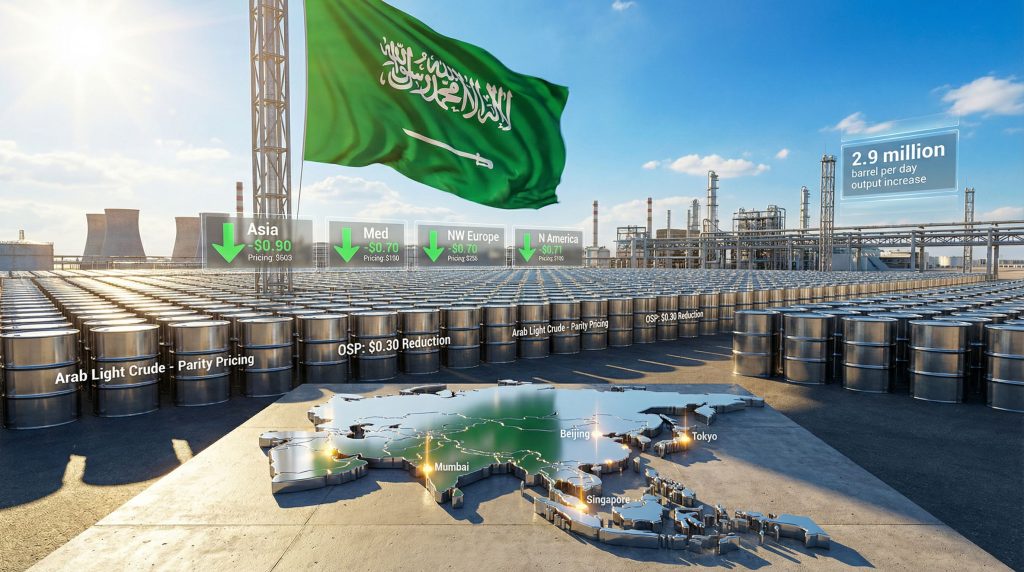
Saudi Arabia cuts Arab Light crude price to Asia for the fourth consecutive month, marking a strategic pivot that signals profound changes in global oil market dynamics. This pricing strategy emerges from a complex interplay of supply-demand fundamentals that have shifted dramatically since April 2025. Furthermore, the current market environment has created conditions that necessitate a deeper oil price stagnation analysis to understand these unprecedented adjustments.
OPEC+ collectively increased production by approximately 2.9 million barrels per day from April 2025 through early 2026, representing roughly 3% of global demand. This substantial volume injection into global markets occurred amid expectations that demand growth would absorb the additional supply. However, market conditions revealed that supply expansion significantly outpaced consumption increases, creating persistent downward pressure on pricing.
The economic rationale behind these consecutive price reductions reflects a fundamental shift from revenue optimisation through premium pricing to market share preservation through competitive positioning. Traditional producer economics typically favour supply constraint to maintain higher per-barrel margins. The current strategy suggests that volume maintenance has become more valuable than margin protection in the prevailing market environment.
Critical Market Indicators:
- Four consecutive months of price cuts for Asian markets
- Production increases of 2.9 million barrels daily since April 2025
- Supply growth exceeding demand absorption capacity
- Shift from premium pricing to competitive benchmarking
OPEC+ Production Policy and Market Dynamics
The organisation's production strategy reveals internal recognition that unlimited supply increases would further depress pricing without corresponding revenue benefits. Eight OPEC+ members implemented a production pause for Q1 2026, effectively acknowledging that market conditions could not support additional volume without significant price deterioration. In addition, this OPEC production meeting impact has demonstrated coordinated efforts to prevent further market destabilisation.
This pause decision, reaffirmed in early February 2026, demonstrates coordinated market management aimed at preventing further oversupply. The timing suggests producers recognised that releasing additional crude into already saturated markets would create self-defeating economics where volume increases fail to compensate for price declines.
The relationship between production quotas and pricing mechanisms has evolved significantly. Previously, OPEC+ could rely primarily on supply adjustments to influence market pricing. Current conditions require more nuanced strategies combining production management with aggressive pricing to defend market position against non-OPEC competitors.
The shift to contango pricing in Dubai markets indicates lower demand for immediate crude deliveries, suggesting market participants expect future supply abundance rather than current scarcity.
When big ASX news breaks, our subscribers know first
What Does the Arab Light Crude Price Cut Signal for Asian Energy Markets?
Regional Pricing Differentials and Market Positioning
The March 2026 pricing adjustments reveal a coordinated global strategy rather than region-specific responses to local market conditions. The consistency of reductions across multiple markets demonstrates systematic competitive repositioning. These developments align with broader oil price crash insights that examine the underlying factors driving current market dynamics.
Saudi Aramco OSP Changes Across Global Markets (February to March 2026)
| Region | Previous OSP | New OSP | Change | Benchmark |
|---|---|---|---|---|
| Asia | +$0.30/bbl | Parity | -$0.30 | Oman/Dubai |
| Mediterranean | -$0.55/bbl | -$0.85/bbl | -$0.30 | ICE Brent |
| Northwest Europe | -$0.35/bbl | -$0.65/bbl | -$0.30 | ICE Brent |
| North America | +$2.20/bbl | +$2.10/bbl | -$0.10 | ASCI |
The uniform $0.30 reduction across Asia, Mediterranean, and Northwest Europe markets indicates strategic coordination rather than responsive pricing. This approach suggests prioritisation of global market share defence over regional profit optimisation.
The transition of Arab Light crude to parity with the Oman/Dubai benchmark eliminates the quality premium historically commanded by Saudi crude. This represents a significant strategic concession, indicating that demand elasticity at premium pricing levels had reached critical thresholds where customers readily substituted alternative crude sources.
Five-Year Low Implications for Energy Economics
Arab Light crude pricing reached levels not seen since 2020-2021, a period characterised by pandemic-driven demand destruction and major supply disruptions. The return to these pricing levels despite normalised global economic conditions signals structural rather than cyclical market changes.
Historical context reveals that previous five-year lows occurred during extraordinary circumstances including global lockdowns, transportation demand collapse, and geopolitical supply disruptions. Current pricing levels occurring during relatively normal economic conditions suggest fundamental shifts in market structure and competitive dynamics.
The parity pricing with Oman/Dubai benchmark represents more than tactical price adjustment; it signals acceptance of reduced pricing power in global crude markets. This strategic positioning prioritises volume preservation over margin maintenance, reflecting long-term market share considerations.
Economic significance includes:
- Elimination of traditional quality premiums for Saudi crude
- Market share preservation prioritised over revenue optimisation
- Acceptance of reduced pricing power in core export markets
- Strategic response to intensified competitive pressure
How Are Global Supply Chain Dynamics Influencing Oil Market Structure?
Non-OPEC Production Growth and Market Competition
The emergence of multiple high-capacity, low-cost producers outside OPEC control has fundamentally altered global oil market dynamics. United States shale production continues expansion despite lower pricing, demonstrating improved cost structures and operational efficiency that maintain profitability at reduced price levels. Moreover, the US production market impact continues to influence global supply balances significantly.
Brazil's deepwater pre-salt fields have established consistent production growth trajectories, adding significant light crude volumes to global markets. These operations benefit from long-term development commitments and sunk capital costs that justify continued production despite price pressures.
Guyana's rapid emergence as a major producer represents one of the most significant supply additions in recent years. The country's low-cost, high-quality crude production directly competes with traditional Middle Eastern exports, particularly in light, sweet crude categories that historically commanded premium pricing.
Competitive pressure indicators:
- US shale production maintaining output despite price declines
- Brazilian pre-salt fields contributing consistent supply growth
- Guyanese production rapidly scaling to significant volumes
- Multiple producers operating profitably at current price levels
Contango Market Structure and Forward Pricing Signals
The Dubai crude market's transition to contango pricing structure reflects fundamental changes in market participants' expectations about future supply and demand balance. This pricing pattern indicates reduced urgency for immediate crude purchases and expectations of continued supply availability.
Contango conditions create specific market incentives that influence producer and consumer behaviour. Storage economics become favourable when forward prices exceed spot prices by margins greater than carrying costs. This encourages inventory accumulation when storage capacity exists.
The technical aspects of contango pricing reflect market psychology and fundamental expectations. When participants expect future supply abundance, forward contracts command premiums to spot pricing. This market structure signal provides insight into collective market intelligence about supply-demand evolution.
Contango implications:
- Reduced immediate purchase urgency among consumers
- Inventory build incentives where storage capacity exists
- Forward market expectations of continued supply abundance
- Technical trading patterns supporting lower spot pricing
Supply Chain Resilience and Geopolitical Risk Assessment
Despite ongoing Middle East tensions and various regional disruptions, global oil markets demonstrate remarkable supply chain resilience. The ability of prices to decline amid geopolitical uncertainty reflects diversified supply sources and reduced dependence on any single producing region.
Risk-adjusted pricing mechanisms have evolved to account for multiple supply sources and reduced concentration risk. Traditional geopolitical premiums have diminished as supply optionality increased through non-OPEC production growth and strategic petroleum reserve policies. Consequently, the trade war oil price movements have shown how geopolitical tensions increasingly have less sustained impact on global pricing.
Market participants demonstrate increased confidence in supply security through reduced risk premiums despite ongoing regional tensions. This reflects structural improvements in global oil supply diversity and reduced vulnerability to single-source disruptions.
What Are the Investment Implications of Saudi Arabia's Pricing Strategy?
Revenue Optimisation Models in Oversupplied Markets
Saudi Arabia's aggressive pricing strategy reflects sophisticated revenue optimisation analysis that prioritises long-term market position over short-term margin maximisation. The economic logic involves accepting lower per-barrel profits to maintain volume and prevent market share erosion to competitors.
The strategic calculation involves comparing revenue outcomes under different scenarios: maintaining premium pricing with volume loss versus competitive pricing with volume preservation. Current strategy selection indicates that volume maintenance generates superior total revenue outcomes under prevailing market conditions.
Investment implications extend beyond immediate revenue considerations to long-term market positioning and relationship preservation. Maintaining refinery partnerships and supply chain relationships provides strategic value that transcends current price cycles.
Strategic revenue considerations:
- Volume preservation versus margin optimisation trade-offs
- Long-term market relationship maintenance value
- Competitive positioning against alternative suppliers
- Total revenue optimisation across price-volume combinations
Regional Influence on Gulf State Pricing Mechanisms
Saudi Aramco's official selling prices influence approximately 9 million barrels per day of crude exports from Iran, Kuwait, and Iraq to Asian markets. This regional pricing leadership creates coordinated Gulf state strategies rather than independent competitive responses.
The coordination mechanism allows regional producers to collectively pursue volume-focused strategies while avoiding destructive internal price competition. This approach maximises collective Gulf state market share against non-regional competitors rather than competing primarily among regional producers.
Regional pricing coordination provides stability benefits for both producers and consumers. Refiners benefit from predictable pricing relationships among substitute crudes, while producers avoid margin-destroying competition within the Gulf production complex.
Regional coordination benefits:
- Collective market share defence against non-Gulf producers
- Reduced internal price competition among regional suppliers
- Stable pricing relationships for refinery planning
- Coordinated strategic response to external competitive pressure
Energy Transition Economics and Fossil Fuel Pricing
Current pricing strategies occur within the broader context of global energy transition trends and long-term fossil fuel demand outlook. Competitive pricing helps maintain crude oil's economic attractiveness relative to alternative energy sources and transportation technologies.
The strategic positioning recognises that maintaining energy cost competitiveness becomes increasingly important as renewable energy costs decline and alternative transportation technologies advance. Aggressive fossil fuel pricing can delay or reduce substitution rates.
Long-term demand considerations influence current pricing decisions as producers balance immediate revenue optimisation against demand preservation strategies. Lower pricing extends the economic viability period for fossil fuel consumption across various applications.
How Will This Pricing Strategy Impact Global Economic Conditions?
Inflationary Pressure Relief Through Lower Energy Costs
Lower crude oil pricing creates disinflationary impulses that benefit energy-importing economies through multiple transmission mechanisms. Direct effects include reduced transportation fuel costs, while indirect effects encompass lower production costs for energy-intensive goods and services.
The timing of sustained energy price reductions in early 2026 provides significant economic policy implications for major central banks. Persistent disinflationary pressure from energy costs may influence monetary policy decisions and interest rate trajectory expectations.
Regional economic benefits vary based on energy import dependence and energy intensity of economic activity. Asian economies, as major energy importers, experience particularly beneficial terms-of-trade improvements from sustained lower energy costs. Furthermore, market analysis by Reuters reports that these pricing adjustments represent the first discounts since 2020.
Economic transmission mechanisms:
- Direct transportation and heating cost reductions
- Lower production costs for energy-intensive industries
- Improved terms-of-trade for energy-importing nations
- Potential monetary policy flexibility from reduced inflation pressure
Currency Market Effects and Trade Balance Adjustments
Sustained lower oil prices create significant currency market impacts through trade balance adjustments and capital flow patterns. Energy-exporting nations experience current account pressure, while energy importers benefit from improved trade positions.
The dollar implications of lower oil pricing depend on complex factors including US energy production levels, global oil trading patterns, and relative economic performance. Lower oil prices can strengthen the dollar through improved US current account positions while potentially weakening oil-exporter currencies.
Trade balance improvements for major Asian economies from lower energy costs free up capital for alternative imports or domestic investment. This creates multiplier effects throughout global trade patterns and economic growth trajectories.
What Does This Mean for Future Energy Market Evolution?
Structural Changes in Global Oil Trading Patterns
The sustained shift toward buyer's market conditions represents a structural change from previous decades of seller-dominated oil markets. This transition reflects diversified supply sources, improved inventory management, and reduced concentration of market power among traditional producers.
Evolution of pricing benchmarks and reference crude importance reflects these structural changes. Traditional benchmark relationships may evolve as new production sources gain market share and influence pricing discovery mechanisms. Additionally, Bloomberg analysis indicates that these adjustments reflect concerns about emerging crude supply gluts.
Long-term implications for producer-consumer relationships include reduced producer pricing power and increased consumer optionality. These changes encourage more competitive and service-oriented approaches from oil producers to maintain market relationships.
Strategic Scenarios for Energy Market Development
Market Evolution Scenarios:
| Market Condition | Probability | Pricing Impact | Strategic Response |
|---|---|---|---|
| Sustained Oversupply | High | Continued Pressure | Market Share Focus |
| Demand Recovery | Medium | Price Stabilisation | Balanced Approach |
| Geopolitical Escalation | Low | Premium Increase | Supply Security |
| Energy Transition Acceleration | Medium | Demand Peak | Long-term Planning |
The highest probability scenario involves continued oversupply conditions requiring sustained competitive pricing strategies. This environment favours low-cost producers and encourages operational efficiency improvements across the industry.
Demand recovery scenarios would allow gradual price stabilisation but may require sustained periods of market share competition before balanced conditions emerge. Geopolitical escalation remains possible but appears less likely to create sustained price premiums given supply diversity.
The next major ASX story will hit our subscribers first
Frequently Asked Questions About Saudi Oil Pricing Strategy
Why is Saudi Arabia cutting oil prices for four consecutive months?
The sustained price reduction strategy reflects rational economic response to oversupplied market conditions and intense competitive pressure from non-OPEC producers. Rather than losing market share through premium pricing, Saudi Arabia prioritises volume maintenance through competitive positioning.
Economic rationale involves total revenue optimisation under conditions where demand elasticity at premium price levels reduces total income despite higher per-barrel margins. Competitive pricing preserves customer relationships and prevents market share erosion to alternative suppliers.
How do these price cuts affect global oil market stability?
Predictable pricing adjustments enhance market stability by providing clear signals about producer strategies and market conditions. Transparent pricing mechanisms reduce uncertainty for refiners and end consumers while preventing disruptive spot market volatility.
Market confidence benefits from understanding producer strategic responses to oversupply conditions. Clear pricing signals allow market participants to make informed decisions about inventory management, supply contracts, and operational planning.
What role does Asian demand play in Saudi pricing decisions?
Asia represents the world's largest crude oil importing region and the primary growth market for global oil consumption. Maintaining competitive position in Asian markets ensures access to the most significant demand centre and future growth opportunities.
Strategic importance of Asian relationships extends beyond immediate volume considerations to long-term market development and refinery partnership preservation. Asian market position influences global market share and competitive dynamics worldwide.
Conclusion: Strategic Positioning in a Transforming Energy Landscape
Long-term Economic Implications
Saudi Arabia cuts Arab Light crude price to Asia represents sophisticated adaptation to fundamentally altered global oil market conditions. The transition from premium pricing to competitive positioning reflects rational economic response to oversupply conditions and intensified competition from diverse production sources.
Assessment of sustainability under various market scenarios suggests continued evolution toward more competitive and service-oriented producer strategies. Traditional pricing power concentration has diminished permanently, requiring ongoing strategic adaptation from major producers.
Integration with broader energy transition economics reveals the importance of maintaining fossil fuel competitiveness during the transition period. Aggressive pricing strategies help preserve market share and extend economic viability periods for oil-based energy systems.
The macro-economic implications extend far beyond oil markets to influence global inflation patterns, currency relationships, and economic policy decisions. Understanding these interconnected effects provides crucial insight into future economic development patterns and investment opportunities across multiple sectors and regions.
This analysis is based on publicly available market information and does not constitute investment advice. Energy market investments involve substantial risks including price volatility, geopolitical factors, and regulatory changes that may significantly impact returns.
Considering Small-Cap Energy Investments in This Volatile Market?
Discovery Alert's proprietary Discovery IQ model delivers real-time alerts on significant ASX mineral discoveries, instantly empowering subscribers to identify actionable opportunities ahead of the broader market in energy and resource sectors. Begin your 14-day free trial today and secure your market-leading advantage while navigating these complex global energy dynamics.