August 6, 2026
When Security Guarantees Stop Guaranteeing: The Architecture Behind Saudi Arabia's Superpower Pivot
Every few decades, the global order tests the durability of its foundational alliances. The post-World War II architecture that locked the United States and Saudi Arabia into a security-for-oil arrangement held remarkably well through oil embargoes, regional conflicts, and ideological divergence. But structural alliances built on commodity exchange have a fundamental vulnerability: when the commodity calculus shifts, so does the loyalty. That inflection point arrived between 2014 and 2016, and the aftershocks are still reshaping the geopolitical map of the Middle East today. The question now is not whether Saudi Arabia shifts from the US to China and Russia, but how far and how fast that realignment travels.
When big ASX news breaks, our subscribers know first
The 1945 Blueprint and Why It Eventually Cracked
The bilateral framework that governed U.S.-Saudi relations for nearly seven decades was forged on 14 February 1945, when U.S. President Franklin D. Roosevelt met Saudi King Abdulaziz Al Saud aboard the USS Quincy on the Great Bitter Lake in Egypt. The terms were straightforward in concept: Washington received guaranteed access to Saudi oil supplies, and in exchange, the United States committed to protecting the security of the House of Saud and the Kingdom itself.
This arrangement survived considerable strain. The 1973 Arab oil embargo, during which Saudi Arabia led OPEC members in cutting off oil exports to the United States and its allies following American support for Israel in the Yom Kippur War, tested the relationship severely but did not break it. What ultimately fractured the foundational compact was something more structural and, from Riyadh's perspective, more personal.
The 2014 to 2016 oil price war represented the moment Washington's calculus fundamentally changed. By that period, the U.S. shale revolution had transformed America into a genuine global oil-producing force, dramatically reducing its strategic dependence on Gulf crude. When Saudi Arabia pursued an aggressive production strategy designed to protect market share by suppressing prices, Washington effectively absorbed the consequences without the urgency of a country whose energy security was at stake.
Riyadh read this as a breach of the 1945 compact's underlying logic. Saudi Arabia's government budget moved into double-digit GDP deficit levels during the first full year of the price war and remained in deficit through the end of 2021. That financial devastation would prove to be the catalyst for one of the most consequential geopolitical repositioning exercises in modern Gulf history.
Russia Enters the Picture: The Birth of OPEC+
How a Price War Reshaped Oil Market Governance
The financial destruction suffered by Saudi Arabia and fellow OPEC members during the 2014 to 2016 price war left the organisation with an uncomfortable reality: it could no longer manage global oil markets without external coordination. The solution was the admission of Russia into an expanded grouping, creating what the market now knows as OPEC+. OPEC's global influence has consequently extended well beyond its original mandate, reshaping the entire architecture of global energy governance.
This structural change carried consequences well beyond oil supply management. By admitting Moscow as an indispensable co-architect of global oil price governance, OPEC effectively transformed itself from a producer cartel into something closer to a geopolitical coordination mechanism operating independently of Western institutional frameworks. Russia gained significant leverage within Gulf energy politics, and China, observing Moscow's new influence, moved swiftly to exploit the opening.
The Russia-Saudi relationship within OPEC+ is best understood through a fiscal lens rather than an ideological one. Both countries maintain relatively high budget breakeven oil prices, meaning both have a structural interest in preventing prolonged price collapses. This shared fiscal arithmetic has made the bilateral relationship durable and largely transactional, with Moscow's primary value to Riyadh lying in joint production management rather than diplomatic alignment on broader geopolitical issues. Furthermore, as explored in analysis by ASPI Strategist, Russia and China have been systematically building influence across the region in ways that compound these shifts.
How China Built a Decade-Long Strategic Foundation in Saudi Arabia
The Aramco IPO: A Pivotal Moment
China's penetration of Saudi Arabia's strategic architecture was not accidental. It was methodically constructed through a sequence of financial gestures, diplomatic investments, and institutional agreements that began precisely when Riyadh was most financially vulnerable.
The entry point was the Aramco IPO episode. Saudi Crown Prince Mohammed bin Salman had publicly championed the idea of listing 5% of Saudi Aramco on international markets in the second half of 2016, with the expectation of raising at least US$100 billion and achieving a valuation of US$2 trillion, which would have made Aramco the most valuable publicly listed company in history. International investors, however, raised serious concerns about corporate governance, the degree of government control, reserve transparency, field security, and valuation methodology.
Major Western stock exchanges, including the New York Stock Exchange and London Stock Exchange, were reluctant to participate on Riyadh's terms. The IPO process stalled. At that precise moment of vulnerability, China offered to purchase the entire 5% stake scheduled for the IPO. The offer was ultimately declined, but the gesture registered deeply with the architect of Saudi Vision 2030. That single act of financial solidarity opened the door to a decade of deepening institutional ties.
A Decade of Deepening Bilateral Agreements
The trajectory of agreements that followed illustrates just how systematically Beijing built its influence:
| Year | Event | Value / Significance |
|---|---|---|
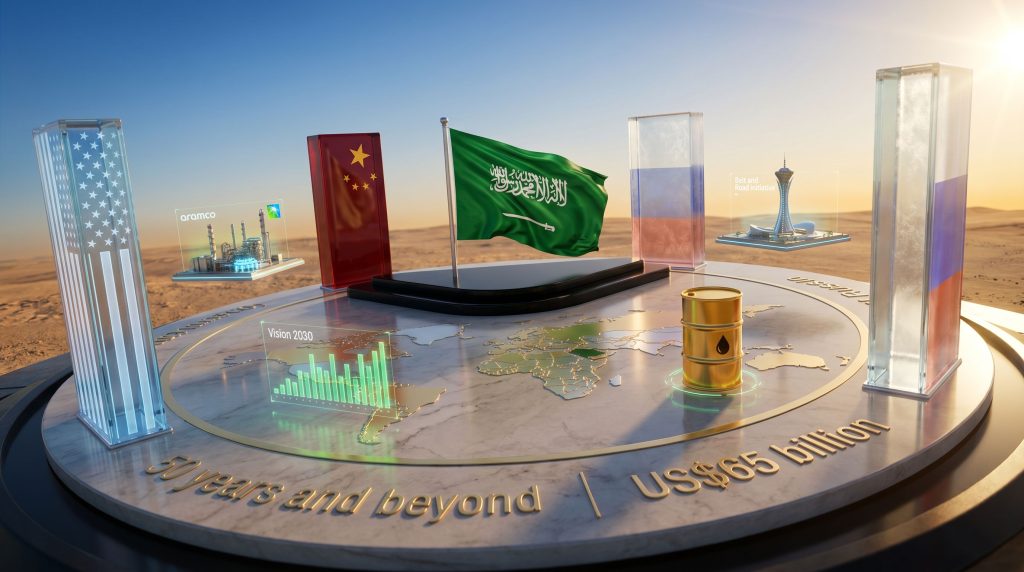
| March 2017 | King Salman state visit to Beijing | Approximately US$65 billion in bilateral agreements across oil refining, petrochemicals, light manufacturing, and electronics |
| August 2017 | Saudi-China Conference, Jeddah | Saudi openness to renminbi-denominated financing confirmed; US$20 billion joint investment fund established on a 50:50 basis |
| August 2022 | Aramco-Sinopec multi-pronged agreement | Linked explicitly to both China's Belt and Road Initiative and Saudi Vision 2030; bilateral relationship elevated to Comprehensive Strategic Partnership |
| Late 2022 | Saudi public declarations | China publicly designated as Saudi Arabia's most reliable partner and crude oil supplier |
The renminbi dimension of these agreements carries significance that extends well beyond trade accounting. Saudi Arabia's willingness to consider yuan-denominated oil transactions represents a direct structural challenge to the petrodollar system. Moreover, broader US-China trade tensions have accelerated Beijing's motivation to embed alternative financial arrangements in its Gulf partnerships, making each renminbi-denominated agreement a geopolitical act as much as a commercial one.
Aramco's chief executive Amin Nasser made clear the depth of the commitment when he publicly stated that guaranteeing China's ongoing energy security represented the company's foremost long-term priority, framing the relationship not in terms of years but of half-centuries. That framing was not rhetorical. It signalled that Saudi Arabia had structurally repositioned China as its primary long-term energy customer and institutional partner, independent of whatever political cycle happened to be running in Washington. As explored by Carnegie Endowment, Beijing's alignment with Vision 2030 has been both deliberate and comprehensive.
Operation Epic Fury and the Security Credibility Crisis
When the Defence Umbrella Failed
If the 2014 to 2016 oil price war was the economic catalyst for Saudi Arabia's realignment, the conflict with Iran known as Operation Epic Fury has become the security catalyst. The strategic logic of maintaining close U.S. ties rested partly on Washington's ability to provide a credible security umbrella over Saudi critical infrastructure. That credibility has been severely tested.
Iranian strikes during the conflict successfully targeted multiple high-value Saudi energy assets, including:
- The East-West Pipeline
- The Manifa and Khurais oil fields
- The Ras Tanura Refinery
- Multiple petrochemical and natural gas facilities stretching from the Eastern Province to Yanbu Industrial City
The political and strategic implication of these strikes is difficult to overstate. Saudi Arabia had invested hundreds of billions of dollars in U.S.-supplied defence systems over decades, precisely to create a deterrent and interception capability against this type of attack. The fact that Iranian forces successfully penetrated that umbrella and damaged core energy infrastructure has raised fundamental questions in Riyadh about the operational value of the U.S. security relationship.
The critical distinction here is not whether the U.S. is politically reliable as an ally, but whether its security architecture is operationally credible as a deterrent. Riyadh's concern appears to centre on the latter, which is far harder to repair through diplomatic assurances alone.
In the immediate aftermath of the conflict, a series of high-level meetings took place between Chinese and Saudi officials, including a meeting between the deputy head of China's National Energy Administration and Saudi Aramco's Downstream President focused on expanding bilateral energy security cooperation. The speed and seniority of China's post-war diplomatic engagement carried a message of its own.
Saudi Arabia's broader fear goes beyond the immediate military question. Any final agreement between Washington and Tehran carries the risk, from Riyadh's perspective, of leaving the Kingdom in a structurally more exposed position than it occupied before the conflict. A U.S.-Iran accommodation that reduces American interest in containing Iranian power projection could remove one of the remaining strategic arguments for maintaining close U.S. ties.
Scenario Analysis: Three Pathways Forward
Understanding Saudi Arabia's trajectory requires moving beyond binary narratives. Riyadh is not simply choosing between Washington and Beijing. It is executing a sophisticated multi-alignment doctrine designed to maximise strategic optionality across three distinct relationships simultaneously.
Scenario 1: Full Pivot to China-Russia Axis (Low Probability)
A complete break with the U.S. faces structural barriers that remain formidable in the near to medium term. No alternative security partner currently possesses the military reach, interoperability, or institutional depth to replace American defence guarantees. Saudi Arabia's deep integration with dollar-denominated oil markets and U.S. financial systems creates significant switching costs. This scenario remains strategically implausible without a fundamental transformation of Chinese military power projection capabilities in the Gulf.
Scenario 2: Managed Multi-Alignment (High Probability, Base Case)
This is the scenario that best fits current evidence. Saudi Arabia continues to extract maximum strategic value from all three relationships simultaneously, with each partner serving a structurally distinct function:
- U.S. ties maintained primarily for security infrastructure, deterrence, and access to Western financial markets
- Chinese ties deepened for trade volume, Vision 2030 financing, technology transfer, and long-term energy customer relationships
- Russian ties leveraged for OPEC+ production coordination and oil market governance
The Kingdom's centrality to multiple power blocs also functions as a source of diplomatic leverage, as demonstrated by Saudi Arabia's role in mediating prisoner exchanges and peace-related negotiations involving parties on opposing sides of major geopolitical divides.
Scenario 3: Conditional Realignment Toward China (Medium Probability, Contingent)
This scenario accelerates if Washington reaches a U.S.-Iran agreement perceived as structurally disadvantageous to Riyadh, if further erosion of U.S. security credibility occurs, or if Chinese military capabilities in the Gulf expand meaningfully. Key indicators to monitor include the pace of renminbi oil pricing adoption, Chinese military infrastructure development in the region, and the depth of Saudi-China institutional integration.
The next major ASX story will hit our subscribers first
The Petrodollar System Under Structural Pressure
Beyond geopolitics, the strategic realignment carries profound implications for global financial architecture. The petrodollar system, in which oil is priced and traded in U.S. dollars, creates structural global demand for the American currency that underpins Washington's ability to run persistent fiscal deficits and maintain financial sanctions as a foreign policy tool. Consequently, growing trust in the US dollar is eroding across multiple fronts simultaneously, with Gulf energy repricing representing one of the most structurally significant pressures.
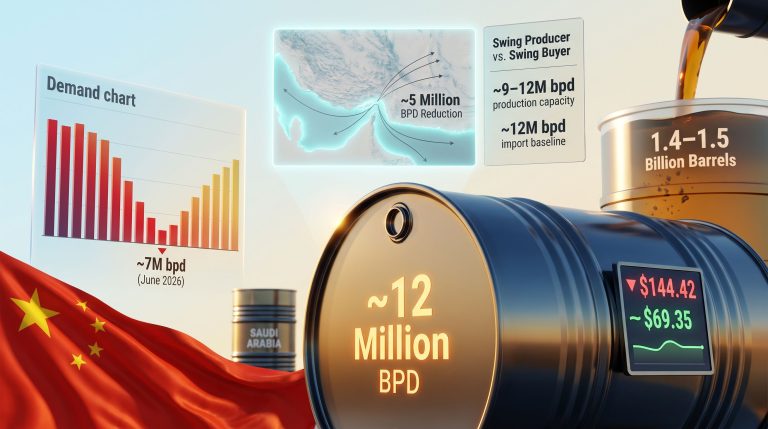
China absorbs approximately 17 to 20% of Saudi oil exports, making it Riyadh's single largest customer since 2011. As this trade relationship deepens and renminbi-denominated financing becomes more embedded in the bilateral architecture, the cumulative erosion of dollar primacy in Gulf energy trade could become one of the most consequential long-term consequences of Saudi Arabia shifts from the US to China and Russia.
OPEC+'s joint production management, co-directed by Riyadh and Moscow, has further reinforced this dynamic. Production decisions that consistently prioritise the fiscal breakeven requirements of Saudi Arabia and Russia over Western economic preferences demonstrate that the organisation now operates as a genuinely independent geopolitical instrument, not merely a commodity cartel.
Three Forces That Will Define the Outcome
The final shape of Saudi Arabia's superpower alignment will ultimately be determined by three converging forces. In addition, understanding each of these forces requires appreciating how they interact with broader shifts in the geopolitical mining landscape and resource competition globally.
-
The outcome of U.S.-Iran diplomacy. If Washington reaches an accommodation with Tehran that Riyadh interprets as strategically disadvantageous, the pace of multi-alignment will accelerate significantly and the conditional realignment scenario becomes more probable.
-
The trajectory of Vision 2030 financing. Saudi Arabia's economic transformation agenda requires massive capital inflows over a sustained period. China's demonstrated willingness to fund Vision 2030 projects at scale gives Beijing structural leverage in the relationship that Washington has not matched with equivalent institutional commitments. Furthermore, the Saudi critical minerals strategy has become a key dimension of how Riyadh is positioning itself across multiple supply chains, deepening its ties with Beijing in the process.
-
The evolution of Chinese military capabilities in the Gulf. As China's power projection capacity expands, the security argument for exclusive reliance on U.S. defence guarantees weakens. If Beijing can credibly offer a security dimension to the partnership, it closes the most significant remaining gap in the multi-alignment architecture. Saudi Arabia shifts from the US to China and Russia not out of ideological preference, but out of structural necessity shaped by these three converging pressures.
Disclaimer: This article contains forward-looking analysis, geopolitical scenario projections, and financial assessments based on publicly available information. These represent analytical perspectives, not investment advice or predictions of definitive outcomes. Geopolitical situations evolve rapidly and readers should consult independent sources before making any decisions based on this content.
Want to Track the Resource Opportunities Reshaping the Global Order?
As Saudi Arabia's strategic realignment accelerates demand shifts across critical minerals, energy, and commodities, Discovery Alert's proprietary Discovery IQ model delivers real-time ASX mineral discovery alerts, turning complex market signals into actionable investment insights — explore historic discovery returns or start your 14-day free trial today to position yourself ahead of the market.