August 20, 2026
When Supply Chains Break Down, Relationship Capital Becomes the New Currency
In commodity markets under stress, the difference between a refinery running at full capacity and one scrambling for spot barrels often comes down to a single document: the monthly crude allocation notice. Most market participants focus on price benchmarks, freight rates, and inventory data. Far fewer pay attention to the quiet but consequential mechanics of term contract fulfilment — until a disruption forces the issue into plain sight.
That is precisely what is unfolding across European energy markets in mid-2026. A convergence of geopolitical trade tensions affecting multiple crude supply corridors simultaneously has elevated the significance of Saudi Aramco full oil allocations to Europe from routine administrative communications to closely watched market signals. Understanding what these allocations mean, why they matter right now, and what they reveal about the structural evolution of Saudi export logistics requires looking well beyond the headline numbers.
When big ASX news breaks, our subscribers know first
The Anatomy of a Saudi Crude Allocation: More Than Just a Volume Confirmation
How the Monthly Nomination Cycle Works
Saudi Aramco operates its crude supply relationships through long-term term contracts, typically structured on an annual basis with monthly volume nominations. Each month, buyers submit their desired lifting volumes, and Aramco responds with an allocation confirming how many barrels it will supply. This process is standard across major national oil company supply frameworks, but the details embedded in each allocation carry outsized informational value.
A full allocation, meaning a buyer receives 100% of the volume nominated, signals that the producer has both the physical supply and the logistical capacity to fulfil its contractual obligations without compromise. A partial cut, by contrast, forces the buyer into the spot market to top up feedstock, often at a premium during periods of broader supply tightness. Deferred notification creates planning uncertainty that cascades through refinery scheduling, crew logistics, and downstream product commitments.
The table below illustrates how different allocation outcomes translate into practical buyer impacts and market signals:
| Allocation Scenario | Buyer Impact | Market Signal |
|---|---|---|
| Full allocation (100%) | Refinery throughput maintained | Seller prioritising relationship stability |
| Partial allocation (70-90%) | Spot market top-up required | Supply tightness or logistics constraints |
| Deferred notification | Planning uncertainty for buyers | Logistical or geopolitical complexity |
| Flexible lifting options offered | Buyer absorbs routing risk | Producer managing multi-route exposure |
Why the Timing Anomaly Matters
For September 2026, Aramco notified its European term customers of their allocations approximately one week later than the typical cycle. While a seven-day delay may appear trivial in isolation, it carries meaningful context. Houthi militant activity in the Red Sea has materially complicated Saudi Arabia's cargo planning and routing processes. The delay itself was a signal of logistical complexity, not of supply unavailability, and the eventual confirmation of full volumes resolved a period of genuine market anxiety.
A Triple Supply Shock: Understanding the European Crude Feedstock Crisis
CPC Blend Disruptions From the Black Sea
The Caspian Pipeline Consortium blend, commonly referred to as CPC Blend, is a light, sweet crude that originates primarily from Kazakhstan and flows through a pipeline system terminating at the Russian Black Sea port of Novorossiysk. It has historically been a significant feedstock source for Mediterranean refiners in particular. Drone attacks targeting Black Sea infrastructure in the months preceding September 2026 sharply curtailed CPC Blend shipments, removing a meaningful volume of preferred-quality crude from the European supply pool.
Persian Gulf Flow Restrictions Through Hormuz
The Strait of Hormuz is the world's single most critical crude oil chokepoint. Roughly 20% of global petroleum liquids pass through this narrow passage annually, according to the U.S. Energy Information Administration. Ongoing disruptions to transit through Hormuz during 2026 have constrained the ability of Persian Gulf producers, including Saudi Arabia, to move barrels eastward and westward via conventional tanker routes. Furthermore, this has forced a rethink of export architecture that has been largely unchanged for decades. These crude logistics pressures are reshaping how producers approach long-term delivery commitments.
Red Sea Transit Risk and Yanbu's Diminished Appeal
Saudi Arabia's western export gateway is the port of Yanbu on the Red Sea coast, connected to the kingdom's oil infrastructure via the East-West Pipeline. Under normal conditions, Yanbu serves European and Mediterranean buyers efficiently. Under current conditions, however, Houthi threats have made tanker operators and insurers increasingly reluctant to route vessels through the Red Sea. War risk premiums have escalated sharply, and several shipping operators have suspended Red Sea transits entirely in recent months.
European refiners entered September 2026 managing a compounding feedstock challenge: reduced CPC Blend availability from Black Sea disruptions, constrained Persian Gulf flows through Hormuz, and elevated risk premiums on Red Sea liftings from Yanbu. Aramco's full allocation decision arrived as a critical buffer against a potential third major disruption vector materialising simultaneously.
Where the Barrels Are Actually Moving: Lifting Options and Route Architecture
Sidi Kerir: The Mediterranean Linchpin
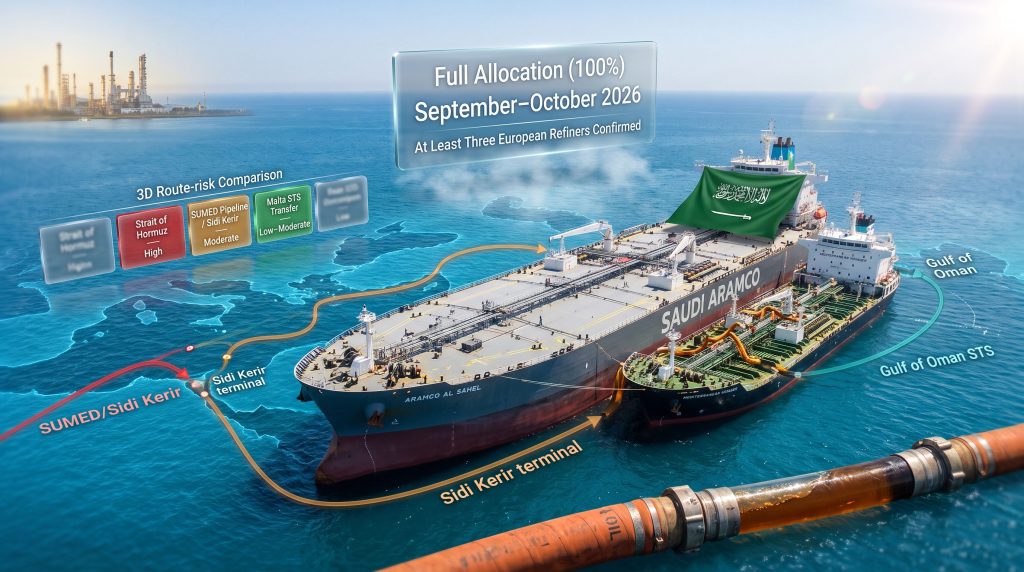
The confirmation that at least two European term buyers will lift their September barrels from Sidi Kerir, Egypt's Mediterranean crude export terminal, is strategically significant. Sidi Kerir sits at the Mediterranean end of the SUMED (Suez-Mediterranean) pipeline, which runs approximately 320 kilometres from Ain Sukhna on the Gulf of Suez to the Mediterranean coast. Crude arriving via tanker from the Red Sea or via pipeline from the Gulf of Suez can be loaded onto vessels at Sidi Kerir for direct delivery to European ports, consequently bypassing the need for vessels to navigate the full length of the Red Sea under Houthi threat.
For European buyers, Sidi Kerir liftings represent the path of least operational resistance during the current disruption environment. The terminal can handle very large crude carriers, offers established loading infrastructure, and positions cargoes within relatively short sailing distances of major European refining hubs in Italy, Spain, Greece, and beyond.
Multi-Option Lifting Structures: A New Aramco Flexibility Architecture
One of the more structurally novel aspects of the September allocation process is that at least one European buyer was offered a three-way optionality structure: liftings from Sidi Kerir, from Yanbu, or via ship-to-ship transfer near Malta. This kind of embedded flexibility in an allocation notice represents a departure from standard practice and signals that Saudi Aramco is actively engineering logistics resilience into its customer relationships.
Ship-to-ship (STS) transfers involve offloading crude from one vessel to another while at sea, typically in calmer, lower-risk waters. The Malta STS option places the transfer point in the central Mediterranean, well away from both the Red Sea threat zone and the Hormuz chokepoint. While STS operations add cost and complexity, they allow Aramco to deliver barrels to buyers without committing a single vessel to a high-risk transit.
Saudi Arabia's Evolving Export Architecture: Structural Shifts, Not Temporary Fixes
The Sohar STS Model and the UAE Parallel
Beyond European allocations, Aramco has been offering crude cargoes on an STS basis from locations near Sohar in the Gulf of Oman. This approach mirrors a strategy employed by Abu Dhabi's ADNOC, which has increasingly used shuttle tanker operations to move Persian Gulf barrels through the Strait of Hormuz in smaller vessels before transferring to larger oceangoing tankers in the Gulf of Oman. The parallels suggest that what may have begun as an emergency workaround is becoming an established operational template for both major Gulf producers.
The emerging export route landscape, with associated risk profiles, looks broadly as follows:
| Export Corridor | Risk Level (2026) | Aramco's Current Usage |
|---|---|---|
| Strait of Hormuz (Persian Gulf) | High – ongoing disruption | Reduced, with STS workarounds |
| Red Sea / Yanbu | High – Houthi threat | Selective, with buyer resistance |
| SUMED Pipeline / Sidi Kerir | Moderate | Prioritised for European buyers |
| Gulf of Oman STS (Sohar) | Lower | Increasing, mirroring UAE model |
| Malta STS Transfer | Low-Moderate | Emerging option for Mediterranean |
Why This Is a Structural Shift
The investment in STS capability, multi-point lifting optionality, and alternative pipeline routing reflects a fundamental reassessment of Saudi export vulnerability. For decades, the kingdom's export model assumed relatively free transit through both Hormuz and the Red Sea. That assumption no longer holds, and the logistical architecture being constructed in its place involves significantly higher operational costs, more complex cargo tracking, and new counterparty relationships across the shipping and insurance industries.
Analysts covering Middle East crude logistics have noted that the speed with which Aramco has adapted its operational model suggests pre-existing contingency planning that was being held in reserve. In addition, producers of Aramco's scale do not improvise STS operations across multiple geographic points simultaneously without having considered these scenarios in advance.
The Asia Factor: How Eastern Buyer Resistance Creates Western Supply Benefits
Asian Pushback Against Yanbu Liftings
An underappreciated dynamic shaping the September 2026 allocation landscape is the behaviour of Asian term buyers. When Aramco notified Asian customers of their allocations earlier in August, multiple refiners pushed back against requests to lift barrels from Yanbu. The reason is straightforward: securing vessels willing to transit the Red Sea, obtaining war risk insurance at acceptable premiums, and managing the reputational and operational risk of potential incidents has become genuinely difficult for Asian buyers operating under their own corporate governance constraints. These oil price movements are further complicated by broader market pressures stemming from ongoing geopolitical conflict.
The Indirect Benefit for European Refiners
Before Aramco confirmed the European allocations, trading desks were actively concerned that Asian buyers accepting Sidi Kerir as an alternative to Yanbu could absorb the available Mediterranean-accessible barrels, leaving European refiners short despite holding valid term contracts. The confirmation that European buyers received full allocations through Sidi Kerir and Malta STS options resolved this competitive uncertainty.
The east-west dynamic in crude allocation cycles is rarely discussed in public market commentary but represents a significant structural feature of how global crude distribution actually works under stress. When Asian buyers resist specific loading points, the downstream effect ripples through the allocation process and can either benefit or disadvantage European buyers depending on how the producer manages the conflict.
The next major ASX story will hit our subscribers first
October Allocation Signals and Forward Market Implications
Consecutive Full Allocations as a Policy Signal
Reports that at least four European term customers across northwest Europe and the Mediterranean received full October allocations following the September confirmations suggest this is not an isolated accommodation but a deliberate positioning by Aramco. Two consecutive months of full allocations during a period of extraordinary logistical complexity indicates the producer is willing to absorb higher operational costs to maintain European refinery relationships.
This matters for downstream product markets across the continent. European refiners carrying CPC Blend shortfalls into an environment where their primary alternative crude source is also constrained would face difficult run rate decisions. Guaranteed contractual volumes from Aramco provide the feedstock certainty needed to maintain diesel, jet fuel, and naphtha output at levels consistent with seasonal demand, particularly heading into the autumn and winter demand period for heating fuels. The trade war impacts on global energy flows have further complicated these supply chain dynamics for refiners across the region. Similarly, the imposition of Russian oil sanctions has narrowed the options available to European buyers seeking alternative crude feedstocks.
Disclaimer: Forward-looking statements regarding allocation trends, refinery run rates, and product market impacts are based on available market reporting as of August 2026. Actual outcomes will depend on geopolitical developments, logistics conditions, and producer decisions that remain subject to change.
Frequently Asked Questions: Saudi Aramco Oil Allocations to Europe
What is a Saudi Aramco full oil allocation?
A full oil allocation means a term contract buyer receives 100% of the crude volume they nominated for a given month under their long-term supply agreement with Saudi Aramco. This is distinct from partial cuts, which force buyers to source additional volumes on the spot market, typically at a premium during periods of tighter supply.
Why did Saudi Aramco notify European buyers later than usual in August 2026?
The notification delay was linked to ongoing logistical complexity caused by Houthi militant activity in the Red Sea, which disrupted Aramco's normal cargo planning and routing processes for its European customer base. The delay itself signalled operational difficulty, while the eventual confirmation of full volumes provided market reassurance.
How many European refiners received full September allocations from Aramco?
At least three European refiners were confirmed to receive their full contractual volumes for September 2026, with at least four term customers across northwest Europe and the Mediterranean receiving full October allocations based on subsequent market reporting.
What is Sidi Kerir and why is it central to Saudi crude flows into Europe?
Sidi Kerir is a major Mediterranean crude export terminal in Egypt connected to the SUMED pipeline, which runs from the Gulf of Suez to the Mediterranean coast. It allows Saudi crude to reach European buyers via Mediterranean tanker routes, bypassing the need for vessels to transit the full length of the Red Sea under current threat conditions.
What is a ship-to-ship transfer and why is Aramco deploying this approach?
An STS transfer involves offloading crude from one vessel to another at sea in lower-risk waters. Aramco has been using STS operations near locations including Malta and Sohar in the Gulf of Oman to route barrels around high-risk transit zones while maintaining delivery commitments to term customers without exposing vessels to Red Sea or Hormuz risks.
How does Hormuz disruption affect Saudi crude flows to Europe specifically?
The Strait of Hormuz is the primary exit point for Persian Gulf crude production. Disruptions force Saudi Arabia to reroute barrels either via the East-West Pipeline to Yanbu, which carries its own Red Sea risks, or via alternative STS logistics, both of which add cost and planning complexity to what were previously straightforward European delivery commitments.
Key Takeaways for Energy Market Participants
-
Supply security signal: Consecutive full allocations for September and October indicate Aramco is actively prioritising European refinery relationships during a period of simultaneous disruption across multiple supply corridors.
-
Logistics innovation underway: The deployment of multi-option lifting structures spanning Sidi Kerir, Yanbu, and Malta STS reflects deliberate engineering of supply chain resilience rather than reactive crisis management.
-
East-west crude competition: Asian buyer resistance to Yanbu liftings has indirectly strengthened Aramco's capacity to fulfil European nominations through Mediterranean-accessible channels, a dynamic not widely flagged in public market analysis.
-
Refinery stability implications: European plants already managing reduced CPC Blend availability gain critical throughput certainty from confirmed contractual volumes heading into the higher-demand autumn season.
-
Structural export architecture shift: Aramco's increasing reliance on STS transfers and Gulf of Oman staging, mirroring UAE operational models, may represent a durable transformation of Saudi export logistics rather than a temporary workaround.
-
Cost absorption as relationship investment: The higher operational costs associated with STS operations and alternative routing are being absorbed by Aramco to protect long-term customer relationships, a strategic choice with implications for how the producer manages its European market share in a post-disruption environment.
Want to Stay Ahead of the Next Major Resource Discovery Driving These Market Shifts?
As geopolitical disruptions reshape global commodity supply chains, identifying the next significant mineral discovery before the broader market can offer a decisive investment advantage. Discovery Alert's proprietary Discovery IQ model delivers real-time ASX mineral discovery alerts, transforming complex resource data into actionable opportunities — begin your 14-day free trial today, and explore historic discoveries that generated substantial returns to understand just how significant these moments can be.