May 11, 2026
Global energy markets demonstrate how supply disruptions can rapidly transform long-established trade patterns, creating both immediate challenges and strategic opportunities for major producers and consumers. The complex interplay between infrastructure capacity, pricing mechanisms, and geopolitical stability shapes how nations secure their energy requirements during periods of uncertainty. Understanding these dynamics becomes particularly crucial when examining the oil price rally and its broader implications.
Strategic Energy Dependencies in Asian Markets
China's position as the world's largest crude oil importer creates intricate dependencies on multiple supplier nations, with Saudi crude supply to China representing one of the most significant bilateral energy relationships globally. This trading partnership extends far beyond simple commodity transactions, encompassing strategic petroleum reserve management, refinery optimization, and long-term energy security planning.
The relationship operates through sophisticated allocation systems where monthly volumes fluctuate based on multiple variables including official selling price adjustments, competitive dynamics with alternative suppliers, and regional security conditions. During normal market periods, China typically imports between 900,000 to 1,000,000 barrels per day from Saudi Arabia, making it the Kingdom's largest Asian customer. Furthermore, these patterns often reflect broader trade war oil movements that impact regional supply chains.
Key Infrastructure Supporting the Trade Corridor:
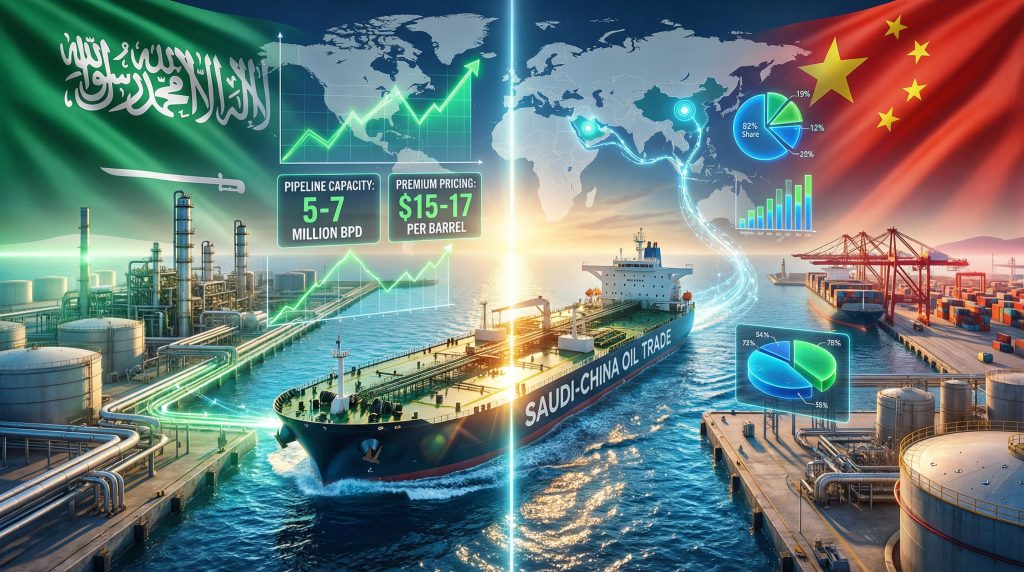
- East-West Pipeline system with 7 million barrel per day capacity
- Dual export terminals at Ras Tanura (Persian Gulf) and Yanbu (Red Sea)
- Strategic petroleum reserve coordination between both nations
- Integrated shipping and logistics networks across multiple maritime routes
Recent market conditions have demonstrated the vulnerability of even well-established supply chains. In May 2026, Saudi crude supply to China dropped to a record low of 645,161 barrels per day (approximately 20 million barrels monthly), representing a 57% reduction from the January-February baseline of 45 million barrels monthly, according to Reuters reporting.
When big ASX news breaks, our subscribers know first
Pricing Strategies During Supply Constraints
Saudi Arabia employs sophisticated pricing mechanisms to balance revenue optimisation with market share protection, particularly during periods when export capacity faces constraints. The Kingdom's official selling price (OSP) methodology reflects both immediate supply-demand dynamics and longer-term strategic positioning with key customers.
During the May 2026 supply disruption period, Saudi Arabia implemented a record premium of $19.50 per barrel above the Oman/Dubai benchmark, representing a $17 increase from the previous month. This pricing decision demonstrated how producers can leverage supply scarcity to maximise revenue per barrel, even when total export volumes decline significantly. These dynamics align with OPEC production impact on global market pricing.
Market Response Patterns:
- State-owned refiners (Sinopec) maintained strategic purchasing commitments despite premium pricing
- Independent refiners (Rongsheng Petrochemical) sharply reduced lifting volumes due to margin compression
- Alternative supplier competition intensified as Chinese buyers sought substitute crude sources
- Forward contract scheduling became critical for securing available export slots
The pricing strategy reflects a calculated trade-off between immediate revenue and long-term market position. Revenue analysis indicates that maintaining January-February volumes at standard pricing would have generated approximately $112.5 million in premium revenue, while the reduced May allocation at record premiums produced $390 million, demonstrating the financial logic behind supply rationing during constraint periods.
Official Selling Price Calculation Framework:
| Component | May 2026 | April 2026 | Change |
|---|---|---|---|
| Oman/Dubai Benchmark | Base Reference | Base Reference | – |
| Saudi Premium | +$19.50/barrel | +$2.50/barrel | +$17.00 |
| Total OSP Adjustment | Record High | Standard Level | 680% Increase |
Infrastructure Resilience and Route Diversification
The ability to maintain Saudi crude supply to China during regional conflicts depends heavily on infrastructure redundancy and rapid response protocols. Saudi Arabia's dual-route export capability through both Persian Gulf and Red Sea terminals provides critical flexibility during maritime security disruptions.
When traditional Strait of Hormuz routing faced security concerns, Saudi Arabia activated emergency protocols involving the East-West Pipeline system to redirect volumes to Yanbu terminal. This infrastructure switching required coordinated adjustments across multiple operational areas including pipeline throughput management, port scheduling, and customer contract modifications. However, these disruptions reflect broader patterns seen in US drilling declines affecting global supply dynamics.
Crisis Response Timeline Analysis:
- Initial Disruption: Production capacity reduced by approximately 600,000 barrels per day
- Pipeline Impact: East-West Pipeline throughput decreased by 700,000 barrels per day
- Recovery Phase: Full 7 million barrel per day pipeline capacity restored within days
- Export Adjustment: Customer loading programmes shifted from Ras Tanura to Yanbu operations
The rapid infrastructure recovery demonstrated Saudi Arabia's investment in redundant systems and emergency response capabilities. However, the temporary capacity constraints still resulted in significant volume reductions and required activation of force majeure clauses in certain long-term contracts.
Route Comparison Analysis:
Persian Gulf Route (Normal Operations): Direct shipping from Ras Tanura to Chinese ports via Strait of Hormuz offers the shortest transit time and lowest shipping costs under normal security conditions.
Red Sea Alternative Route: Yanbu export terminal provides strategic flexibility but extends voyage duration by approximately 5-7 days and increases shipping insurance premiums during regional instability periods.
Economic Modelling Behind Export Allocation Decisions
Saudi Arabia's approach to Saudi crude supply to China reflects sophisticated economic modelling that weighs multiple competing objectives including immediate revenue maximisation, long-term market share protection, and strategic relationship maintenance with key Asian customers.
The Kingdom operates production fields with varying cost structures, enabling flexible supply allocation based on market conditions. Low-cost fields like Ghawar (estimated production costs of $3-5 per barrel) provide substantial margins even during standard pricing periods, while more complex operations like the offshore Manifa field (approximately $15-20 per barrel production costs) become particularly profitable during premium pricing scenarios. These patterns contribute to oil price stagnation trends observed in various markets.
Break-Even Analysis Framework:
- Ghawar Field: Onshore operations with lowest extraction costs
- Safaniyah: Offshore production with moderate cost structure
- Manifa Field: Heavy crude requiring specialised recovery methods
- Export Infrastructure: Pipeline, port, and logistics cost allocation
The May 2026 premium pricing of $19.50 above benchmark provided substantial economic rent capture well above any field's break-even cost, indicating that supply constraints allowed maximum value extraction from available production capacity.
Revenue Optimisation Scenarios:
| Scenario | Volume (Million Barrels) | Premium ($/Barrel) | Total Premium Revenue |
|---|---|---|---|
| Jan-Feb Baseline | 45 | $2.50 | $112.5 Million |
| May Constrained | 20 | $19.50 | $390 Million |
| Alternative High Volume | 35 | $10.00 | $350 Million |
Chinese Refinery Response Patterns and Strategic Behaviour
Chinese refineries demonstrate distinct behavioural patterns when facing elevated pricing for Saudi crude supply to China, with responses varying significantly between state-owned enterprises and independent operators. This differentiation reflects varying strategic mandates and operational flexibility within China's refining sector.
State-owned refiners like Sinopec maintain purchasing commitments during price spikes due to strategic energy security mandates, often absorbing margin compression to ensure consistent supply availability. These enterprises coordinate with government strategic petroleum reserve policies and maintain forward contract compliance regardless of short-term pricing volatility.
Independent refiners such as Rongsheng Petrochemical operate with greater commercial flexibility, adjusting purchases based primarily on processing margin calculations rather than strategic supply considerations. This creates a tiered demand structure where premium pricing affects different customer segments disproportionately.
Refinery Strategic Considerations:
- Inventory Management: Optimising crude oil storage during price volatility periods
- Alternative Sourcing: Developing supplier diversification strategies (Russian, Iraqi, Iranian crude)
- Processing Margins: Maintaining profitability under elevated feedstock costs
- Contract Flexibility: Balancing long-term commitments with spot market opportunities
During the May 2026 supply constraint period, Sinopec nominated reduced volume for immediate loading whilst expecting receipt of April-scheduled cargoes delayed by infrastructure disruptions. This demonstrates how state refiners manage inventory through inter-month scheduling adjustments rather than market exit during unfavourable pricing periods.
Alternative Supplier Competition and Market Dynamics
The reduction in Saudi crude supply to China during constraint periods intensifies competition among alternative suppliers, creating opportunities for Russian, Iraqi, and Iranian crude producers to capture additional market share in Chinese import markets.
Russian URALS crude typically trades at different premium/discount levels compared to Saudi Arabian Light, providing Chinese refiners with substitution options based on relative pricing and processing compatibility. Iraqi crude from southern fields offers another alternative, though with different quality specifications and shipping logistics requirements.
Competitive Positioning Factors:
- Quality Specifications: API gravity and sulphur content compatibility with Chinese refinery configurations
- Payment Terms: Credit arrangements and currency hedging options
- Delivery Reliability: Supply consistency during geopolitical uncertainty
- Long-term Relationship: Strategic partnership benefits beyond pure commercial terms
The ability of alternative suppliers to rapidly scale volumes during Saudi supply constraints demonstrates the dynamic nature of global crude oil markets and the importance of maintaining diversified import portfolios for major consuming nations like China. Furthermore, these developments often correspond with global oil pricing trends affecting regional markets.
The next major ASX story will hit our subscribers first
Strategic Petroleum Reserve Implications
China's strategic petroleum reserve system plays a critical role in managing supply disruptions affecting Saudi crude supply to China, providing buffer capacity that allows more measured responses to temporary market dislocations. The reserve system enables Chinese authorities to maintain domestic supply stability whilst refiners adjust to changed import pricing and availability.
Current SPR capacity utilisation and filling strategies influence how aggressively Chinese entities respond to supply constraints and premium pricing. During periods of elevated costs, strategic reserves can supplement commercial supplies, reducing immediate pressure on refiners to maintain high-cost imports.
Reserve Management Considerations:
- Fill Rate Optimisation: Timing reserve additions during favourable market conditions
- Release Protocols: Coordinated reserve utilisation during supply emergencies
- Commercial Coordination: Balancing strategic and commercial inventory management
- International Cooperation: Potential coordination with IEA and regional reserve systems
The strategic reserve function provides China with enhanced energy security resilience, reducing vulnerability to short-term supply disruptions and creating additional leverage in bilateral energy negotiations with major suppliers.
Future Supply Pattern Evolution
Long-term trends in Saudi crude supply to China will likely reflect both infrastructure development initiatives and evolving energy transition policies in China. Ongoing investments in Saudi export infrastructure and Chinese import capacity should reduce volatility in bilateral trade flows over time.
Enhanced pipeline redundancy, expanded port capacity, and improved storage facilities will create more robust supply chains capable of maintaining consistent flows during regional instability. Digital supply chain management systems and advanced logistics coordination should further optimise operational efficiency.
Infrastructure Development Priorities:
- Pipeline Capacity Expansion: Additional redundancy beyond current East-West Pipeline system
- Port Facility Upgrades: Enhanced loading capabilities at both Yanbu and Ras Tanura terminals
- Storage Network Development: Strategic inventory positioning for supply chain optimisation
- Technology Integration: Advanced monitoring and coordination systems for rapid response protocols
China's renewable energy expansion and electric vehicle adoption may gradually moderate crude oil import growth rates, potentially affecting long-term supply planning. However, petrochemical feedstock demand growth and industrial energy requirements will likely sustain substantial import needs for the foreseeable future.
Transition Timeline Considerations:
- Carbon Neutrality Targets: Chinese policy commitments affecting long-term energy mix
- Electric Vehicle Penetration: Transportation fuel demand evolution patterns
- Petrochemical Growth: Feedstock demand supporting continued crude import needs
- Industrial Efficiency: Energy intensity improvements in manufacturing sectors
The Saudi crude supply to China relationship demonstrates how established energy trade patterns adapt to changing geopolitical conditions whilst maintaining fundamental strategic importance for both nations. Understanding these dynamics requires analysing pricing mechanisms, infrastructure capabilities, and policy frameworks that extend far beyond simple supply-demand economics.
Investment Disclaimer: This analysis is for informational purposes only and should not be considered as investment advice. Energy markets involve substantial risks including price volatility, geopolitical uncertainty, and regulatory changes. Readers should conduct their own research and consult qualified financial advisors before making investment decisions.
Could Your Portfolio Benefit from Real-Time Resource Discovery Insights?
Discovery Alert's proprietary Discovery IQ model delivers instant notifications when significant ASX mineral discoveries are announced, helping investors capitalise on opportunities that can dramatically shift commodity market dynamics. With energy and resource markets experiencing unprecedented volatility, accessing real-time discovery alerts ensures you're positioned ahead of major market movements that reshape global supply chains.