
August 6, 2026
The Invisible Highway: How AIS Darkness Is Reshaping Persian Gulf Oil Flows
Every barrel of crude oil that leaves the Persian Gulf tells a story about the global economy's structural dependencies. For decades, the maritime architecture underpinning that trade operated on a simple principle: vessels broadcast their position, identity, and cargo details in real time, creating a transparent layer of supply-side data that commodity traders, refiners, and policymakers relied upon to make decisions worth billions of dollars. That transparency is now fracturing in ways that carry consequences far beyond the tanker industry itself.
The escalation of geopolitical pressure around the Persian Gulf in 2026 has not simply disrupted oil flows. It has exposed the deep fragility of the visibility infrastructure that modern energy markets depend upon. When Strait of Hormuz tankers with trackers switched off began appearing in shipping intelligence datasets with increasing regularity, it signalled something more significant than a tactical response to local threat conditions. It revealed a structural shift in how crude oil moves through the world's most consequential maritime corridor.
When big ASX news breaks, our subscribers know first
The Strait That Cannot Be Replaced
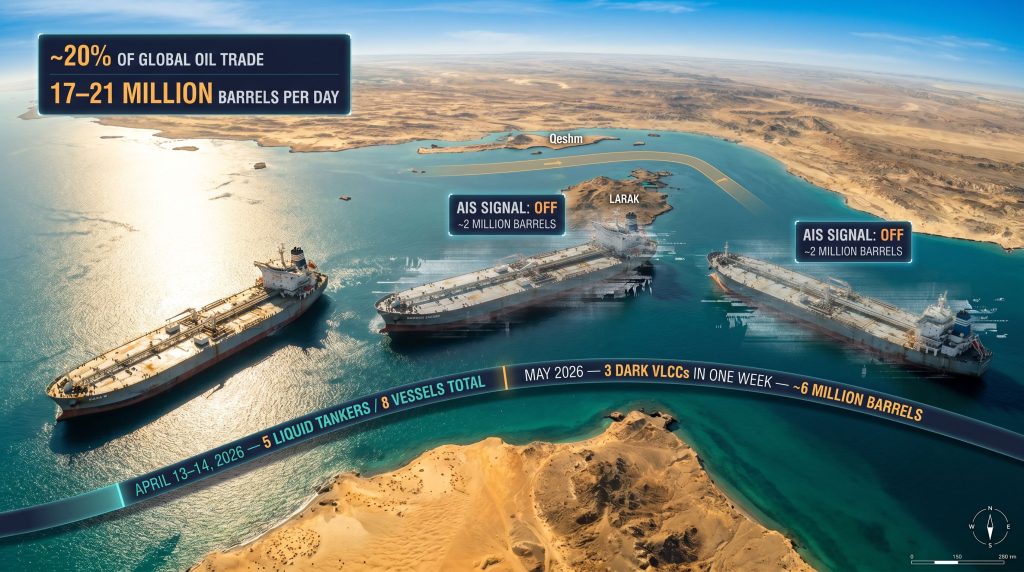
The Strait of Hormuz is not simply a geographic feature. It functions as the circulatory system of the global oil economy, and there is no viable bypass that replicates its efficiency. At its narrowest point, this corridor spans approximately 33 kilometres, yet it handles an estimated 17 to 21 million barrels of crude oil per day at peak operational throughput. That figure represents roughly 20% of all oil traded globally, making it the single most concentrated energy chokepoint on earth.
The passage connects the Persian Gulf to the Gulf of Oman, linking the production fields of Saudi Arabia, Iraq, Iran, Kuwait, the UAE, and Qatar to international markets. Alternative routing via the Cape of Good Hope adds weeks to voyage times and significantly increases operational costs, making it economically unviable for most cargo types under normal market conditions.
The enforcement architecture that emerged in mid-April 2026 fundamentally altered the operating environment within this corridor. US Central Command extended its interdiction authority to cover vessels transiting near Iranian ports and coastal zones east of the strait, irrespective of flag state. Simultaneously, Iranian naval assets began targeting vessels perceived as non-compliant with Tehran's own transit directives. This created an unprecedented dual-threat environment: operators faced enforcement risk from both sides of a geopolitical confrontation within the same narrow waterway.
The Strait of Hormuz has no strategic substitute. Any sustained disruption to observable throughput in this corridor ripples immediately into global crude pricing benchmarks, refinery feedstock planning, and sovereign energy security calculations across import-dependent economies.
Tehran subsequently designated a narrow northern transit lane near Larak and Qeshm islands as the only officially sanctioned passage, effectively compressing commercial traffic into a geographic bottleneck within an already constrained waterway and intensifying the navigational risk calculus for every vessel seeking to exit the Gulf.
Understanding AIS: The Technology Being Switched Off
How the Automatic Identification System Functions
The Automatic Identification System is a maritime transponder technology that continuously broadcasts a vessel's identity, position, speed, heading, and cargo classification to nearby ships and shore-based receiving stations. Under the International Maritime Organization's Safety of Life at Sea convention, most commercial vessels above 300 gross tonnes engaged in international voyages are legally required to maintain active AIS transponders at all times.
The system was designed primarily as a collision-avoidance tool, but its secondary function as a supply chain visibility mechanism has become equally important. Shipping intelligence platforms aggregate AIS signals in near-real time, allowing commodity analysts, port operators, and trading desks to track vessel movements across entire ocean basins with remarkable granularity. Furthermore, these crude oil price trends are closely tied to the reliability of such tracking data.
The practical mechanics are straightforward:
- VHF radio signals broadcast vessel data to other ships within approximately 74 kilometres (40 nautical miles)
- Terrestrial receivers along coastlines capture signals from vessels near shore
- Satellite-based AIS systems extend coverage to open ocean areas beyond terrestrial range
- Data aggregators such as Kpler and LSEG compile these signals into real-time tracking platforms used by commodity markets globally
The Two Flavours of Signal Manipulation
Not all AIS manipulation is the same. Understanding the distinction is critical to interpreting the data gaps appearing in Persian Gulf tracking records:
AIS deactivation (going dark): The transponder is simply switched off, creating a signal gap in tracking systems. The vessel becomes invisible to AIS-based monitoring but does not actively deceive tracking platforms. It simply disappears. Vessels can reappear days or weeks later in entirely different locations, requiring analysts to reconstruct their movements retrospectively using satellite imagery, port records, and signal resumption data.
AIS spoofing: The transponder remains active but transmits deliberately falsified data, including fabricated position coordinates, false flag state information, or altered vessel identity codes. This is technically more complex to execute, significantly harder to detect in real time, and represents a growing analytical challenge for tracking firms. A spoofed vessel inserts corrupted data into the tracking ecosystem rather than simply creating an absence of data.
One US-sanctioned tanker identified in tracking datasets from early April 2026 was reportedly operating under a falsified flag state to mask its Iranian crude origin, illustrating how spoofing techniques are being deployed alongside conventional signal blackouts as enforcement pressure intensifies.
Strait of Hormuz Tankers With Trackers Switched Off: The Documented Cases
By early May 2026, the frequency of AIS deactivation events in and around the Strait of Hormuz had reached a level that Kpler and LSEG analysts characterised as a defining operational trend. Three crude-laden tankers exited the strait with transponders disabled within a single week, according to data published by these shipping intelligence platforms. US Energy Secretary Chris Wright publicly confirmed during this period that at least one tanker had transited the strait without detection, validating the analytical picture emerging from commercial tracking data.
The vessels involved spanned multiple flag states, ownership structures, cargo origins, and destination markets, suggesting that dark-sailing behaviour was no longer confined to shadow-fleet operators with existing evasion infrastructure. Mainstream commercial operators were adopting the same tactics in response to elevated threat conditions. This pattern of oil market disruption is reshaping how global energy supply chains are managed.
Documented Dark-Transit Events: March to May 2026
| Vessel Name | Flag | Cargo | Approximate Volume | Notable Detail |
|---|---|---|---|---|
| Shenlong | Greek (Dynacom-operated) | Saudi crude | ~1 million barrels | Signal off March 4; resumed approximately March 9 |
| Unnamed sanctioned tanker | Falsely flagged (China-linked) | Iranian crude | Undisclosed | AIS spoofed to conceal Iranian cargo origin |
| Basrah Energy (VLCC) | Panama | Upper Zakum crude (ADNOC, Zirku terminal) | ~2 million barrels | Exited May 6; discharged Fujairah May 8 |
| Agios Fanourios I (VLCC) | Undisclosed | Basrah Medium crude (Iraqi) | ~2 million barrels | Two prior failed transit attempts since April 17 load date; heading to Nghi Son, Vietnam |
| Kiara M (VLCC) | San Marino | Basrah crude (Iraqi) | ~2 million barrels | Exited Sunday May 11; transponder off; Shanghai-managed, Marshall Islands-registered |
The combined cargo volume across the three confirmed May 2026 dark transits alone exceeded 6 million barrels, a figure that underscores both the scale of stranded oil accumulating in the Gulf and the operational pressure on producers to move it regardless of detection risk.
What the Cargo Origins Reveal About the Broader Dynamic
Several patterns emerge from examining the cargo data across these events. Iraqi Basrah crude appears prominently across multiple dark-transit instances, reflecting the acute export pressure facing Baghdad as conflict-related transit uncertainty lengthens cargo dwell times and strains revenue flows. The Agios Fanourios I loaded its Basrah Medium cargo on April 17 and required nearly three weeks and multiple failed attempts before successfully transiting the strait, a timeline that carries significant financial consequences for all parties in the cargo chain.
ADNOC's Upper Zakum crude from the Zirku terminal also features in the dataset, indicating that Abu Dhabi's state producer and its buyers have been actively working to clear Gulf-stranded inventories. ADNOC has reportedly moved several tankers through the strait in recent weeks as part of a coordinated effort to manage crude accumulation resulting from the regional conflict.
The ownership structure of the Kiara M illustrates another dimension of this story. A San Marino flag, Shanghai-based management, and Marshall Islands registration combine to create a layered corporate structure that mirrors the ownership architectures commonly associated with grey-fleet operations, even in cases where the vessel itself may not carry sanctions-designated cargo. This structural convergence between mainstream and shadow-fleet operational practices represents one of the most significant long-term consequences of the current disruption.
Near-Zero Visibility: What the Traffic Data Shows
The blockade's immediate impact on observable traffic was stark. During the first two operational days following the mid-April enforcement activation, Kpler data recorded only 5 liquid tankers and 8 total vessels crossing the strait, a figure representing a dramatic compression of what had previously been a high-frequency commercial corridor. By late April, observable traffic had effectively approached near-zero levels in standard tracking platforms.
This data collapse does not necessarily reflect a complete cessation of physical movement. It reflects, at least in part, the growing gap between actual vessel activity and observable vessel activity created by AIS deactivation and spoofing. Maritime intelligence firms have consistently noted that current transit counts are likely understated, with actual throughput potentially materially higher than observable AIS data indicates.
Shipping intelligence analysts have cautioned that transit count estimates through the Strait of Hormuz should be treated as lower bounds rather than accurate representations of actual throughput during periods of elevated dark-sailing activity. The systematic upward revision of counts as vessels reactivate signals days or weeks later has become a predictable pattern in the current operating environment.
Vessels that transit the strait dark and are destined for Southeast Asian markets typically reactivate their AIS signals in the Gulf of Oman, the Arabian Sea, or, in cases involving the longest voyages, near the Strait of Malacca. The Agios Fanourios I's projected arrival at Vietnam's Nghi Son Refinery and Petrochemical facility on approximately May 26 implies a signal-dark period of roughly 10 to 13 days from the strait to the point of AIS resumption, consistent with patterns observed across multiple prior dark-transit events.
The Shadow Fleet Connection: How Evasion Tactics Went Mainstream
The normalisation of dark sailing among non-Iranian commercial operators represents one of the less-discussed consequences of the current disruption. Iran's network of vessels operating outside conventional insurance, flag state, and ownership frameworks had already developed sophisticated evasion infrastructure long before the 2026 escalation. These practices included transponder manipulation, ship-to-ship transfers beyond territorial waters, and layered corporate registration structures specifically designed to frustrate sanctions enforcement.
The enforcement pressure emanating from mid-April 2026 has effectively transferred these operational tactics into the broader commercial shipping ecosystem. When operators managing legitimate cargo face the same physical threat environment as sanctions-designated vessels, the risk calculus driving transponder deactivation becomes identical regardless of the cargo's origin or ownership. In addition, the broader context of sanctions on oil trade has already normalised many of these evasion techniques across global shipping networks.
By early May 2026, four Iranian crude tankers were reported idle in the Gulf of Oman, unable or unwilling to transit. The parallel operation of these stranded vessels alongside dark-transiting commercial tankers carrying Iraqi and Emirati crude illustrates how enforcement pressure simultaneously immobilises some vessels while driving others to adopt evasion techniques that were previously associated exclusively with the sanctioned trade.
The next major ASX story will hit our subscribers first
Supply Chain Fragility: The Numbers Behind the Risk
The market implications of sustained Hormuz disruption are best understood through the lens of scale and concentration risk:
| Metric | Data Point |
|---|---|
| Share of global oil trade through Hormuz | ~20% |
| Estimated peak daily crude throughput | 17-21 million barrels per day |
| Confirmed dark-transit VLCCs in one week (May 2026) | 3 vessels |
| Combined cargo volume across those three transits | ~6 million barrels |
| Kpler-recorded crossings in blockade's first 48 hours | 5 liquid tankers; 8 vessels total |
| Agios Fanourios I failed transit attempts before success | At least 2 |
| Approximate dark period for Gulf-to-Southeast-Asia transits | 10-13 days |
Reduced observable throughput creates upward pricing pressure even without a complete physical blockade, because commodity markets respond to supply uncertainty as much as to supply shortfalls. When trading desks cannot reliably track whether cargoes are moving, the risk premium embedded in crude pricing rises to compensate for the informational gap.
Historical precedent supports this dynamic. The 2019 tanker attack episodes in the Gulf of Oman triggered immediate oil price volatility despite no material reduction in physical supply. The 2012 Iranian sanctions confrontation similarly produced price spikes driven more by market anxiety about potential disruption than by actual supply reductions. The current episode adds a novel layer: the data infrastructure that previously allowed markets to distinguish between genuine supply disruption and threat-related anxiety is itself being degraded by dark-sailing activity. Consequently, OPEC market influence over pricing benchmarks becomes even more pronounced when visibility into actual supply flows diminishes.
Downstream Exposure: Asian Refining at the End of the Supply Chain
The Agios Fanourios I's destination illustrates a structural dependency that extends well beyond the Persian Gulf itself. Vietnam's Nghi Son Refinery and Petrochemical complex, a major refining facility on the country's northern coast, is directly in the supply chain for Iraqi Basrah crude moving through the Hormuz corridor. Disruptions to scheduled cargo deliveries create feedstock uncertainty that affects refinery run rates, product output, and domestic fuel pricing in markets that have limited ability to rapidly diversify their crude sourcing.
India represents the most significant exposure point in this chain. As one of the world's largest importers of Persian Gulf crude, India's refining sector depends heavily on the reliable operation of the Hormuz corridor. Prolonged transit uncertainty translates into longer cargo lead times, elevated shipping insurance premiums, and increased feedstock planning complexity for refiners managing just-in-time supply chains.
South and Southeast Asian markets collectively account for a substantial share of Persian Gulf crude demand, meaning that any sustained compression of observable throughput carries downstream consequences across a region that has fewer short-term alternatives to Gulf-origin supply than Western markets. However, the wider geopolitical trade tensions reshaping global commerce are accelerating efforts by these economies to diversify their energy sourcing strategies.
The Intelligence Gap: Tracking Vessels That Don't Want to Be Found
Shipping intelligence platforms face a fundamental methodological challenge in the current environment. Their core analytical product relies on continuous AIS signal streams. When those streams are deliberately interrupted, the platforms must fall back on secondary and tertiary data sources to reconstruct vessel movements:
- Satellite imagery analysis: High-resolution commercial satellite imagery can identify vessels at known anchorage zones or near loading terminals even during AIS blackout periods, though coverage is not continuous and requires analytical interpretation
- Port arrival and departure records: Official port documentation provides a lagging indicator of actual transit activity, often confirming dark-transit events days after they have occurred
- Signal resumption mapping: Tracking the geographic location where vessels reactivate their AIS provides retrospective data about probable transit routes, even when the transit itself was invisible to real-time monitoring
- Cross-referencing against loading schedules: Known cargo loading events create an expectation of subsequent vessel movement that can be matched against eventual signal resumption data to estimate transit timing
The systematic upward revision of transit count estimates as vessels reactivate their signals has become a predictable feature of the current analytical environment. What appears in real-time data as a near-total cessation of traffic is progressively revised upward as dark vessels emerge from their signal blackout periods in the Arabian Sea and beyond.
Spoofing cases are substantially more difficult to reconstruct. A vessel transmitting false position data contaminates the tracking dataset rather than simply creating a gap, making retrospective analysis reliant on physical observation or corroborating documentation that may not be available for weeks or months. Specialist tanker analysts at TradeWinds have documented specific vessels, including Sinokor and Eastmed VLCCs, among those exiting the strait with trackers off, further corroborating the scale of this phenomenon.
Frequently Asked Questions: Strait of Hormuz Tankers and AIS Tracker Deactivation
Why are tankers turning off their trackers in the Strait of Hormuz?
Vessel operators are deactivating AIS transponders primarily to reduce their detection risk in a dual-threat enforcement environment, where both US naval interdiction operations targeting Iran-affiliated vessels and Iranian naval assets targeting perceived non-compliant ships create physical danger for any identifiable commercial tanker transiting the corridor. Switching off the transponder removes the vessel from real-time commercial tracking systems, making it significantly harder to identify and intercept.
Is it legal for a tanker to switch off its AIS transponder?
Under the International Maritime Organization's SOLAS framework, most commercial vessels engaged in international voyages are legally obligated to maintain active AIS transponders. In practice, enforcement is inconsistent in contested maritime zones, and operators in high-threat environments frequently accept the regulatory risk of deactivation in preference to the physical risk of operating as a visible, identifiable target in an active interdiction zone.
How many barrels of oil were carried by the tankers that went dark in May 2026?
The three confirmed dark-transit VLCCs identified through Kpler and LSEG data during the week ending May 11, 2026 collectively carried approximately 6 million barrels of crude, comprising approximately 2 million barrels each of Iraqi Basrah crude aboard the Agios Fanourios I and Kiara M, and approximately 2 million barrels of ADNOC Upper Zakum crude aboard the Basrah Energy.
What percentage of global oil supply passes through the Strait of Hormuz?
Approximately 20% of total global oil trade transits the Strait of Hormuz, making it the world's most strategically significant maritime energy chokepoint. At peak operational throughput, the corridor handles an estimated 17 to 21 million barrels of crude oil per day.
Where do tankers reappear after going dark in the Persian Gulf?
Based on tracking data from multiple dark-transit events, vessels typically reactivate their AIS signals in the Gulf of Oman, the Arabian Sea, or, for voyages destined for Southeast Asian markets, near the Strait of Malacca. The dark period for Gulf-to-Southeast-Asia transits typically spans 10 to 13 days from departure at Persian Gulf loading terminals.
What is the difference between AIS spoofing and going dark?
Going dark involves complete transponder deactivation, creating a signal absence in tracking systems. AIS spoofing involves transmitting deliberately falsified identity, position, or flag data, actively inserting false information into the tracking ecosystem. Spoofing is considered the more sophisticated and analytically challenging form of signal manipulation because it corrupts data rather than simply withholding it.
What Comes Next: Three Scenarios for Hormuz Transit Operations
Scenario 1: Sustained Enforcement Pressure
Dark-sailing activity remains elevated across a range of vessel types and cargo origins. Observable transit counts stay structurally suppressed below actual throughput levels. Shipping insurance premiums for Gulf-origin crude continue rising, increasing the all-in cost of Persian Gulf crude relative to Atlantic Basin alternatives. Stranded oil volumes in the Gulf accumulate, putting mounting financial pressure on producing countries dependent on export revenue. This scenario appears closest to the current trajectory based on observable data through May 2026.
Scenario 2: Diplomatic De-escalation
A negotiated framework between the United States and Iran reopens the strait to unrestricted commercial traffic. AIS compliance among commercial operators rapidly recovers as physical threat levels diminish, restoring the transparency layer that commodity markets depend on. Regional crude price differentials normalise as supply uncertainty dissipates and observable throughput data becomes a reliable indicator of actual flows again.
Scenario 3: Escalation and Physical Interdiction
Increased enforcement actions by either the US or Iran result in vessel seizures or direct confrontations, triggering a rapid reduction in willing operators and a sharp spike in global crude prices. Alternative routing via the Cape of Good Hope becomes economically viable for a significantly expanded range of cargo types, adding weeks to voyage times and permanently altering freight rate structures for Gulf-origin crude. This scenario would represent the most severe test of Asian refining economics in a generation.
Each of these pathways carries materially different consequences for global oil benchmarks, Asian refinery feedstock economics, and the long-term reliability of the Persian Gulf as the anchor of the international oil supply chain. The scenario that ultimately unfolds will be shaped not just by military and diplomatic decisions, but by the evolving risk calculations of the vessel operators, cargo owners, and insurers whose collective behaviour determines whether oil actually moves through this corridor regardless of what geopolitical actors intend.
This article is based on publicly reported shipping intelligence data and should not be construed as investment advice. Vessel movement data from AIS-based tracking platforms is subject to revision as dark-transit events are retrospectively confirmed. Geopolitical situations affecting maritime operations can change rapidly, and readers should consult current intelligence sources for the latest developments.
Want to Know Which ASX Resource Companies Are Positioned Around Energy Supply Disruptions?
Discovery Alert's proprietary Discovery IQ model scans ASX announcements in real time, instantly identifying significant mineral discoveries across more than 30 commodities — including those tied to the energy sector reshaping global supply chains like the one explored above. Discover why major finds have historically delivered extraordinary returns by visiting Discovery Alert's dedicated discoveries page, and begin your 14-day free trial today to gain an actionable market edge before the broader market catches on.