August 7, 2026
The Structural Blind Spot at the Heart of Europe's Russia Sanctions
When policymakers design sanctions regimes, they typically focus on finished goods, financial flows, and named entities. What they frequently underestimate is the strategic leverage embedded in intermediate industrial inputs — the unglamorous raw materials that sit quietly in the middle of global supply chains. Alumina is precisely this kind of material. Chemically unremarkable, commercially widespread, and entirely legal to export from the European Union to Russia as of mid-2026, it nevertheless occupies a position of extraordinary geopolitical sensitivity. Understanding why requires tracing both the chemistry and the politics of a commodity that has become one of the most contested exports in Europe's ongoing response to the war in Ukraine.
When big ASX news breaks, our subscribers know first
Where Alumina Sits in the Weapons Supply Chain
To appreciate the controversy surrounding Aughinish Alumina exports to Russia sanctions pressure, it helps to understand the fundamental chemistry connecting bauxite ore to aluminium metal. The production pathway moves in three distinct stages:
-
Bauxite mining extracts aluminium-bearing ore from the earth, primarily from equatorial deposits in Guinea, Australia, and Brazil. Disruptions to the global bauxite supply have historically amplified the strategic importance of refining capacity in politically stable regions.
-
Alumina refining converts raw bauxite into aluminium oxide, a fine white powder that serves as the essential feedstock for the next stage.
-
Aluminium smelting uses an electrolytic process called the Hall-Heroult process to reduce alumina into primary aluminium metal, which is then cast, rolled, or extruded into commercial products.
Alumina is therefore not a finished product but an indispensable precursor. Without a continuous supply of aluminium oxide, even the most sophisticated smelter cannot produce a single tonne of primary metal. This dependency is absolute and cannot be substituted through any alternative chemistry at industrial scale.
Smelters are also capital-intensive, long-lived assets with fixed geographic locations, making their alumina supply chains strategically critical in ways that few other industrial inputs match. The broader aluminium supply chain — from ore extraction to finished metal — is consequently one of the most geopolitically sensitive industrial systems in the modern economy.
The civilian applications of aluminium are broad and genuinely important: aircraft fuselage panels, beverage cans, automotive components, construction profiles, and electrical transmission cables all depend on primary aluminium. But so do artillery systems, missile casings, armoured vehicle components, and bomber airframes. The metal itself carries no inherent military classification. Its end use is entirely determined by who buys it and what they manufacture from it.
This is precisely where the policy gap emerges. The EU's 14th sanctions package, which took effect on 26 February 2026, prohibited the import of Russian aluminium into EU member states. Yet the same framework left untouched the reverse trade flow: European alumina exports to Russia. The asymmetry is not accidental, but its consequences are now under intense political scrutiny.
Europe's Largest Alumina Refinery and Its Russian Owner
Located on a peninsula in the Shannon Estuary in County Limerick, Aughinish Alumina is the largest alumina refinery in Europe by processing capacity. The facility has operated for decades as a major industrial employer in Ireland's midwest region, refining imported bauxite into aluminium oxide for export.
The refinery is owned by United Company Rusal, which ranks among the world's largest primary aluminium producers by output. Rusal's position within Russian industrial structure is not incidental: the company is deeply integrated into the Russian economy and has connections to figures within Russia's corporate and political establishment that have attracted recurring regulatory scrutiny in both the United States and Europe.
The company was the subject of US Treasury OFAC sanctions designations in 2018, which were subsequently wound back following Rusal's ownership restructuring. However, the episode illustrated the sensitivity of the firm's ownership relationships. Furthermore, the scale of alumina and aluminium operations globally means that ownership structures at major refineries carry outsized strategic consequences for the markets they serve.
The strategic importance of Aughinish to Rusal's supply chain intensified materially after Russia's full-scale invasion of Ukraine in February 2022. Ukraine's Mykolaiv alumina refinery, which had previously been a significant source of alumina for Russian smelters, was nationalised by Ukrainian authorities following the invasion, removing a key feedstock source from Rusal's network. In this context, Aughinish's uninterrupted output assumed greater significance within Rusal's global refining portfolio.
The Irish government's position on the refinery has consistently been shaped by the facility's economic footprint. According to reporting by AL Circle and confirmed by Irish authorities, the plant supports approximately 1,000 direct jobs, with an additional 1,000 positions sustained through associated companies and suppliers in the Shannon region. This level of regional economic dependency creates powerful domestic political incentives to protect the facility from sanctions exposure, regardless of the geopolitical context.
The Investigation That Changed the Conversation
The debate over Aughinish Alumina exports to Russia sanctions moved from background concern to active political crisis following a cross-border investigative project published in March 2026. The Organised Crime and Corruption Reporting Project collaborated with the Irish Times, The Guardian, iStories, KibOrg, De Tijd, and Delfi to map the downstream trajectory of alumina leaving the County Limerick facility.
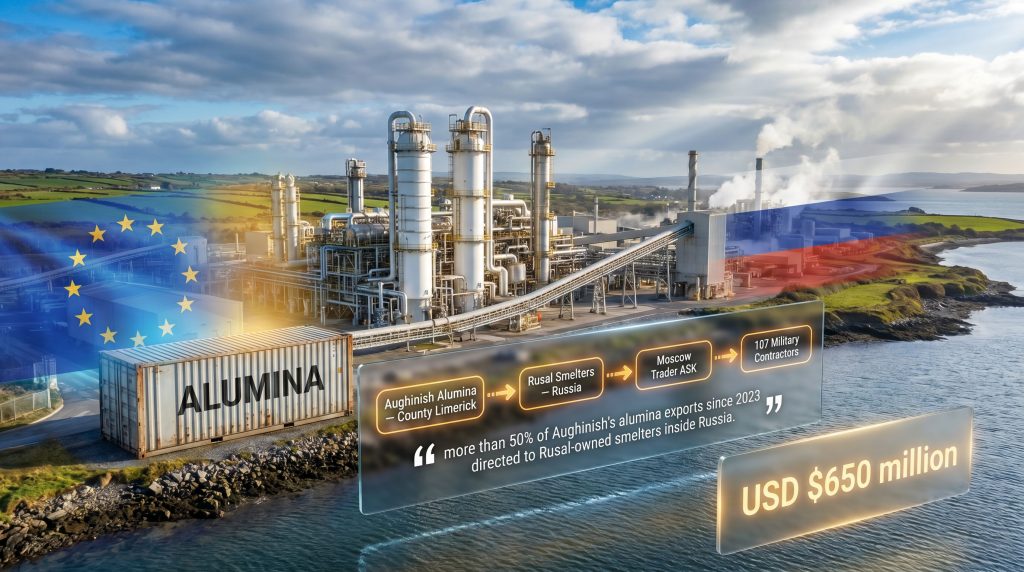
The investigation's central findings were stark. Investigators concluded that more than 50 percent of Aughinish's alumina exports since 2023 were directed to Rusal-operated smelters inside Russia. The methodology drew on multiple data streams, including customs records, transport documentation, shipping manifests, and satellite imagery analysis of industrial sites.
What Did the Supply Chain Evidence Show?
The documented supply chain pathway traced the following sequence:
| Supply Chain Stage | Actor | Outcome |
|---|---|---|
| Alumina refining | Aughinish Alumina, County Limerick (Rusal-owned) | Aluminium oxide exported to Russia |
| Primary smelting | Rusal-operated Russian smelters | Conversion to primary aluminium ingot |
| Distribution | Moscow-based trader ASK | Sale to Russian industrial and defence clients |
| End manufacturing | Over 107 Russian military contractors, 40+ under active EU sanctions | Weapons components for active conflict |
| Deployed end-use | Russian armed forces | Bomber airframes, missiles, tank components, artillery systems |
The estimated value of aluminium flowing through this chain since 2023 exceeded USD $650 million, according to the investigation's findings. Crucially, the aluminium in question reached defence contractors that are themselves subject to active EU sanctions designations, creating a documented, if indirect, linkage between a legal EU export and sanctioned military production.
As The Guardian's investigation reported, the Irish refinery sits within a supply chain that demonstrably feeds the Russian war machine, a conclusion drawn from records covering commercial relationships rather than individual batch tracking.
"The critical technical limitation: Alumina loses its individual identity during the smelting process. Once batches from different sources are combined in a smelter's feed stream and reduced to primary metal, it becomes technically impossible to attribute any specific ingot to any specific alumina shipment."
Investigators therefore relied on systemic supply chain mapping rather than product-level traceability. The chain is documented at the level of commercial relationships and verified flows, not individual batch tracking. This traceability constraint is a defining feature of how industrial commodity sanctions work in practice.
The question is not whether one can identify which molecule of aluminium came from Aughinish, but whether the documented commercial system that begins at Aughinish demonstrably terminates at sanctioned military manufacturers.
The Political Response Across Europe
The investigative findings generated rapid political mobilisation across the European Parliament and among member state governments. A coalition of 39 MEPs drawn from 12 countries, including Denmark, France, Germany, and Poland, formally wrote to EU High Representative for Foreign Affairs Kaja Kallas and Trade Commissioner Maroš Šefčovič calling for restrictions on alumina exports connected to the Russian defence sector.
Within that coalition, 17 MEPs from the Renew Europe group and 11 from the European People's Party (EPP) were among the signatories, representing a cross-partisan alignment that crossed traditional divisions between liberal and centre-right groupings in the European Parliament. Notably, Ireland declined to participate in the coalition, consistent with its broader position on protecting Aughinish from sanctions exposure.
Key Stakeholder Positions
| Stakeholder | Position | Action |
|---|---|---|
| EU Sanctions Envoy David O'Sullivan | Characterised exports as deeply concerning; signalled alumina may need to enter the sanctions framework | Public statement, March 2026 |
| EP Vice-President Pina Picierno | Raised formal question to Commission on whether exports are compatible with EU commitments to Ukraine | Submitted week of 6 May 2026 |
| Dutch MEP Bart Groothuis | Described ongoing operations as irresponsible; demanded export ban to Russia's defence sector | Formal letter, 27 March 2026 |
| 39-MEP Coalition | Urged Kallas and Šefčovič to restrict alumina exports | Formal letter, May 2026 |
| Belgian FM Maxime Prévot | Called for closing structural loopholes in the sanctions framework | Public statement, 2026 |
| Polish MEP Arkadiusz Mularczyk | Drew comparisons with Australia's existing alumina export restrictions | Parliamentary intervention, 2026 |
| Irish Government | Initiated two internal reviews; maintained Aughinish's exemption from sanctions | Ongoing, April to May 2026 |
EU Sanctions Envoy David O'Sullivan's position deserves particular attention. O'Sullivan indicated publicly that if evidence confirms alumina is contributing to Russian military production, the material may need to be incorporated into the EU's sanctions architecture. Given the documented investigative findings, this conditional framing effectively positions alumina inclusion as a matter of policy will rather than evidentiary uncertainty.
Irish Minister for Enterprise Peter Burke confirmed that alumina exports to Russia remain entirely legal under current EU law. Furthermore, the existence of strategic commodity loopholes in major trade frameworks is increasingly recognised as a structural vulnerability that adversaries can exploit. Critics argue the current situation reflects the inadequacy of the law rather than any vindication of the trade.
The Australia Precedent: Demonstrating That Restrictions Are Feasible
One of the most frequently cited reference points by European lawmakers is Australia's decision to restrict alumina exports to Russia following the 2022 invasion. Australia was a significant supplier of both bauxite and alumina to Russian processors prior to the conflict. Its decision to impose export controls demonstrated that restrictions on alumina are operationally feasible.
Polish MEP Arkadiusz Mularczyk explicitly raised the Australian precedent in parliamentary debate, questioning why the EU has not adopted a comparable approach given the documented evidence of downstream military end-use. The comparison is particularly pointed because Australia is not a party to the conflict and has no treaty obligations to Ukraine comparable to those that EU member states implicitly carry through their collective foreign policy commitments.
"The feasibility argument: If a non-EU, non-NATO country with genuine commercial interests in the Russian aluminium market was able to implement alumina export controls without economic collapse, the argument that EU member states cannot do the same loses much of its structural credibility."
In addition, Europe's raw materials strategy increasingly recognises the need to reduce strategic dependencies and close regulatory gaps — a context that makes the Aughinish debate even more consequential for policymakers.
The next major ASX story will hit our subscribers first
Aughinish's Legal Compliance and Why It Does Not End the Debate
Aughinish Alumina has maintained consistently that its operations are conducted in full compliance with all applicable EU laws, sanctions regulations, and export control measures, and that the company operates a comprehensive due diligence framework across its supply chain. This position is legally accurate: no current EU regulation prohibits the company from exporting alumina to Russia.
However, the compliance argument contains a structural limitation that the company's critics are quick to identify. Legal compliance with an existing framework does not address the adequacy of the framework itself. The policy gap is not a matter of Aughinish violating rules but of the rules being insufficient to capture the full strategic consequences of the trade they govern.
There is also a practical ceiling on what any due diligence framework can achieve in this context. Once alumina is delivered to a Russian smelter and enters the production process, it exits the exporter's sphere of influence entirely. The downstream commercial decisions of Rusal's trading subsidiary, the identity of its industrial customers, and the end-use applications of the aluminium they manufacture are beyond the reach of any supply chain monitoring system operating at the point of export.
"A fundamental policy question: If a product is demonstrably legal to export, yet investigative evidence documents its contribution to sanctioned military activity through a traceable commercial chain, does legal compliance constitute an adequate response to that evidence? This is the question now sitting uncomfortably at the centre of European sanctions policy."
Four Scenarios for Policy Resolution
European policymakers currently face four plausible trajectories for resolving the Aughinish alumina exports to Russia sanctions question, each carrying distinct implications for trade law, industrial economics, and sanctions credibility.
Scenario 1: Alumina Included in the Next EU Sanctions Package
This outcome would require the European Commission to formally propose alumina's inclusion, the Council of the EU to reach unanimous agreement among member states, and Ireland to either acquiesce or be overruled. Given Ireland's consistent opposition, this represents the most politically difficult pathway, though not an impossible one if broader Council consensus crystallises. Timeline would likely align with the EU's next major sanctions review cycle.
Scenario 2: A Targeted Export Licensing Regime
A middle-ground approach would introduce mandatory end-use certification requirements for alumina exports to non-allied nations, requiring exporters to document the intended downstream application. This model draws on existing dual-use export control frameworks applied to other industrial materials and represents a compromise that might attract Ireland's conditional acceptance while still imposing meaningful oversight.
Scenario 3: Status Quo Maintained
Ireland continues to resist sanctions inclusion, the Council fails to achieve unanimity, and Aughinish continues operating under current legal frameworks. The practical consequence would be the continuation of documented alumina flows to Russian smelters whose output demonstrably reaches sanctioned military manufacturers, accompanied by ongoing reputational damage to the EU's broader sanctions credibility.
Scenario 4: Voluntary Supply Chain Restructuring
Rusal and Aughinish respond to political pressure by voluntarily redirecting Aughinish's output away from Russian smelters toward alternative commercial customers in non-sanctioned markets. This scenario is structurally unlikely given Rusal's ownership incentives, but it represents a pathway that would resolve the political problem without requiring legal changes.
The Broader Precedent: When Ownership Structure Becomes a Strategic Risk
The Aughinish case raises a question that extends well beyond alumina and well beyond Ireland. At its core, it asks whether the ownership of a major EU industrial asset by an entity connected to a country actively sanctioned by the EU is itself a category of strategic risk that existing regulatory frameworks are equipped to manage.
The EU's sanctions architecture was designed primarily around trade flows and financial transactions, not around the industrial ownership structures that determine where commercial decisions are made and who benefits from them. Rusal's ownership of Aughinish means that a Russian-linked entity retains decision-making authority over one of Europe's most strategically significant aluminium production assets.
If alumina is ultimately added to the EU sanctions framework, it will raise immediate questions about what other intermediate industrial inputs might warrant similar scrutiny. The principle it establishes — that downstream military end-use of an intermediate commodity can justify export restrictions even when the commodity itself has overwhelmingly civilian applications — could theoretically extend to a broader range of industrial inputs used by Russian manufacturers.
The long-term structural question is whether the EU will develop a more systematic framework for evaluating intermediate-goods export controls in conflict contexts. The growing scrutiny of alumina trade in European defence supply discussions suggests that policymakers are increasingly aware that existing tools are inadequate for the challenge. The Aughinish Alumina exports to Russia sanctions debate may consequently represent the point at which that framework begins to take shape.
Frequently Asked Questions
Is it currently illegal for Aughinish Alumina to export to Russia?
No. As of May 2026, alumina exports from the EU to Russia are not prohibited under any active EU sanctions package. The 14th EU sanctions package banned Russian aluminium imports into the EU but did not restrict alumina exports to Russia.
Who owns Aughinish Alumina?
Aughinish Alumina is owned by United Company Rusal, Russia's largest aluminium producer and one of the world's largest aluminium companies by primary metal output.
What is alumina used for in Russia?
Alumina is the primary feedstock for aluminium smelting. Russian smelters convert alumina into primary aluminium, which is sold to industrial clients including, according to investigative findings, military contractors producing weapons systems deployed in Ukraine.
Why has Ireland not supported sanctions on Aughinish exports?
Ireland has consistently cited the economic importance of the Aughinish facility to the Shannon region, including approximately 1,000 direct jobs and a further 1,000 positions through associated companies, as justification for opposing export restrictions.
What did Australia do differently?
Australia imposed restrictions on alumina exports to Russia following the 2022 invasion of Ukraine, a decision cited by European lawmakers as evidence that export controls on alumina are operationally feasible and do not require economic catastrophe as their precondition.
Could the EU sanction alumina exports without Ireland's agreement?
EU sanctions require unanimous agreement among member states in the Council. Ireland's opposition creates a significant procedural obstacle, though the European Commission retains trade-related authority under certain treaty provisions that could potentially be exercised through separate legal mechanisms.
Disclaimer: This article is intended for informational purposes only and does not constitute legal, financial, or investment advice. Figures relating to export volumes, monetary values, employment numbers, and supply chain documentation are drawn from investigative reporting and industry sources as cited. Readers should consult primary source documentation and official EU regulatory publications for confirmation of specific claims. The scenarios presented represent analytical projections and should not be interpreted as predictions of policy outcomes.
Want to Track the Commodity Stories Shaping Global Markets?
Discovery Alert's proprietary Discovery IQ model delivers real-time alerts on significant ASX mineral discoveries — cutting through the complexity of over 30 commodities, including aluminium and its critical upstream inputs, to surface actionable investment opportunities the moment they emerge. Explore how major mineral discoveries have historically generated substantial returns on Discovery Alert's dedicated discoveries page, and begin your 14-day free trial to position yourself ahead of the broader market.