
August 14, 2026
Global energy markets face unprecedented vulnerability as critical infrastructure becomes increasingly exposed to sophisticated attack methodologies. The concentration of production assets within geographically constrained regions creates systemic risks that cascade through international supply chains, affecting commodity pricing and strategic reserve policies worldwide. Modern energy security frameworks must adapt to evolving threat landscapes where precision targeting capabilities intersect with complex geopolitical tensions, particularly regarding attacks on Saudi energy infrastructure.
Understanding the Strategic Vulnerability of Saudi Energy Assets
The Kingdom's energy architecture operates through a carefully orchestrated network of production facilities, processing complexes, and transportation systems that collectively sustain global oil market stability. This interconnected infrastructure represents both the strength and weakness of centralised energy production models.
Critical Infrastructure Dependencies in the Kingdom
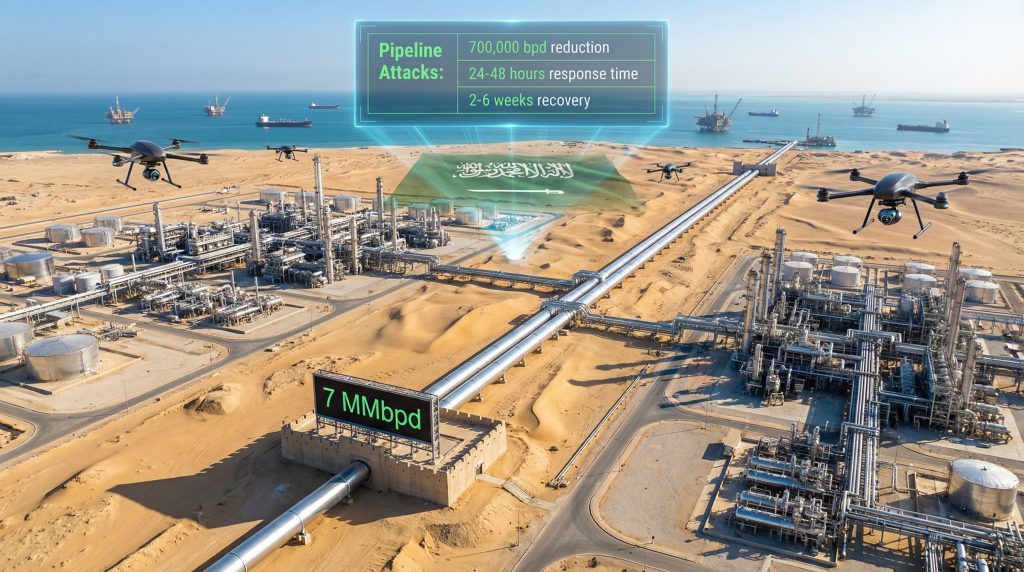
Saudi Arabia's dual-route export strategy centres on the East-West pipeline system, which maintains approximately 7 million barrels per day (MMbpd) total capacity, with roughly 5 MMbpd designated for export markets. This massive transportation artery serves as the kingdom's primary mechanism for circumventing maritime chokepoints, particularly when alternative routes face disruption.
Recent attacks on Saudi energy infrastructure have demonstrated the cascading effects of targeting strategic nodes within this system. The disruption reduced pipeline flows by approximately 700,000 barrels per day, representing a significant portion of the system's export capacity and highlighting the vulnerability of concentrated infrastructure networks. Furthermore, this demonstrates how attacks on Saudi energy infrastructure create ripple effects throughout global market impact dynamics.
The geographic distribution of production assets across the Eastern Province creates both operational efficiency and concentrated risk exposure. Major production facilities including the Ghawar field, Safaniyah complex, and Manifa offshore platform operate within relatively close proximity, allowing for integrated processing and transportation but also creating clustered target opportunities.
Key infrastructure vulnerabilities include:
- Single-point failure risks in critical pumping stations
- Geographic concentration of processing facilities in the Eastern Province
- Limited redundancy in pipeline routing for emergency bypass operations
- Offshore platform exposure to maritime-based security threats
The East-West pipeline's strategic importance extends beyond mere transportation capacity. This system represents Saudi Arabia's primary tool for maintaining export flexibility when traditional Gulf routes through the Strait of Hormuz face constraints. The pipeline's seven pumping stations and associated infrastructure require synchronised operation to maintain optimal flow rates and pressure specifications.
Regulatory Framework Governing Energy Security
International maritime law provides foundational protection for energy infrastructure through the International Ship and Port Facility Security Code (ISPS Code), which establishes minimum security standards for port facilities and vessels engaged in international trade. However, these frameworks primarily address maritime security rather than comprehensive infrastructure protection.
Pipeline protection protocols operate under a complex matrix of domestic legislation and international cooperation agreements. The International Energy Agency (IEA) Emergency Response System provides coordination mechanisms for member countries during supply disruptions, though Saudi Arabia's non-member status limits direct participation in formal response protocols.
Regional cooperation agreements facilitate information sharing and coordinated response capabilities. Nevertheless, the effectiveness of these arrangements depends heavily on geopolitical relationships and real-time threat assessment capabilities.
When big ASX news breaks, our subscribers know first
What Makes Saudi Oil Infrastructure a Prime Target for Regional Adversaries?
Energy infrastructure represents a force multiplier for regional adversaries seeking to influence global economic conditions without engaging in direct military confrontation. The interconnected nature of global energy markets means that localised disruptions create disproportionate international impact.
Geopolitical Leverage Through Energy Disruption
The strategic value of attacks on Saudi energy infrastructure lies in their ability to simultaneously disrupt local production capacity and influence global commodity pricing. When traditional export routes through the Strait of Hormuz face constraints, the East-West pipeline system becomes increasingly critical to global supply continuity.
Historical precedent demonstrates that approximately 21% of global petroleum typically transits through the Strait of Hormuz, according to U.S. Energy Information Administration data. During periods when this chokepoint faces disruption, alternative transportation routes experience increased utilisation and strategic importance.
The current regional conflict environment has effectively constrained Strait of Hormuz operations, forcing Saudi Arabia to redirect volumes through the East-West pipeline system. This operational shift transforms the pipeline infrastructure from a supplementary export route into a critical component of global supply maintenance.
Economic warfare tactics targeting export capacity leverage several key vulnerabilities:
- Supply chain bottlenecks that create price volatility disproportionate to actual production losses
- Market psychology effects where perceived threats amplify actual disruption impacts
- Strategic reserve deployment triggers that force coordinated international responses
- Refinery feed disruption affecting downstream processing capacity in key markets
Technical Vulnerabilities in Large-Scale Operations
Large-scale energy operations present multiple attack vectors due to their distributed nature and complex interdependencies. The recent targeting of both offshore and onshore facilities demonstrates sophisticated understanding of system vulnerabilities and operational priorities.
The Manifa offshore field experienced capacity reductions of approximately 300,000 barrels per day, affecting heavy crude production streams. Offshore platforms operate with fixed infrastructure that cannot be rapidly relocated or defended through conventional security measures. These facilities face unique exposure to maritime-based threats and require specialised response capabilities.
Conversely, the Khurais onshore complex sustained similar capacity reductions of 300,000 barrels per day, impacting lighter crude streams typically processed through the East-West pipeline system. Onshore facilities present different security challenges, including perimeter defence requirements and vulnerability to precision-guided attacks.
| Facility Type | Production Impact | Crude Grade | Recovery Complexity |
|---|---|---|---|
| Manifa (Offshore) | 300,000 bpd | Heavy crude | High – Maritime access required |
| Khurais (Onshore) | 300,000 bpd | Light crude | Moderate – Land-based repair access |
| East-West Pipeline | 700,000 bpd transport | Mixed grades | Variable – Depends on damage location |
The differentiation between heavy and light crude production impacts creates specific market effects. Lighter crude streams command premium pricing and serve particular refinery configurations in key export markets, whilst heavy crude grades require specialised processing capabilities that limit market flexibility.
Pipeline monitoring systems typically employ Supervisory Control and Data Acquisition (SCADA) networks that provide real-time flow monitoring, pressure management, and leak detection capabilities. However, these systems also create potential cyber-attack vectors that complement physical infrastructure targeting.
How Do Production Disruptions Cascade Through Global Markets?
Energy market disruptions create cascading effects that extend far beyond immediate production losses. The interconnected nature of global oil markets means that regional supply constraints influence pricing, inventory management, and strategic planning across multiple continents.
Supply Chain Impact Assessment
The magnitude of recent attacks on Saudi energy infrastructure demonstrates how coordinated strikes can create systemic supply chain disruption. Total production capacity cuts exceeded 600,000 barrels per day, whilst pipeline transportation reductions reached 700,000 barrels per day, creating a comprehensive constraint on export capability.
These figures represent approximately 10% of Saudi Arabia's pre-conflict crude exports, according to JPMorgan analyst assessments. Such disruption levels trigger automatic response protocols within international energy security frameworks and influence strategic petroleum reserve deployment decisions.
The cascading impact analysis reveals several critical transmission mechanisms:
Immediate Supply Response (0-48 hours):
- Spot market pricing adjustments based on perceived supply constraints
- Tanker scheduling modifications to access alternative loading terminals
- Strategic petroleum reserve activation discussions among IEA member countries
- Refinery crude slate adjustments to accommodate grade availability changes
Short-term Market Adaptation (2-14 days):
- Contract renegotiation for term crude purchases
- Alternative crude grade sourcing from supplementary producers
- Inventory drawdown acceleration at key storage facilities
- Forward curve pricing adjustments reflecting extended outage scenarios
Medium-term Structural Shifts (2-8 weeks):
- Supply chain route optimisation for sustained operations
- Infrastructure repair timeline assessment and market communication
- Strategic reserve replenishment planning for sustained supply security
- Alternative producer capacity utilisation optimisation
Price Volatility and Market Psychology
Brent crude pricing serves as the primary global benchmark for oil market valuation, making Saudi production disruptions immediately visible across international financial markets. Attacks on Saudi energy infrastructure occurred during a period when Brent crude had already risen sharply due to broader regional conflict impacts, reflecting oil price dynamics.
Market psychology during infrastructure attacks typically follows predictable patterns that amplify actual supply disruption impacts. Initial price responses often exceed mathematical supply-demand calculations due to uncertainty regarding damage extent and repair timelines.
The assessment by JPMorgan analysts that recent infrastructure damage represents a "measurable supply shock" reflects professional market recognition that current disruption levels warrant immediate strategic response. This terminology indicates that the disruption exceeds normal market volatility thresholds and requires coordinated international attention.
Price volatility mechanisms during infrastructure attacks include:
- Uncertainty premiums reflecting unknown repair timelines and damage extent
- Inventory management pressure as buyers accelerate purchases to avoid supply gaps
- Speculative position adjustments by commodity trading firms and hedge funds
- Currency correlation effects as oil price movements influence petrodollar recycling patterns
The timing and duration of production outages remain uncertain following recent attacks, creating sustained volatility as markets attempt to price recovery scenarios without definitive repair timeline information. This uncertainty factor typically adds $5-15 per barrel premium to crude pricing during major infrastructure incidents.
Strategic petroleum reserve deployment triggers vary by country but typically activate when supply disruptions exceed 2-3% of global daily consumption for extended periods. The current disruption levels approach these thresholds, particularly when combined with concurrent Strait of Hormuz constraints.
What Are the Long-Term Implications for Energy Security Policy?
The evolving threat landscape for energy infrastructure requires comprehensive policy adaptation that addresses both immediate security vulnerabilities and long-term strategic resilience. Current attack methodologies demonstrate sophisticated understanding of system interdependencies that traditional security frameworks may not adequately address.
Infrastructure Hardening Requirements
Modern energy infrastructure protection requires multi-layered defence strategies that integrate physical security, cybersecurity, and rapid response capabilities. The geographic distribution of Saudi energy assets across multiple provinces necessitates coordinated defence planning that can adapt to diverse threat vectors.
Advanced surveillance systems increasingly incorporate artificial intelligence-enhanced pattern recognition that can distinguish between normal operational variations and potential security threats. These systems monitor pipeline flow rates, pressure differentials, and vibration signatures to provide early warning of potential attacks.
Critical infrastructure hardening priorities include:
- Redundant transportation networks that provide alternative routing during primary system outages
- Distributed processing capabilities that reduce single-point failure risks
- Enhanced perimeter security utilising integrated sensor networks and automated response systems
- Rapid repair protocols with pre-positioned equipment and specialised response teams
The development of mobile processing units represents an emerging trend in infrastructure resilience planning. These systems can provide temporary processing capability during facility repairs, maintaining partial production capacity whilst permanent infrastructure undergoes restoration.
International Cooperation Frameworks
Energy infrastructure protection increasingly requires international coordination that transcends traditional bilateral relationships. The global nature of energy markets means that regional infrastructure attacks create worldwide economic impacts that justify coordinated response mechanisms.
Moreover, given the connection to broader energy security trends, these frameworks must also consider US‑China trade effects on global supply chains.
Maritime security partnerships focus on protecting offshore energy facilities and tanker transit routes through enhanced patrol coordination and intelligence sharing agreements. The Combined Maritime Forces (CMF) provides operational coordination for maritime security in critical shipping lanes, though coverage limitations require supplementary bilateral arrangements.
Intelligence sharing agreements facilitate early warning systems that can provide advance notification of potential infrastructure threats. However, the effectiveness of these arrangements depends on real-time information processing capabilities and coordinated response authorisation procedures.
Joint infrastructure protection initiatives increasingly incorporate cyber-security coordination as energy infrastructure control systems become more interconnected and potentially vulnerable to coordinated cyber-physical attacks.
How Do These Attacks Compare to Historical Energy Infrastructure Incidents?
Historical analysis of energy infrastructure attacks provides critical context for understanding both threat evolution and response effectiveness. The comparison between current incidents and previous disruptions reveals patterns in attack methodology, damage assessment, and recovery timelines.
Precedent Analysis: 2019 Abqaiq-Khurais Strikes
The September 2019 attacks on the Abqaiq processing facility and Khurais field created the most significant temporary supply disruption in modern energy history, halving Saudi oil output and removing approximately 5.7 million barrels per day from global markets. This represented roughly 5% of global supply and demonstrated the vulnerability of centralised processing infrastructure.
According to analysis from energy security experts, the 2019 incident showcased both the devastating immediate impact of precision infrastructure targeting and the remarkable resilience of modern energy systems when supported by adequate financial resources and technical expertise.
Recovery operations following the 2019 attacks demonstrated several critical capabilities that influence current response expectations:
Rapid Assessment Protocols: Saudi Aramco deployed specialised damage assessment teams within hours of the attacks, providing preliminary repair timelines within 48 hours of the incident.
Strategic Reserve Utilisation: The kingdom immediately activated stored crude inventories to maintain export commitments whilst production facilities underwent repair.
Accelerated Repair Operations: Round-the-clock repair operations utilising pre-positioned equipment and specialised contractors restored production to approximately 80% capacity within 10 days and full capacity within 2-3 weeks.
Market Communication: Transparent communication regarding repair progress helped moderate price volatility as markets gained confidence in recovery timelines.
The 2019 recovery demonstrated that financial resources, technical expertise, and operational flexibility can significantly compress repair timelines compared to initial market expectations. Brent crude prices initially surged approximately $10-15 per barrel following the attacks but moderated quickly as repair progress became evident.
Evolution of Attack Methodologies
The progression from the 2019 Abqaiq-Khurais strikes to current infrastructure targeting reveals significant advancement in attack sophistication and coordination. Modern attacks demonstrate improved precision targeting capabilities and enhanced understanding of system vulnerabilities.
Technological Enhancement in Targeting Systems:
- Improved GPS precision allowing for sub-metre accuracy in target identification
- Enhanced payload delivery systems capable of penetrating hardened infrastructure
- Coordinated multi-site attack capabilities requiring sophisticated command and control systems
- Real-time damage assessment capabilities that can guide follow-up strikes
Strategic Targeting Evolution:
- Shift from processing facilities to transportation infrastructure targeting
- Coordinated offshore and onshore facility targeting within compressed timeframes
- Selection of targets that maximise supply chain disruption relative to attack complexity
- Integration of cyber and physical attack vectors for enhanced effectiveness
The current attack pattern targeting both the East-West pipeline and production facilities simultaneously represents a more sophisticated understanding of system interdependencies compared to the single-facility focus of the 2019 incidents.
What Risk Mitigation Strategies Can Energy Companies Implement?
Energy infrastructure protection requires comprehensive risk management approaches that address both immediate security threats and long-term operational resilience. Modern threat environments demand integrated strategies that combine traditional physical security with advanced technological solutions.
Operational Security Enhancements
Real-time threat monitoring systems provide the foundation for effective infrastructure protection through continuous surveillance of both physical facilities and surrounding areas. These systems integrate satellite imagery, ground-based sensors, and predictive analytics to identify potential threats before they materialise into actual attacks.
Advanced monitoring technologies include:
- Distributed fiber optic sensing that can detect vibrations along pipeline routes indicating unauthorised access or tampering attempts
- Thermal imaging networks providing 24-hour facility perimeter monitoring with automated alert capabilities
- Drone surveillance systems that conduct regular patrol flights over critical infrastructure areas
- Seismic monitoring arrays that can distinguish between normal operational vibrations and potential attack signatures
Diversified export route development represents a critical long-term strategy for reducing single-point failure risks. The concentration of Saudi exports through limited transportation corridors creates systemic vulnerability that can be mitigated through infrastructure investment and operational flexibility enhancement.
Infrastructure Diversification Priorities:
- Alternative pipeline routing that provides redundant transportation capacity during primary system outages
- Multiple loading terminal development to distribute export capacity across geographic locations
- Flexible processing capabilities that can redirect crude streams between different export routes based on operational requirements
- Enhanced storage capacity at multiple locations to provide operational buffer during transportation disruptions
Facility hardening protocols focus on critical node protection whilst maintaining operational efficiency. Modern approaches integrate passive protection (structural hardening) with active defence systems (automated response capabilities) to create multi-layered security environments.
Financial Risk Management
Supply disruption insurance mechanisms have evolved significantly following recent infrastructure attack patterns. Traditional business interruption insurance may not adequately cover the complex cascading effects of modern infrastructure attacks, requiring specialised coverage for energy sector operational risks.
Specialised Insurance Coverage Areas:
- Cyber-physical attack protection covering coordinated digital and physical infrastructure targeting
- Export capacity loss insurance specifically addressing transportation system disruptions
- Strategic reserve replacement costs covering the financial impact of emergency inventory utilisation
- Extended business interruption accounting for prolonged recovery periods following infrastructure damage
Commodity price hedging strategies provide financial protection against price volatility during infrastructure disruptions. Energy companies increasingly utilise sophisticated hedging instruments that can provide protection during both supply shortage and recovery periods.
Emergency response funding frameworks ensure adequate financial resources are available for rapid infrastructure repair and recovery operations. The 2019 Abqaiq-Khurais recovery demonstrated that immediate access to substantial financial resources significantly accelerates repair timelines and reduces overall market disruption.
The next major ASX story will hit our subscribers first
How Should Investors Evaluate Energy Infrastructure Risk?
Investment analysis of energy infrastructure assets requires comprehensive risk assessment frameworks that integrate geopolitical, operational, and financial risk factors. Traditional investment metrics may not adequately capture the complexity of modern infrastructure security challenges.
Due Diligence Framework for Energy Assets
Geopolitical risk assessment methodologies must incorporate both current threat levels and dynamic threat evolution patterns. Static risk assessments based on historical data may not accurately reflect rapidly changing security environments or evolving attack capabilities.
Comprehensive Risk Assessment Components:
Geographic Risk Analysis:
- Proximity to conflict zones and historical attack patterns
- Regional stability indicators and political risk trends
- Cross-border security cooperation effectiveness
- Alternative transportation route availability and capacity
Infrastructure Vulnerability Assessment:
- Facility hardening levels and security system capabilities
- Redundancy planning and backup system effectiveness
- Recovery time estimates for various attack scenarios
- Insurance coverage adequacy for operational disruptions
Operational Resilience Evaluation:
- Management team crisis response experience and capabilities
- Financial resource availability for emergency response operations
- Technical expertise depth for rapid infrastructure repair
- Strategic partnership relationships for recovery support
Regional stability indicators extend beyond traditional political risk metrics to include cyber-security threat levels, non-state actor capabilities, and technology proliferation patterns that influence attack likelihood and sophistication.
Portfolio Diversification Strategies
Geographic risk distribution becomes increasingly important as attack methodologies become more sophisticated and potentially transferable between regions. Concentration in any single region, regardless of historical stability, may create portfolio vulnerability to coordinated infrastructure targeting.
Diversification Strategy Framework:
Geographic Diversification:
- Distribution across multiple continents and regulatory environments
- Balance between stable regions and higher-return frontier markets
- Consideration of cross-regional correlation during crisis periods
- Assessment of alternative supply source availability during regional disruptions
Technology-Based Risk Mitigation:
- Investment in infrastructure hardening and advanced security systems
- Portfolio allocation toward distributed energy systems with lower vulnerability profiles
- Technology investment in rapid response and recovery capabilities
- Cyber-security enhancement funding for critical infrastructure protection
Operational Diversification:
- Balance between offshore and onshore asset exposure
- Distribution across different crude grades and processing requirements
- Integration of renewable energy assets that face different risk profiles
- Strategic partnership development for shared risk management
Alternative energy transition hedging provides long-term protection against traditional energy infrastructure risks whilst positioning portfolios for fundamental energy market evolution. However, renewable energy infrastructure faces its own security challenges that require careful assessment.
What Does This Mean for Global Energy Transition Planning?
Recent attacks on Saudi energy infrastructure highlight the strategic advantages of distributed energy systems and renewable resource utilisation in long-term energy security planning. The vulnerability of centralised fossil fuel infrastructure creates additional momentum for energy transition investments.
Accelerated Renewable Energy Investment
Distributed energy systems offer inherent security advantages through reduced single-point failure risks and decreased dependency on centralised transportation infrastructure. Solar installations, wind farms, and energy storage systems create resilient energy networks that can maintain partial operation even during coordinated attacks.
The distributed generation model fundamentally alters energy security calculations by replacing vulnerable transportation networks with distributed production capabilities. Whilst renewable installations face their own security challenges, the distributed nature makes system-wide disruption significantly more difficult to achieve.
Security Advantages of Renewable Energy Infrastructure:
- Geographic distribution reduces the impact of localised attacks or disruptions
- Minimal transportation requirements eliminate pipeline and tanker vulnerability
- Modular design allows partial system operation during component outages
- Rapid replacement capability for damaged components compared to complex refinery rebuilding
- Local energy independence reducing dependency on vulnerable international supply chains
Regional energy independence strategies become increasingly attractive as traditional energy supply chains face persistent security challenges. Countries with significant renewable energy potential can reduce exposure to international energy infrastructure vulnerabilities through domestic resource development.
Strategic Reserve Policy Evolution
Traditional strategic petroleum reserves may require fundamental reconceptualisation in light of evolving infrastructure vulnerability patterns. The frequency and sophistication of attacks on Saudi energy infrastructure suggest that emergency response capacity requirements may exceed current reserve capabilities.
Enhanced Reserve Strategy Components:
Diversified Storage Locations:
- Geographic distribution to prevent coordinated attacks on storage infrastructure
- Integration of private sector storage capabilities with government strategic reserves
- Development of floating storage capacity that can be repositioned during crisis periods
- Creation of regional reserve sharing agreements for enhanced collective capacity
Technology-Enhanced Storage Solutions:
- Advanced monitoring systems for real-time inventory management and security assessment
- Automated release mechanisms that can respond rapidly to supply disruption triggers
- Integration with renewable energy systems for hybrid energy security approaches
- Cyber-security hardening for storage facility control and monitoring systems
International coordination mechanisms require enhancement to address the speed and scale of modern infrastructure attacks. The current disruption levels affecting Saudi energy infrastructure demonstrate that individual country responses may be insufficient for managing global market impacts.
Emergency response capacity requirements may need to account for prolonged disruption scenarios rather than traditional short-term supply interruptions. The evolution of attack capabilities suggests that future incidents may create more sustained infrastructure damage requiring extended recovery periods.
Building Resilient Energy Security Architecture
The integration of traditional and renewable energy security strategies offers the most comprehensive approach to managing evolving infrastructure risks. Hybrid systems that combine strategic petroleum reserves with renewable energy capacity and advanced storage technologies provide multiple layers of supply security.
Comprehensive Energy Security Framework:
Infrastructure Hardening and Diversification:
- Physical security enhancement for existing critical infrastructure
- Development of redundant transportation and processing capabilities
- Integration of cyber-security measures with physical protection systems
- Creation of rapid response and recovery capabilities for infrastructure damage
Strategic Reserve and Emergency Response:
- Enhanced strategic petroleum reserve capacity and distribution
- Development of renewable energy emergency response capabilities
- International cooperation agreements for crisis response coordination
- Financial mechanisms for rapid infrastructure repair and recovery operations
Long-term Transition Planning:
- Gradual shift toward distributed energy systems with enhanced security profiles
- Development of hybrid energy security approaches combining traditional and renewable resources
- Investment in advanced energy storage technologies for enhanced grid resilience
- Creation of regulatory frameworks that support energy security and transition objectives
The recent attacks on Saudi energy infrastructure serve as a critical reminder that energy security requires constant adaptation to evolving threat environments. Investment in both immediate security enhancements and long-term energy transition planning provides the most comprehensive approach to managing these complex challenges.
Disclaimer: This analysis is provided for informational purposes only and should not be construed as investment advice. Energy infrastructure investments involve significant risks including geopolitical instability, operational disruption, and market volatility. Investors should conduct their own due diligence and consult with qualified financial advisors before making investment decisions. Historical performance and current market conditions do not guarantee future results.
Want to Stay Ahead of Market-Moving Energy and Mining Discoveries?
Discovery Alert delivers instant notifications on significant ASX mineral discoveries through its proprietary Discovery IQ model, helping investors identify actionable opportunities in energy transition metals, critical minerals, and commodity plays before broader market recognition. Start your 14-day free trial today and discover why major mineral discoveries can generate substantial returns in volatile market conditions like these.