May 13, 2026
Saudi Arabia's remarkable industrial transformation demonstrates how resource-rich nations can leverage existing advantages while building diverse manufacturing capabilities. The Kingdom's Saudi industrial output growth reflects a sophisticated dual-track approach that maximises hydrocarbon revenues whilst developing parallel industrial sectors. This strategic positioning showcases the effectiveness of systematic diversification efforts within established commodity-dependent economies.
The current trajectory of Middle Eastern industrial development demonstrates this phenomenon particularly clearly, where established hydrocarbon economies are simultaneously expanding traditional energy output while building parallel manufacturing and processing capabilities. This dual-track approach represents a sophisticated risk management strategy that leverages existing resource advantages while constructing alternative revenue streams through value-added production processes.
Chemical Processing and Petroleum Refining Leadership
Saudi Arabia's downstream petroleum processing sector has achieved remarkable momentum through strategic capacity expansion and technological modernisation initiatives. The refined petroleum products manufacturing segment recorded 5.2% annual growth in February 2026, representing a significant acceleration in value-added hydrocarbon processing capabilities. This expansion reflects the Kingdom's systematic approach to capturing greater margins from crude oil resources through sophisticated refining operations.
The chemical and chemical products sector complemented this performance with 4.5% year-over-year growth, demonstrating the effectiveness of integrated petrochemical development strategies. These sectors benefit from Saudi Arabia's unique position as a low-cost feedstock provider with access to abundant crude oil and natural gas resources. The proximity to raw materials creates substantial competitive advantages in polymer production, fertiliser manufacturing, and specialty chemical synthesis.
Key performance indicators reveal the sector's resilience despite monthly volatility patterns:
- Refined petroleum products: 5.2% annual growth with -0.8% monthly adjustment
- Chemical manufacturing: 4.5% annual expansion with -1.4% monthly decline
- Overall manufacturing index: 3.6% year-over-year improvement
The monthly fluctuations reflect typical production scheduling adjustments rather than underlying weakness. Petrochemical facilities often implement maintenance cycles during specific calendar periods, creating temporary output reductions that do not indicate long-term capacity constraints. This operational pattern is common across global refining and chemical processing industries.
Strategic positioning within international petrochemical value chains has enabled Saudi Arabia to capture increasing market share in key export categories. The integration of refining and chemical production facilities creates operational synergies where refined products serve as feedstocks for higher-value chemical derivatives, maximising the economic value extracted from each barrel of crude oil processed.
Investment flows into downstream processing capabilities continue accelerating through both domestic capital deployment and international joint venture arrangements. Furthermore, major refinery expansion projects and chemical complex development initiatives are expanding the Kingdom's total processing capacity while incorporating advanced technologies that improve efficiency and environmental performance.
When big ASX news breaks, our subscribers know first
Non-Metallic Minerals and Basic Metals Performance
The basic metals manufacturing sector has demonstrated exceptional annual growth of 6.2%, reflecting strong domestic demand from infrastructure development initiatives and export market opportunities. This performance significantly exceeds regional averages and indicates successful capacity utilisation across steel production, aluminium smelting, and other primary metal processing operations.
Monthly performance variations reveal the cyclical nature of metals demand, with basic metals experiencing a 2% month-on-month decline in February 2026 despite strong annual trends. This pattern typically correlates with construction project scheduling, where material procurement concentrates during specific seasonal periods to align with optimal building weather conditions.
Non-metallic mineral products achieved 2.2% year-over-year growth, supporting the broader construction and infrastructure sectors. This category encompasses cement production, glass manufacturing, ceramic products, and other building materials essential for large-scale development projects. The steady growth trajectory reflects sustained construction activity across residential, commercial, and infrastructure segments.
Manufacturing performance by category demonstrates sectoral diversity:
| Product Category | Annual Growth | Monthly Change | Market Driver |
|---|---|---|---|
| Basic Metals | +6.2% | -2.0% | Infrastructure demand |
| Non-metallic Minerals | +2.2% | N/A | Construction activity |
| Paper Products | +1.9% | +2.0% | Packaging growth |
The aluminium smelting industry benefits particularly from Saudi Arabia's competitive electricity costs, enabling economically viable primary aluminium production for both domestic consumption and export markets. Energy-intensive smelting operations require stable, low-cost power supplies that the Kingdom can provide through its extensive energy infrastructure.
Cement demand correlates directly with Vision 2030 infrastructure development timelines, including mega-project construction phases and urban development initiatives. The sustained non-metallic minerals growth indicates continued momentum in large-scale construction activities that require substantial material inputs over extended timeframes.
Paper and paper products manufacturing achieved notable performance with 1.9% annual growth and 2% monthly increase, suggesting expanding packaging and distribution sector activity. This growth likely reflects increasing domestic consumer markets and export packaging requirements for various manufactured goods.
Mining and Quarrying Driving Double-Digit Growth Rates
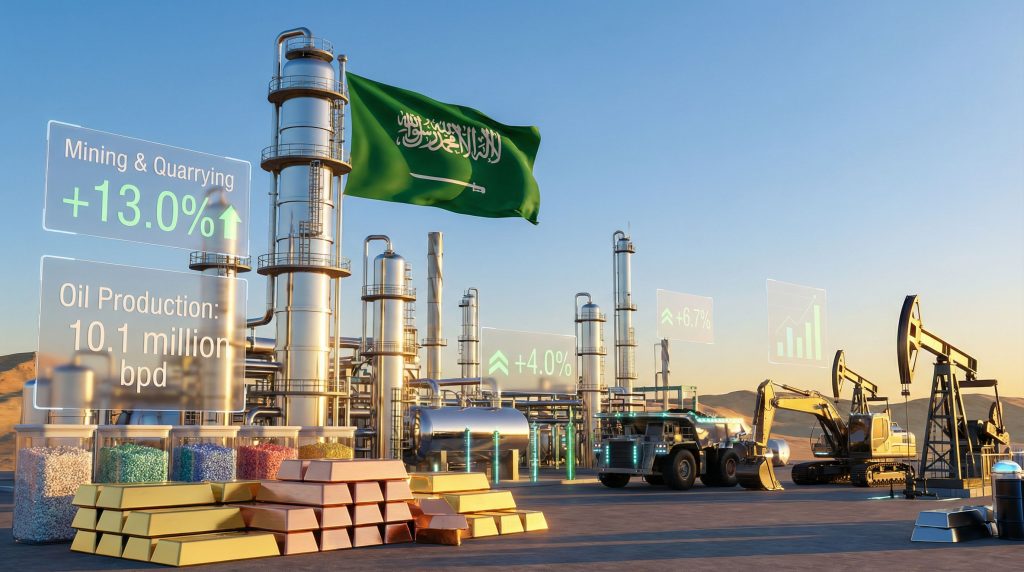
The mining and quarrying sector has emerged as the standout performer within Saudi industrial output growth, achieving 13% annual growth that significantly outpaces other major industrial categories. This exceptional performance reflects both expanded oil production capacity and accelerated development of non-hydrocarbon mining operations.
Oil production optimisation strategies have enabled Saudi Arabia to increase output to 10.1 million barrels per day in February 2026, representing a substantial 1.2 million barrel per day increase from the 8.9 million bpd baseline established in February 2025. This production expansion demonstrates sophisticated capacity management within OPEC+ framework parameters whilst maintaining market stability obligations.
Monthly stability indicators show minimal volatility with 0.1% month-on-month growth in mining and quarrying activities, suggesting that production levels have stabilised at elevated rates following the phased increases implemented throughout 2025. This stability indicates effective operational management of both offshore and onshore petroleum extraction facilities.
The strategic importance of sustained oil production growth extends beyond immediate revenue generation to encompass long-term energy security considerations and international market influence. However, the broader mining industry evolution demonstrates how nations can diversify their resource portfolios beyond hydrocarbons.
Non-oil mining sector development has accelerated dramatically through systematic licence issuance and regulatory framework modernisation. The Ministry of Industry issued 67 new mining licences during the first quarter of 2026, including 38 licences in February alone, demonstrating aggressive implementation of diversification objectives.
Mining licence distribution encompasses several key mineral categories:
- Precious metals: Gold extraction operations in established mining regions
- Industrial minerals: Phosphate and potash production for fertiliser manufacturing
- Rare earth elements: Strategic mineral exploration for technology applications
- Construction materials: Aggregate and stone quarrying for infrastructure projects
The licensing acceleration reflects Saudi Arabia's systematic approach to developing non-hydrocarbon mineral resources through private sector engagement and foreign investment attraction. In addition, the mineral exploration importance cannot be understated as each licence represents potential employment generation, technology transfer, and export revenue diversification opportunities.
Geographic distribution of mining activities spans the Saudi Shield geological province and Nubian Shield regions, areas known for significant mineral potential. The systematic exploration and development of these resources supports long-term economic diversification whilst creating sustainable employment opportunities in non-urban regions.
Industrial Production Index Analysis
The Industrial Production Index reached 114.6 in February 2026, representing substantial progress from the 105.3 baseline established in February 2025. This 9.3-point increase translates to 8.9% overall industrial output growth, demonstrating broad-based expansion across multiple industrial categories.
Sectoral performance comparison reveals significant variation in growth trajectories and strategic priorities:
| Sector | Annual Growth | Monthly Change | Strategic Role |
|---|---|---|---|
| Mining & Quarrying | +13.0% | +0.1% | Revenue foundation |
| Oil Activities | +11.5% | -0.1% | Economic backbone |
| Water/Waste Management | +8.1% | N/A | Infrastructure support |
| Manufacturing | +3.6% | -0.2% | Value creation |
| Non-Oil Activities | +2.4% | -0.4% | Diversification target |
| Electricity/Gas/Steam | -3.7% | N/A | Efficiency improvement |
The data reveals that oil-related activities continue dominating Saudi industrial output growth with 11.5% annual expansion, whilst non-oil activities achieved more modest 2.4% growth. This differential indicates that economic diversification efforts are progressing but remain in early development phases relative to hydrocarbon sector maturity.
Monthly volatility patterns suggest seasonal production adjustments rather than structural weaknesses. The manufacturing sector's 0.2% monthly decline contrasts with strong annual performance, reflecting normal operational cycles in industrial production scheduling.
International Standard Industrial Classification (ISIC) methodology ensures consistent measurement frameworks that enable accurate benchmarking against regional and global industrial performance indicators. The index covers comprehensive industrial activities including mining operations, manufacturing processes, utility services, and waste management systems.
Base year indexing using 2016 as the reference point provides historical context for current performance levels. Consequently, the February 2026 reading of 114.6 represents a 14.6% cumulative increase from the baseline, indicating sustained industrial expansion over the measurement period.
Seasonal adjustment mechanisms account for predictable cyclical patterns in industrial production, ensuring that underlying trends are accurately captured despite temporary fluctuations. This methodology is essential for distinguishing between structural improvements and routine operational variations.
Utility Sectors Supporting Industrial Infrastructure
Water supply, sewerage, and waste management activities recorded impressive 8.1% annual growth, reflecting critical infrastructure investment that supports broader industrial expansion. These utility services provide essential foundations for manufacturing operations, mining activities, and urban development initiatives.
The substantial growth in water and waste management capabilities indicates systematic infrastructure modernisation that anticipates future industrial capacity requirements. Advanced water treatment facilities, sewerage system expansion, and waste management optimisation create necessary preconditions for sustained industrial development.
Circular economy principles are increasingly integrated into waste management operations, creating opportunities to recover valuable materials and reduce environmental impact. This approach aligns with international sustainability standards whilst generating additional revenue streams from waste processing activities.
Conversely, electricity, gas, steam, and air conditioning supply activities experienced a 3.7% annual decline, potentially reflecting improved energy efficiency in industrial operations or increased renewable energy integration. This reduction may indicate successful demand management strategies rather than capacity constraints.
Grid modernisation initiatives support increasing industrial electricity demand whilst incorporating smart grid technologies that optimise power distribution efficiency. These investments enable more sophisticated load management and reduce overall system costs through improved operational control.
Energy distribution infrastructure adaptations accommodate changing industrial demand patterns as manufacturing capacity expands and new industrial facilities become operational. Furthermore, the utility sector's ability to provide reliable services at competitive costs directly influences industrial competitiveness and investment attraction potential.
Monthly Volatility and Seasonal Patterns
Short-term manufacturing fluctuations reveal normal cyclical patterns inherent in industrial production scheduling. The 0.2% monthly decline in manufacturing output occurred despite robust annual growth trends, indicating temporary adjustments rather than fundamental weakness.
Coke production and refined petroleum products experienced 0.8% monthly decrease, whilst chemical and chemical products declined 1.4% month-over-month. These variations typically reflect maintenance scheduling, inventory management, and demand cycle optimisation rather than capacity limitations.
Production scheduling optimisation enables manufacturers to align output with anticipated demand patterns whilst maintaining operational efficiency. Monthly volatility often results from strategic decisions to concentrate maintenance activities during specific periods or adjust inventory levels based on market conditions.
Mixed performance indicators across manufacturing subsectors demonstrate the complexity of industrial production management:
- Paper products: +1.9% annually, +2% monthly (packaging demand growth)
- Electrical devices: -3.2% annually, +0.3% monthly (technology transition)
- Basic metals: +6.2% annually, -2% monthly (seasonal construction patterns)
Market demand alignment requires sophisticated forecasting and production planning capabilities that enable manufacturers to respond effectively to changing customer requirements whilst maintaining cost efficiency. The ability to manage these variations successfully indicates mature operational management systems.
Seasonal demand patterns particularly affect construction-related materials, where procurement concentrates during optimal building periods. Understanding these cycles enables more accurate interpretation of monthly data variations and better prediction of future performance trends.
The next major ASX story will hit our subscribers first
Regional Economic Context and Global Positioning
Saudi Arabia's 8.9% industrial output growth substantially exceeds typical regional performance benchmarks, positioning the Kingdom as a leading industrial growth economy within the Gulf Cooperation Council region. This performance reflects successful policy implementation and strategic investment allocation across multiple industrial sectors.
Competitive positioning within the global mining landscape benefits from Saudi Arabia's scale advantages, resource availability, and infrastructure development. The Kingdom's larger domestic market and more diverse industrial base provide foundations for sustained growth that smaller regional economies cannot easily replicate.
Cross-border industrial supply chain integration creates opportunities for regional specialisation and efficiency optimisation. Saudi Arabia's expanding manufacturing capacity can serve as a hub for Gulf-wide industrial networks whilst benefiting from complementary capabilities in neighbouring countries.
Global manufacturing sector context reveals that Saudi Arabia's industrial performance compares favourably with emerging market industrial indices, particularly considering the challenging international economic environment. This relative strength attracts international investment and technology transfer partnerships.
Export competitiveness in manufactured goods continues improving through cost advantages, quality improvements, and market access expansion. The combination of competitive input costs and improving production capabilities creates opportunities for increasing market share in international markets.
Technology transfer partnerships with leading international manufacturers accelerate capabilities development whilst providing access to advanced production methods and quality management systems. These collaborations are essential for achieving world-class manufacturing standards.
Investment Implications and Market Opportunities
Foreign direct investment attraction strategies benefit significantly from demonstrated Saudi industrial output growth momentum and diversification progress. International investors increasingly recognise Saudi Arabia as an attractive manufacturing and processing hub with substantial competitive advantages.
Industrial zone development and special economic areas provide structured environments for new investment projects with streamlined regulatory processes and infrastructure support. These facilities offer international companies efficient pathways for establishing operations within the Kingdom.
Joint venture opportunities in high-growth subsectors enable international partners to access Saudi Arabia's market opportunities whilst contributing technology and expertise. However, junior mining investments demonstrate how strategic partnerships can accelerate sector development whilst managing risk exposure.
Capital market implications for industrial stocks include improved performance expectations and increased investor interest in Saudi-listed industrial companies. The strong sectoral growth data supports positive equity valuations and IPO opportunities for industrial enterprises.
Private equity opportunities in non-oil industrial development reflect the substantial growth potential in manufacturing, mining, and processing sectors. These investments can capture value from the ongoing economic transformation whilst supporting further diversification efforts.
Sovereign wealth fund industrial investment strategies increasingly focus on building domestic capabilities whilst generating attractive returns. The Public Investment Fund's involvement in industrial development provides substantial capital and strategic support for sector growth.
Future Growth Projections and Strategic Outlook
Vision 2030 milestone achievement assessment indicates strong progress toward industrial sector diversification objectives, with current performance trends supporting optimistic projections for continued growth. The sustained momentum across multiple industrial categories demonstrates effective policy implementation.
Conservative growth scenarios project 5-7% annual industrial expansion through systematic capacity building and market development. This baseline assumes continued policy support and stable international economic conditions without major disruptions.
Optimistic scenarios envision 10-12% sustained growth driven by major investment projects, technology adoption acceleration, and export market expansion. Achievement of these higher growth rates requires continued success in attracting international investment and maintaining competitive advantages.
Risk factors include global economic volatility, commodity price fluctuations, and potential geopolitical disruptions that could affect industrial production and investment flows. For instance, effective risk management strategies are essential for maintaining growth momentum through various external challenges.
Opportunity factors encompass mega-project industrial demand, export expansion potential, and technology advancement adoption. The Kingdom's large-scale development projects create substantial industrial demand whilst building capabilities for future growth.
Long-term sustainability requires continued investment in human capital development, technology advancement, and environmental performance improvement. These foundational elements support competitive advantages and enable sustained industrial growth over extended timeframes.
This analysis is based on official data from the General Authority for Statistics (GASTAT) and should be considered alongside broader economic indicators. Industrial performance projections involve inherent uncertainties and actual results may vary from expectations based on changing market conditions and policy implementations.
Are You Ready to Capitalise on the Next Major Mining Discovery?
Discovery Alert delivers instant notifications on significant ASX mineral discoveries using its proprietary Discovery IQ model, transforming complex mineral data into actionable investment insights for both short-term traders and long-term investors. Explore how historic discoveries have generated substantial returns and begin your 14-day free trial today to secure your market advantage.