August 3, 2026
When Shipping Lanes Become Battlegrounds: The New Reality of Gulf Oil Transit
The global oil market has spent decades treating maritime chokepoints as logistical variables — factors to be priced into freight models and hedged through diversified sourcing. That assumption is under acute stress in 2026. For the first time in the modern era of tanker commerce, the movement of a Saudi oil tanker to India amid Red Sea and Hormuz attacks has exposed a fundamental vulnerability in global energy logistics. Two of the world's most consequential maritime corridors are simultaneously facing active, organised, and sustained interdiction campaigns.
The result is not merely higher shipping costs or longer voyage times. It is a fundamental renegotiation of how crude oil moves from the Gulf to the refineries of Asia, and who bears the risk when it does.
When big ASX news breaks, our subscribers know first
The Architecture of a Two-Chokepoint Crisis
Understanding the severity of the current disruption requires appreciating the structural role that the Bab el-Mandeb Strait and the Strait of Hormuz each play in global energy logistics. These are not interchangeable routes. They serve distinct and complementary functions in the global crude supply chain.
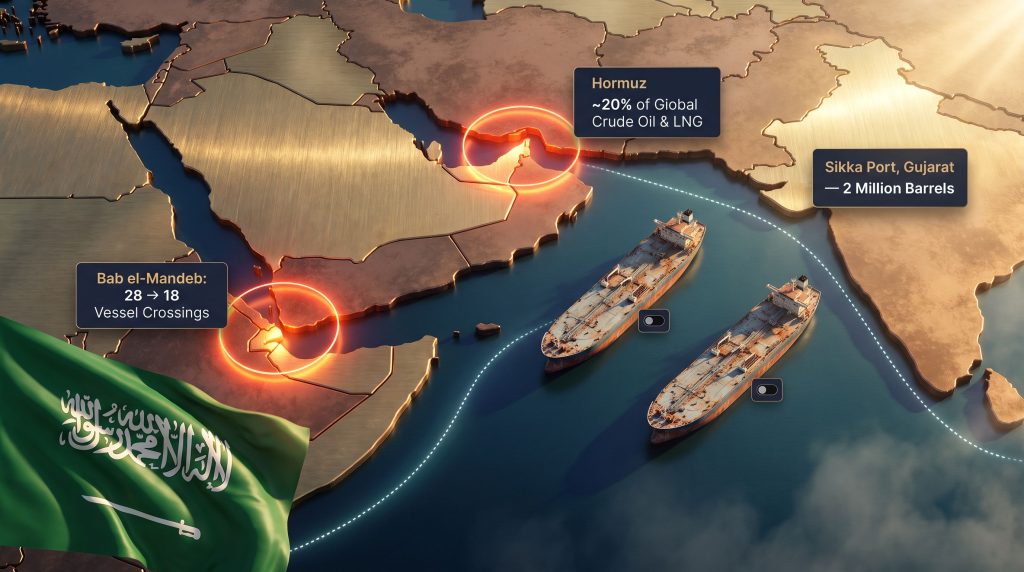
The Strait of Hormuz, the narrow channel separating Oman and Iran at the mouth of the Persian Gulf, is a production-origin chokepoint. Roughly one-fifth of the world's crude oil and liquefied natural gas transits this passage. For Gulf producers including Saudi Arabia, the UAE, Kuwait, Iraq, and Qatar, Hormuz is effectively the only maritime exit for the bulk of their export volumes. There is no practical bypass for the majority of Gulf production.
The Bab el-Mandeb Strait, connecting the Red Sea to the Gulf of Aden at Yemen's southern tip, serves a different function. It is the critical transit corridor linking the Indian Ocean to the Suez Canal and onward to European and Mediterranean markets. For Asian importers, it also represents the shortest eastbound route for crude originating from the Persian Gulf after Hormuz transit.
When both corridors face disruption simultaneously, no single rerouting decision resolves the problem. Operators are consequently caught between two active threat zones with no clean alternative.
The Houthi Embargo: A Strategic Escalation Beyond Previous Campaigns
The Houthi movement, aligned with Iran, declared a formal maritime embargo targeting Saudi Arabian shipping on July 20, 2026. This declaration represents a meaningful strategic evolution from the interdiction campaigns that characterised the 2023 to 2025 period. Earlier Houthi Red Sea operations were largely opportunistic, targeting commercial vessels based on ownership or port call history.
The July 2026 embargo is qualitatively different: it names a specific nation, applies declared enforcement criteria, and has extended operational reach into Gulf waters beyond the traditional Red Sea theatre. Furthermore, the Houthis claimed a missile strike on a Saudi oil tanker, underscoring that the embargo carries genuine enforcement capability.
This shift matters for several reasons:
- It moves Houthi maritime strategy from reactive interdiction to proactive blockade doctrine
- It creates legal and operational ambiguity for tanker operators, insurers, and flag states
- It signals Iranian strategic intent to use proxy maritime forces as instruments of economic pressure against U.S.-aligned Gulf producers
- It has prompted tanker operators to adopt navigational and electronic countermeasures not previously seen at scale in commercial shipping
Two confirmed attacks on tankers — the Encelia and the Layla — in the Red Sea during late July 2026 have reinforced that the embargo carries enforcement capability, not just declaratory weight.
Saudi Oil Tankers Heading to India: Vessels, Cargoes, and Routes
The VLCC Desh Vaibhav: 2 Million Barrels to Gujarat
The most significant confirmed movement involves the Desh Vaibhav, a Very Large Crude Carrier operated by the Shipping Corporation of India. The vessel departed with approximately 2 million barrels of Saudi crude and is bound for Sikka port in Gujarat, the primary crude receiving terminal for Reliance Industries' Jamnagar refinery complex — one of the highest-throughput refining facilities on the planet.
Critically, the vessel exited the Red Sea via the Bab el-Mandeb with its Automatic Identification System transponder deactivated, a practice commonly referred to as going dark. This manoeuvre renders the vessel invisible to standard open-source maritime tracking platforms, including the commercial databases that Houthi intelligence networks have reportedly used to identify and target Saudi-origin cargo.
The Suezmax Lesvos: 1 Million Barrels, Destination Undisclosed
The Malta-flagged Suezmax tanker Lesvos, managed by Dynacom, also transited the Bab el-Mandeb with its AIS transponder switched off. The vessel carried approximately 1 million barrels of Saudi crude. Its destination had not been publicly confirmed at the time of reporting, though the AIS deactivation pattern is consistent with operators attempting to limit route predictability as a security measure.
In addition, two India-bound Saudi oil tankers made U-turns amid Houthi threats in the Red Sea, further illustrating how profoundly the threat environment has disrupted normal routing decisions.
The Amazon and the Rodos: Further Saudi Movements Under Dark Navigation
Two additional vessels — the Amazon and the Rodos — followed the same navigation protocol when exiting the Red Sea. The Rodos is reportedly destined for Mangalore, while the Amazon is understood to be heading for Chennai. Both destinations are major crude processing hubs on India's eastern and western coastlines respectively.
The emergence of multiple vessels simultaneously adopting AIS-off protocols across different operators and flag states suggests this is no longer an isolated ship-captain decision. It reflects a coordinated, industry-wide risk management response to an identifiable and consistent threat model.
Understanding AIS Deactivation: What Going Dark Actually Means
The Automatic Identification System was originally mandated under international maritime law to improve collision avoidance and port authority coordination. It broadcasts a vessel's identity, position, speed, and heading in near real-time. In peacetime commercial operations, going dark is rare and often treated as a regulatory red flag.
In the current environment, however, AIS deactivation has become a calculated security tradeoff. The logic is straightforward:
- Houthi targeting relies partly on open-source maritime data to identify vessels carrying cargo from embargoed nations
- Deactivating AIS removes the vessel's digital signature from publicly accessible tracking platforms
- This raises the operational cost and complexity of identifying and intercepting specific targets
Nevertheless, the practice carries significant secondary risks:
- Collision risk increases materially in congested straits when vessels are not broadcasting position
- War risk insurance underwriting becomes substantially more complex for vessels that cannot be tracked
- Port authority coordination is compromised, affecting berthing scheduling and cargo accountability
- Cargo liability in the event of an attack becomes legally contested when standard tracking records have gaps
International maritime law permits AIS deactivation under specific safety-related circumstances. The widespread adoption of this practice across commercial operators in mid-2026 is an indicator of how dramatically the threat assessment has shifted in the Gulf region.
Vessel Traffic Data: The Numbers Behind the Disruption
Shipping analytics from Kpler provide a quantitative picture of how severely both chokepoints have been affected during the period surrounding the August 2026 escalation.
| Maritime Chokepoint | Day | Commodity Vessel Crossings |
|---|---|---|
| Bab el-Mandeb Strait | Friday | 28 |
| Bab el-Mandeb Strait | Saturday | 27 |
| Bab el-Mandeb Strait | Sunday | 18 |
| Strait of Hormuz | Friday | 19 (highest since mid-July) |
| Strait of Hormuz | Saturday | 10 |
The 35% single-day drop at Bab el-Mandeb between Saturday and Sunday reflects immediate operator response to the weekend's attack reports. The 47% decline at Hormuz between Friday and Saturday is particularly significant because Friday's figure of 19 crossings was already being characterised as a recovery high.
The subsequent collapse to 10 suggests the market interpreted the weekend's escalation as negating any temporary stabilisation. These figures, moreover, have direct implications for crude oil price trends and broader market sentiment.
Vessels that did transit Hormuz during the Friday window included:
- VLCC Kiku: approximately 1.4 million barrels of Qatari crude, managed by Apex Shipping
- VLCC Rotterdam Energy: approximately 2 million barrels of Das crude (UAE origin), owned by ADNOC
- VLCC Spain B and VLCC Noble: additional exits during the same operational window
- One LPG tanker carrying Iranian-loaded cargo completed a Hormuz crossing on Sunday, demonstrating that Iranian-origin movements continued even as Gulf Arab shipments faced intensified scrutiny
The next major ASX story will hit our subscribers first
Why India's Refining Sector Faces Compounded Exposure
India's position in this crisis is structurally uncomfortable. Saudi Arabia has historically ranked among India's top two crude oil suppliers alongside Iraq, with total Indian crude import requirements running at approximately 4.5 to 5 million barrels per day. Saudi crude constitutes a material portion of that volume, much of it flowing to Reliance Industries' Jamnagar complex via Sikka port.
The Red Sea route through Bab el-Mandeb represents the shortest and most cost-efficient pathway for Saudi crude reaching Indian west coast refineries. The alternative — circumnavigation of Africa via the Cape of Good Hope — adds approximately 10 to 14 additional days of voyage time and significantly increases per-barrel freight costs.
This is not merely an inconvenience. For refineries running on tight margin economics with just-in-time crude delivery schedules, voyage extension of this magnitude has material operational and financial consequences. The dual-chokepoint scenario removes the option of a clean rerouting solution:
- Cape routing solves the Bab el-Mandeb problem but adds cost and voyage time
- Hormuz remains the only viable Gulf exit for non-Red Sea routing but is now itself under active threat
- Saudi Arabia's Petroline pipeline can move crude from the Eastern Province to Yanbu on the Red Sea coast, bypassing Hormuz, but Yanbu exports still face the Bab el-Mandeb constraint. The pipeline does not resolve the dual-chokepoint problem — it simply shifts which chokepoint applies
Freight Economics and the Cost Cascade
The financial implications of sustained disruption extend well beyond the tanker operators directly involved. The cost transmission mechanism operates through several channels.
War risk insurance premiums for Gulf and Red Sea transits have risen sharply, adding a per-barrel surcharge to every cargo moving through the affected corridors. This cost is contractually passed through to crude buyers in most term supply arrangements.
Tanker day-rates increase as voyage duration extends and as fewer vessels are willing to accept Gulf nominations at standard rates. This creates a supply squeeze in the available tanker pool for high-risk routes. Furthermore, oil price movements in response to these dynamics have added further complexity to procurement decisions for Asian refiners.
Freight cost escalation ultimately reaches refinery gate economics and, in markets where retail fuel prices are not fully administered, filters through to consumer pump prices. The UK Maritime Trade Operations agency had reported three additional tanker attacks since the weekend preceding the August 3 data release, suggesting the attack tempo was not declining at the time of writing.
Three Scenarios for Gulf Oil Flows in the Weeks Ahead
The trajectory of this crisis is genuinely uncertain. Three broad pathways are plausible depending on geopolitical and military developments.
Scenario 1: Sustained Dual-Corridor Compression
Both chokepoints remain under active threat. Tanker operators accelerate Cape of Good Hope rerouting. Freight costs rise materially for Asian importers. Indian and Chinese refiners face spot market tightening for Saudi and Gulf Arab crude grades. AIS-dark transits become the operational norm rather than the exception.
Scenario 2: Partial De-escalation Through Diplomatic Channel
Back-channel negotiations reduce Houthi operational tempo at Bab el-Mandeb. Vessel traffic recovers partially. Hormuz stabilises as Iranian-coalition incentives to avoid full Gulf closure reassert themselves. AIS-dark transits continue but at reduced frequency. Freight premiums compress but remain elevated above pre-crisis levels.
Scenario 3: Naval Enforcement Restores Corridor Functionality
Intensified coalition naval escort operations reduce successful attack frequency at both chokepoints. Vessel traffic volumes recover toward pre-embargo levels. Short-term freight and insurance premiums persist, however long-term supply continuity expectations stabilise. AIS transparency gradually returns as attack risk diminishes.
Disclaimer: The scenarios presented above are analytical frameworks based on available information as of early August 2026. They do not constitute investment advice or predictions of specific outcomes. Geopolitical developments in the Gulf region carry high uncertainty, and actual outcomes may differ materially from any of the scenarios described.
Supply Diversification: The Structural Response Asian Importers Are Accelerating
Beyond the immediate tactical question of which route to use, the dual-chokepoint crisis is accelerating a strategic conversation among Asian crude importers that was already underway before the July 2026 escalation. The logic of geographic supply diversification has gained considerable urgency.
Several alternative supply vectors are attracting increased attention:
- WTI and Brent futures markets reflect growing demand for U.S. WTI crude exports, which move through Atlantic routing and are entirely unaffected by Gulf chokepoint disruption
- West African producers including Nigeria, Angola, and Guinea, whose cargo routing to Asian markets avoids both the Red Sea and the Hormuz corridor
- Strategic Petroleum Reserve drawdown decisions in India and other import-dependent economies may be accelerated if supply continuity concerns deepen
The crisis also highlights a longer-term infrastructure vulnerability: no major Gulf producer has yet developed sufficient pipeline capacity to move production volumes to non-Gulf-exit terminals at the scale required to fully bypass both chokepoints simultaneously.
Saudi Arabia's Petroline represents the most advanced version of this infrastructure, but its capacity and the constraints at the Yanbu end of the route mean it cannot serve as a complete substitute for Hormuz transit. For context, the LNG supply outlook faces similarly compounding pressures as both chokepoints remain contested. Any oil price rally driven by these supply disruptions could, furthermore, alter the calculus for producers and importers alike in the months ahead.
For ongoing coverage of Gulf maritime developments and their implications for India's energy sector, readers can explore reporting from ET EnergyWorld at energy.economictimes.indiatimes.com.
Want to Stay Ahead of the Next Major Resource Discovery Triggered by Shifting Global Supply Chains?
When geopolitical shocks reshape energy and commodity flows at this scale, the ripple effects reach far beyond oil markets — they create urgent re-evaluation across the entire resources sector. Discovery Alert's proprietary Discovery IQ model scans ASX announcements in real time, delivering instant alerts on significant mineral discoveries so subscribers can identify actionable opportunities the moment they emerge. Explore historic discoveries and their market-moving returns, then begin a 14-day free trial at Discovery Alert to position yourself ahead of the broader market.