August 3, 2026
When Diplomacy Moves Oil Markets Faster Than Bombs
Energy markets operate on a simple but powerful psychological principle: anticipated disruption commands a premium, and perceived resolution demands its removal. The speed at which crude oil prices collapsed in early August 2026 had little to do with any actual change in physical supply, and everything to do with how traders collectively recalibrated the probability of a worst-case scenario. Understanding why Trump cancels attack on Iran to reach nuclear deal talks dominated market movements requires looking beyond the headline and into the structural mechanics of how geopolitical risk gets priced into a barrel of crude.
When big ASX news breaks, our subscribers know first
The Decision That Moved Billions in Market Value Overnight
Late on a Saturday evening, U.S. President Donald Trump announced through his Truth Social platform that a planned military operation against Iran had been called off. The reasoning, as Trump framed it publicly, centred on requests from Iran and a number of Middle Eastern nations for additional time to work toward a formal agreement, one that would address Tehran's nuclear capabilities and restore full commercial access through the Strait of Hormuz.
Critically, this was not presented as a permanent withdrawal from the military option. Trump made clear the pause was conditional, and that the threat of force remained active should diplomatic momentum stall. The medium chosen for the announcement, a social media post rather than a formal White House address or State Department briefing, itself communicated something important about the nature of the decision: this was a unilateral, fluid call made outside the structured machinery of traditional diplomatic communication.
Important Context: As of early August 2026, no binding nuclear agreement between Washington and Tehran has been signed or ratified. What exists is a reported Iranian peace proposal, active negotiations, and a conditional U.S. military pause. These are materially different from a completed diplomatic settlement.
The backdrop to this moment matters enormously. Trump withdrew the United States from the Joint Comprehensive Plan of Action (JCPOA) in 2018, creating a seven-year diplomatic void. Any new framework would need to be constructed from fundamentally different foundations, under far greater verification demands and with a U.S. political environment that has grown considerably more sceptical of Iranian commitments.
Oil Price Collapse: Reading the Numbers Behind the Drop
The market's response was immediate and severe. By early Asian trading hours on August 3, 2026, both major crude benchmarks had shed more than five percent of their value in a single session. Furthermore, crude oil price volatility of this magnitude within a single session is rarely driven by fundamentals alone — it reflects mass repositioning across futures markets.
| Benchmark | Price (Aug 3, 2026) | Change | % Move |
|---|---|---|---|
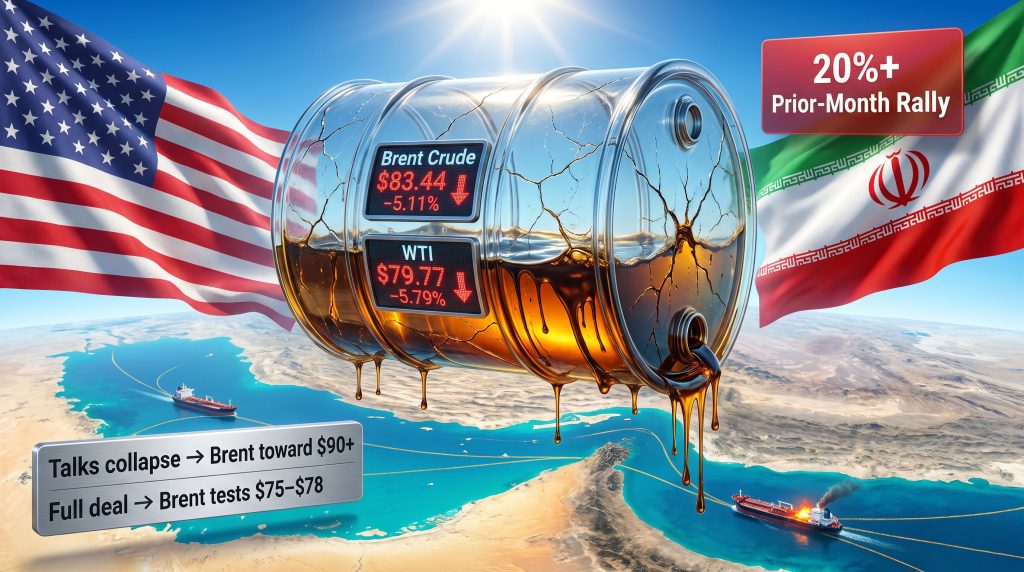
| Brent Crude Futures | $83.44/barrel | -$4.49 | -5.11% |
| WTI Crude (U.S.) | $79.77/barrel | -$4.90 | -5.79% |
To understand the scale of this reversal, it is necessary to recall what had happened during the preceding month. Both Brent and WTI had surged by more than 20% as U.S.-Iran hostilities escalated and a series of tanker attacks near Oman made Gulf transit increasingly hazardous. Shipping companies began refusing to enter the Gulf to load crude, and the fear premium embedded in oil prices had grown to reflect a genuine possibility of sustained military conflict disrupting one of the world's most critical energy corridors.
When Trump's de-escalation signal arrived, that premium did not gradually deflate. It collapsed. The speed of the move reflects a market that had arguably overpriced the probability of imminent conflict, and now found itself rapidly recalibrating toward a negotiation baseline.
One important nuance that energy market participants track closely is the concept of the geopolitical risk premium, which is the additional cost per barrel that markets assign to account for potential supply disruptions arising from political or military instability. This premium does not move linearly with events; it spikes sharply on fear and can evaporate just as quickly on any credible signal of resolution, even one that is explicitly conditional and unverified.
The Strait of Hormuz: Why This Waterway Controls Global Energy Prices
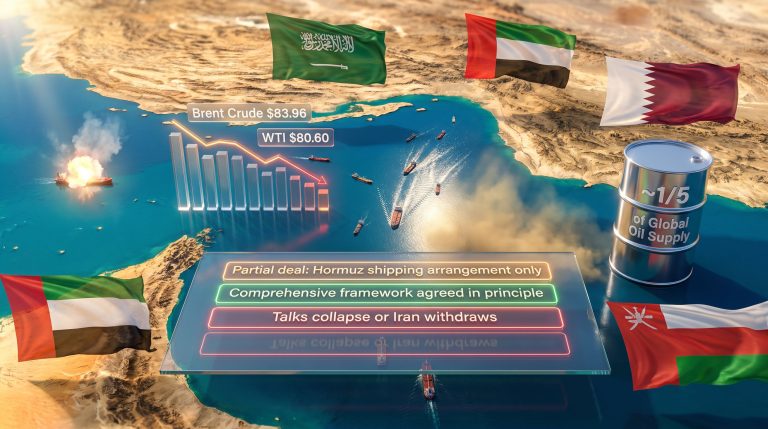
Few geographical features have as outsized an influence on energy markets as the Strait of Hormuz. This narrow passage between Iran and Oman is the transit point for approximately 20% of the world's petroleum liquids annually, making it the single most consequential chokepoint in global oil supply chains.
The nations most directly exposed to Hormuz disruption include Saudi Arabia, the United Arab Emirates, Kuwait, and Iraq, all of which rely on the strait as their primary export corridor. Alternative routes exist but are costly, slow, and in many cases have insufficient pipeline capacity to compensate for a full closure. Consequently, any geopolitical trade tensions involving Iran carry disproportionate weight in energy market pricing.
Iran has historically understood that its geographic position along the strait constitutes a form of strategic leverage that functions independently of its military capabilities. The threat of closure, even without execution, is enough to move global oil prices. This creates a unique bargaining dynamic: Iran does not need to actually close the strait to extract geopolitical value from controlling access to it.
What made the mid-2026 crisis particularly complex was the simultaneous pressure on a second major chokepoint.
The Bab el-Mandeb Dimension
While global attention focused on Hormuz, the Bab el-Mandeb Strait, which connects the Red Sea to the Gulf of Aden and serves as a critical transit corridor for tankers moving toward the Suez Canal, was also under pressure. Shipping data confirmed that two Saudi crude-laden tankers successfully crossed the Bab el-Mandeb over the weekend following Trump's announcement, a positive signal. However, traffic through Hormuz itself slowed materially after further vessel attack reports emerged, demonstrating that a diplomatic signal alone was insufficient to immediately restore commercial shipping confidence.
The United Kingdom Maritime Trade Operations (UKMTO), which serves as the primary maritime security alert body for Gulf shipping, reported at least three additional tanker attacks since the Saturday announcement. This is a critical data point: the physical security environment in the Gulf had not changed simply because a diplomatic conversation had been announced.
OPEC+ Adds a Compounding Bearish Layer
Arriving simultaneously with the Iran de-escalation narrative was a separate supply-side development. On Sunday, OPEC+ formally approved a production quota increase of approximately 188,000 barrels per day, effective from September 2026. This decision represented the completion of the unwinding of a layer of voluntary output cuts that member nations had maintained during the period of demand uncertainty. In this context, OPEC's market influence proved to be a decisive secondary force amplifying the bearish price movement.
The timing created a double bearish effect: reduced war premium on one hand, and increased paper supply commitments on the other.
However, a crucial distinction separates OPEC+ announced quotas from actually delivered supply. Throughout most of 2026, successive monthly quota increases have remained largely theoretical due to a convergence of export disruptions:
- Gulf export infrastructure has been constrained by the ongoing security environment surrounding the Hormuz crisis
- Russian crude flows remain curtailed as a consequence of the continuing Russia-Ukraine war and the sanctions architecture surrounding it
- Kazakhstan's export capacity has faced its own disruptions, further limiting the group's ability to convert paper increases into physical barrels reaching global markets
This structural gap between announced production and delivered supply has acted as a partial buffer, preventing OPEC+ quota increases from exercising their full theoretical downward pressure on prices. Energy analysts tracking the physical oil market, rather than just the futures curve, have consistently noted this divergence throughout 2026. Indeed, OPEC demand forecasts have similarly struggled to keep pace with the rapidly shifting geopolitical landscape.
Scenario Analysis: How This Resolves From Here
The current situation presents traders, energy companies, and policymakers with a range of materially different outcomes, each carrying distinct implications for crude prices.
| Scenario | Probability Assessment | Oil Price Implication |
|---|---|---|
| Full nuclear deal reached, Strait reopens | Low to moderate near-term | Sustained bearish pressure; Brent may test $75-$78 range |
| Talks collapse, Iran resumes provocations | Moderate | Rapid re-escalation; Brent recovers toward $90+ |
| Prolonged negotiation limbo | High probability | Elevated volatility; prices range-bound with residual risk premium |
| New tanker attack disrupts Gulf transit | Possible at any point | Immediate spike; full risk premium re-enters market |
The scenario that market analysts have flagged as carrying the most immediate risk is a repetition of the pattern observed the prior week, where deal optimism builds momentum only to collapse as Iran reasserts its leverage over the strait, potentially through a fresh attack on a tanker or a U.S. military installation.
Iran's strategic approach appears designed to maintain deliberate ambiguity: engaging diplomatically just enough to deter a U.S. strike, while retaining the implicit threat of Hormuz disruption as an active negotiating instrument.
This dynamic is not new. Iran has deployed similar tactics across multiple confrontational cycles with Washington. What distinguishes the current episode is the nuclear weapons dimension, which introduces a qualitatively different level of existential risk that previous sanctions-era standoffs did not carry. A nuclear-armed Iran would alter the entire Middle Eastern security architecture, with cascading implications for regional stability and long-term energy investment across Gulf producing states.
The next major ASX story will hit our subscribers first
What Energy Investors and Traders Should Watch Right Now
For those with exposure to energy markets, whether through equities, commodities, or broader portfolio allocation, the current environment requires monitoring a narrow set of high-signal indicators rather than reacting to daily headlines. In addition, understanding the broader oil market disruption context helps frame why these indicators carry such weight.
The three most consequential real-time signals are:
- UKMTO maritime alerts covering vessel movements through Hormuz and Bab el-Mandeb, which provide the most reliable ground-truth data on whether the physical security environment is actually improving or deteriorating
- Official statements from the U.S. and Iranian negotiating teams, particularly any language about timelines, verification mechanisms, or mutual concessions, which would signal whether talks have moved beyond preliminary positioning
- IAEA inspection and verification reporting, which would become the most important technical indicator if a formal agreement framework begins to take shape, since Iran's nuclear programme transparency is the central deliverable that any deal must address
The prior-month rally of more than 20% in both benchmarks established a high price base. Even a partial return of the war premium, triggered by a single tanker attack or a hardening of the Iranian negotiating position, could push Brent back toward the $90 level relatively quickly given the momentum dynamics already established.
The Deeper Structural Story Behind the Headlines
The mid-2026 Gulf crisis has exposed something that energy security analysts have warned about for years: the global oil supply system carries insufficient redundancy when multiple chokepoints face simultaneous disruption. The Hormuz and Bab el-Mandeb straits are not independent risk variables. They are linked by regional conflict dynamics that can activate both simultaneously.
Asian and European energy importers, who collectively represent the largest block of Gulf crude consumers, have responded by accelerating drawdowns of strategic petroleum reserves and diversifying emergency procurement across spot markets. This type of precautionary demand, driven not by consumption growth but by fear of supply interruption, can itself distort price signals and make the underlying supply-demand picture harder to read.
The diplomatic process between Washington and Tehran also carries a structural complication that goes beyond the immediate crisis. The 2018 JCPOA withdrawal created a precedent that any new agreement reached under Trump could be unwound by a subsequent administration, reducing the long-term credibility of whatever framework eventually emerges. Iranian negotiators are acutely aware of this, and it is likely to influence both the demands they make and the verification structures they accept. Ultimately, the question of whether Trump cancels attack on Iran to reach nuclear deal commitments translates into durable policy will define whether this diplomatic pause becomes a genuine turning point or merely another episode in a prolonged standoff.
Disclaimer: This article contains forward-looking scenario analysis and price projections based on publicly available information as of early August 2026. These projections involve significant uncertainty and should not be construed as financial or investment advice. Energy markets are subject to rapid and unpredictable change. Readers should conduct independent research and consult qualified financial advisers before making investment decisions based on geopolitical or commodity market analysis.
Want to Stay Ahead of the Next Major Commodity Market Shift?
Geopolitical events can reshape commodity markets in hours, and Discovery Alert's proprietary Discovery IQ model ensures subscribers receive real-time alerts on significant ASX mineral discoveries the moment they are announced — cutting through the noise to deliver actionable investment insights. Explore how historic mineral discoveries have generated substantial returns on Discovery Alert's dedicated discoveries page, and begin your 14-day free trial today to position yourself ahead of the broader market.