August 7, 2026
Why the World's Most Critical Oil Chokepoint Holds Global Markets Hostage
Every barrel of oil that leaves the Persian Gulf carries with it an invisible risk premium, one priced into futures contracts, refinery hedges, and sovereign energy security budgets across the globe. That risk has a physical address: a narrow corridor of water barely 33 kilometres wide at its tightest point, flanked by Oman to the south and Iran to the north. The Strait of Hormuz is not merely a geographic feature — it is the central nervous system of global petroleum supply, and when Saudi oil tankers cross Strait of Hormuz routes, the consequences ripple outward to every economy that depends on crude oil.
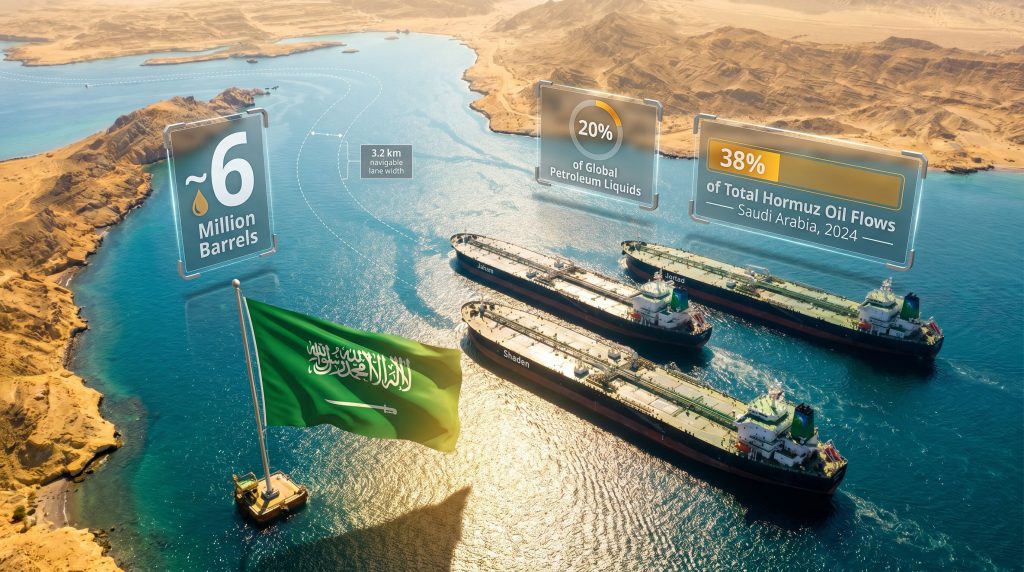
The recent transit of three Saudi supertankers through this waterway, carrying a combined ~6 million barrels of crude oil, marks a meaningful operational development. However, it does not mark a return to normalcy. Understanding what these crossings actually signal, and what they do not, requires unpacking the architecture of Hormuz dependency, the fragility of the current diplomatic framework, and the structural uncertainties still weighing on commercial shipping confidence.
When big ASX news breaks, our subscribers know first
The Anatomy of Hormuz Dependency: A Single Corridor, Global Consequences
How Much Oil Actually Flows Through the Strait?
Before the Iran conflict disrupted transit operations, the Strait of Hormuz was processing approximately 21 million barrels of petroleum liquids per day — a figure representing roughly 20% of global daily consumption. No other maritime chokepoint on Earth concentrates such a volume of energy flow into such a compressed geographic space.
The navigable shipping lanes within the strait measure only 3.2 kilometres in each direction, separated by a two-kilometre buffer zone. Vessels transiting these lanes include some of the largest commercial ships ever built — very large crude carriers (VLCCs) that displace over 300,000 tonnes of water when fully loaded.
Furthermore, understanding the broader oil price movements at play helps contextualise why this corridor commands such intense global attention.
"The Strait of Hormuz is the only maritime exit route for crude exports from Saudi Arabia, Iraq, Kuwait, the UAE, and Iran. There is no functional alternative for the vast majority of Persian Gulf petroleum exports."
Saudi Arabia alone accounted for 38% of total Hormuz oil flows in 2024, making it by far the largest single-nation contributor to traffic through the strait. This concentration of export dependency in a single waterway creates a structural vulnerability with no easy engineering solution.
Saudi Arabia's Limited Bypass Options
Unlike the UAE, which developed the Habshan-Fujairah pipeline to move crude overland to a Red Sea-adjacent terminal, Saudi Arabia's bypass infrastructure does not cover its full export volume. The East-West Pipeline, which routes crude from the Eastern Province to the Red Sea terminal at Yanbu, carries a theoretical capacity of approximately 5 million barrels per day. However, this falls well short of Saudi Arabia's total export volumes under normal operating conditions.
Saudi Aramco's primary loading facilities, including Ras Tanura — one of the world's highest-throughput offshore oil terminals — feed directly into shipping lanes that converge on Hormuz. Consequently, any sustained disruption to the strait constrains Saudi Arabia's ability to honour long-term crude supply contracts with Asian buyers, regardless of how much oil the Kingdom can produce.
Three Supertankers, Six Million Barrels: What the Crossings Tell Us
Vessel-Level Intelligence: The Ships That Made the Transit
According to vessel tracking data from global trade intelligence firm Kpler, three Saudi VLCCs successfully transited the Strait of Hormuz and reactivated their AIS transponders in the Gulf of Oman on Thursday, 19 June 2026.
| Vessel Name | Vessel Type | Estimated Cargo | Destination | Transponder Status |
|---|---|---|---|---|
| Shaden | VLCC | ~2 million barrels | Kiire, Japan | Reactivated in Gulf of Oman |
| Awtad | VLCC | ~2 million barrels | Ulsan, South Korea | Reactivated in Gulf of Oman |
| Jaham | VLCC | ~2 million barrels | Undisclosed | Reactivated in Gulf of Oman |
Each of these vessels had suppressed its Automatic Identification System (AIS) transponder for more than two months — a deliberate operational practice now widespread across Gulf shipping lanes. The simultaneous reactivation of all three transponders in the Gulf of Oman was a coordinated decision, not a technical anomaly.
The combined cargo of approximately 6 million barrels represents roughly 6% of global daily oil consumption, loaded into just three vessels. It is a striking illustration of how concentrated petroleum logistics have become at the VLCC scale.
Other Notable Crossings: A Wider Pattern Emerging
The three Saudi VLCCs were not the only vessels to make notable transits in this period. In addition, several other significant crossings reinforced the emerging pattern:
- The Idemitsu Maru, a Panama-flagged VLCC carrying approximately 2 million barrels of Saudi crude, became the first Japan-associated tanker to successfully complete a Hormuz transit since the Iran conflict began.
- The Shenlong, a Liberia-flagged Suezmax tanker, transported over 135,000 metric tonnes of Saudi crude from Ras Tanura to Mumbai, operating in dark mode through the high-risk corridor.
- Chinese-linked vessels Cospearl Lake and He Rong Hai used a routing corridor south of Iran's Larak Island, a tactical navigational adaptation designed to reduce exposure to IRGC naval patrol zones.
- On a single Saturday following the US-Iran announcement, more than 20 vessels transited the strait — the highest single-day count since 1 March.
These crossings collectively suggest that a tentative, commercially driven resumption of transit is underway. However, the volumes remain far below the 100-plus vessels per day that transited Hormuz before the conflict.
The US-Iran Diplomatic Agreement: What Changed and What Hasn't
The Deal and Its Stated Objectives
US President Donald Trump and Iranian President Masoud Pezeshkian formalised an agreement on Wednesday, 18 June 2026, aimed at restoring commercial navigation through the Strait of Hormuz. The diplomatic development followed a prolonged period during which the strait was effectively operating under conditions of a de facto closure, with daily transit volumes collapsing and hundreds of tankers stranded or diverting.
The agreement's immediate measurable effect has been a shift in Iranian naval behaviour. The Joint Maritime Information Center (JMIC), a US-led maritime security coordination body headquartered in Bahrain, formally downgraded its threat classification for Hormuz from "Severe" to "Substantial" in the wake of the deal. These broader geopolitical trade tensions continue to shape how markets interpret diplomatic signals.
The JMIC Assessment: A Downgrade With Caveats
The threat level reduction is meaningful but carries explicit limitations. The JMIC's formal position includes the following active warnings:
- Attacks within Hormuz shipping lanes remain a "strong possibility"
- Underwater mines in active transit corridors continue to pose a navigational hazard to vessel crews
- The overall situation is characterised as "developing", with threat levels subject to upward revision
- The IRGC's naval posture has become "less volatile" since the announcement, but this is described as a behavioural shift, not a structural guarantee
The Contradiction at the Heart of the Iranian Position
A significant complication for commercial shippers stems from a disconnect between Iranian government actions and Iranian government statements. While IRGC naval vessels have measurably reduced hostile engagements, Iranian Revolutionary Guard officials have simultaneously issued public statements claiming the strait remains closed and threatening commercial vessels attempting to cross.
This creates an environment of strategic ambiguity that risk managers at shipping companies and their insurers must price into every crossing decision. When official rhetoric and observable naval behaviour diverge this sharply, the uncertainty premium on Hormuz transits remains elevated regardless of diplomatic announcements.
"At least five Iranian vessels crossed the US blockade line between June 16 and June 18, including three state-owned Iranian oil tankers exiting the Gulf of Oman, suggesting de-escalation is occurring at the operational level even as hardline rhetoric persists at the political level."
The "Dark Mode" Shipping Phenomenon: A New Structural Reality
What AIS Suppression Actually Means
The widespread adoption of transponder suppression by tankers navigating Hormuz represents one of the most consequential and least-discussed structural shifts in global maritime logistics. AIS — the Automatic Identification System — functions as a vessel's real-time location broadcast, transmitting position, speed, heading, and identity data to receivers on shore and on other vessels.
When a tanker operates in dark mode, it disappears from commercial vessel tracking platforms entirely. This practice has become the operational norm for a significant share of the Hormuz-transiting fleet, driven by the rational calculation that reduced visibility lowers targeting risk from hostile actors.
The secondary consequences of mass dark-mode operation are substantial:
- Collision risk increases significantly when vessels in busy, narrow shipping lanes are not broadcasting position data to one another
- Emergency response capacity degrades because rescue coordination depends on knowing where vessels are located in real time
- Commodity market intelligence becomes unreliable, as standard vessel-tracking methodologies used by traders and analysts to estimate crude flows break down when large portions of the fleet are invisible
- Port arrival data and customs records become the primary reconstruction tools for actual supply flows, introducing time lags into market information
This creates a structural information asymmetry in oil futures markets. Traders operating on incomplete supply data face heightened price discovery challenges, and the risk of significant supply surprises — in either direction — increases materially.
Assessing the Gap Between Diplomatic Signal and Operational Reality
Where Hormuz Shipping Stands Right Now
The current state of Strait of Hormuz shipping can be understood most clearly through a comparative framework:
| Indicator | Pre-Conflict Baseline | Post-Deal Status (June 2026) |
|---|---|---|
| Daily vessel transits | 100+ ships | Well below baseline |
| Tanker-specific crossings | Dozens per day | Single to low double-digit |
| AIS transponder compliance | Near-universal | Widespread dark-mode operation |
| JMIC threat classification | Not applicable | Substantial (downgraded from Severe) |
| War risk insurance premiums | Standard commercial rates | Significantly elevated |
| Saudi VLCC operational deployment | Full | Partial resumption underway |
Why Commercial Operators Remain Hesitant
Matt Smith, Director of Commodity Research at Kpler, characterised the post-deal environment plainly: shipping volumes have not surged following the diplomatic announcement, and operators are approaching Hormuz transits with continued caution rather than renewed confidence.
The hesitancy reflects several compounding factors:
- War risk insurance premiums remain elevated, adding per-voyage costs that erode the commercial economics of standard crossing decisions
- Mine clearance operations in Hormuz shipping lanes have not been publicly confirmed as complete by any naval authority
- Flag state advisories from Panama, Liberia, and other major maritime registries continue to recommend heightened vigilance
- Iranian rhetorical threats continue despite reduced IRGC operational aggression, creating legal and liability uncertainty for vessel operators
- Crew welfare considerations have become a primary factor in routing decisions at many major tanker operators
Rapidan Energy Group's president has publicly described the oil market as facing a reckoning that has not yet fully materialised. This framing points to potentially significant geopolitical oil price analysis as the true scope of supply disruption and recovery becomes clearer to market participants.
The next major ASX story will hit our subscribers first
Asian Refinery Exposure and the Downstream Supply Chain Impact
Why Japan, South Korea, and India Are Most Exposed
The routing destinations of the three Saudi VLCCs are not coincidental. The Shaden's course to Kiire, Japan and the Awtad's destination of Ulsan, South Korea reflect the structural reality that Northeast Asian refiners represent the primary customer base for Saudi crude exports.
Japan and South Korea collectively source a substantial portion of their crude requirements from the Persian Gulf, with limited short-term substitution capacity from alternative origins such as West Africa, the Americas, or North Sea producers. The trade war impact on oil supply chains has further complicated the ability of these nations to pivot away from Gulf dependence.
India's exposure is illustrated by the Shenlong's delivery to Mumbai, with Indian refiners having navigated significant supply uncertainty and cost escalation throughout the Hormuz disruption period. Indian state refiners, unlike their Japanese and Korean counterparts, had somewhat greater flexibility to source alternative crudes given their more diversified refinery configurations, but still absorbed meaningful cost impacts.
Strategic Petroleum Reserve Stress Testing
The Hormuz disruption period served as an unplanned stress test of strategic petroleum reserve adequacy across major importing nations. The results were instructive:
- Japan, South Korea, and the US drew on strategic reserves during the peak disruption period, revealing that reserve quantities sized for historical disruption scenarios may be insufficient for a prolonged Hormuz closure
- The coordination mechanisms between the International Energy Agency member states were activated, but the pace of reserve release was not matched to the speed of commercial supply disruption
- Future reserve adequacy planning is likely to incorporate Hormuz closure scenarios with longer assumed durations than historical baselines
The Medium and Long-Term Implications: Infrastructure, Insurance, and Geopolitical Recalibration
Accelerating Bypass Infrastructure Investment
The Hormuz disruption has materially strengthened the investment case for bypass pipeline infrastructure across Gulf states. The UAE's Habshan-Fujairah corridor and Saudi Arabia's East-West Pipeline to Yanbu both received renewed strategic attention during the closure period. Furthermore, future capital allocation decisions by Gulf sovereign energy entities are likely to prioritise bypass capacity expansion as a risk mitigation measure, regardless of how smoothly the current diplomatic framework holds.
The Persistent Dark-Mode Capability
One of the less-discussed legacies of the Hormuz disruption is that tanker operators across the globe have now built operational familiarity and institutional procedures around AIS suppression as a risk management tool. Even after Hormuz returns to full operational normalcy, this capability is unlikely to be abandoned entirely. It represents a permanent shift in the information landscape of global crude oil tracking.
The Hormuz Deterrence Question Going Forward
The Iran conflict demonstrated conclusively that Hormuz closure remains a credible and executable Iranian strategic instrument. Future diplomatic and security frameworks in the region will need to incorporate explicit maritime security guarantees that go beyond the current arrangement if commercial shipping confidence is to be fully and durably restored. Monitoring current crude oil prices will remain essential as these dynamics continue to evolve.
Disclaimer: This article is intended for informational purposes only and does not constitute financial or investment advice. Oil market conditions, geopolitical developments, and shipping intelligence data are subject to rapid change. Readers should consult professional advisors before making investment decisions based on any information contained herein.
Key Metrics: Strait of Hormuz Shipping Resumption at a Glance
| Metric | Detail |
|---|---|
| Saudi VLCCs that crossed Hormuz | 3 vessels: Shaden, Awtad, Jaham |
| Total barrels transported | ~6 million barrels |
| Duration of transponder suppression | More than 2 months |
| Iranian vessels crossing US blockade line | At least 5 (since June 16) |
| JMIC threat classification | Substantial (downgraded from Severe) |
| Saudi share of Hormuz oil flows (2024) | 38% of total |
| Pre-conflict daily vessel transits | 100+ ships per day |
| Single-day transit high post-deal | 20+ vessels (first Saturday after announcement) |
| First Japan-associated tanker crossing | Idemitsu Maru (~2 million barrels) |
Frequently Asked Questions
What does it mean that Saudi oil tankers cross Strait of Hormuz routes again?
The transit of three Saudi VLCCs carrying approximately 6 million barrels of crude oil through the Strait of Hormuz signals the beginning of a cautious supply resumption following a period of effective closure during the Iran conflict. It does not indicate that full normal shipping operations have been restored. Volumes remain far below pre-conflict levels, and significant operational and insurance uncertainties persist.
Why were the tankers operating in "dark mode"?
Dark mode refers to the deliberate deactivation of AIS transponders — the tracking technology that broadcasts a vessel's real-time position. Tanker operators suppressed these signals to reduce their vessels' visibility to potential hostile actors, including IRGC naval forces. All three Saudi VLCCs had operated without active transponders for more than two months before reactivating them in the Gulf of Oman following the US-Iran deal.
Is the Strait of Hormuz fully open for commercial shipping?
Not yet. While the US-Iran diplomatic agreement has reduced Iranian naval aggression and enabled some commercial crossings, the JMIC continues to classify the strait as a substantial threat zone. War risk insurance premiums remain elevated, mine clearance has not been publicly confirmed as complete, and daily vessel transit volumes remain well below the 100-plus ships per day that characterised pre-conflict operations.
Which countries are most exposed to Hormuz shipping disruptions?
Japan, South Korea, India, and China face the greatest direct exposure due to their heavy dependence on Persian Gulf crude imports. Saudi Arabia, Iraq, Kuwait, and the UAE are the primary exporters whose supply chains are most constrained when the strait is disrupted. European energy markets experience secondary effects through global benchmark price movements.
Want to Stay Ahead of Commodity Market Shifts Driven by Geopolitical Events Like the Hormuz Crisis?
Discovery Alert's proprietary Discovery IQ model delivers real-time alerts on significant ASX mineral discoveries, instantly translating complex commodity and resource data into actionable investment insights — so subscribers can identify opportunities ahead of the broader market. Explore Discovery Alert's discoveries page to understand how major resource discoveries have historically generated substantial returns, and begin your 14-day free trial today to gain a market-leading edge.