August 3, 2026
The Route That History Forgot Is Now the Route the World Needs
Before the Suez Canal reshaped global commerce in 1869, every barrel of oil, every ton of cargo, and every merchant vessel moving between Europe and Asia had no choice but to round the southern tip of Africa. The Cape of Good Hope was not a detour. It was the only path. Over 150 years later, that ancient corridor is experiencing a structural revival, not out of nostalgia, but out of necessity. The escalating threat environment in the Red Sea is forcing two of the world's most significant oil exporters to rethink logistics that had been largely settled for generations.
The scale of this shift carries implications far beyond shipping schedules. It touches oil pricing benchmarks, Asian refinery economics, tanker fleet utilisation, African port infrastructure, and the long-term architecture of global energy trade. Furthermore, oil price movements are increasingly being shaped by the decisions made along these newly active routes.
When big ASX news breaks, our subscribers know first
The Bab el-Mandeb Strait: A Single Point of Catastrophic Vulnerability
To understand why Saudi and Russian oil shipments around Africa have become a defining feature of 2025's energy landscape, it helps to understand what is actually being avoided.
The Bab el-Mandeb Strait is an 18-mile-wide channel separating Yemen from Djibouti, connecting the Red Sea to the Gulf of Aden. At its narrowest navigable point, the usable lane for large vessels is even tighter. Under normal conditions, this waterway handles millions of barrels of crude oil and refined products daily, serving as the essential gateway between the Indian Ocean and the Suez Canal.
Any vessel moving crude from the Arabian Gulf to Europe, or refined products from the Middle East to Asian markets via the Suez Canal, must pass through this chokepoint. The dependency runs deep. Saudi Arabia's key Red Sea export terminal at Yanbu sits north of the strait, making it the primary loading point for crude headed to Mediterranean and European buyers.
Disruption at the Bab el-Mandeb does not merely inconvenience shippers. It severs an entire supply chain architecture that connects Arabian Gulf production to Suez Canal throughput to Mediterranean port deliveries.
What the Houthi Blockade Has Done to Shipping Traffic
The Houthi movement's formal blockade declaration on July 20 marked a strategic escalation in a campaign that had already caused significant disruption. What changed after that date was not merely the frequency of incidents, but the systematic nature of interdiction. Shipping data captured in the aftermath reveals the scale of the response from vessel operators.
Since the blockade announcement, the figures have been stark:
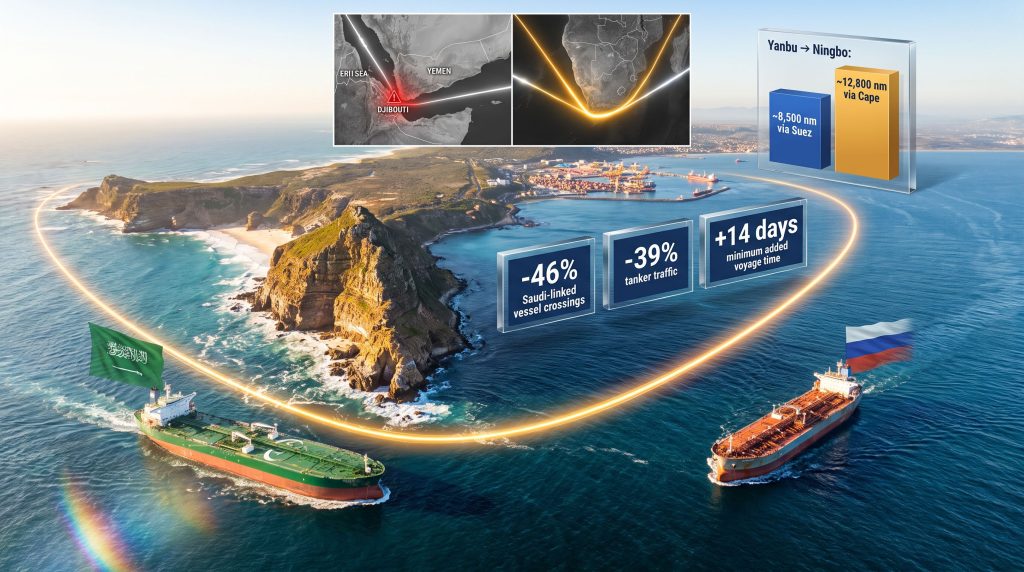
| Metric | Change Since July 20 Blockade |
|---|---|
| Total Bab el-Mandeb crossings | -22% |
| Tanker traffic (all flags) | -39% |
| Saudi-linked vessel crossings | -46% |
| Minimum added voyage time (Cape route) | +14 days |
The 46% collapse in Saudi-linked vessel crossings is the most dramatic figure in the dataset. It reflects a deliberate and rapid risk management decision by one of the world's largest state-owned shipping fleets. The numbers also reveal an important asymmetry: overall crossings fell 22%, but tanker-specific traffic fell nearly double that rate at 39%, indicating that energy cargo operators are disproportionately risk-averse compared to general cargo operators.
This is rational given the catastrophic consequences of losing a fully laden VLCC carrying two million barrels of crude. In addition, the trade war oil impact has compounded existing market pressures, making every rerouting decision carry greater financial weight.
"The Houthi threat has evolved from opportunistic attack to systematic interdiction, and the shipping market is pricing that transition into routing decisions with remarkable speed."
Saudi Arabia's Dual-Track Response: Cape Route and Mediterranean Pivot
Saudi Arabia's reaction to the Red Sea crisis has not been passive. The kingdom is pursuing two parallel strategies simultaneously, each targeting a different segment of its export customer base.
The VLCC Cape Diversion: Bahri's Six-Ship Signal
According to Bloomberg reporting, six Saudi-owned Very Large Crude Carriers operated by Bahri, Saudi Arabia's national shipping company, were observed diverting away from the Bab el-Mandeb and rerouting around the Cape of Good Hope. A VLCC is not a small vessel. These ships typically carry between 1.9 million and 2.2 million barrels of crude oil per voyage. Six simultaneous diversions represent a substantial volume of committed crude cargo being rerouted at significant cost.
The economics of that decision deserve closer examination. A hypothetical Saudi VLCC carrying 2 million barrels destined for a South Korean refinery would normally complete the Yanbu-to-Ulsan leg via the Red Sea and Suez Canal in approximately 20 to 22 days. Rerouting via the Cape of Good Hope extends that same journey to roughly 35 to 38 days.
At current bunker prices, the additional fuel and operational costs for that single voyage are estimated at $1.5 million to $2.5 million per ship, before factoring in any savings on war-risk insurance premiums. Waypoint data from vessel tracking systems shows diverted tankers calling at or near Gibraltar, Durban, and Algoa Bay in South Africa, serving multiple operational purposes including bunkering, crew changes, minor maintenance, and cargo status checks.
The Sidi Kerir Mediterranean Pivot: A Structural Workaround
The second track of Saudi Arabia's response involves redirecting some Asia-bound crude exports away from Yanbu entirely, routing them instead through Egypt's Mediterranean terminal at Sidi Kerir. This is made possible by the Arab Petroleum Pipeline, commonly known as SUMED, which runs overland across Egypt from Ain Sukhna on the Red Sea coast to Sidi Kerir on the Mediterranean.
By loading onto SUMED rather than onto Red Sea tankers, Saudi crude can bypass the Bab el-Mandeb chokepoint entirely. The kingdom is simultaneously developing new pricing mechanisms allowing Asian buyers to lift crude from Mediterranean loading points rather than traditional Red Sea terminals.
The longer-term question is whether this Mediterranean pivot represents a temporary workaround or the beginning of a structural shift in Saudi export logistics. Given the capital investment required to reconfigure long-standing supply agreements, the answer likely depends on how long the Red Sea threat environment persists.
Russia's Compounded Rerouting Challenge
Russian exporters are navigating the same geographic obstacle with fundamentally different constraints. Where Saudi Arabia is managing a tactical routing problem from a position of strategic choice, Russian energy companies face a dual bind.
Novatek's Naphtha Diversion: A Supply Chain Ripple
Reuters reported that a Panama-flagged tanker carrying approximately 100,000 metric tons of Russian naphtha departed the Baltic port of Ust-Luga bound for Asian petrochemical markets. In late July, the vessel turned away from the Bab el-Mandeb and instead committed to the Cape of Good Hope passage around southern Africa. The cargo was identified as belonging to Novatek, which has emerged as a significant naphtha supplier to Asian markets following shifts in its European trade flows after 2022.
Naphtha is a critical petrochemical feedstock. Asian cracker operators that process naphtha into ethylene, propylene, and other base chemicals are highly sensitive to supply timing. Extended voyage times introduce scheduling uncertainty that can disrupt refinery run rates and create short-term spot market tightness.
The Dual Constraint Problem
Russia's rerouting situation is structurally distinct from Saudi Arabia's in one critical way. Western sanctions imposed following the 2022 invasion of Ukraine have already restricted Russian vessels' access to certain ports and financial services, effectively creating parallel shipping corridors for sanctioned cargo. Russian oil exports have increasingly flowed through what market observers describe as a shadow fleet, operating outside conventional Western-aligned shipping infrastructure.
The Houthi blockade has now added a second constraint on top of an already constrained system. For Russian exporters, the Cape of Good Hope route is not a strategic preference. It is, in many cases, a near-mandatory fallback given the intersection of sanctions-driven port restrictions and Red Sea security risks.
"Russian and Saudi cargo is converging on the same Cape route for entirely different reasons. One is making a calculated cost-benefit trade-off. The other has run out of alternatives."
The Cape Route's Economics and Africa's Emerging Role
Route Distance Comparison
The physical scale of the Cape detour is considerable. The table below illustrates the additional nautical miles involved for key origin-destination pairs:
| Origin | Destination | Via Suez (nm) | Via Cape of Good Hope (nm) | Extra Distance |
|---|---|---|---|---|
| Yanbu, Saudi Arabia | Ningbo, China | ~8,500 | ~12,800 | ~4,300 nm |
| Ust-Luga, Russia | Singapore | ~11,200 | ~14,600 | ~3,400 nm |
| Ras Tanura, Saudi Arabia | Ulsan, South Korea | ~8,200 | ~12,500 | ~4,300 nm |
These distances translate directly into vessel utilisation. When tankers spend more time at sea completing individual voyages, the effective size of the global VLCC fleet contracts. Fewer ships are available for new loadings at any given time, which mechanically tightens tanker supply and pushes day rates upward. This is one of the less-discussed transmission mechanisms through which Red Sea disruption flows into delivered oil costs for Asian consumers. Consequently, crude oil price trends are reflecting this structural tightening across multiple benchmarks.
South African Ports: Unintended Beneficiaries
The surge in Cape route traffic has created measurable economic spillover for South African port operators. Durban and Algoa Bay are emerging as the primary waypoints for diverted VLCCs, generating increased demand for marine bunker fuel, port services, crew logistics, and minor vessel maintenance. South African marine fuel suppliers are experiencing a demand environment that would have been difficult to anticipate before the current disruption cycle.
For African coastal nations more broadly, the question is whether this traffic spike translates into durable infrastructure investment or remains a temporary windfall dependent on an unresolved geopolitical conflict thousands of kilometres away.
Market Implications: Freight Rates, Insurance, and Oil Price Transmission
War-Risk Premiums and the Tipping Point Calculation
War-risk insurance for Red Sea transits has escalated sharply since Houthi attacks intensified. Lloyd's of London and specialist marine insurers have progressively reclassified the Red Sea as a high-risk zone, with premium rates reflecting the elevated threat environment. For vessel operators, there is a specific tipping point calculation: at what premium level does paying for Red Sea war-risk coverage become more expensive than absorbing the operational cost of the Cape detour?
For VLCCs carrying high-value crude cargoes, that calculation has clearly shifted. The $1.5 to $2.5 million additional operational cost of the Cape route becomes economically competitive, and potentially preferable, when war-risk premiums for a single Red Sea transit approach similar magnitudes, particularly when combined with the risk of total cargo loss.
Naphtha and Petrochemical Feedstock Tightness
The Novatek diversion carries particular significance for Asian petrochemical markets. Naphtha supply chains are less flexible than crude oil markets because crackers are designed to run specific feedstock compositions at consistent throughput rates. When a large naphtha cargo adds two or more weeks to its delivery timeline, downstream chemical producers face either inventory drawdowns or spot market purchases at elevated prices.
South Korean and Chinese petrochemical operators are particularly exposed given their heavy reliance on naphtha from both Russian Baltic sources and Middle Eastern suppliers. Persistent Red Sea disruption could accelerate interest in alternative feedstocks, including liquefied petroleum gas and ethane, in markets that have historically favoured naphtha cracking.
The next major ASX story will hit our subscribers first
The Longer Arc: From Crisis to Structural Realignment
A Post-2022 Fragmentation Pattern
The Red Sea crisis is not occurring in isolation. It is accelerating a fragmentation of global oil shipping corridors that began with Russia's 2022 invasion of Ukraine and the subsequent Western sanctions regime. Before 2022, global oil shipping operated through a largely integrated network of routes, insurers, financiers, and vessel operators. Since then, parallel systems have emerged: sanctioned-cargo corridors operating alongside conventional Western-aligned trade lanes.
The Houthi disruption has introduced a new variable into this already fragmented system. The Cape of Good Hope route is now serving double duty, functioning as both a security bypass for vessels avoiding Houthi interdiction and as a sanctions-management corridor for Russian exports unable to use certain ports or financial services. Furthermore, OPEC market influence continues to shape how these rerouting decisions interact with broader production and pricing strategies.
Saudi Arabia's Long-Term Infrastructure Calculus
Saudi Arabia already operates the East-West Pipeline, known as Petroline, which transports crude overland from the Gulf to Yanbu on the Red Sea coast, providing a bypass for the Strait of Hormuz. The kingdom's decision to utilise the SUMED pipeline and Sidi Kerir as a Red Sea alternative reveals an existing capability to think in terms of multi-route export resilience.
The current crisis may accelerate investment planning around additional bypass capacity, though no specific infrastructure commitments in this direction have been publicly confirmed at this stage.
Could This Become Permanent?
The central question for energy logistics planners is whether the operational and financial infrastructure being built around the Cape route will outlast the immediate Houthi threat. Insurance products, bunkering networks, voyage planning tools, and commercial contracts are all being reconfigured around the assumption of a long Red Sea bypass. If that infrastructure matures sufficiently, some trade flows may not return to the Red Sea even after the security environment normalises.
Historical precedent supports this caution. The 2021 Ever Given blockage in the Suez Canal lasted only six days, yet it triggered a significant reassessment of single-corridor dependency across multiple industries. The Houthi disruption has now persisted across multiple quarters, giving logistics operators considerably more time to build and embed alternative systems. For traders and investors, commodity volatility hedging has consequently become an increasingly critical consideration in this environment.
Vessel operators and energy traders seeking to monitor these shifts can benefit from resources such as the International Energy Agency's oil market reports, which provide regular updates on supply route disruptions and their impact on global balances.
Disclaimer: This article contains forward-looking analysis, market estimates, and voyage cost projections that involve inherent uncertainty. These figures should not be interpreted as financial advice. Readers should consult qualified financial and commodity market advisors before making investment or commercial decisions based on the information presented here.
Frequently Asked Questions: Saudi and Russian Oil Shipments Around Africa
Why are Saudi and Russian oil tankers going around Africa instead of through the Suez Canal?
Houthi attacks and a formal blockade declaration on July 20 have made the Bab el-Mandeb Strait, the entry point to the Red Sea, too costly and dangerous for many tanker operators to transit. The combination of elevated war-risk insurance premiums and the threat of vessel seizure or attack has pushed operators toward the longer but substantially safer Cape of Good Hope passage around southern Africa.
How much longer does the Africa route take compared to the Suez Canal route?
Rerouting around the Cape of Good Hope adds a minimum of approximately 14 days to voyages between the Arabian Gulf and major Asian destinations. Depending on vessel speed, origin port, and destination, the total additional transit time can reach 16 to 18 days for some origin-destination pairs.
Which Saudi shipping company is diverting tankers around Africa?
Bahri, Saudi Arabia's national shipping company, operates the six VLCCs that have been observed diverting away from the Bab el-Mandeb Strait and rerouting around southern Africa.
What Russian company is rerouting cargo around Africa?
Novatek, a major Russian energy producer, has been identified as the owner of the naphtha cargo aboard a Panama-flagged tanker that bypassed the Red Sea in late July and sailed around Africa to reach Asian markets.
What is the Bab el-Mandeb Strait and why does it matter for oil shipping?
The Bab el-Mandeb is an 18-mile-wide waterway between Yemen and Djibouti linking the Red Sea to the Gulf of Aden. It is one of the world's most strategically critical maritime chokepoints, through which millions of barrels of oil transit daily on routes connecting the Middle East, Asia, and Europe.
How has the Houthi blockade affected shipping traffic through the Red Sea?
Since the formal blockade declaration on July 20, total Bab el-Mandeb crossings have fallen by 22%, tanker-specific traffic has dropped 39%, and crossings by Saudi-linked vessels have declined 46%.
What African ports benefit from tankers rerouting around the Cape of Good Hope?
South African ports, particularly Durban and Algoa Bay, are emerging as key bunkering stops and operational waypoints for diverted tankers, generating increased port revenue and demand for marine fuel services.
Want to Track the Commodities Reshaping Global Trade Routes?
As energy logistics fracture and oil shipping corridors undergo structural realignment, Discovery Alert's proprietary Discovery IQ model delivers real-time alerts on significant ASX mineral discoveries — instantly translating complex market shifts into actionable investment opportunities for both short-term traders and long-term investors. Explore how historic discoveries have generated substantial returns and begin your 14-day free trial today to position yourself ahead of the market.