August 3, 2026
The Mechanics Behind Oil's Sharpest Single-Day Drops
When crude oil prices fall more than 5% in a single trading session without any corresponding collapse in physical demand, the explanation rarely lies in barrels. It lies in beliefs. Specifically, it lies in the unwinding of a geopolitical risk premium — an invisible layer of fear-based value that traders embed into crude prices whenever military conflict threatens to disrupt the world's most critical energy transit corridors.
Understanding why WTI tumbles after US calls off new attacks requires a working knowledge of how that premium gets built, how it evaporates, and why the speed of its removal consistently catches markets off guard.
When big ASX news breaks, our subscribers know first
The Geopolitical Risk Premium: Fear as a Pricing Mechanism
How Conflict Inflates Crude Prices Beyond Supply and Demand Fundamentals
Crude oil pricing operates on two distinct layers. The first is the fundamental layer: actual supply volumes, inventory levels, refinery throughput, and real-world demand signals. The second is the sentiment layer: what traders believe might happen to supply, even before it does.
When military conflict approaches or disrupts a major transit route, traders pre-emptively add a risk premium to crude prices that can range from a few dollars per barrel to well above $10/bl, depending on the severity of the perceived threat. This premium does not reflect oil that has already been taken off the market. It reflects oil that might be disrupted in the future.
The critical implication is structural: risk premiums are almost always easier to add than they are to sustain. A single credible threat can spike prices within hours. However, confirming that the threat has passed requires not just a diplomatic statement, but verified physical evidence — shipping data, transit volumes, port activity — that often takes days or weeks to confirm. These crude oil price trends illustrate precisely how sentiment-driven shifts can override fundamental supply data.
The Strait of Hormuz as a Permanent Chokepoint Premium
No single geography commands a more persistent structural premium in global oil pricing than the Strait of Hormuz. Approximately 20% of the world's total oil supply passes through the 33-kilometre-wide strait at any given time, making it the most consequential chokepoint in the global energy system.
Unlike other supply risks, Hormuz carries what analysts call a baseline premium even in peacetime, because any escalation in Iranian-US relations carries a credible risk of disruption regardless of whether conflict is actively underway. When conflict is underway, that baseline premium multiplies rapidly.
"The Strait of Hormuz is not merely a shipping lane. It is a single-point failure node for the global oil system, meaning any credible threat to its operations can reprice crude benchmarks within minutes of a headline appearing on a terminal."
WTI Price Movement in Numbers: What Actually Happened
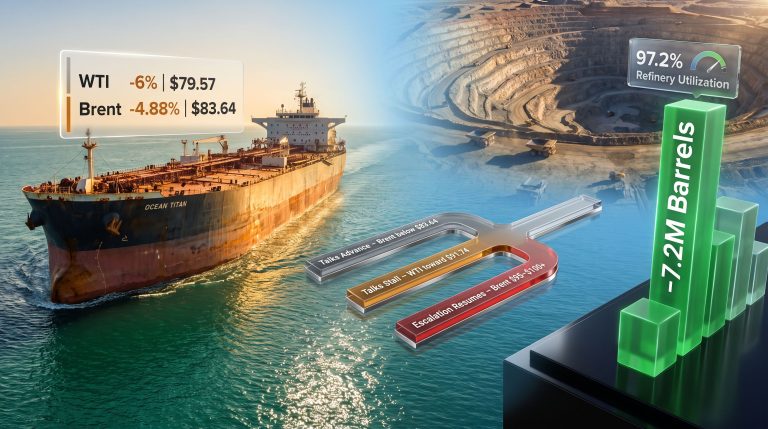
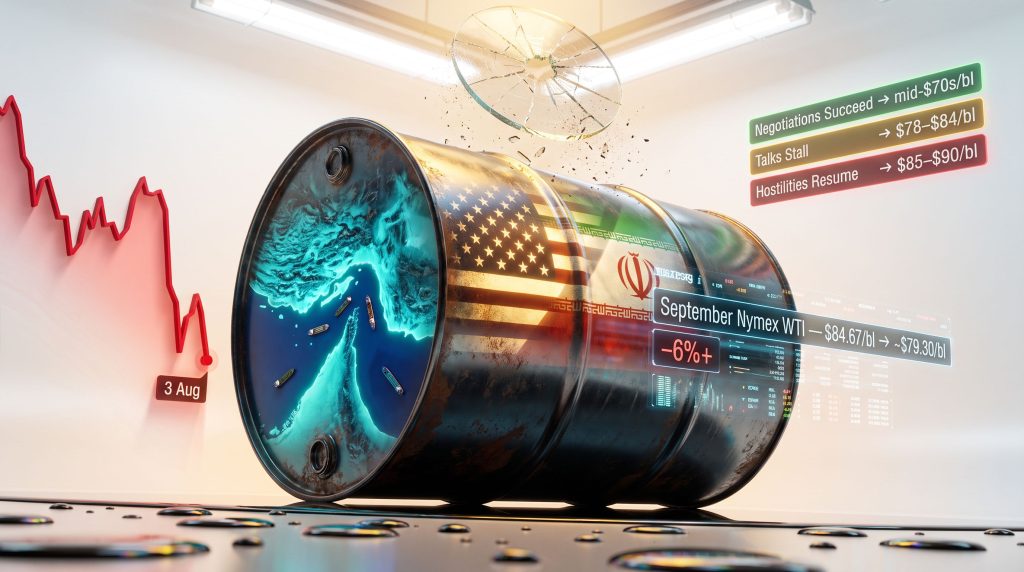
On 31 July 2026, September Nymex WTI settled at $84.67/bl. By 10:30am ET on 3 August, the same contract was trading at approximately $79.30/bl — a decline exceeding 6% in less than two trading sessions. Front-month Ice Brent futures followed, falling by approximately $4.22/bl to trade near $83.71/bl by mid-morning in London.
| Benchmark | Pre-Event Price | Post-Announcement Level | Approximate Change |
|---|---|---|---|
| September Nymex WTI | $84.67/bl (31 July settle) | ~$79.30/bl (10:30am ET, 3 Aug) | ~−6%+ |
| Front-Month Ice Brent | ~$87.93/bl (prior close) | ~$83.71/bl (11:24 BST, 3 Aug) | ~−$4.22/bl |
| WTI (broader market reports) | — | ~$80.66/bl | ~−4.7% |
The catalyst was a social media post from US President Donald Trump on 1 August, confirming the cancellation of a planned new military assault on Iran and signalling openness to negotiations. According to Reuters, Trump stated that progress on the parameters of a potential deal had prompted Iran and other regional nations to request a pause in any military action to allow more time for talks.
Why the Reaction Was So Aggressive
The magnitude of the price drop reflects not just the diplomatic pause itself, but the size of the risk premium that had been priced in. Markets had spent weeks building fear into prices following the 28 July surprise attack on US military installations in the region, attributed to Iranian-aligned forces. The cancellation of a retaliatory strike removed the most acute near-term escalation risk from the pricing equation in a single moment.
This is the asymmetry that energy traders understand well: fear prices in faster and higher than relief prices out. Escalation premium builds gradually across days and weeks. De-escalation relief arrives in a single session.
The Conflict Timeline: How Oil Markets Got Here
The current US-Iran conflict has followed a volatile and non-linear trajectory that has fundamentally disrupted global oil flows since February 2026. Furthermore, the oil market impacts of this prolonged uncertainty have extended well beyond the immediate region.
- 28 February 2026: Active conflict commenced between the US and Iran, triggering an immediate and severe contraction in Strait of Hormuz transit volumes
- Mid-June 2026: An interim ceasefire agreement was reached, allowing Hormuz transits to briefly resume and providing temporary relief to crude prices
- Early July 2026: The ceasefire collapsed following disputes over control of the strait, with both sides returning to active hostilities
- Throughout July 2026: Iranian forces and regional proxies launched drone and missile attacks against oil infrastructure in neighbouring countries, adding cumulative supply disruption to the conflict's impact
- 28 July 2026: A reported surprise attack on US military installations in the region attributed to Iranian-aligned forces triggered a new escalation cycle
- 1 August 2026: Trump announced the cancellation of planned retaliatory strikes, citing deal framework progress
- 3 August 2026: Iran's foreign ministry publicly denied any active negotiations were underway with Washington
Iran's Denial and the Credibility Gap
The contradiction between Trump's diplomatic framing and Iran's public denial is itself a significant market variable. Iran's foreign ministry confirmed that bilateral discussions with Oman were occurring, focused specifically on establishing a safe shipping corridor through Hormuz. However, Iranian officials explicitly stated that these Oman-mediated talks would not automatically result in the strait's reopening.
Tehran tied any change in Hormuz status to what it characterised as unresolved violations of the prior interim agreement by the United States. The broader geopolitical oil risks embedded in this standoff continue to shape trader positioning across both Brent and WTI contracts.
"When a diplomatic signal is contradicted by one of the parties involved within 24 hours, markets face a credibility deficit that prevents a full risk premium unwind. This is why crude prices frequently stabilise at levels above their pre-conflict baseline even after apparent de-escalation signals."
OPEC+ Production Targets vs. Physical Reality
The same week that WTI tumbles after US calls off new attacks, the OPEC+ core group announced a further production target increase of 188,000 b/d effective September 2026 — formally completing the phased unwinding of the 1.65 million b/d in voluntary cuts originally announced in 2023.
| OPEC+ Decision | Detail |
|---|---|
| New production target increase | 188,000 b/d from September 2026 |
| Total voluntary cuts being unwound | 1.65mn b/d (originally announced 2023) |
| Participating countries | Saudi Arabia, Russia, Iraq, Kuwait, Kazakhstan, Algeria, Oman |
| Actual physical supply impact | Minimal — conflict-related disruptions persist |
In addition, the seven participating nations reiterated their commitment to compensate for past overproduction. However, this announcement holds limited practical significance in the current environment. OPEC's market influence has been consistently undermined by the gap between paper production quotas and real-world barrel delivery — one of the defining structural distortions in the 2026 oil market.
Scenario Framework: Three Pathways for WTI in Coming Weeks
Given the contradictory signals from Washington and Tehran, crude oil markets now face three materially different forward scenarios, each carrying distinct price implications.
Scenario 1 — Negotiations Succeed and Hormuz Reopens
- Full unwinding of the geopolitical risk premium embedded since February 2026
- OPEC+ physical supply begins reaching markets in meaningful volumes
- Estimated WTI range: potential decline toward the mid-$70s/bl depending on demand conditions and inventory data
Scenario 2 — Talks Stall but Military Pause Holds
- Moderate risk premium retained; prices stabilise in a consolidation band
- Hormuz remains partially restricted; supply uncertainty persists without acute escalation
- Estimated WTI range: $78–$84/bl
Scenario 3 — Negotiations Collapse and Hostilities Resume
- Sharp re-escalation premium; WTI could recover above $85–$90/bl rapidly
- Renewed infrastructure attacks and shipping disruption
- Broader energy security transition concerns re-emerge globally across importing nations
Disclaimer: These scenarios represent analytical frameworks based on currently available information and should not be construed as financial advice. Crude oil markets carry significant uncertainty, and actual price outcomes may differ materially from any scenario projection.
The next major ASX story will hit our subscribers first
The Oil Field Services Perspective: Beyond the Headline Price
While crude benchmark moves dominate market commentary, the broader oilfield services sector offers a distinct analytical lens on the conflict's long-term implications. Major services operators including SLB and Halliburton have indicated growing confidence in international market opportunities, even as Middle East operations remain constrained.
A key insight from industry observers is that regional labour forces in the Middle East have remained largely intact throughout the conflict, and operational equipment has not sustained significant damage. Consequently, once hostilities ease, the pathway back to full production activity could be faster than historical post-conflict recoveries.
Several additional dynamics are shaping the sector's outlook:
- Final investment decisions for long-cycle upstream projects are expected to increase by approximately 30% in 2026, according to third-party forecasts cited by industry participants
- Africa has been identified as the leading growth region for upstream capital expenditure in the second half of 2026, with a more significant impact anticipated in 2027
- North American shale sector consolidation has concentrated ownership among larger operators that are less reactive to short-term price swings, redirecting services capacity toward international markets
- Shale development is expanding internationally, with Argentina's Vaca Muerta formation, the UAE, and Australia emerging as target markets for redeployed equipment and expertise
The power market represents an additional growth vector for oilfield services firms, with gas turbine and generator capacity expanding as energy security concerns elevate demand for distributed power infrastructure.
Secondary Pressure Points: The Rhine River Effect
While WTI price movements attract global attention, secondary supply disruptions are creating meaningful regional market stress that compounds the global picture.
Water levels at the Rhine's Kaub bottleneck fell below 0.3 metres in late July, severely restricting barge movements from the Amsterdam-Rotterdam-Antwerp (ARA) hub into Germany. The consequences are creating a regional price split within the German market: inland locations are experiencing genuine supply scarcity and rising prices for motor fuels and heating oil, while refinery-adjacent locations near the Karlsruhe refinery are facing oversupply as export channels remain constrained.
Germany is typically a net gasoline exporter, but Rhine restrictions are simultaneously cutting off blending component deliveries needed for finished product production, adding pressure to availability from two directions simultaneously.
Australia's Fuel Security Response: A Case Study in Strategic Vulnerability
The US-Iran conflict has accelerated strategic reserve discussions globally, with Australia providing one of the clearest case studies in how supply disruption risk translates into domestic policy urgency. Furthermore, as reported by the Straits Times, the broader regional implications of the US-Iran standoff continue to reverberate across Asia-Pacific energy markets.
Australia's Northern Territory government has formally urged the federal government to incorporate fuel storage infrastructure at the Gove peninsula into the country's proposed A$3.2 billion fuel security reserve.
| Metric | Detail |
|---|---|
| Proposed storage capacity (Gove) | 220mn litres (~1.38mn bl) |
| Federal fuel security reserve target | 1bn litres (~6.29mn bl) |
| Gove's share of national reserve target | ~22% |
| Current Australian gasoil stocks (28 July) | 22.89mn bl (~39 days of consumption) |
| Current jet fuel stocks | 5.87mn bl (~34 days of consumption) |
| Current gasoline stocks | 11.48mn bl (~43 days of consumption) |
| Decision deadline for infrastructure future | Mid-2027 |
The Gove site includes seven fuel-compliant storage tanks and deep-water port access capable of receiving bulk fuel shipments. However, the facility's significant distance from Australia's major population and consumption centres raises genuine questions about distribution costs and response time effectiveness during acute supply disruptions. A decision on whether to preserve or decommission the infrastructure must be made by mid-2027.
Key Signals to Monitor in the Coming Days
For energy market participants, the variables most likely to determine whether WTI's current lower range holds or reverses are identifiable and trackable:
- Confirmation or denial of formal US-Iran negotiation channels opening beyond informal contact
- Strait of Hormuz transit volume data and independent vessel tracking reports
- OPEC+ member compliance data relative to stated production targets
- Further official communications from the Trump administration on Iran policy direction
- Iranian foreign ministry statements and the progress of Oman-mediated discussions
- WTI technical support levels following the sharp selloff, particularly the $78/bl zone
"The defining characteristic of the current oil market is not war or peace. It is the sustained state of ambiguity between the two. Diplomatic ambiguity generates more sustained volatility than either confirmed escalation or confirmed resolution, because it prevents traders from committing fully to either a risk-on or risk-off positioning framework."
WTI tumbles after US calls off new attacks is not simply a price event. It is a demonstration that in the modern oil market, the dominant pricing variable is no longer spare capacity, inventory levels, or demand forecasts. It is the credibility of diplomatic signals in a conflict where both sides are telling materially different stories about what is actually happening. Until that credibility gap closes, crude markets will remain structurally volatile regardless of what the fundamental supply and demand picture suggests.
Further market intelligence on how geopolitical risk shapes global crude oil pricing, including ongoing coverage of the US-Iran conflict and its impact on energy markets, is available through Argus Media at argusmedia.com.
Want to Stay Ahead of the Next Major Market-Moving Discovery?
While geopolitical shocks continue to reshape commodity markets, Discovery Alert's proprietary Discovery IQ model scans ASX announcements in real time, delivering instant notifications on significant mineral discoveries so subscribers can act on actionable opportunities before the broader market reacts — explore historic discovery returns or start your 14-day free trial today.