
May 21, 2026
Understanding the Sawlog Cost Squeeze in Nordic Timber Operations
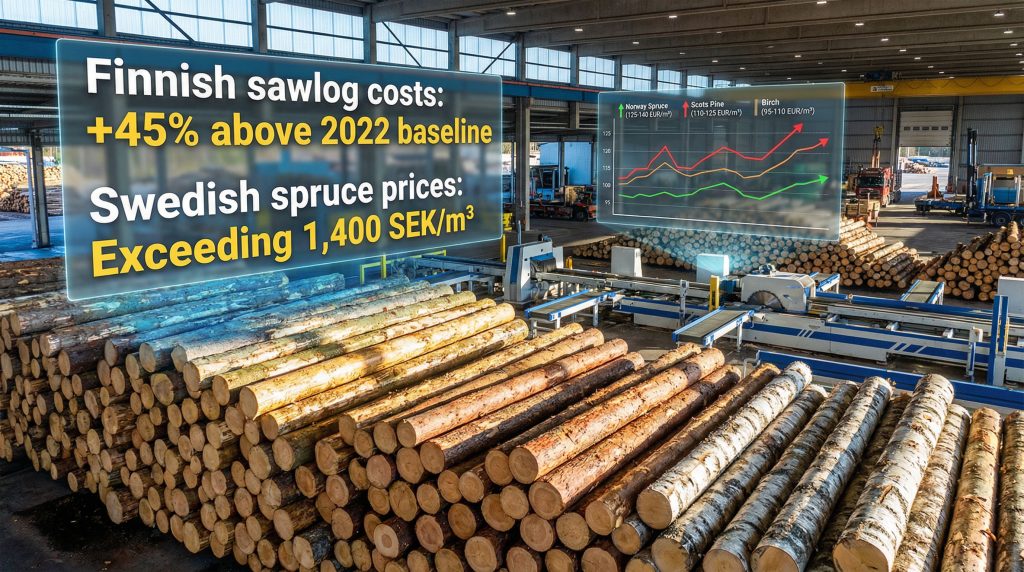
The sawlog cost squeeze in Nordic timber industry reflects deeper structural changes in regional forest product economics. Finnish operations report sawlog cost inflation exceeding 45% above 2022 baseline levels, while Swedish spruce procurement costs surpass 1,400 SEK per cubic meter in southern regions. Norwegian facilities face sawlog premiums of 300-350 NOK per cubic meter over historical averages, creating widespread profitability challenges across the sector.
Supply chain disruption patterns following 2022 geopolitical developments eliminated approximately 50% of traditional Russian timber imports to Finland and Sweden. This reduction forced Nordic mills to source domestic raw materials at premium pricing whilst competing for constrained harvest volumes. Russian timber exports declined to approximately 18.7 million cubic meters in 2024, representing a substantial reduction from pre-2022 volumes that previously supplied Nordic processing facilities.
Regional Impact Analysis:
- Finnish sawlog costs: +45% above 2022 baseline
- Swedish spruce prices: Exceeding 1,400 SEK/m³
- Norwegian sawlog premiums: +300-350 NOK/m³
- Swedish mill profitability: Widespread losses reported across operations
Industry representatives characterise the situation as unprecedented in recent decades. The Finnish Sawmill Association notes that Russian import cessation pushed domestic prices higher whilst economic uncertainty simultaneously reduced end-product demand, creating what executives describe as an operational double bind for processing facilities.
When big ASX news breaks, our subscribers know first
Species-Specific Cost Pressures Reshaping Production Mix
Species availability constraints compound the sawlog cost squeeze in Nordic timber industry through differential pricing pressures across traditional product lines. Norway spruce faces particular supply tightness following the conclusion of bark beetle salvage operations in Central Europe. Mills previously accessing damaged timber at discounted rates now compete for regular harvest volumes, driving species-specific cost inflation.
Comparative Species Pricing Evolution (2022-2024):
| Species | 2022 Baseline (EUR/m³) | 2024 Peak (EUR/m³) | Price Increase |
|---|---|---|---|
| Norway Spruce | 85-95 | 125-140 | +47% |
| Scots Pine | 75-85 | 110-125 | +46% |
| Birch | 65-75 | 95-110 | +46% |
The shift from salvage timber availability to regular harvest procurement creates sustained upward pressure on spruce costs. German and Czech facilities processed approximately 3-5% of damaged Norway spruce forests during the 2017-2022 bark beetle epidemic, providing temporary market relief through discounted salvage volumes. This surplus has largely concluded, forcing Nordic mills to adjust procurement strategies and production portfolios.
Pine processing emerges as a strategic adaptation where raw material access proves more favourable. However, this species substitution requires equipment recalibration and market repositioning, particularly affecting established export patterns to Middle East and North Africa markets where redwood specifications traditionally commanded premium pricing.
Environmental Regulatory Framework Impact on Operational Costs
The EU's Land Use, Land-Use Change and Forestry (LULUCF) regulation creates binding carbon removal requirements of 310 Mt CO₂ equivalent per year by 2030. Finland and Sweden, with combined forested area approximating the UK and Italy combined, bear disproportionate responsibility for achieving these targets. This regulatory framework intensifies the sawlog cost squeeze in Nordic timber industry through harvest volume constraints.
Finland's transition from carbon sink to carbon source status represents a critical regulatory challenge. The country's Natural Resources Institute revised 2022 LULUCF sector emissions from 4.44 Mt CO₂eq to 12.01 Mt CO₂eq, reflecting updated methodology incorporating peatland soil emissions and revised carbon sequestration assumptions. This 171% upward revision directly influences harvest availability calculations.
Finnish Harvest Volume Implications:
- Current annual harvest: ~73 million cubic metres
- Proposed reduction target: ~60 million cubic metres
- Reduction percentage: 15%
- Estimated economic impact: €3 billion ($3.47 billion USD)
- Direct sawmilling jobs at risk: 3,000-4,000 positions
The EU Deforestation Regulation (EUDR) adds compliance costs without immediate regulatory certainty. Implementation deadlines have been delayed twice, with large operators now facing December 2026 compliance requirements. Companies invest in traceability systems and documentation processes whilst facing potential requirement changes, creating ongoing operational overhead.
EUDR Compliance Cost Structure (per mill):
- Traceability system implementation: €50,000-200,000
- Annual documentation and certification: €15,000-35,000
- Third-party verification cycles: €25,000-50,000
- Total initial setup costs: €90,000-285,000
- Ongoing annual expenses: €40,000-85,000
Regional Operational Pressure Distribution
Geographic proximity to disrupted supply chains creates uneven impacts across Nordic timber processing regions. Southern Finnish facilities experience acute pressure due to historical dependence on former Russian supply corridors. Mills like Koskisen's Kärkölä operation, representing €80 million in expansion investments, require sustained raw material access at viable pricing to maintain competitive positioning.
Swedish sawmill operations report the highest loss ratios across the region. Industry evolution trends indicate nine in ten Swedish facilities operate with negative margins despite recent volume growth, reflecting the severity of the sawlog cost squeeze in Nordic timber industry. Southern Swedish mills face particular challenges due to elevated spruce procurement costs exceeding sustainable processing margins.
Norwegian operations benefit from more integrated forest ownership structures but still experience significant cost inflation. Domestic sawlog prices rising 300-350 NOK per cubic metre above historical baselines strain profitability across Norwegian processing facilities, though vertical integration provides some supply chain stability compared to Finnish and Swedish counterparts.
Regional Vulnerability Assessment:
- Finland: Highest exposure to former Russian supply disruption
- Sweden: Most widespread profitability challenges reported
- Norway: Better supply chain integration but substantial cost inflation
Export Market Disruption Effects on Processing Economics
The Middle East and North Africa (MENA) region historically absorbed approximately two-thirds of European softwood lumber exports from Nordic producers. Finnish whitewood exports to Egypt reached 850,000 cubic metres annually, whilst Swedish redwood shipments to Saudi Arabia totalled 1.2 million cubic metres per year. Combined Nordic MENA exports approached 3.8 million cubic metres before recent disruptions.
Geopolitical developments affecting Persian Gulf shipping routes eliminate critical volume outlets during peak cost pressure periods. The February 2026 Middle East conflict, including Strait of Hormuz closure and suspended Qatari LNG flows, created severe logistical and financial uncertainty for MENA-bound shipments. Energy price spikes in Europe compound industrial operating costs for Nordic timber processors.
Russian competition in MENA markets intensified following European sanctions, with Russia shipping approximately 1.7 million cubic metres to the region in 2024, including 550,000 cubic metres to Egypt alone. This competitive pressure eliminates Nordic market share during periods when domestic processing margins face maximum stress from elevated sawlog costs.
Central European market saturation provides limited alternative volume absorption. German and Czech mills, previously accepting Nordic overflow capacity, now face their own raw material constraints following bark beetle recovery periods. This reduces traditional market outlets when Nordic producers require alternative channels due to MENA disruption.
Operational Efficiency Strategies Addressing Cost Pressures
Advanced sawmill operations implement comprehensive efficiency optimisation programmes to maximise output per unit of expensive raw material input. Automated sawing systems and precision cutting technologies reduce waste percentages from traditional 25-30% levels to optimised 18-22% ranges in leading facilities, directly addressing the sawlog cost squeeze in Nordic timber industry.
Production Efficiency Metrics Comparison:
| Efficiency Measure | Traditional Mills | Optimised Operations | Improvement |
|---|---|---|---|
| Yield Rate | 72-75% | 78-82% | +6-7% |
| Processing Speed | 45 m³/hour | 65 m³/hour | +44% |
| Waste Reduction | 25-30% | 18-22% | -7-8% |
Species mix adaptation represents another strategic response to raw material availability constraints. Mills adjust production portfolios toward accessible species, shifting from traditional spruce-heavy output to pine-dominant manufacturing where supply conditions permit. This transition requires equipment recalibration and market repositioning strategies but can improve raw material procurement economics.
Furthermore, vertical integration development allows leading operators to secure forest ownership or establish long-term supply agreements, stabilising raw material access. This approach reduces exposure to spot market volatility whilst ensuring consistent feedstock availability, though it requires substantial capital investment and forest asset acquisition capabilities.
Technology Investment Priorities:
- Automated grading systems: €200,000-500,000 per line
- Precision sawing equipment: €1.2-2.5 million per installation
- Yield optimisation software: €50,000-150,000 implementation
- Integrated logistics systems: €300,000-800,000 per facility
The next major ASX story will hit our subscribers first
International Competitiveness Analysis
Nordic timber operations historically maintained competitive advantages through processing efficiency and species quality premiums. Current raw material inflation erodes these advantages, particularly against North American and Baltic producers with more stable supply chain access. In addition, commodity price trends indicate broader market pressures affecting material costs across industries.
Currency impacts compound competitive pressures as Swedish krona strengthening against USD affects export competitiveness in dollar-denominated markets. Finnish and Norwegian operations face similar currency headwinds when competing in international markets, whilst domestic costs continue rising due to constrained raw material availability.
Baltic and Romanian timber producers benefit from lower regulatory compliance costs and more diversified supply chain access. These regional competitors capture market share in Central European construction grades previously dominated by Nordic producers, reflecting structural shifts in European timber trade patterns.
Processing technology adoption becomes increasingly critical for maintaining competitive positioning. Mills investing in artificial intelligence-driven cutting algorithms and digital optimisation systems maximise output per unit of expensive raw material, creating differentiation opportunities despite elevated input costs.
Investment Decision Framework Under Cost Pressure
Capacity expansion decisions require reassessment based on raw material cost projections and supply availability forecasts. Major operators evaluate expansion projects against sustained high-volume processing requirements when input costs approach or exceed sustainable processing margins. However, investment decision framework analysis must account for multiple risk factors simultaneously.
Koskisen's €80 million expansion at Kärkölä facility represents significant commitment during elevated cost periods, suggesting management confidence in longer-term market fundamentals. Nevertheless, such investments depend on securing raw material access at economically viable pricing through the investment payback period.
Technology investment priorities emphasise yield optimisation and automation systems that maximise value extraction from expensive raw materials. Advanced sawing equipment and integrated logistics systems become essential competitive differentiators rather than optional productivity enhancements.
Capital Allocation Priorities:
- Primary focus: Yield optimisation technologies
- Secondary focus: Supply chain integration investments
- Tertiary focus: Capacity expansion (selective basis)
- Risk management: Long-term supply agreement development
Market Evolution Scenarios Through 2026-2027
Supply chain rebalancing scenarios suggest gradual development of alternative raw material sources may reduce Nordic dependence on constrained domestic harvest volumes. Baltic and Romanian timber availability could provide partial relief, though transportation costs limit economic viability for many processing applications.
Regulatory resolution pathways remain uncertain as EU policy modifications addressing LULUCF calculation methodologies require consensus across 27 member states. Finnish and Swedish government lobbying efforts highlight political urgency, but systemic policy changes face substantial implementation timelines that extend beyond immediate operational planning horizons.
Construction market recovery in key export destinations could improve pricing power for finished products, potentially offsetting elevated raw material costs. However, this recovery requires sustained economic growth in primary European and MENA markets, with current geopolitical disruptions creating ongoing uncertainty about demand recovery timing.
Scenario Planning Considerations:
- Optimistic: Alternative supply development and regulatory modification
- Baseline: Continued cost pressure with gradual market adjustment
- Pessimistic: Extended regulatory constraints and supply disruption
- Wild card: Accelerated technology adoption changing cost structures
How Do Tariff Policies Affect Nordic Timber Economics?
Tariffs and inflation pressures create additional complexity for Nordic timber exporters already managing elevated domestic costs. Trade policy uncertainty affects planning cycles and investment decisions across the sector.
European timber products face potential tariff barriers in key export markets, compounding existing competitiveness challenges from elevated raw material costs. Consequently, tariff market impacts must be factored into strategic planning processes.
The interaction between domestic cost inflation and international trade policies creates multiple layers of operational risk. Companies develop scenario planning frameworks addressing various combinations of cost pressures and market access constraints.
Strategic Implications for Industry Stakeholders
The convergence of supply constraints, regulatory pressures, and market disruptions creates fundamental challenges requiring comprehensive strategic responses. Nordic timber operations must emphasise operational efficiency, supply chain diversification, and technology adoption to maintain competitiveness despite elevated input costs.
Mills implementing integrated efficiency programmes whilst securing stable raw material access demonstrate greater operational resilience. Success strategies combine yield optimisation technology, species mix flexibility, and supply chain integration to navigate cost pressure periods. However, industry-wide profitability recovery requires either significant operational cost reduction or substantial finished product price increases across key markets.
The sector's adaptive capacity depends on coordinated responses addressing regulatory uncertainty, supply chain development, and operational optimisation simultaneously. Companies maintaining investment discipline whilst pursuing strategic positioning for post-disruption recovery periods are positioned to capture market share as conditions stabilise.
Long-term industry sustainability requires policy framework stability, diversified supply chain access, and continued technology adoption to optimise resource utilisation efficiency. The current cost squeeze period may accelerate structural changes that reshape Nordic timber industry competitive dynamics permanently.
According to European timber industry analysis, volatility patterns suggest extended adjustment periods. Furthermore, Nordic sawmill financial reports confirm widespread margin compression across regional operations, indicating systemic rather than isolated challenges affecting the industry.
Seeking Opportunities in Commodity-Related Investments?
Discovery Alert's proprietary Discovery IQ model delivers real-time alerts on significant ASX mineral discoveries, providing instant insights into actionable trading and investment opportunities that could benefit from commodity market volatility. Begin your 14-day free trial today at Discovery Alert to gain a market-leading edge whilst broader commodity markets experience continued uncertainty.