June 21, 2026
Understanding the Strategic Value Proposition of Scandium-Enhanced Aluminum
The transformation of global manufacturing depends increasingly on materials that deliver breakthrough performance while maintaining economic viability. The aluminum-scandium alloy supply chain represents a convergence of metallurgical innovation and strategic necessity, where trace amounts of one of Earth's rarest elements unlock dramatic improvements in structural performance across multiple industries.
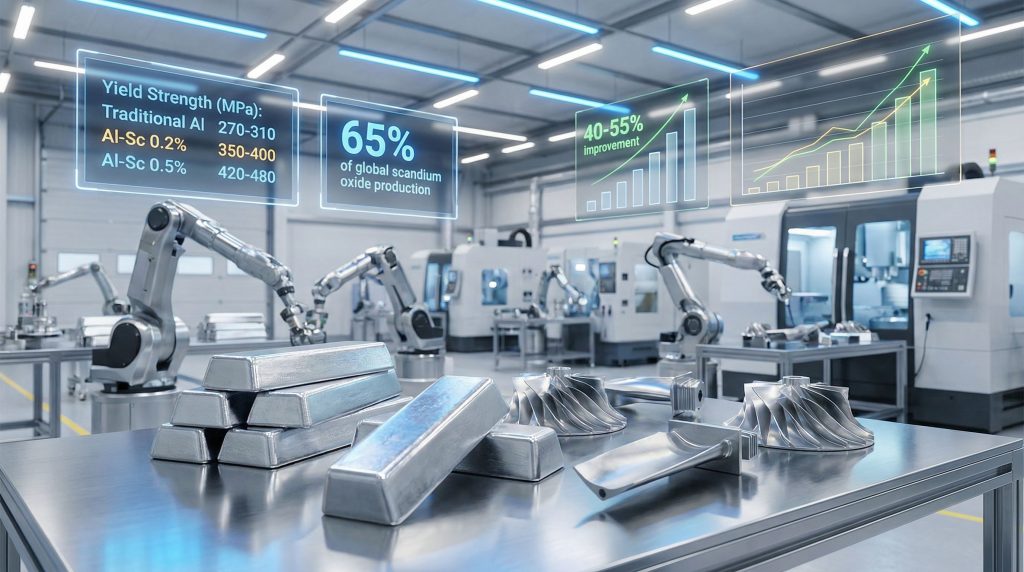
Scandium's unique atomic structure enables it to refine aluminum's grain boundaries at concentrations as low as 0.2%, creating alloys that challenge the traditional performance-weight trade-offs that have constrained aerospace and automotive design for decades. This grain refinement mechanism produces simultaneous enhancements across yield strength, corrosion resistance, and weldability characteristics.
Scandium's Performance Impact on Aluminum Alloys
| Property Enhancement | Traditional Al | Al-Sc 0.2% | Al-Sc 0.5% | Strategic Advantage |
|---|---|---|---|---|
| Yield Strength (MPa) | 270-310 | 350-400 | 420-480 | 40-55% improvement |
| Weight Reduction | Baseline | 15-20% | 25-30% | Fuel efficiency gains |
| Corrosion Resistance | Standard | Enhanced | Superior | Extended service life |
| Weldability | Moderate | Excellent | Exceptional | Manufacturing flexibility |
Recent validation of these performance parameters emerged from domestic production capabilities. IBC Advanced Alloys successfully cast 0.2% aluminum-scandium alloy at its Nebraska foundry facility, demonstrating that theoretical metallurgical advantages translate into practical manufacturing outcomes within U.S. infrastructure.
Manufacturing Process Advantages
The strategic value extends beyond material properties to encompass manufacturing versatility. Aluminum-scandium alloys maintain compatibility with conventional aluminum processing methods while enabling previously impossible design configurations. Furthermore, components can undergo casting, forging, extrusion, and welding operations without degradation of enhanced properties.
This processing flexibility represents a paradigm shift for industries constrained by material selection trade-offs. Aerospace manufacturers can specify lighter components without sacrificing structural integrity, while automotive designers can pursue aggressive weight reduction targets without compromising safety margins.
In addition, the recyclability advantage of aluminum-scandium alloys preserves scandium content through multiple material lifecycles, creating a closed-loop system that maximises the utilisation of this scarce element while maintaining performance characteristics.
When big ASX news breaks, our subscribers know first
What Are the Critical Bottlenecks in Current Scandium Supply Architecture?
The global scandium supply chain exhibits structural vulnerabilities that constrain widespread adoption of aluminum-scandium alloys despite their proven performance advantages. Understanding these bottlenecks reveals both the challenges facing manufacturers and the strategic opportunities for nations seeking supply chain independence.
Primary Resource Concentration Risks
Scandium production operates under extreme geographic concentration, with China controlling approximately 65% of global scandium oxide output. This dominance creates systemic vulnerabilities for industries dependent on scandium-enhanced materials, particularly in defense and aerospace applications where supply interruptions carry national security implications.
Moreover, the recent defense supply chain crisis has highlighted three critical factors driving U.S. scandium supply chain development:
• Aluminum-scandium alloys provide significant performance and durability improvements for military and civilian aircraft while reducing fuel consumption
• Scandium remains among the rarest and least produced metals globally
• China dominates global supply and has implemented severe export restrictions
Annual global scandium oxide production estimates range from 25-30 tonnes, creating a market where demand growth quickly overwhelms available supply. Consequently, this scarcity drives price volatility, with scandium oxide trading between $3,000-$5,000 per kilogram depending on supply availability and geopolitical tensions.
Processing Technology Maturation Gaps
The conversion from scandium oxide to usable master alloy represents the most significant technical barrier in supply chain development. Traditional fluoride-based processes generate substantial environmental waste streams while requiring energy-intensive high-temperature operations that increase production costs.
Process Innovation Comparison
| Technology Approach | Environmental Impact | Energy Efficiency | Scalability Potential | Commercial Readiness |
|---|---|---|---|---|
| Traditional Fluoride | High waste generation | Energy intensive | Limited | Established |
| Direct Oxide Reduction | Reduced emissions | Moderate efficiency | High potential | Pilot scale |
| Electrolytic Co-reduction | Minimal waste | High efficiency | Very high | Early commercial |
| Vacuum Distillation | Low environmental impact | High efficiency | Moderate | Research phase |
Recent technological breakthroughs address these processing challenges. FEA Materials developed a proprietary method to convert scandium oxide directly into 2% to 4% aluminum-scandium master alloy, bypassing the intermediate metallic scandium production stage. This innovation reduces both processing complexity and environmental impact while improving economic viability.
Byproduct Recovery Dependencies
Current scandium supply relies heavily on byproduct recovery from titanium dioxide and bauxite processing operations. This dependency creates structural supply constraints where scandium availability depends on demand for primary products rather than market demand for scandium itself.
When titanium dioxide producers reduce output due to market conditions, scandium recovery decreases regardless of growing demand for scandium-enhanced alloys. However, this misalignment between primary product economics and scandium market needs perpetuates supply bottlenecks that constrain aluminum-scandium alloy adoption.
How Are Geopolitical Dynamics Reshaping Supply Chain Strategies?
National security imperatives are fundamentally altering investment patterns in scandium supply chain development. The intersection of advanced materials requirements with defense manufacturing needs has elevated scandium from a specialty metal to a strategic resource requiring government intervention and funding support.
Defense Manufacturing Imperatives
The U.S. Department of Defense awarded NioCorp Developments $10 million in Defense Production Act Title III funding in August 2025, representing direct government recognition that scandium supply chain development constitutes a national security priority. This funding targets the development and deployment of aluminum-scandium alloy components for defense aerospace systems.
Furthermore, the implementation of Trump's critical minerals executive order has prioritised domestic production capabilities. Military aerospace applications demand specific supply chain characteristics:
Supply Chain Sovereignty Requirements:
• Domestic production capability independent of foreign supply disruptions
• Quality assurance systems ensuring consistent alloy properties for mission-critical applications
• Scalability planning enabling rapid production increases during geopolitical tensions
• Technology security protecting proprietary alloy formulations and processing methods
Strategic Partnership Development
Defense contractors are establishing direct partnerships with material suppliers to secure aluminum-scandium alloy access. NioCorp has formed collaborations with Lockheed Martin's Skunk Works Advanced Development Programs division to prototype aluminum-scandium alloy components for advanced fighter aircraft development.
The F-35 Lightning fighter programme incorporates aluminum-scandium alloys to achieve weight reduction and improved structural properties. Continued F-35 production through the 2030s creates sustained demand for scandium-enhanced materials, providing market stability that supports supply chain investment.
Projected Military Aerospace Demand Growth:
| Time Period | Estimated Annual Usage | Primary Applications |
|---|---|---|
| 2025 | 1.5-2.0 tonnes | F-35 components, prototype systems |
| 2027 | 4-6 tonnes | Expanded F-35 production, next-generation platforms |
| 2030 | 8-12 tonnes | Full-scale military aerospace adoption |
These projections reflect Defence Department procurement plans and aircraft manufacturer development roadmaps, though actual demand may vary based on defense spending allocations and programme timelines.
Commercial Aviation Regulatory Drivers
Commercial aviation faces increasing regulatory pressure for fuel efficiency improvements and emissions reductions. Aluminum-scandium alloys enable aircraft weight reduction while maintaining structural requirements, supporting compliance with evolving environmental regulations.
In addition, major aircraft manufacturers are evaluating aluminum-scandium alloy integration across multiple platforms. The certification process for new aerospace materials requires extensive testing and validation, creating a multi-year timeline from initial evaluation to production implementation.
Commercial Aviation Adoption Timeline:
• 2025-2026: Prototype testing and certification processes for non-critical components
• 2027-2028: Limited production implementation for specific aircraft models
• 2029-2030: Broader adoption across multiple aircraft platforms
• 2031-2035: Standard specification integration for new aircraft designs
What Investment Models Are Emerging for Vertical Integration?
The strategic advantage of controlling complete value chains from raw material extraction through finished alloy production is driving new investment models that integrate mining operations with manufacturing capabilities. These vertical integration strategies address supply security concerns while creating competitive advantages through cost control and technology protection.
Mine-to-Manufacturing Integration Strategies
NioCorp's acquisition of FEA Materials' intellectual property for $8.4 million demonstrates the economic rationale for vertical integration. The company's subsidiary, NioCorp Advanced Metals and Alloys LLC, purchased proprietary processing technology and equipment to control the conversion from scandium oxide to finished aluminum-scandium master alloy.
This integration strategy encompasses the Elk Creek mine project in Nebraska, which contains:
• Scandium oxide: 11,300 metric tons in estimated resources
• Niobium oxide: 970,000+ metric tons
• Titanium oxides: 4.2 million metric tons
• Rare earth oxides: 632,900 metric tons
The polymetallic nature of the Elk Creek deposit enables multi-product revenue generation, reducing per-unit scandium production costs through fixed cost allocation across multiple metal outputs.
Vertical Integration Value Creation:
| Advantage Category | Strategic Benefit | Economic Impact |
|---|---|---|
| Cost Control | Elimination of intermediate markups | 25-40% cost reduction potential |
| Quality Assurance | Direct control over purity standards | Consistent alloy properties |
| Supply Security | Reduced external disruption exposure | Reliable material availability |
| Technology Protection | Proprietary process development | Competitive differentiation |
Public-Private Partnership Models
Government funding mechanisms are accelerating private sector investment through risk-sharing arrangements that reduce capital requirements for supply chain development. The Defense Production Act funding received by NioCorp exemplifies this partnership model, particularly as Australia develops its defense-critical materials strategy.
Risk Mitigation Framework:
• Direct Investment: Government funding reducing private investor capital requirements
• Purchase Commitments: Government demand guarantees providing revenue certainty
• Technology Transfer: Military specifications driving commercial application development
• Market Creation: Government procurement establishing baseline demand for private expansion
Annual scandium oxide production projections for the Elk Creek operation approach 100 metric tons, representing substantial capacity relative to current global supply levels. This production volume could significantly reduce U.S. dependence on foreign scandium sources while supporting domestic aluminum-scandium alloy supply chain expansion.
Technology Acquisition Strategies
The acquisition of FEA Materials highlights the value of proprietary processing technologies in scandium supply chain development. Eugene Prahin, CEO of FEA Materials, emphasised that "the scandium alloying technology represents significant U.S. engineering innovation that will enable growth in scandium-based structural alloys."
Direct oxide-to-alloy conversion technology eliminates intermediate processing steps while reducing environmental impact. This technological advantage creates competitive moats for companies controlling advanced processing methods, particularly in markets where environmental regulations constrain traditional processing approaches.
How Will Processing Technology Evolution Impact Supply Chain Economics?
Breakthrough innovations in scandium processing technology are fundamentally altering the economic parameters that have historically constrained aluminum-scandium alloy adoption. These technological advances address both cost barriers and environmental concerns while improving production scalability.
Next-Generation Production Methods
The evolution from traditional fluoride-based processing to direct oxide conversion represents a paradigm shift in scandium alloy manufacturing. Advanced processing methods eliminate intermediate conversion steps while significantly reducing environmental waste generation.
Technology Innovation Assessment:
| Innovation Category | Technical Advantage | Economic Impact | Implementation Timeline |
|---|---|---|---|
| Direct Oxide Processing | Eliminates metal conversion step | 30-40% cost reduction | 2025-2027 |
| Continuous Production Systems | Higher throughput efficiency | 25-35% capacity increase | 2026-2028 |
| Automated Quality Control | Consistent alloy properties | 15-20% yield improvement | 2025-2026 |
| Integrated Recycling | Closed-loop material flow | 20-30% raw material savings | 2027-2029 |
Manufacturing Process Optimisation
Energy recovery systems integrated into scandium processing facilities can reduce overall energy consumption by 25-30% through heat integration and waste stream optimisation. These efficiency improvements directly impact production economics while supporting environmental compliance requirements.
Advanced separation technologies enable recovery of 95%+ scandium content from process streams, maximising utilisation of this scarce element. Furthermore, predictive maintenance systems utilising IoT monitoring optimise equipment uptime while reducing maintenance costs through condition-based servicing schedules.
Process Efficiency Improvements:
• Energy Integration: Heat recovery systems reducing overall energy requirements
• Waste Minimisation: Advanced separation recovering maximum scandium content
• Automation Systems: Robotic handling ensuring quality consistency while reducing labour costs
• Predictive Maintenance: IoT monitoring optimising equipment reliability and process uptime
Environmental Impact Reduction
Traditional scandium processing generates significant environmental waste requiring costly treatment and disposal. Direct oxide processing methods minimise waste generation while eliminating hazardous chemical usage associated with fluoride-based approaches.
However, closed-loop recycling systems enable continuous reuse of scandium-containing materials, reducing primary resource requirements while maintaining alloy performance characteristics. This circular economy approach maximises scandium utilisation efficiency while addressing supply scarcity concerns, particularly as mining sustainability advances become increasingly important.
What Market Penetration Scenarios Are Most Likely?
Market adoption of aluminum-scandium alloys follows distinct pathways across different industry sectors, with each facing unique implementation challenges and adoption drivers. Understanding these scenarios enables strategic planning for supply chain capacity development and technology investment priorities.
Aerospace Adoption Pathways
Military aerospace represents the initial market penetration pathway due to performance requirements that justify premium material costs. Defense applications prioritise capabilities over cost considerations, creating market entry opportunities for advanced materials.
Commercial aviation adoption follows a more complex timeline constrained by certification requirements and cost sensitivity. For instance, aircraft manufacturers evaluate new materials through extensive testing protocols that extend implementation timelines but ensure reliability for passenger safety applications.
Aerospace Implementation Progression:
| Phase | Timeline | Market Segment | Key Characteristics |
|---|---|---|---|
| Initial Adoption | 2025-2026 | Military prototypes | Performance-focused applications |
| Limited Production | 2027-2028 | Specific aircraft models | Selective component integration |
| Broad Implementation | 2029-2030 | Multiple platforms | Standard specification adoption |
| Market Maturity | 2031-2035 | New aircraft designs | Routine material specification |
Automotive Market Entry Strategies
The automotive sector presents the largest potential market for aluminum-scandium alloys, but adoption faces different challenges than aerospace applications. Cost sensitivity and volume requirements create barriers that must be addressed through manufacturing scale and process optimisation.
Automotive Penetration Analysis:
| Market Segment | Primary Drivers | Implementation Challenges | Timeline Projection |
|---|---|---|---|
| Luxury Electric Vehicles | Performance differentiation | Cost justification | 2026-2028 |
| Commercial Electric Vehicles | Range optimisation | Scale manufacturing | 2028-2030 |
| Mass Market Applications | Regulatory compliance | Price competitiveness | 2030-2035 |
| Performance Vehicles | Weight reduction benefits | Limited volume impact | 2025-2027 |
Electric vehicle manufacturers face particularly strong incentives for weight reduction, as battery efficiency directly correlates with vehicle range. Aluminum-scandium alloys enable structural weight reduction while maintaining safety performance, supporting extended driving ranges that address consumer adoption barriers.
Industrial Applications Development
Beyond aerospace and automotive applications, aluminum-scandium alloys offer advantages for specialised industrial uses including fuel cells, high-performance electronics, and laser systems. These niche markets provide revenue diversification opportunities while supporting supply chain economic viability.
Space launch systems represent a growing market segment where aluminum-scandium alloy benefits align with industry cost and performance requirements. Commercial space development creates sustained demand growth independent of traditional aerospace market cycles, complementing broader mining industry innovation trends.
The next major ASX story will hit our subscribers first
How Will Supply Chain Resilience Be Achieved?
Building resilient aluminum-scandium alloy supply chains requires addressing multiple risk categories including geopolitical disruptions, technology obsolescence, demand volatility, and quality control challenges. Comprehensive risk mitigation strategies encompass geographic diversification, technology redundancy, and flexible production systems.
Geographic Diversification Strategies
Reducing dependence on Chinese scandium supply requires developing alternative production capabilities across multiple regions. The United States, Australia, and European nations are establishing research initiatives and pilot production facilities to create supply chain alternatives.
Regional Supply Chain Development:
• North America: Elk Creek mine development supporting domestic scandium oxide production
• Australia: Potential scandium recovery integration with existing mining operations
• Europe: Research initiatives and pilot production facility development
• Strategic Partnerships: Technology sharing agreements between allied nations for critical materials
Domestic production capability provides strategic autonomy while reducing exposure to export restrictions and transportation disruptions. The Nebraska facility operated by IBC Advanced Alloys demonstrated successful domestic aluminum-scandium alloy casting, validating technical feasibility for U.S. manufacturing independence.
Risk Assessment and Mitigation
Supply Chain Risk Evaluation:
| Risk Category | Probability Assessment | Impact Level | Mitigation Strategy |
|---|---|---|---|
| Geopolitical Supply Disruption | High | Critical | Domestic production capacity development |
| Technology Obsolescence | Medium | Moderate | Continuous R&D investment programmes |
| Demand Volatility | Medium | High | Flexible production system implementation |
| Quality Control Issues | Low | Critical | Advanced monitoring system deployment |
Investment requirements for supply chain resilience vary significantly by risk category. Domestic production capacity requires substantial capital investment ranging from $50-100 million for comprehensive facilities, while advanced monitoring systems require $5-15 million in technology infrastructure.
Inventory and Buffer Strategies
Strategic stockpiling of scandium oxide and aluminum-scandium master alloys provides buffer capacity against supply disruptions. Government-maintained strategic reserves complement private sector inventory management to ensure continued production capability during supply chain stress periods.
Flexible production systems enable rapid capacity adjustments based on demand fluctuations while maintaining economic efficiency during normal operating conditions. This adaptability becomes critical as aluminum-scandium alloy supply chain markets develop and demand patterns stabilise.
What Are the Long-Term Competitive Dynamics?
The aluminum-scandium alloy market is transitioning from specialty material status to strategic industrial input, creating competitive dynamics that will reshape multiple industry sectors over the next decade. Understanding these evolving market structures enables strategic positioning for long-term success.
Market Structure Evolution
Industry consolidation around vertically integrated supply chains creates competitive advantages for companies controlling complete value chains from mining through finished alloy production. These integrated operators achieve cost advantages while ensuring supply security for downstream customers.
Competitive Positioning Categories:
• Technology Leaders: Companies controlling advanced processing methods and proprietary alloy formulations
• Resource Controllers: Organisations with access to scandium-bearing mineral deposits
• Application Specialists: Manufacturers developing industry-specific alloy solutions
• System Integrators: Entities managing complete supply chain solutions from mine to market
Market leadership requires capabilities across multiple categories rather than dominance in single areas. Companies achieving technology leadership without resource access remain vulnerable to supply disruptions, while resource controllers lacking processing technology cannot capture value-added margins.
Innovation Investment Priorities
Research and development focus areas determine competitive positioning as aluminum-scandium alloy markets mature. Investment priorities include alternative scandium sources, alloy composition optimisation, processing efficiency improvements, and recycling system development.
Strategic R&D Focus Areas:
| Innovation Category | Strategic Importance | Investment Level | Timeline to Impact |
|---|---|---|---|
| Alternative Sources | Critical for supply security | $20-50M annually | 5-10 years |
| Alloy Optimisation | Competitive differentiation | $10-25M annually | 2-5 years |
| Processing Efficiency | Cost competitiveness | $15-30M annually | 3-7 years |
| Recycling Systems | Sustainability advantage | $5-15M annually | 3-5 years |
Market Expansion Scenarios
Long-term competitive success depends on market expansion beyond initial aerospace and defense applications. Automotive market penetration represents the largest growth opportunity, requiring manufacturing scale and cost reduction achievements that benefit all market segments.
Industrial applications including renewable energy systems, advanced electronics, and specialised manufacturing equipment provide market diversification opportunities while supporting supply chain economic viability through demand stability.
The aluminum-scandium alloy supply chain represents a convergence of technological innovation, geopolitical strategy, and market opportunity that will reshape advanced materials industries over the coming decade. Success requires integrated approaches combining resource access, processing technology, and market development capabilities that address both current constraints and future growth opportunities.
Note: Market projections and demand scenarios presented in this analysis are based on current industry trends and development plans but may vary significantly based on economic conditions, regulatory changes, and technological developments. Investment decisions should incorporate comprehensive due diligence and risk assessment appropriate to individual circumstances.
Ready to Invest in the Next Major Mineral Discovery?
The aluminum-scandium supply chain's evolution highlights how rare earth elements drive transformative industrial changes, yet identifying these opportunities requires sophisticated market intelligence. Discovery Alert instantly alerts investors to significant ASX mineral discoveries using its proprietary Discovery IQ model, turning complex mineral data into actionable insights. Understand why historic discoveries can generate substantial returns by visiting Discovery Alert's dedicated discoveries page.