June 14, 2026
The global economy increasingly depends on specialised materials that exist in concentrated geographic clusters, creating vulnerabilities that extend far beyond simple supply and demand mechanics. When examining critical mineral dependencies, few cases illustrate these systemic risks as clearly as scandium supply ex-China chains, where production concentration has created strategic dependencies that now drive geopolitical tensions and reshape industrial planning across multiple sectors.
Modern manufacturing relies on materials whose supply chains remain opaque to most investors and policymakers until disruption occurs. Furthermore, scandium represents one such material where understanding supply dynamics requires examining not just current production patterns, but the technical barriers, geopolitical relationships, and economic incentives that shape future availability.
Critical Mineral Dependencies in Global Supply Architecture
The scandium market demonstrates how concentrated production creates cascading vulnerabilities across multiple industrial sectors. Current global production estimates suggest approximately 10-15 tonnes of scandium oxide equivalent annually, with Chinese sources controlling roughly 60-70% of accessible supply chains.
Unlike other critical minerals where production data remains relatively transparent, scandium supply figures reflect significant uncertainty due to proprietary production methods and limited public reporting requirements. The U.S. Geological Survey notes that refined scandium production data by country remains limited due to the proprietary nature of production processes.
Current Global Production Distribution Analysis:
| Region | Estimated Annual Output | Production Method | Supply Chain Risk |
|---|---|---|---|
| China | 6-8 tonnes | Primary/Byproduct | Medium (Policy Control) |
| Russia | 0.5-1 tonnes | Uranium Byproduct | Very High (Sanctions) |
| Kazakhstan | <0.1 tonnes | Uranium Byproduct | High (Political Instability) |
| Ukraine | 0.2-0.5 tonnes | Processing Facilities | Critical (Conflict Zone) |
| Philippines | 0.1-0.3 tonnes | Nickel Byproduct | Medium (Regulatory) |
This concentration creates multiple failure points that extend beyond traditional supply disruption scenarios. Russian production has effectively ceased following 2022 sanctions implementation, while Ukrainian processing capabilities remain offline due to ongoing conflict. However, Kazakhstan's minimal production depends on uranium operations that face their own geopolitical pressures.
The technical complexity of scandium extraction compounds these geographic risks. Three primary production pathways exist, each with distinct economic and technical characteristics:
Laterite Clay Processing: Lower concentration deposits requiring acid leaching, environmentally sensitive but potentially scalable.
Hard Rock Mining: However, higher grade deposits demand conventional mining with complex hydrometallurgical processing.
Byproduct Recovery: Opportunistic extraction from uranium, nickel, or rare earth processing, limited by host mineral production volumes.
Each methodology presents different cost structures, environmental considerations, and scalability limitations that influence long-term supply development prospects.
When big ASX news breaks, our subscribers know first
Industrial Applications Driving Strategic Material Demand
The push for scandium supply ex-China stems from applications where material properties create few viable substitutes, particularly in defence critical materials strategy and advanced manufacturing sectors where supply security outweighs cost considerations.
Defence aerospace applications represent the most critical demand driver, where scandium-aluminium alloys provide specific performance characteristics for military aircraft components. These alloys offer documented tensile strength improvements of 20-30% through grain refinement, enabling weight reduction in structural applications where traditional materials reach performance limitations.
Defence Procurement Signal Analysis:
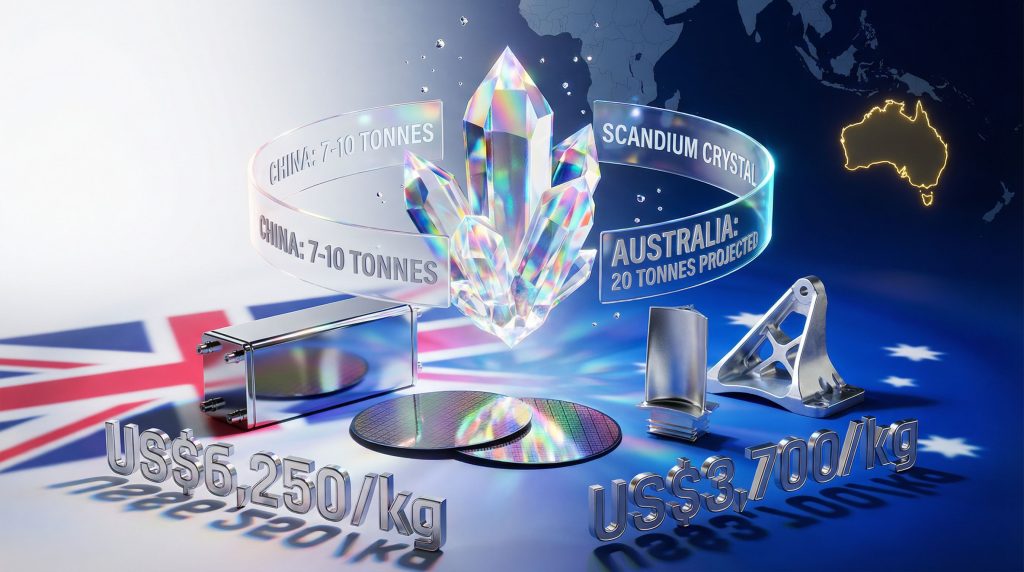
The U.S. Defence Logistics Agency's procurement action for 6.4 tonnes of scandium oxide over five years, priced at up to US$6,250/kg, provides concrete evidence of military-industrial supply security priorities. This procurement represents approximately 1.28 tonnes annually at US$8.0 million in total value, significant within the small scandium market but modest in absolute defence spending terms.
The 69% premium over estimated commercial pricing of US$3,700/kg demonstrates willingness to pay substantial premiums for supply chain security. This pricing differential creates economic incentives for alternative production development outside traditional Chinese supply channels.
Technology Infrastructure Applications
Solid oxide fuel cell technology represents an emerging application where scandium-doped materials improve ionic conductivity in high-temperature operations. Scandium-doped zirconia electrolytes enhance power density and reduce operating temperature requirements compared to yttria-stabilised zirconia baseline materials.
However, current commercial deployment remains limited to demonstration projects. While the technology shows promise for data centre power applications, as of 2026, major technology companies continue pursuing nuclear power solutions for artificial intelligence infrastructure rather than fuel cell technologies.
Aerospace Industry Integration
Commercial aerospace adoption of scandium-aluminium alloys faces cost-benefit calculations where material premiums must justify performance improvements. Addition of 0.3-0.5% scandium to aluminium increases costs by 30-50% over base alloy pricing, requiring clear operational benefits to justify adoption.
Weight reduction calculations for fuel efficiency gains depend on specific aircraft configurations, operational profiles, and fuel pricing assumptions. While theoretical benefits exist, widespread adoption requires both supply security and cost predictability that current market conditions do not provide.
Geopolitical Tensions and Supply Chain Restructuring
The drive for scandium supply ex-China acceleration reflects broader concerns about critical mineral dependencies, though specific export restrictions on scandium have not been formally implemented as of 2026. Chinese policy makers have demonstrated willingness to restrict rare earth export controls during diplomatic tensions, creating precedent concerns for scandium consumers.
The 2010 rare earth export restrictions provide a framework for understanding potential scandium supply disruption scenarios. China reduced rare earth export quotas by 40% and implemented licensing requirements that created US$1+ billion in supply chain disruptions across automotive and electronics sectors.
Strategic Minerals Classification Impact
Multiple Western governments have designated scandium as a critical mineral requiring supply diversification:
- United States: Department of Energy Critical Materials designation
- European Union: Critical Raw Materials Act inclusion (2023)
- Canada: Critical Minerals List designation
- Australia: Australia's critical minerals reserve inclusion
These classifications enable government support mechanisms including export credit financing, strategic stockpiling programmes, and research funding for alternative production technologies.
Export Control Mechanisms Available
Chinese authorities possess multiple policy tools for restricting scandium exports:
- Export licensing requirements similar to rare earth element controls
- Production quota restrictions limiting total export volumes
- Strategic reserve mandates allocating production to domestic use
- Tariff mechanisms increasing export costs for foreign buyers
Alternative Production Development Scenarios
Several non-Chinese production pathways offer potential for significant supply chain diversification, though each faces distinct technical and economic challenges. The Trump executive order on critical minerals demonstrates continued policy focus on supply chain security.
Australian Production Leadership Pathway
Australia's lateritic clay deposits in New South Wales represent the most advanced alternative production development. The Syerston project demonstrates technical feasibility for primary scandium mining with projected production capacity of 60 tonnes annually by 2028.
Project economics show capital requirements of approximately US$120 million for initial production, with C1 cash operating costs estimated at US$534/kg. These figures suggest economic viability at current premium pricing levels while maintaining competitive positioning against Chinese supply.
North American Processing Integration
Rio Tinto's Sorel-Tracy facility in Quebec provides proof of concept for high-purity scandium processing in North America. While current operations focus on demonstration-scale production, the facility could potentially scale to 5-10 tonnes annually within existing infrastructure constraints.
The facility's strategic value extends beyond production volume to include processing technology development and supply chain integration capabilities for North American manufacturing sectors.
European Resource Development Potential
Nordic countries possess scandium resources within existing mining operations, particularly nickel and iron ore facilities in Norway and Finland. Byproduct recovery could yield 2-3 tonnes annually without requiring dedicated mining infrastructure investments.
However, byproduct recovery operations depend on host mineral production levels and face technical challenges in achieving consistent grade and quality specifications for aerospace applications.
Economic Models Supporting Supply Diversification
Alternative scandium supply development requires economic frameworks that account for supply security premiums and long-term contract structures rather than spot market pricing optimisation. The mining industry innovation trends support development of more efficient extraction technologies.
Primary Production Economics Analysis
Capital costs for dedicated scandium operations range from US$50-150 million for 10-20 tonnes annual capacity, depending on deposit type and processing requirements. Operating costs vary significantly based on extraction methodology:
- Laterite processing: US$400-600/kg including acid leaching and purification
- Hard rock mining: US$600-800/kg including conventional mining and processing
- Byproduct recovery: US$200-400/kg additional costs to host operations
Premium Pricing Sustainability
Market segmentation supports differentiated pricing based on supply source and quality specifications:
Table: Scandium Pricing Segmentation (2026 Estimates)
| Grade Category | Price Range (US$/kg) | Supply Source | Application Focus |
|---|---|---|---|
| Commodity Grade | $2,500-3,500 | Chinese Supply | Industrial Applications |
| Defence Grade | $4,000-6,000 | Ex-China Premium | Military/Aerospace |
| Research Grade | $8,000-12,000 | Ultra-High Purity | Semiconductor/R&D |
| Emergency Procurement | $15,000+ | Supply Disruption | Critical Applications |
Financial Risk Mitigation Strategies
Government support mechanisms reduce private sector investment risks through multiple channels:
- Export credit agency financing from institutions like US EXIM Bank and Export Development Canada
- Strategic procurement agreements providing guaranteed offtake volumes
- Research and development incentives supporting technology advancement
- Infrastructure development grants reducing capital requirements
Private sector risk sharing includes long-term offtake agreements with aerospace manufacturers, defence contractor supply chain integration, and joint venture structures with established mining companies possessing operational expertise and financing capabilities.
Market Dynamics Favouring Supply Chain Resilience
The small size of the global scandium market creates unique dynamics where supply security considerations increasingly outweigh pure cost optimisation for critical applications.
Technology Adoption Acceleration Factors
Scandium's performance characteristics become more valuable as industries pursue optimisation over cost minimisation:
Aerospace Weight Reduction Benefits:
- Aluminium-scandium alloys enable 15-20% weight savings in structural components
- Fuel efficiency improvements create operational cost savings exceeding material premiums
- Extended component lifecycles reduce maintenance and replacement costs
Energy Infrastructure Efficiency Gains:
- SOFC technology with scandium-doped electrolytes improves power density by 25-30%
- Grid stability improvements provide substantial economic value for utility operations
- Carbon reduction benefits support ESG investment criteria and regulatory compliance
Investment Arbitrage Opportunities
Pricing disparities between Chinese supply and alternative sources create investment opportunities for companies capable of developing reliable production outside traditional supply chains. The defence sector's willingness to pay 60-70% premiums for supply security creates sustainable margins for alternative producers while maintaining competitive positioning against substitute materials.
The next major ASX story will hit our subscribers first
Investment Frameworks for Supply Chain Diversification
Multiple investment approaches provide exposure to scandium supply diversification trends, each with distinct risk-return profiles and market timing considerations.
Direct Production Investment Strategies
Primary Development Companies: Firms developing dedicated scandium mining operations offer direct exposure to supply diversification trends. Key evaluation criteria include:
- Geological resource quality and extraction cost competitiveness
- Management team experience in specialty metals development
- Regulatory approval timelines and government support accessibility
- Offtake agreement security and pricing mechanism sustainability
Integrated Mining Operations: Established mining companies adding scandium byproduct recovery provide lower-risk exposure with steady cash flow support from primary commodities production.
Technology and Processing Investment Themes
Advanced Extraction Technologies: Companies developing improved scandium extraction and purification processes could capture significant value as global production scales and quality requirements increase.
End-Use Application Development: Businesses creating new scandium applications or improving existing processes benefit from supply diversification reducing input cost volatility and availability uncertainty.
Infrastructure and Logistics Opportunities
Regional scandium processing hubs could serve multiple mining operations while providing supply chain resilience for industrial customers requiring consistent quality and delivery reliability.
Specialised storage, blending, and distribution capabilities could benefit from market fragmentation and quality differentiation requirements as the industry matures.
Strategic Outlook for Alternative Supply Development
The trajectory for scandium supply ex-China depends on multiple converging factors including geopolitical tensions, technology adoption rates, and economic viability of alternative production methods.
Timeline for Production Development
Primary scandium mining projects typically require 5-7 years from resource definition to commercial production, while byproduct recovery operations can be implemented within 2-3 years of existing mining operations. This timeline differential favours near-term byproduct development while primary production projects address long-term demand growth.
Scalability Considerations
Current alternative production projects could potentially supply 70-75 tonnes annually by 2030, compared to estimated Western demand of 15-20 tonnes currently. This suggests adequate capacity development if projects achieve planned production levels.
However, quality specifications for aerospace and defence applications may require specific processing capabilities that not all alternative sources can achieve, creating potential bottlenecks despite adequate total supply volume.
Policy Support Evolution
Government support for critical mineral supply diversification continues expanding through strategic stockpiling, procurement preferences, and research funding. The sustainability of these support mechanisms depends on continued geopolitical tensions and recognition of supply chain vulnerabilities.
Market Maturation Implications
As scandium supply ex-China sources diversify and production scales increase, market dynamics may shift from supply security premiums toward more traditional commodity pricing. However, defence and aerospace applications likely maintain willingness to pay premiums for supply reliability and quality assurance.
The development of transparent pricing mechanisms and quality standards could facilitate broader industrial adoption while maintaining differentiated pricing for critical applications.
This analysis reflects current market conditions and publicly available information as of March 2026. Investors should conduct independent research and consult with qualified professionals before making investment decisions. The specialty metals sector involves significant technical and market risks that may result in substantial losses.
Are You Positioned for Australia's Critical Minerals Boom?
Discovery Alert's proprietary Discovery IQ model provides immediate notifications when ASX-listed companies announce significant mineral discoveries, including critical materials like scandium that are reshaping global supply chains. With alternative supply sources gaining strategic importance, subscribers gain instant access to actionable investment opportunities in Australia's critical minerals sector before broader market recognition occurs.