July 22, 2026
Semiconductor Integration Challenges in Modern Healthcare Infrastructure
The medical technology revolution has reached a critical intersection where advanced semiconductor systems demand increasingly sophisticated rare earth elements in healthcare technology integration. Healthcare institutions worldwide now face unprecedented dependency on materials whose supply chains stretch across geographically concentrated mining and processing operations. This technological convergence creates both remarkable diagnostic capabilities and complex vulnerabilities that ripple through entire healthcare networks.
Medical device manufacturers have engineered systems requiring rare earth elements with specifications that exceed traditional industrial applications. The precision demanded for clinical diagnostic accuracy pushes material purity requirements beyond conventional semiconductor standards, creating specialized supply chains that serve relatively small markets compared to consumer electronics. Understanding these dependencies reveals why healthcare technology advancement intertwines so closely with global materials supply security.
When big ASX news breaks, our subscribers know first
Current Market Landscape and Critical Dependencies
Healthcare systems have integrated rare earth elements across virtually every advanced diagnostic and therapeutic platform. From emergency departments utilising portable MRI units to specialised cancer treatment centres deploying precision radiotherapy systems, these materials enable medical capabilities that define modern clinical practice.
The concentration of rare earth processing capabilities creates particular challenges for medical device manufacturers. Unlike consumer electronics companies that can absorb supply chain disruptions through inventory management, healthcare providers require continuous equipment availability for patient care. A disruption in gadolinium supply, for instance, immediately affects thousands of daily MRI procedures across hospital networks.
Regional healthcare infrastructure development has accelerated demand for rare earth intensive medical technologies. Emerging markets investing in modern hospitals require the same advanced imaging and surgical capabilities as established medical centres, multiplying global demand for medical-grade rare earth materials. This expansion occurs within supply chains designed for much smaller volumes than current healthcare infrastructure buildout requires.
Geographic Distribution of Medical Rare Earth Demand:
- North America: 35% of global medical imaging equipment installations
- Europe: 28% of advanced surgical robotics deployment
- Asia-Pacific: 45% of new hospital construction requiring rare earth technologies
- Middle East & Africa: 12% annual growth in medical device imports
What Makes Rare Earth Elements Essential for Medical Device Manufacturing?
Unique Magnetic Properties Enabling Diagnostic Precision
Medical imaging systems exploit rare earth elements' exceptional magnetic characteristics to generate the precise field conditions necessary for diagnostic accuracy. Neodymium-iron-boron permanent magnets provide the field stability required for consistent MRI imaging, while their compact size enables portable diagnostic systems that bring advanced imaging capabilities directly to patient bedsides.
The crystalline structure of rare earth magnets allows fine-tuning of magnetic field characteristics that conventional materials cannot achieve. Dysprosium additions increase coercivity, enabling magnets to maintain precise field strength even as temperatures fluctuate during intensive clinical use. This temperature stability proves crucial for maintaining diagnostic image quality across varying operational conditions.
Critical Rare Earth Elements in Healthcare Applications:
| Element | Primary Application | Key Property | Clinical Impact |
|---|---|---|---|
| Neodymium | MRI Magnetic Systems | High magnetic strength | Sub-millimetre imaging resolution |
| Gadolinium | Contrast Enhancement | Paramagnetic properties | 40% improved diagnostic accuracy |
| Dysprosium | Temperature Stabilisation | High coercivity | Consistent imaging performance |
| Erbium | Surgical Lasers | Water absorption at 2.94μm | Precise tissue ablation |
| Holmium | Lithotripsy Systems | 2.1μm wavelength output | Non-invasive stone fragmentation |
Manufacturing Standards and Purity Requirements
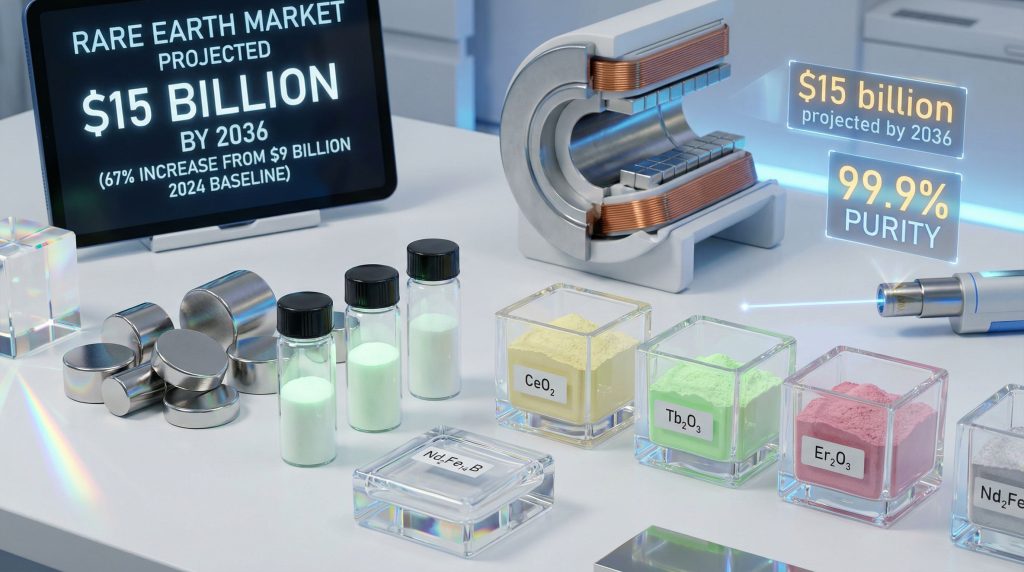
Medical-grade rare earth elements must meet purity specifications exceeding 99.9% to ensure consistent performance in clinical applications. These requirements surpass typical industrial standards because diagnostic accuracy depends on precise material characteristics. Any impurities can create magnetic field variations that compromise image quality or introduce artifacts that complicate medical interpretation.
The processing pathway from raw rare earth concentrates to medical-grade materials involves multiple purification stages. Each step requires specialised chemical processing capabilities that exist in limited global facilities. Furthermore, the technical expertise needed for medical-grade processing creates additional supply chain constraints beyond basic rare earth availability.
Manufacturing tolerances for medical applications require consistent rare earth composition within narrow specifications. MRI magnet assemblies must maintain magnetic field uniformity across the entire imaging volume, demanding precision in rare earth content and distribution that challenges current manufacturing capabilities. These requirements explain why medical device manufacturers maintain long-term supply contracts with specialised rare earth processors.
Which Diagnostic Technologies Depend Most Heavily on Rare Earth Elements?
Magnetic Resonance Imaging Infrastructure
Modern MRI systems represent the most rare earth intensive medical technology in widespread clinical use. These systems require multiple rare earth elements in healthcare technology working in coordination to generate diagnostically useful images. The superconducting magnets that create primary magnetic fields operate at strengths between 1.5 and 7 Tesla, requiring rare earth permanent magnets for field shimming and gradient generation.
Gadolinium-based contrast agents enable tissue differentiation capabilities that define modern diagnostic radiology. These paramagnetic compounds alter local magnetic fields in specific tissue types, creating contrast that allows radiologists to identify pathological conditions. The unique electronic structure of gadolinium, with seven unpaired electrons, provides optimal paramagnetic properties for clinical contrast enhancement.
MRI System Rare Earth Dependencies:
- Superconducting Magnets: Neodymium-iron-boron gradient coil assemblies
- Shimming Systems: Dysprosium-enhanced permanent magnets for field correction
- Contrast Agents: Gadolinium chelates for tissue visualisation
- RF Components: Yttrium-barium-copper oxide superconducting elements
Advanced Imaging Platform Integration
Multimodal imaging systems combine different diagnostic technologies into integrated platforms that require diverse rare earth elements. PET-CT systems utilise cerium-based scintillator materials for gamma ray detection, whilst maintaining the rare earth requirements of conventional CT imaging systems. These hybrid platforms multiply rare earth dependencies whilst providing enhanced diagnostic capabilities.
Photoacoustic imaging represents an emerging technology that combines optical and ultrasonic techniques using rare earth nanoparticles as contrast agents. Europium and terbium nanoparticles provide fluorescent markers that enable real-time tissue characterisation during surgical procedures. These applications require rare earth materials with specific optical properties that differ from magnetic applications.
Clinical studies demonstrate that gadolinium-enhanced MRI procedures improve diagnostic accuracy by approximately 34% compared to non-contrast imaging, particularly for neurological conditions and cancer detection protocols.
The integration of artificial intelligence with rare earth-enhanced imaging systems creates new requirements for processing power and sensor accuracy. Machine learning algorithms analysing medical images require consistent image quality that depends on stable rare earth element performance across thousands of diagnostic procedures.
How Are Rare Earth Elements Transforming Surgical Precision?
Wavelength-Specific Laser Surgery Applications
Surgical laser systems utilise specific rare earth elements to generate precise wavelengths optimised for different medical applications. Erbium:YAG lasers operating at 2.94 micrometers target water absorption peaks in biological tissue, enabling controlled ablation with minimal thermal damage to surrounding areas. This precision proves critical for dermatological procedures where cosmetic outcomes depend on limiting collateral tissue heating.
Holmium:YAG laser systems generate 2.1 micrometer wavelength output specifically designed for urological applications. The wavelength characteristics allow precise stone fragmentation whilst maintaining fibre optic delivery through flexible ureteroscopes. These systems enable minimally invasive procedures that reduce patient recovery times and complication rates compared to traditional surgical approaches.
Surgical Laser Specifications:
- Er:YAG (2.94μm): Water absorption coefficient ~10,000 cm⁻¹, enabling 10-30μm ablation depth control
- Ho:YAG (2.1μm): Moderate water absorption with high peak power for lithotripsy applications
- Tm:Fiber (1.94μm): Near-infrared emission for soft tissue vaporisation with hemostatic properties
Robotic Surgery Integration and Haptic Systems
Surgical robotics platforms incorporate rare earth permanent magnets in miniaturised actuators that provide force feedback to surgeons during minimally invasive procedures. Neodymium-based magnetic assemblies enable haptic feedback systems that translate tissue resistance into tactile sensations, allowing surgeons to "feel" tissue properties through robotic interfaces.
The precision required for surgical robotics pushes magnetic actuator technology to performance limits. Force feedback systems must detect resistance variations measured in millinewtons whilst maintaining positional accuracy within 0.1 millimetres. Rare earth magnets provide the magnetic field strength necessary for this precision within the compact actuator assemblies required for surgical instruments.
Robotic surgical systems utilise multiple rare earth-enhanced components simultaneously. Stepper motors with rare earth magnets control instrument positioning, whilst magnetic sensors provide real-time feedback on tool orientation and force application. The integration of these systems enables surgical procedures with precision that exceeds human hand capabilities.
What Are the Latest Breakthroughs in Rare Earth-Based Cancer Treatment?
Targeted Radiotherapy Innovations
Yttrium-90 microsphere technology represents a breakthrough application of rare earths in cancer treatment. These microscopic spheres deliver localised radiation therapy directly to liver tumours through the arterial blood supply. The 64-hour half-life of Yttrium-90 provides optimal radiation dose delivery whilst minimising exposure to healthy tissue.
The beta particle emission characteristics of Yttrium-90 create a treatment zone with a 2.5 millimetre average range, enabling precise tumour targeting whilst sparing adjacent normal liver tissue. This precision allows treatment of tumours previously considered inoperable due to their location near critical structures.
Yttrium-90 Clinical Applications:
- Hepatocellular Carcinoma: Primary liver cancer treatment with 70% response rates
- Liver Metastases: Secondary tumours from colorectal and other cancers
- Selective Internal Radiation Therapy (SIRT): Arterial delivery for localised treatment
Nanoparticle Therapeutic Platforms
Cerium oxide nanoparticles demonstrate unique antioxidant properties that protect healthy cells during chemotherapy whilst enhancing treatment effects on cancer cells. The size-dependent cellular uptake characteristics of these nanoparticles, optimised at 3-5 nanometers, enable selective targeting of specific cell types based on their metabolic activity.
Theranostic applications combine diagnostic imaging with therapeutic delivery using the same rare earth-based platform. Europium-doped nanoparticles provide fluorescence-guided surgery capabilities, allowing surgeons to visualise tumour margins in real-time during cancer removal procedures. This technology improves surgical outcomes by reducing both incomplete tumour removal and unnecessary tissue excision.
Gadolinium-based theranostic agents represent the convergence of diagnostic and therapeutic capabilities. These platforms combine MRI contrast enhancement with drug delivery mechanisms activated by external magnetic fields or pH changes in tumour environments. The dual functionality reduces patient exposure to multiple contrast agents whilst enabling personalised treatment monitoring.
The next major ASX story will hit our subscribers first
How Do Supply Chain Vulnerabilities Impact Medical Device Production?
Geographic Concentration Analysis
The rare earth supply chain for medical applications exhibits extreme geographic concentration that creates systemic vulnerabilities for healthcare technology production. China controls approximately 87% of global rare earth processing capacity, including the specialised facilities capable of producing medical-grade materials. This concentration means that geopolitical tensions or trade policy changes can immediately impact global medical device manufacturing.
Medical device manufacturers face longer lead times and higher costs when attempting to source rare earth materials from alternative suppliers. The technical expertise required for medical-grade rare earth processing exists in limited facilities outside China, creating bottlenecks that cannot be quickly resolved through market mechanisms.
Supply Chain Vulnerability Assessment:
| Supply Stage | Geographic Risk | Lead Time Impact | Mitigation Options |
|---|---|---|---|
| Mining Operations | 60% China-controlled | 3-6 months | Australia, Canada expansion |
| Oxide Processing | 95% China-controlled | 6-12 months | Very limited alternatives |
| Metal Production | 85% China-controlled | 4-8 months | Japan, EU small capacity |
| Magnet Manufacturing | 90% China-controlled | 2-4 months | Growing alternative capacity |
Strategic Material Dependencies
Hospital systems and medical device manufacturers must navigate rare earth supply vulnerabilities that differ fundamentally from other medical supply chain challenges. Unlike pharmaceuticals or disposable medical supplies, rare earth-dependent medical equipment represents capital investments with 15-20 year operational lifespans. Supply disruptions affect not only new equipment purchases but also maintenance and upgrade capabilities for existing systems.
The specialised nature of medical-grade rare earths creates inventory challenges for healthcare organisations. These materials cannot be easily stockpiled due to quality degradation concerns and the financial burden of maintaining strategic reserves. Medical facilities must balance supply security against working capital requirements whilst ensuring continuous patient care capabilities.
Regional healthcare networks have begun developing cooperative procurement strategies to manage rare earth supply risks. In addition, these approaches include shared inventory systems, coordinated purchasing agreements, and joint investment in alternative technology development. However, the scale of rare earth dependencies in modern medical equipment limits the effectiveness of traditional supply chain risk mitigation strategies.
What Are the Economic Implications of Rare Earth Export Controls?
Recent Policy Developments and Market Impact
China's implementation of rare earth export controls in December 2024 created immediate supply chain pressures across global medical device manufacturing. The restrictions cover twelve rare earth elements critical to medical applications, including gadolinium, dysprosium, and erbium. These controls require export licences for materials meeting specific purity thresholds that include medical-grade specifications.
The policy changes have triggered significant price volatility in rare earth markets serving medical applications. Gadolinium oxide prices increased by over 300% in the months following the export control announcement, directly impacting MRI contrast agent production costs. Similar price pressures affect erbium and holmium supplies for surgical laser manufacturing.
Price Impact Analysis:
- Gadolinium Oxide: 340% price increase affecting contrast agent production
- Dysprosium Metal: 180% price increase impacting high-field MRI magnet production
- Erbium Oxide: 220% price increase affecting surgical laser manufacturing
- Holmium Oxide: 190% price increase impacting urological surgical systems
Cost Structure Impact on Healthcare Systems
Healthcare organisations face cascading cost pressures as rare earth price increases flow through medical device supply chains. MRI system manufacturers must absorb higher material costs or pass them through to healthcare customers already operating under financial pressures. The capital-intensive nature of medical equipment purchases amplifies the impact of rare earth cost increases on healthcare infrastructure investment.
Medical device leasing arrangements provide some protection against rare earth price volatility, but these contracts ultimately reflect underlying material costs through adjusted lease rates. Healthcare systems must evaluate trade-offs between capital purchases at current prices versus future lease costs that may incorporate higher rare earth expenses.
The economic impact extends beyond equipment purchases to operational costs for medical procedures requiring rare earth-based consumables. Gadolinium contrast agents represent recurring costs for hospital radiology departments, with price increases directly affecting per-procedure economics. These cost pressures influence medical decision-making regarding which patients receive contrast-enhanced imaging studies.
Which Emerging Technologies Show the Greatest Promise?
Next-Generation Diagnostic Platforms
Quantum dot medical imaging technologies utilising europium-doped quantum dots enable cellular-level fluorescence imaging with unprecedented resolution. These platforms provide real-time visualisation of cellular processes during surgical procedures, allowing surgeons to identify malignant tissue based on metabolic activity rather than anatomical appearance alone.
Terbium-based time-resolved fluorescence microscopy systems offer diagnostic capabilities that complement traditional imaging modalities. The unique photoluminescence properties of terbium complexes enable detection of biological processes with temporal resolution impossible using conventional fluorescent markers. These systems show particular promise for early cancer detection and treatment monitoring.
Emerging Rare Earth Diagnostic Technologies:
- Lanthanide-Based Biosensors: Real-time metabolic monitoring for critical care applications
- Europium Quantum Dots: Single-cell resolution imaging for cancer surgery guidance
- Dysprosium MRI Enhancement: Ultra-high field imaging beyond current clinical capabilities
Regenerative Medicine Applications
Rare earth-doped bioceramics demonstrate enhanced bone regeneration properties that accelerate healing in orthopaedic applications. Cerium oxide incorporation in tissue engineering scaffolds promotes osteoblast activity whilst providing antibacterial properties that reduce infection risk. These materials enable reconstruction of complex bone defects that previously required multiple surgical procedures.
Magnetic field-activated drug delivery systems utilising rare earth nanoparticles enable precise therapeutic targeting with temporal control. These platforms respond to external magnetic field activation, releasing therapeutic agents at specific anatomical locations based on magnetic guidance. The technology enables treatment of previously inaccessible anatomical targets whilst minimising systemic drug exposure.
Biocompatible coatings incorporating rare earth elements enhance the performance of implantable medical devices. Cerium oxide coatings on orthopaedic implants reduce inflammatory responses whilst promoting tissue integration. These surface modifications extend implant longevity and reduce complications requiring revision surgery.
How Can Healthcare Organisations Mitigate Supply Chain Risks?
Strategic Procurement Approaches
Healthcare systems must develop rare earth supply chain strategies that balance cost management with availability assurance. Strategic inventory management for critical rare earth components requires 6-12 month reserves to buffer against supply disruptions whilst managing working capital requirements. These stockpiles focus on high-impact, low-volume materials like gadolinium contrast agents rather than attempting to inventory all rare earth dependencies.
Long-term supply contracts with rare earth processors provide some protection against price volatility whilst ensuring material availability. These agreements often include price stabilisation mechanisms that spread cost increases over extended periods, allowing healthcare organisations to manage budget planning more effectively. However, contract terms must account for the limited number of qualified suppliers capable of producing medical-grade materials.
Risk Mitigation Strategies:
- Supplier Diversification: Multiple geographic sources where technically feasible
- Strategic Partnerships: Joint procurement with other healthcare systems
- Technology Alternatives: Investment in rare earth-free diagnostic platforms
- Recycling Programmes: Recovery of rare earths from end-of-life medical equipment
Alternative Technology Development
Healthcare organisations increasingly invest in research and development of rare earth-free medical technologies. Permanent magnet alternatives for MRI systems using iron-nitrogen compounds show promise for reducing neodymium dependencies whilst maintaining diagnostic performance. These alternatives require significant validation studies to prove clinical equivalence but offer long-term supply chain independence.
Synthetic contrast agents represent another avenue for reducing rare earth dependencies in diagnostic imaging. Manganese-based contrast agents provide similar tissue enhancement properties to gadolinium whilst utilising more abundant materials. However, regulatory approval processes for these alternatives extend development timelines and require extensive safety studies.
Medical device recycling programmes enable recovery of rare earth elements from end-of-life equipment, reducing dependence on primary supply chains. Current recycling technologies can recover approximately 85% of rare earths from decommissioned MRI systems, although the economics of recycling depend on rare earth prices and collection logistics. Healthcare systems increasingly view equipment disposal as an opportunity for rare earth recovery rather than waste management.
What Does the Future Hold for Rare Earth Elements in Healthcare Technology?
Technology Roadmap Through 2030
The evolution of healthcare technology will likely reduce rare earth intensity through improved efficiency and alternative materials development. Point-of-care diagnostic devices requiring minimal rare earth content enable diagnostic capabilities previously available only in hospital settings. These portable systems democratise access to advanced medical technologies whilst reducing supply chain dependencies.
Advanced recycling systems under development could recover rare earths from medical waste streams with 90% efficiency by 2030. These technologies would create closed-loop supply chains for healthcare applications, reducing dependence on primary rare earth mining. The economic viability of medical rare earth recycling improves as volumes increase and recovery technologies achieve commercial scale.
Projected Technology Developments:
- 2026: Point-of-care MRI systems with 50% reduced rare earth content
- 2027: Synthetic contrast agents achieving regulatory approval in major markets
- 2028: Commercial-scale rare earth recycling from medical equipment
- 2030: Alternative permanent magnet technologies for medical applications
Investment Opportunities and Market Evolution
The convergence of healthcare technology advancement with supply chain security concerns creates investment opportunities across multiple technology sectors. Companies developing rare earth alternatives, recycling technologies, and supply chain diversification solutions benefit from both healthcare demand growth and geopolitical supply concerns.
Healthcare technology companies increasingly prioritise supply chain resilience in product development decisions. This strategic focus drives investment in materials research, alternative supplier development, and technology platforms that reduce rare earth dependencies. The integration of supply chain considerations into healthcare technology innovation represents a fundamental shift from previous development approaches focused primarily on clinical performance.
Regional healthcare infrastructure development continues driving global demand for rare earth-intensive medical technologies. However, this growth occurs alongside increasing awareness of supply chain vulnerabilities and growing investment in alternative technologies. Furthermore, the balance between continued rare earth demand growth and supply chain diversification efforts will determine the future structure of healthcare technology markets.
Consequently, understanding these trends becomes crucial for healthcare administrators who must navigate the intersection of mining industry trends and medical technology advancement. In addition, policy developments such as the recent executive order on minerals highlight the strategic importance of these materials for healthcare infrastructure.
Finally, Australia's critical reserves position the nation as a potential alternative supplier for medical-grade rare earth elements. The ongoing development of the European CRM facility represents another strategic initiative to diversify supply chains for healthcare technology applications.
Medical professionals and healthcare administrators seeking to understand rare earth elements in healthcare technology can access additional technical resources through specialised industry publications and materials science journals. The ongoing evolution of these technologies requires continuous monitoring of both clinical developments and supply chain dynamics affecting global healthcare infrastructure.
Ready to Capitalise on Critical Materials Discoveries?
Rare earth supply chain disruptions in healthcare technology create immediate opportunities for investors tracking mineral discoveries in emerging markets. Discovery Alert's proprietary Discovery IQ model delivers instant notifications on significant critical materials discoveries across the ASX, transforming complex geological data into actionable investment insights ahead of market movements. Begin your 30-day free trial today to position yourself at the forefront of the critical materials investment revolution.