August 14, 2026
Understanding Senegal's Onshore Oil Exploration Renaissance
West African petroleum systems present compelling geological puzzles that continue reshaping regional energy landscapes. While deepwater discoveries dominate headlines across the continent's margins, the fundamental hydrocarbon generation processes that created these offshore giants often extend far inland, creating untapped terrestrial opportunities that many national oil companies are now positioning to unlock through Senegal onshore oil exploration initiatives.
The geological architecture underlying successful offshore developments rarely terminates at continental shorelines. Instead, petroleum systems typically exhibit lateral continuity across vast sedimentary basins, suggesting that proven source rocks, migration pathways, and trap geometries may persist in adjacent onshore domains. This principle drives contemporary exploration thinking across multiple West African margins, where established offshore production validates broader regional prospectivity.
When big ASX news breaks, our subscribers know first
The Strategic Shift from Offshore Dominance to Terrestrial Prospects
Senegal onshore oil exploration represents a fundamental strategic pivot following decades of offshore-focused activity. The nation's petroleum sector achieved significant milestones through international partnerships, with bp's Greater Tortue Ahmeyim project delivering first LNG cargo in 2025 and Woodside Energy's Sangomar development commencing oil production in 2024 at approximately 80,000 barrels per day at plateau.
These offshore successes established critical precedents for Senegal's hydrocarbon potential while generating substantial government revenues. The Sangomar project alone contributed approximately $2.1 billion in 2024 revenues, demonstrating the economic transformation possible through petroleum development.
However, both flagship projects experienced extended development delays before reaching commercial production, highlighting the inherent complexity and capital intensity of deepwater operations. These challenges create compelling economic rationale for exploring alternative development pathways with potentially faster time-to-market and reduced capital requirements.
Furthermore, the success of offshore developments validates the broader geological framework that supports terrestrial exploration initiatives. Consequently, oil price movements and market volatility strengthen the case for diversified production portfolios that include onshore developments.
Geological Foundation: Why Onshore Potential Mirrors Offshore Success
The geological case for Senegal onshore oil exploration rests on established petroleum system principles within the MSGBC Basin (Mauritania-Senegal-Guinea-Bissau-Conakry). This extensive West African margin basin stretches approximately 2,000+ kilometres along the continental margin, incorporating both proven offshore hydrocarbon systems and unexplored terrestrial extensions.
Cretaceous-Tertiary sequence rocks spanning 145 million to 2.6 million years represent the primary petroleum system intervals across West African margin basins. These formations contain:
- Source Rock Characteristics: Lacustrine and marine shales with documented hydrocarbon generation capacity
- Reservoir Quality: Cretaceous sandstones and Tertiary fluvial units with proven porosity and permeability
- Seal Integrity: Extensive mudstone and shale packages providing vertical migration barriers
- Structural Framework: Anticlines and fault-bounded structures creating hydrocarbon accumulation sites
Regional geological mapping indicates these petroleum system elements extend onshore from documented offshore discoveries, suggesting lateral continuity of hydrocarbon generation and migration processes. Thermal maturity modelling supports early to peak oil window conditions (0.7-1.2 vitrinite reflectance) in onshore formations, optimal for liquid hydrocarbon preservation.
Additionally, 3D geological modelling techniques enable more precise identification of prospective onshore structures and their relationship to proven offshore petroleum systems.
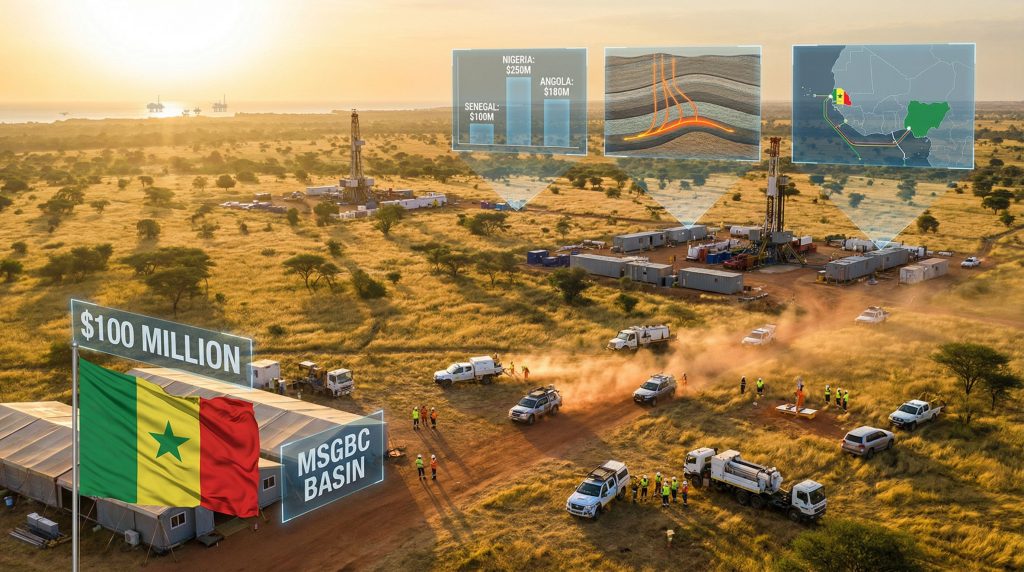
What Drives Petrosen's $100 Million Onshore Investment Strategy?
Contemporary African petroleum sector dynamics reflect evolving national oil company capabilities and strategic ambitions. Petrosen's commitment to independent Senegal onshore oil exploration represents broader regional trends toward resource sovereignty and operational control over domestic hydrocarbon assets.
National Oil Company Evolution in West Africa
The decision to allocate $100 million for independent exploration campaigns reflects institutional maturation within Petrosen following successful offshore project participation. Alioune Gueye, Petrosen's Chief Executive Officer, articulated the logical foundation for this strategic shift, noting that offshore discoveries validate similar onshore potential within the same geological framework.
This perspective aligns with established exploration principles demonstrating that proven petroleum systems in offshore domains typically indicate comparable conditions in adjacent terrestrial formations, particularly within continuous sedimentary basins. Such geological reasoning drives exploration decisions across multiple petroleum provinces globally.
African national oil companies across Nigeria, Equatorial Guinea, and Angola have undertaken parallel capacity-building initiatives to reduce dependency on international oil company-led exploration programs. This regional trend toward NOC operational independence reflects several convergent factors:
- Financial Capacity Growth: Revenue streams from existing production provide exploration funding
- Technical Expertise Development: Knowledge transfer from IOC partnerships builds institutional capabilities
- Strategic Resource Control: Government policies emphasising national resource sovereignty
- Risk Management Diversification: Portfolio expansion beyond single-operator dependencies
Moreover, the evolving landscape of exploration licenses impact across global markets demonstrates the strategic value of maintaining operational control over domestic resources.
Resource Sovereignty and Capacity Building Imperatives
Petrosen's independent exploration campaign directly supports Senegal's stated energy policy objectives of maintaining operational control over domestic hydrocarbon resources. This approach aligns with ECOWAS (Economic Community of West African States) directives encouraging NOC strengthening across member nations.
The temporal scope of Petrosen's campaign targets discovery results by year-end 2026, establishing aggressive exploration timelines that suggest confidence in existing seismic data quality and geological models. Such compressed timelines indicate substantial preliminary technical work supporting investment decisions.
Risk-Reward Analysis of Independent Exploration Campaigns
Senegal's $100 million commitment represents focused investment compared to larger African NOC programs operating across broader geographical areas. This strategic emphasis on targeted exploration versus extensive acreage acquisition reflects several analytical considerations:
Economic Advantages:
- Lower development costs compared to deepwater projects (estimated 40-60% reduction)
- Faster development cycles enabling quicker return on investment
- Reduced infrastructure requirements in terrestrial environments
- Simplified logistics and operational management
Technical Risk Factors:
- Limited recent onshore exploration data requiring new seismic acquisition
- Uncertain reservoir characteristics in unexplored formations
- Potential environmental and social challenges in populated areas
- Infrastructure development requirements in remote locations
How Do Senegal's Onshore Basins Compare to Regional Analogues?
West African onshore exploration presents compelling comparative frameworks across multiple proven petroleum provinces. Understanding these regional analogues provides critical context for evaluating Senegal's exploration potential and investment strategies.
MSGBC Basin Geological Architecture and Hydrocarbon Systems
The MSGBC Basin represents one of West Africa's most geologically complex margin systems, incorporating multiple structural domains and depositional environments. Senegal's onshore exploration targets occur within this broader regional framework, benefiting from extensive geological characterisation conducted for offshore developments.
Basin architecture includes several key structural elements:
- Syn-rift Sequences: Early Cretaceous lacustrine deposits with source rock potential
- Post-rift Thermal Subsidence: Marine transgression creating seal and reservoir intervals
- Neogene Deltaic Systems: Progradational sequences analogous to proven Nigerian systems
- Salt Tectonics: Localised deformation creating structural traps
Cretaceous-Tertiary Source Rock Potential Assessment
Comparative petroleum system analysis across West African onshore basins reveals consistent source rock characteristics spanning Cretaceous-Tertiary intervals. Regional thermal maturity modelling indicates optimal hydrocarbon generation windows across multiple analogous provinces:
| Basin Element | Senegal (Projected) | Nigeria Niger Delta | Angola Kwanza |
|---|---|---|---|
| Primary Source Rocks | Cretaceous lacustrine/marine shales | Tertiary deltaic shales | Cretaceous lacustrine shales |
| Maturity Range | 0.7-1.2 Ro (oil window) | 0.8-1.3 Ro (mature oil) | 1.0-1.4+ Ro (mature to post-mature) |
| Reservoir Types | Cretaceous sandstones; Tertiary fluvial | Tertiary paralic sandstones | Cretaceous-Tertiary sandstones |
| Trap Styles | Anticlines; fault blocks | Rollover anticlines; fault traps | Four-way closures; fault systems |
Comparative Analysis with Nigeria and Angola Onshore Discoveries
Regional exploration investment patterns reveal strategic emphasis on onshore opportunities following successful offshore campaigns. Current NOC investment commitments across West Africa demonstrate coordinated regional development approaches:
| Country | NOC Investment | Target Basins | Expected Timeline |
|---|---|---|---|
| Senegal | $100M | MSGBC/Interior | 12 months |
| Nigeria | $250M | Chad Basin | 18 months |
| Angola | $180M | Kwanza Basin | 24 months |
Nigeria's onshore Niger Delta provides the most relevant analogues for Senegal onshore oil exploration. Multiple fields produce from Tertiary sequences across onshore and shallow offshore provinces, demonstrating economic viability of terrestrial developments. Key success factors include:
- Infrastructure Integration: Existing pipeline and export systems reduce development costs
- Technical Expertise: Established drilling and completion practices optimise field development
- Regulatory Framework: Mature fiscal and operational regulations provide investment certainty
Angola's Kwanza Basin onshore activity demonstrates similar geological principles, with production from Cretaceous-Tertiary sequences proving economic returns despite smaller resource volumes compared to deepwater projects. Lower development costs drive project economics in terrestrial environments.
What Are the Technical Challenges in Senegal's Onshore Exploration?
Senegal onshore oil exploration faces distinctive technical challenges that require specialised approaches and increased operational costs compared to temperate-zone exploration programmes. These challenges span seismic acquisition, drilling operations, and infrastructure development across tropical environments.
Seismic Survey Requirements in Tropical Environments
West African tropical climates present significant constraints for seismic data acquisition campaigns. Senegal's exploration areas experience high seasonal rainfall (up to 1,500mm annually in southern regions) transitioning to semi-arid conditions in northern territories, creating complex operational planning requirements.
Environmental Constraints:
- Seasonal Limitations: Tropical wet seasons (June-October) restrict effective survey periods to 4-6 months annually
- Vegetation Attenuation: Dense bush and savanna vegetation absorb seismic energy, reducing signal quality
- Ground Saturation: High groundwater tables and seasonal flooding degrade geophone coupling effectiveness
- Access Restrictions: Remote interior locations require extensive infrastructure development
These factors necessitate specialised seismic acquisition methodologies including high-fold data collection, advanced processing algorithms, and extended survey timelines. Operational costs typically increase 15-30% compared to temperate exploration environments due to these technical requirements.
Technical Solutions:
- Marine-equivalent processing techniques for improved signal resolution
- Multiple attenuation algorithms addressing vegetation interference
- Enhanced geophone arrays optimising subsurface coupling
- Extended acquisition periods compensating for seasonal restrictions
Drilling Technology Adaptation for Shallow Source Rocks
Onshore exploration targets occur at shallower burial depths (1,000-3,500 metres) compared to offshore deepwater environments, creating distinctive drilling and completion challenges. Cretaceous source rocks at reduced burial depths may exhibit limited thermal maturation, affecting hydrocarbon generation efficiency and reservoir characteristics.
Drilling Complexities:
- Pressure Regimes: Potentially sub-normal formation pressures requiring specialised mud systems
- Water Saturation: Higher water content intervals affecting completion design
- Unconsolidated Overburden: Complex surface sequences requiring modified casing programmes
- Geothermal Gradients: Lower thermal maturation requiring careful reservoir evaluation
Shallow burial environments typically exhibit geothermal gradients of 2.5-3.5°C per 100 metres in stable West African cratonic areas, potentially limiting hydrocarbon thermal maturation compared to deeper offshore analogues. This geological consideration requires comprehensive thermal history modelling to validate exploration targets.
Infrastructure Development Needs for Remote Areas
Senegal's interior exploration basins require substantial infrastructure development including access roads, power supply systems, and logistics networks. These requirements add estimated 20-40% to exploration programme budgets in similar African environments based on World Bank extractive industries infrastructure assessments.
Critical Infrastructure Elements:
- Transportation Networks: All-weather access roads enabling year-round operations
- Power Generation: Independent electrical systems supporting drilling and processing
- Water Supply: Reliable freshwater sources for drilling operations and personnel
- Communications: Satellite connectivity enabling real-time operational management
Community Engagement Requirements:
- Land access negotiations with traditional and government authorities
- Cultural heritage assessments protecting archaeological and sacred sites
- Environmental impact studies addressing biodiversity conservation
- Local employment and procurement programmes supporting community development
The next major ASX story will hit our subscribers first
How Will Success Impact Senegal's Energy Independence Goals?
Successful Senegal onshore oil exploration could fundamentally transform the nation's energy security profile while creating complex strategic decisions regarding domestic consumption versus export revenue optimisation. These outcomes would significantly influence Senegal's broader economic development trajectory and regional energy market positioning.
Domestic Supply Security vs. Export Revenue Optimisation
Current offshore production from Sangomar and Greater Tortue Ahmeyim projects primarily targets international export markets, generating substantial foreign exchange revenues while leaving domestic energy needs largely dependent on imports. Onshore discoveries could alter this strategic calculus by providing more accessible hydrocarbon resources for domestic utilisation.
Potential domestic supply benefits include:
- Refined Product Security: Reduced dependence on imported petrol, diesel, and aviation fuels
- Industrial Feedstock: Reliable petrochemical inputs supporting manufacturing sector development
- Power Generation: Natural gas prices forecast indicates potential for domestic gas utilisation
- Transportation Fuel: Domestic crude oil reducing foreign exchange exposure for fuel imports
However, economic optimisation may favour continued export focus given international price premiums versus subsidised domestic consumption. Government policy decisions will ultimately determine resource allocation between domestic supply security and export revenue generation.
Local Content Development and Skills Transfer Programmes
Petrosen's independent exploration campaign creates opportunities for accelerated local content development and technical skills transfer within Senegal's petroleum sector. This capacity building supports broader economic diversification objectives while reducing dependency on international service providers.
Technical Capacity Building Areas:
- Geological Interpretation: Training programmes developing local subsurface expertise
- Drilling Operations: Skills transfer in drilling engineering and well completion
- Project Management: Leadership development for complex technical projects
- Environmental Management: Local expertise in environmental monitoring and mitigation
Economic Multiplier Effects:
- Local employment generation across technical and support services
- Indigenous company development in specialised petroleum services
- Technology transfer supporting broader industrial capabilities
- Educational partnerships enhancing university petroleum engineering programmes
Integration with Existing Offshore Production Infrastructure
Successful onshore discoveries could benefit from integration with existing offshore production infrastructure, reducing development costs and accelerating time-to-market. The Sangomar project's processing facilities and export systems provide potential tie-in opportunities for onshore production.
Infrastructure Integration Benefits:
- Processing Capacity: Existing separation and treatment facilities reducing capital requirements
- Export Systems: Established pipeline and terminal infrastructure enabling efficient crude oil marketing
- Operational Synergies: Shared maintenance, logistics, and technical support services
- Regulatory Efficiency: Streamlined permitting processes leveraging existing operational frameworks
These integration opportunities could enable onshore developments to achieve economic thresholds at lower resource volumes compared to standalone projects requiring dedicated infrastructure investments.
What Economic Models Support Onshore Exploration Viability?
Economic evaluation of Senegal onshore oil exploration requires comprehensive analysis of development costs, production profiles, fiscal terms, and market access scenarios. These models must account for both technical uncertainties and evolving global market impact affecting long-term project viability.
Break-Even Analysis for Senegalese Onshore Development
Onshore development economics typically demonstrate significant cost advantages compared to deepwater projects, primarily through reduced capital intensity and operational complexity. Preliminary economic modelling suggests Senegalese onshore projects could achieve commercial viability at substantially lower resource thresholds than offshore analogues.
Cost Structure Advantages:
- Development Costs: 40-60% reduction compared to deepwater projects
- Operational Expenses: Lower ongoing production costs due to accessibility
- Infrastructure Requirements: Simplified processing and transportation systems
- Maintenance Efficiency: Land-based operations enabling routine maintenance access
Economic Threshold Estimates:
- Minimum economic field size potentially 10-50 million barrels versus 100+ million barrels for deepwater
- Break-even oil prices estimated $30-45 per barrel versus $50-70 for deepwater developments
- Development timelines 2-3 years versus 4-7 years for offshore projects
- Capital efficiency improvements of 40-60% per barrel of production capacity
Fiscal Framework and Government Revenue Projections
Senegal's petroleum fiscal regime balances government revenue capture with investment incentive preservation, creating frameworks that could support onshore development economics. Government revenue projections assume successful discovery and development scenarios within established fiscal parameters.
Revenue Generation Mechanisms:
- Signature Bonuses: Upfront payments for exploration licence awards
- Royalty Payments: Production-based revenue sharing typically 5-10% of gross production
- Corporate Tax: Standard corporate tax rates applied to petroleum company profits
- Petroleum Revenue Tax: Additional profit-based taxation on successful developments
Projected Economic Impacts:
- Successful onshore discoveries could add 15-25% to national production capacity
- Government revenues potentially increasing by $200-500 million annually depending on discovery size
- Local economic development through employment and procurement opportunities
- Foreign exchange savings through reduced petroleum product imports
International Partnership vs. Solo Development Scenarios
Petrosen's strategic decision regarding international partnerships versus independent development significantly influences project economics and risk distribution. Each approach presents distinctive advantages and challenges requiring careful evaluation.
Independent Development Advantages:
- Revenue Retention: Petrosen maintains 100% economic interest in discoveries
- Operational Control: Full decision-making authority over development strategies
- Capacity Building: Maximum technology transfer and skills development opportunities
- Strategic Flexibility: Ability to align developments with national energy policy objectives
Partnership Development Benefits:
- Risk Sharing: International partners share exploration and development risks
- Technical Expertise: Access to specialised technologies and operational experience
- Financial Capacity: Partner funding reduces Petrosen's capital requirements
- Market Access: International partner marketing networks and trading capabilities
Key Investment Metrics: With offshore projects generating substantial revenues, onshore discoveries could add significant production capacity while reducing development costs substantially compared to deepwater projects, creating attractive economics for both independent and partnership development scenarios.
Which International Players Are Monitoring Senegal's Onshore Progress?
Senegal onshore oil exploration attracts significant international attention from diverse stakeholders including major oil companies, service providers, and financial institutions seeking exposure to emerging West African opportunities. This interest reflects broader industry trends toward lower-risk, faster-cycle developments in established petroleum provinces.
Strategic Partnerships and Joint Venture Opportunities
International oil companies operating in Senegal's offshore developments maintain strategic interest in onshore extensions, particularly given geological continuity between proven offshore systems and unexplored terrestrial areas. Existing relationships provide natural partnership platforms for onshore exploration collaboration.
Potential Partnership Categories:
- Current Offshore Operators: bp and Woodside Energy possess extensive Senegalese geological knowledge applicable to onshore exploration
- Regional African Operators: Companies with established West African onshore expertise seeking portfolio expansion
- Independent Oil Companies: Mid-tier operators specialising in onshore development and production
- National Oil Company Partnerships: Joint ventures with other African NOCs sharing technical expertise
Partnership Structure Options:
- Technical service agreements providing specialised expertise while maintaining Petrosen operational control
- Joint venture partnerships sharing both investment risks and economic returns
- Farm-in arrangements where international partners earn working interests through exploration funding
- Comprehensive development partnerships encompassing exploration through production phases
Technology Transfer Requirements and Capabilities Assessment
Successful onshore exploration requires specialised technologies and expertise that international partnerships can provide while supporting Petrosen's capacity-building objectives. Technology transfer represents critical value creation beyond traditional risk and capital sharing arrangements.
Critical Technology Areas:
- Seismic Processing: Advanced algorithms for tropical environment data quality enhancement
- Basin Modelling: Sophisticated petroleum systems modelling for resource assessment
- Drilling Technology: Specialised techniques for shallow source rock environments
- Production Optimisation: Enhanced recovery technologies maximising field development economics
Capacity Building Requirements:
- Training programmes for Senegalese technical personnel in advanced petroleum technologies
- Local facility development for geological and engineering analysis capabilities
- Educational partnerships with international universities and technical institutions
- Knowledge management systems ensuring technology transfer permanence within Petrosen
Regional Competition for West African Onshore Acreage
Senegal's onshore exploration occurs within broader regional competition for West African terrestrial opportunities, as multiple countries pursue similar strategies following offshore development success. This competition influences partnership negotiations and investment terms across the region.
Competitive Regional Landscape:
- Nigeria: Chad Basin exploration attracting significant international investment
- Angola: Kwanza Basin onshore development competing for technical resources and capital
- Ghana: Tano Basin onshore exploration building on offshore Jubilee field success
- Côte d'Ivoire: Tano Basin development leveraging offshore discoveries for onshore opportunities
International Company Strategy Factors:
- Portfolio diversification across multiple West African opportunities
- Risk management through geographic and geological spread
- Operational efficiency gains from regional technical expertise concentration
- Market positioning for future acreage awards and partnership opportunities
What Timeline and Milestones Define Success for This Campaign?
Petrosen's onshore exploration campaign follows structured phases designed to systematically evaluate geological potential while managing technical and financial risks. These phases incorporate industry best practices while accommodating Senegal-specific operational constraints and strategic objectives.
Phase 1: Seismic Acquisition and Basin Modelling (Q1-Q2 2026)
Initial exploration activities focus on comprehensive geological characterisation through modern seismic data acquisition and advanced basin modelling techniques. This phase establishes fundamental technical foundations supporting subsequent drilling decisions.
Seismic Programme Objectives:
- High-resolution 3D seismic data acquisition across priority target areas
- Integration with existing regional seismic datasets from offshore exploration programmes
- Advanced processing addressing tropical environment signal quality challenges
- Structural interpretation identifying potential drilling locations and trap geometries
Basin Modelling Activities:
- Comprehensive petroleum systems modelling incorporating regional geological understanding
- Thermal maturity assessment validating source rock generation capacity
- Migration pathway analysis identifying potential accumulation sites
- Resource volumetric calculations supporting economic evaluation frameworks
Phase 1 Success Metrics:
- Completion of minimum 500-1,000 square kilometres 3D seismic coverage
- Identification of 5-10 high-priority drilling prospects with defined risk assessments
- Basin modelling confirmation of active petroleum systems in target areas
- Regulatory approval for exploration drilling permit applications
Phase 2: Exploratory Drilling Programme (Q3-Q4 2026)
Drilling operations represent the critical value inflection point for Senegal onshore oil exploration, testing geological models and providing definitive assessment of hydrocarbon potential. Drilling programme design balances technical risk management with cost optimisation objectives.
Drilling Strategy Elements:
- Prospect Selection: Target prioritisation based on seismic interpretation confidence and resource potential
- Well Design: Optimised drilling programmes addressing shallow source rock challenges
- Technology Deployment: Advanced logging and testing techniques maximising geological information recovery
- Environmental Management: Comprehensive environmental monitoring and community engagement protocols
Operational Considerations:
- Seasonal Timing: Drilling schedules coordinated with tropical weather patterns
- Infrastructure Development: Access road construction and logistics base establishment
- Local Content: Senegalese personnel and service provider integration maximising economic benefits
- Safety Protocols: International safety standards implementation protecting personnel and environments
Phase 2 Success Indicators:
- Commercial hydrocarbon shows in minimum one exploratory well
- Reservoir quality confirmation through comprehensive formation testing
- Resource estimation supporting economic development scenarios
- Environmental compliance maintaining community and regulatory acceptance
Phase 3: Resource Assessment and Development Planning (2027)
Successful exploration results trigger comprehensive resource assessment and development planning activities, transitioning from exploration risk evaluation to commercial development optimisation. This phase determines long-term project viability and strategic positioning.
Resource Assessment Components:
- Reserve Certification: Independent third-party resource assessments meeting international standards
- Development Optimisation: Engineering studies determining optimal production profiles and recovery factors
- Economic Modelling: Comprehensive financial analysis incorporating fiscal terms and market scenarios
- Environmental Assessment: Detailed environmental and social impact studies supporting development approvals
Development Planning Activities:
- Production Facility Design: Processing and treatment systems optimised for reservoir characteristics
- Infrastructure Planning: Pipeline, roads, and utilities development supporting field operations
- Regulatory Strategy: Comprehensive permitting and approval processes for commercial development
- Partnership Evaluation: Strategic assessment of development partnership opportunities versus independent development
Strategic Decision Points:
- Commercial development authorisation based on economic viability assessments
- Partnership structure finalisation balancing risk sharing with strategic control objectives
- Development timeline establishment coordinating with broader national energy policy goals
- Integration planning with existing offshore production and export infrastructure
How Does This Strategy Align with Global Energy Transition Trends?
Senegal onshore oil exploration occurs within evolving global energy transition dynamics that influence long-term strategic positioning and investment frameworks. Understanding these transitions provides critical context for evaluating project sustainability and strategic value creation.
Lower Carbon Footprint of Onshore vs. Offshore Operations
Terrestrial petroleum development typically demonstrates significantly lower carbon intensity compared to offshore operations, primarily through reduced energy requirements for extraction, processing, and transportation. These environmental advantages align with international climate policy frameworks while maintaining economic competitiveness.
Carbon Intensity Advantages:
- Reduced Transportation: Shorter distances between production sites and processing facilities
- Simplified Operations: Lower energy requirements for drilling, production, and maintenance activities
- Infrastructure Efficiency: Land-based operations requiring less energy-intensive support systems
- Monitoring Capabilities: Enhanced ability to implement carbon capture and monitoring technologies
Environmental Benefits:
- Estimated 20-40% lower carbon emissions per barrel compared to deepwater developments
- Reduced methane venting through improved gas handling and processing systems
- Enhanced environmental monitoring capabilities in terrestrial settings
- Opportunities for renewable energy integration in production operations
Shorter Development Cycles and Reduced Capital Intensity
Onshore development timelines typically span 2-3 years from discovery to production versus 4-7 years for offshore projects, creating advantages for both economic returns and environmental impact management. These shorter cycles align with energy transition planning horizons while generating faster returns on investment.
Development Cycle Benefits:
- Faster Time-to-Market: Reduced project development complexity enabling quicker production startup
- Capital Efficiency: Lower per-barrel capital requirements improving project economics
- Risk Management: Shorter exposure periods reducing technical and market risks
- Flexibility: Enhanced ability to modify development plans responding to changing market conditions
Bridge Energy Role in Senegal's Renewable Transition
Successful onshore petroleum development provides strategic bridge energy supporting Senegal's renewable energy transition while generating revenues for sustainable development investments. This positioning balances immediate economic needs with long-term sustainability objectives.
Transition Strategy Elements:
- Revenue Generation: Petroleum revenues funding renewable energy infrastructure investments
- Energy Security: Domestic hydrocarbon production reducing import dependency during renewable transition
- Technical Expertise: Petroleum sector capabilities transferring to renewable energy project development
- Infrastructure Utilisation: Existing energy infrastructure supporting hybrid renewable-conventional systems
Long-term Strategic Positioning:
- Petroleum revenues supporting solar and wind energy development programmes
- Natural gas resources enabling renewable energy grid stabilisation and backup power
- Technical workforce transition from petroleum to renewable energy sectors
- Infrastructure leverage for electric vehicle charging networks and energy storage systems
Positioning Senegal for Diversified Hydrocarbon Production
Senegal onshore oil exploration represents strategic portfolio diversification that could fundamentally enhance the nation's petroleum sector resilience while supporting broader economic development objectives. Success in these endeavours positions Senegal among West Africa's most diversified hydrocarbon producers with balanced offshore-onshore production profiles.
Long-term Strategic Implications for West African Energy Markets
Regional energy market dynamics increasingly favour countries with diversified production portfolios offering multiple development pathways and risk mitigation strategies. Senegal's potential onshore discoveries complement existing offshore production creating strategic advantages in regional energy market positioning.
Diversified production capabilities provide several strategic benefits:
- Market Flexibility: Multiple production sources enabling optimised market timing and pricing strategies
- Operational Resilience: Reduced dependency on single production domains improving supply security
- Investment Attraction: Diversified resource base appealing to broader investor categories and risk profiles
- Regional Leadership: Enhanced positioning within ECOWAS energy cooperation frameworks and regional energy trade
Risk Mitigation Through Portfolio Diversification
Portfolio diversification across offshore and onshore production domains creates substantial risk mitigation benefits addressing technical, economic, and geopolitical uncertainties affecting single-domain strategies. This diversification enhances overall sector stability while supporting sustainable economic growth.
Risk Mitigation Benefits:
- Technical Risk Distribution: Multiple geological domains reducing concentration risk in single petroleum systems
- Market Risk Management: Different development cost structures providing varied economic thresholds and market positioning
- Operational Risk Reduction: Diversified operations reducing impact of domain-specific technical challenges
- Political Risk Mitigation: Balanced domestic and international market exposure supporting strategic flexibility
Building Foundation for Sustained Economic Growth
Successful onshore exploration establishes foundations for sustained economic growth extending beyond immediate petroleum revenues through capacity building, infrastructure development, and technological advancement. These benefits create lasting economic transformation supporting long-term national development objectives.
The economic multiplier effects of successful onshore development include substantial local employment generation across technical and support services, indigenous company development in specialised petroleum services, technology transfer supporting broader industrial capabilities, and educational partnerships enhancing national technical education programmes.
Strategic positioning through diversified hydrocarbon production creates sustainable competitive advantages within evolving global energy markets while supporting Senegal's transition toward more sophisticated energy sector management and broader economic diversification beyond natural resource extraction. Additionally, Petrosen's strategic approach demonstrates the nation's commitment to building long-term hydrocarbon sector capacity.
Furthermore, successful implementation of Senegal onshore oil exploration initiatives positions the country as a regional leader in petroleum sector development, while providing essential bridge energy resources supporting the nation's renewable energy transition goals and broader economic transformation objectives.
Disclaimer: This analysis contains forward-looking statements and projections based on current available information. Actual exploration results, economic outcomes, and strategic developments may differ significantly from projections presented. Petroleum exploration involves substantial technical and financial risks, and success is not guaranteed regardless of geological analysis or strategic planning. Investment decisions should incorporate comprehensive risk assessment and professional financial advice.
Ready to Capitalise on Africa's Emerging Petroleum Opportunities?
Senegal's onshore exploration strategy showcases the type of strategic energy developments that can significantly impact market valuations, particularly for ASX-listed companies with West African exposure. Discovery Alert's proprietary Discovery IQ model delivers real-time alerts on significant mineral and energy discoveries across global markets, instantly empowering subscribers to identify actionable opportunities ahead of the broader market through sophisticated analysis of exploration announcements and strategic developments. Begin your 14-day free trial today to gain a market-leading edge in identifying the next major discovery opportunity.