
June 13, 2026
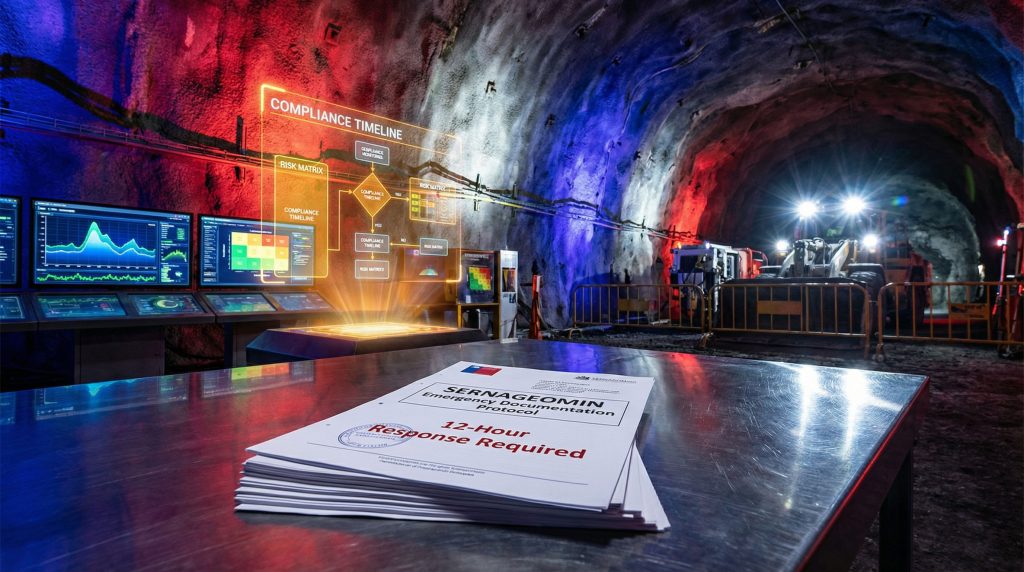
Sernageomin exige documentación a Codelco represents a significant regulatory escalation that highlights evolving safety oversight in Chile's mining sector. The intersection of geological hazards in deep underground operations and regulatory accountability creates unprecedented challenges that extend far beyond traditional incident management frameworks.
Rock burst phenomena in deep copper mining operations represent one of the most unpredictable safety threats in modern extractive industries, requiring sophisticated monitoring systems and transparent reporting mechanisms to protect worker safety and operational continuity. The mining industry evolution in Chile demonstrates how technological advancement intersects with regulatory oversight to create complex governance environments.
Emergency Regulatory Powers in Critical Mining Safety Situations
Understanding Sernageomin's Enforcement Authority Framework
Chile's mining regulatory architecture grants the Servicio Nacional de Geología y Minería (Sernageomin) substantial emergency powers when safety protocols are compromised. The regulatory framework operates through clearly defined escalation mechanisms that enable rapid intervention in critical situations.
Emergency Response Protocols:
- 12-hour compliance deadlines for initial extraordinary safety measure submissions
- 5-day reporting cycles for ongoing transparency maintenance
- Ex officio authority permitting regulatory action without external complaints
- Comprehensive documentation demands including technical and administrative records
The regulatory framework emphasises that mining safety is strengthened through veracity and transparency in periodic information delivered by companies. This principle establishes that technical collaboration based on reliable data is fundamental to operational excellence and worker protection. Furthermore, this reflects a shift toward proactive regulatory engagement rather than reactive incident response.
Sernageomin's authority to act ex officio represents a significant regulatory tool, enabling immediate intervention when ordinary compliance channels fail to surface material inconsistencies. However, this enforcement mechanism bypasses standard procedural requirements, allowing regulators to demand immediate documentation and safety measures when critical information gaps are discovered.
The Mechanics of Crisis-Level Regulatory Intervention
Emergency regulatory intervention typically involves multiple layers of documentation requirements and compliance verification. The process begins with immediate extraordinary safety measures, followed by comprehensive technical reporting that addresses both historical incidents and forward-looking risk management protocols.
Key Intervention Components:
- International consulting report requirements for independent verification
- Internal audit results with specific inconsistency documentation
- Technical reporting of each deviation detected in safety protocols
- Impact assessment on active risk management models
The regulatory emphasis on comprehensive documentation reflects recognition that incidents often involve both technical failure and information control failures. Consequently, this dual-focus approach ensures that regulatory responses address not only immediate safety concerns but also the systemic information integrity issues that may contribute to ongoing operational risks.
When big ASX news breaks, our subscribers know first
Information Integrity Challenges in Deep Mining Operations
The Critical Role of Complete Data in Underground Safety Systems
Deep mining operations depend on continuous geological monitoring data to maintain worker safety and operational stability. Information asymmetries between actual underground conditions and documented safety assessments create substantial risks that extend beyond individual incidents to systemic operational vulnerabilities.
Underground copper mining at significant depths requires real-time stress assessment, seismic activity tracking, and continuous evaluation of worker positioning relative to high-stress geological zones. Risk models in these environments depend on accurate historical data-driven operations for pattern recognition and risk assessment.
Critical Data Dependencies:
- Geological stress monitoring for rock burst prediction
- Historical seismic data for pattern recognition and risk assessment
- Worker positioning systems coordinated with geological stress indicators
- Continuous monitoring data integrity for predictive safety model accuracy
The El Teniente case demonstrates how documentation gaps can remain undetected for extended periods. Inconsistencies surfaced only through internal review processes or whistleblower mechanisms. The 31-month span between the July 2023 rock burst incident and February 2026 regulatory enforcement action highlights the challenge of maintaining real-time data integrity verification in complex underground operations.
Risk Model Dependencies and Documentation Standards
Modern mining safety protocols rely heavily on predictive risk models that integrate geological, operational, and historical data to assess ongoing safety conditions. These models require complete and accurate data inputs to maintain their predictive capability and effectiveness in protecting worker safety.
Regulatory requirements now specify that companies must document what data were omitted or altered. In addition, they must explain how those omissions impact the active risk model of the operation. This technical precision requirement reflects regulatory recognition that incomplete information directly undermines predictive safety systems in high-stress underground environments.
"The regulatory requirement for detailed risk model impact analysis indicates that documentation failures challenge traditional safety protocols by exposing gaps between actual geological conditions and documented risk assessments."
The integration of risk model recalibration into regulatory compliance represents an evolution in mining safety governance. This moves beyond incident-specific reporting toward comprehensive system integrity verification that addresses both historical accuracy and prospective safety implications.
Corporate Governance Responses in State Enterprise Mining
Executive Accountability in Public Mining Operations
State-owned mining enterprises face unique governance challenges when safety reporting failures are discovered. The intersection of corporate accountability, public ownership, and regulatory compliance creates complex decision-making environments that require careful balance between operational continuity and governance integrity.
The removal of three senior executives following internal audit findings represents a governance acknowledgment that reporting failures warrant operational leadership changes. This response demonstrates board-level recognition that safety information integrity requires executive accountability beyond technical compliance measures.
Governance Response Framework:
- Board extraordinary sessions for crisis-level decision making
- Internal audit mechanisms with independent verification requirements
- International consultant engagement for credibility enhancement
- Public disclosure protocols for transparency maintenance
The requirement for international consultant involvement in internal investigations suggests recognition that internal credibility may be compromised when reporting failures are discovered. For instance, this third-party validation approach enhances the credibility of governance responses while providing independent verification of audit findings.
Institutional Trust Rebuilding in Public Mining Operations
Governance crisis management in state enterprises requires careful attention to public accountability and institutional credibility. The distinction between different incidents and their associated governance responses becomes critical for maintaining stakeholder confidence and regulatory compliance.
CODELCO's clarification that executive removals relate to 2023 reporting failures rather than separate 2025 accidents demonstrates institutional effort to maintain governance transparency boundaries. This compartmentalisation approach helps distinguish between operational safety incidents and information integrity failures, enabling targeted governance responses.
The public disclosure process, including detailed explanations of governance decisions and their rationale, represents an attempt to maintain institutional transparency during crisis periods. However, this approach balances accountability requirements with operational continuity needs in state enterprise management.
Technical Challenges of Rock Burst Management in Deep Mining
Underground Geological Stress Phenomena and Safety Protocols
Rock burst events represent sudden stress relief phenomena that occur when stored energy in rock mass at depth is released violently. These events are particularly challenging in deep copper mining operations where high-stress geological environments create continuous safety monitoring requirements.
Rock Burst Characteristics:
- Sudden energy release in high-stress underground environments
- Unpredictable timing despite continuous monitoring efforts
- Significant worker safety implications requiring immediate response protocols
- Complex geological stress patterns challenging traditional prediction methods
The El Teniente Division's operational depth and copper extraction methods create inherently high-stress underground environments that are vulnerable to rock burst events. The July 24, 2023 incident represents a typical example of these challenging geological conditions that require sophisticated monitoring and rapid response capabilities.
Traditional safety protocols face significant challenges in addressing rock burst phenomena because these events can occur despite extensive monitoring and safety measures. The unpredictable nature of sudden stress relief in deep underground operations requires adaptive safety systems that can respond to rapidly changing geological conditions.
Advanced Monitoring and Prediction Challenges
Current technological approaches to rock burst prediction involve continuous seismic monitoring, stress assessment, and geological stability evaluation. However, the complex interaction of geological forces in deep mining environments limits the accuracy of predictive systems, requiring comprehensive safety protocols that address both predicted and unpredicted events.
Monitoring System Components:
- Real-time seismic activity tracking for stress pattern recognition
- Geological stress redistribution monitoring for pressure point identification
- Worker safety protocol coordination with geological stress indicators
- Predictive model calibration based on historical and real-time data
The regulatory requirement for comprehensive technical reporting of how data omissions affected predictive capability reflects recognition that rock burst management depends on complete data integrity. Missing or altered information can significantly compromise the effectiveness of monitoring systems and safety protocols.
Post-incident investigation standards now mandate comprehensive analysis of both the geological event itself and the information systems used to predict and respond to such events. Consequently, this dual-focus approach ensures that safety improvements address both technical monitoring capabilities and data integrity requirements.
Evolution of Chilean Mining Regulatory Standards
Proactive Enforcement Mechanisms and Transparency Requirements
Chile's mining regulatory framework has evolved toward more proactive enforcement mechanisms that emphasise information integrity and transparency as foundational elements of safety governance. This evolution reflects recognition that regulatory effectiveness depends on data accuracy as a primary requirement rather than an incidental compliance element.
Regulatory Framework Evolution:
- Ex officio enforcement authority for proactive regulatory intervention
- Rapid response timelines (12-hour compliance deadlines)
- Continuous transparency mechanisms (5-day reporting cycles)
- Comprehensive documentation requirements including risk model impact assessment
The emphasis on veracity and transparency in periodic information delivery represents a shift from episodic compliance reporting toward continuous accountability mechanisms. Furthermore, this approach aligns Chilean mining governance with international best practices while addressing specific challenges in the domestic mining environment.
Sernageomin's investigation demonstrates willingness to target state-owned enterprises with the same enforcement rigour as private operators. This approach indicates non-discriminatory regulatory evolution that enhances regulatory credibility while ensuring that public ownership does not create compliance exemptions or reduced accountability standards.
Integration of Technical Standards with Regulatory Compliance
Modern Chilean mining regulation integrates sophisticated technical requirements with traditional compliance mechanisms, creating comprehensive oversight frameworks that address both operational safety and information integrity. The AI in mining technology sector continues to evolve alongside regulatory requirements.
The requirement for risk model impact specification represents technical validation integrated into regulatory enforcement. This moves beyond simple incident reporting toward comprehensive system integrity verification. This technical sophistication in regulatory requirements reflects the complexity of modern mining operations and the need for correspondingly sophisticated oversight mechanisms.
Enhanced Regulatory Standards:
- Technical precision requirements for data impact assessment
- Predictive system validation as compliance requirement
- Independent verification mechanisms for internal audit credibility
- Continuous monitoring integration with regulatory oversight
The public declaration format used by Sernageomin, which specifies regulatory rationale and detailed requirements, represents transparent enforcement communication. This enhances accountability while providing clear guidance for industry compliance expectations.
Investment Risk Assessment in Chilean Mining Regulatory Environment
Due Diligence Considerations for Mining Asset Evaluation
The Chilean mining regulatory environment presents specific risk factors that require careful evaluation in investment risk assessment decision-making processes. The intersection of technical complexity, regulatory oversight, and governance accountability creates multiple dimensions of risk that extend beyond traditional operational and financial considerations.
Key Investment Risk Indicators:
- Executive turnover patterns as governance stability indicators
- Regulatory compliance track records in safety and information integrity
- Internal audit mechanisms and their effectiveness in identifying issues
- Transparency standards in safety reporting and incident management
The CODELCO case demonstrates how information integrity failures can lead to significant governance disruption, including executive removals and enhanced regulatory scrutiny. Investors must evaluate the robustness of corporate governance systems and their ability to maintain regulatory compliance under challenging operational conditions.
Mining investments in Chile require particular attention to companies' data integrity systems and safety reporting mechanisms. The regulatory emphasis on complete and accurate information delivery means that companies with weak information systems face elevated regulatory risk regardless of their operational safety performance.
Long-term Sector Implications and Market Confidence
Enhanced regulatory scrutiny in Chilean mining creates both challenges and opportunities for sector participants. While increased compliance requirements may raise operational costs, they also create competitive advantages for companies with robust governance and information systems.
Market Impact Factors:
- Compliance infrastructure investment requirements affecting operational costs
- Enhanced due diligence standards for investment evaluation
- Governance quality differentiation among sector participants
- Regulatory credibility enhancement supporting long-term sector stability
The evolution toward more sophisticated regulatory oversight may initially create adjustment costs for industry participants. However, it ultimately supports sector credibility and international competitiveness. Companies that proactively invest in compliance infrastructure and transparency mechanisms are likely to benefit from enhanced regulatory clarity and reduced uncertainty.
Investors should evaluate companies' readiness for continued regulatory evolution. This includes their capacity to meet enhanced documentation requirements and maintain real-time compliance with evolving safety and transparency standards.
The next major ASX story will hit our subscribers first
Frequently Asked Questions About Mining Regulatory Enforcement
What happens when mining companies fail to meet emergency documentation deadlines?
Failure to meet Sernageomin exige documentación a Codelco emergency deadlines can result in escalated enforcement actions, including potential operational shutdowns and legal consequences for non-compliance. The regulatory framework provides clear escalation procedures that move from documentation demands to operational restrictions based on compliance response adequacy.
Companies facing emergency documentation requirements must prioritise complete and accurate submission within specified timeframes. Partial compliance or missed deadlines can trigger more severe regulatory interventions that may significantly impact operational continuity.
How do internal audits differ from regulatory investigations?
Internal audits represent corporate self-assessment mechanisms designed to identify compliance gaps and operational improvements. Regulatory investigations involve external oversight with enforcement authority. However, the effectiveness of internal audits in identifying and addressing issues can significantly influence regulatory responses and compliance outcomes.
Key Distinctions:
- Authority scope: Internal audits are voluntary corporate processes; regulatory investigations have enforcement power
- Disclosure requirements: Internal audit findings may trigger mandatory regulatory disclosure depending on their significance
- Independence: Regulatory investigations provide independent verification that internal audits cannot match
The integration of internal audit findings with regulatory compliance frameworks creates opportunities for proactive governance. This ensures that corporate self-assessment mechanisms support rather than substitute for external regulatory oversight.
Building Resilient Mining Safety Governance Frameworks
Preventive Measures and Technological Integration
Future mining safety governance requires integration of advanced monitoring technologies with robust information management systems that ensure real-time data integrity and transparent reporting mechanisms. This technological foundation must support both operational safety and regulatory compliance requirements.
Essential Components:
- Proactive reporting systems with real-time data integration
- Executive accountability frameworks linking governance to operational performance
- Continuous monitoring technology integrated with predictive safety systems
- Transparent communication mechanisms for stakeholder engagement
The development of resilient safety governance requires investment in both technological capabilities and organisational systems that can maintain information integrity under challenging operational conditions. Companies must balance operational efficiency with comprehensive documentation requirements that support regulatory compliance and safety management.
Stakeholder Engagement and Accountability Mechanisms
Effective mining safety governance requires active engagement from multiple stakeholders, including workers, communities, investors, and regulatory bodies. This engagement creates accountability mechanisms that support both safety performance and governance transparency.
Stakeholder Integration:
- Worker participation in safety oversight and reporting mechanisms
- Community involvement in environmental and safety monitoring
- Investor expectations for transparency and governance standards
- Regulatory collaboration in developing and implementing safety standards
The evolution of Chilean mining regulatory standards demonstrates the importance of collaborative approaches that balance regulatory authority with industry expertise and stakeholder engagement. This collaborative framework supports continuous improvement in safety governance while maintaining operational flexibility and competitive positioning.
Future mining safety governance must anticipate continued regulatory evolution and technological advancement. These mining leadership trends require adaptive systems that can integrate new requirements and capabilities while maintaining focus on fundamental safety and transparency principles.
The Sernageomin exige documentación a Codelco case represents a watershed moment in Chilean mining governance, establishing new benchmarks for regulatory oversight and corporate accountability. This precedent indicates that regulatory standards will continue evolving toward greater transparency, technical sophistication, and proactive enforcement mechanisms that prioritise worker safety and operational integrity.
Ready to Invest in the Next Major Mining Discovery?
Discovery Alert's proprietary Discovery IQ model delivers real-time alerts on significant ASX mineral discoveries, instantly empowering subscribers to identify actionable opportunities ahead of the broader market. Understand why major mineral discoveries can lead to significant market returns by exploring Discovery Alert's dedicated discoveries page, showcasing historic examples of exceptional outcomes, and begin your 14-day free trial today to position yourself ahead of the market.