June 11, 2026
What Makes Serra Verde's Contract Termination a Critical Supply Chain Inflection Point?
The global rare earth industry stands at a defining crossroads as traditional supply chain dependencies face unprecedented restructuring. For decades, the concentration of heavy rare earth processing capabilities in China has created strategic vulnerabilities that Western economies are only now beginning to address. The emergence of alternative supply pathways represents more than market diversification—it signals the potential transformation of geopolitical leverage in critical technology sectors. Furthermore, the mining industry evolution reflects broader shifts towards strategic resource independence across Western markets.
The Strategic Value of Ionic Clay Heavy Rare Earth Deposits
Ionic clay deposits represent a geological anomaly that has fundamentally shaped the rare earth industry's geography. Unlike conventional hard rock deposits containing monazite or xenotime minerals, ionic clay formations allow rare earth elements to be absorbed directly into clay mineral structures through weathering processes. This unique characteristic enables extraction through simple aqueous leaching techniques, dramatically reducing processing complexity and capital requirements compared to traditional mining methods.
Key characteristics of ionic clay advantages:
• Lower energy requirements for extraction processes
• Reduced chemical reagent consumption during leaching
• Higher recovery rates for heavy rare earth elements
• Simplified waste stream management protocols
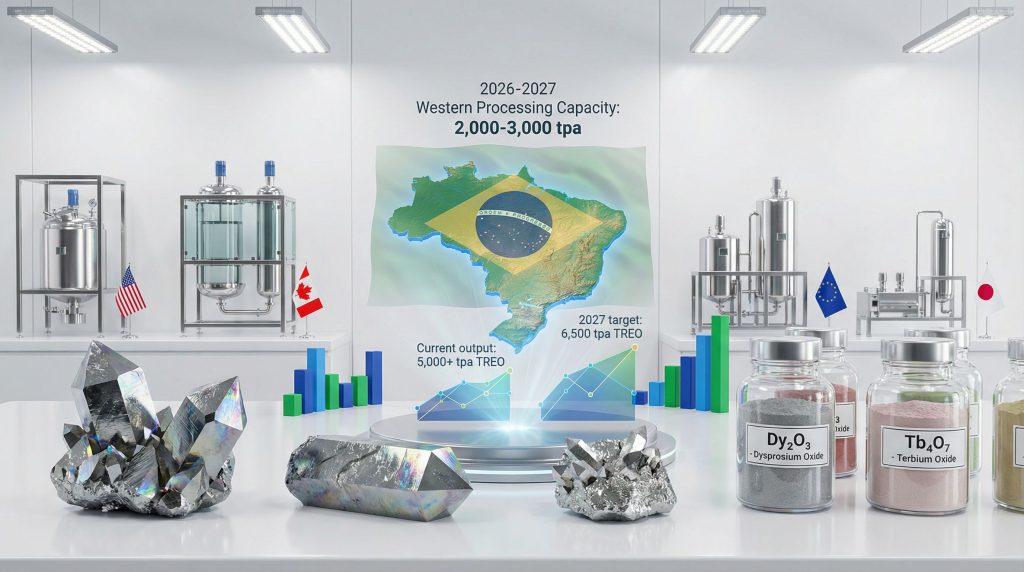
Serra Verde's Brazilian deposit stands as one of the world's few commercially viable ionic clay formations outside China and Myanmar. With current production exceeding 5,000 tonnes per annum (tpa) TREO and expansion plans targeting 6,500 tpa by 2027, the facility represents a rare combination of geological fortune and strategic positioning.
The deposit's heavy rare earth concentration profile includes 8-12% dysprosium content and 2-4% terbium content—percentages that place it among the world's richest heavy REE sources. These elements command premium pricing due to their scarcity and critical applications in permanent magnet manufacturing.
Why Chinese Offtake Agreements Were Initially Unavoidable
The original Chinese offtake agreements signed by Serra Verde reflected stark market realities rather than strategic preference. When the Brazilian company initiated production planning, Western heavy rare earth separation capacity was effectively non-existent at commercial scale. Chinese processors possessed the only proven technological capabilities and infrastructure to handle ionic clay concentrate at the volumes Serra Verde projected.
Historical market constraints that drove Chinese partnerships:
• Technology monopoly: Chinese firms held proprietary separation processes refined over decades
• Infrastructure gaps: No Western facility could process 5,000+ tpa of heavy REE concentrate
• Financial guarantees: Chinese buyers offered upfront payment mechanisms unavailable from Western counterparts
• Market access: Chinese domestic demand provided guaranteed offtake volumes
The decade-long contract structure provided Serra Verde with essential production financing while Chinese processors secured feedstock for their expanding magnet manufacturing operations. This arrangement represented rational economic decision-making within existing supply chain constraints.
Geopolitical Timing Behind the 2026 Contract Termination
Serra Verde's decision to terminate Chinese contracts in 2026 reflects calculated strategic positioning rather than operational necessity. The timing coincides with anticipated commissioning of Western heavy rare earth separation facilities across multiple regions. This synchronisation creates the first legitimate opportunity for Western supply chain integration in the heavy REE sector.
The $465 million DFC loan approval validates both the deposit's geological merits and its strategic importance to U.S. supply chain security objectives. DFC financing typically requires rigorous technical and commercial due diligence, suggesting confidence in Serra Verde's production capabilities and market positioning.
According to CEO Thras Moraitis, as reported by Mining.com, Western separation plants for heavy rare earth elements are expected to become operational within the next few years, creating the first legitimate non-Chinese supply pathway for critical magnet materials used in defence applications, electric vehicles, and wind turbine manufacturing. Moreover, this development aligns with broader North American mining trends towards strategic mineral security.
When big ASX news breaks, our subscribers know first
How Will Western Separation Infrastructure Change the Heavy REE Landscape?
The development of Western heavy rare earth separation capacity represents one of the most ambitious industrial undertakings in the critical minerals sector. After decades of Chinese technological dominance, multiple Western regions are simultaneously pursuing heavy REE processing capabilities with government backing and private investment.
Current State of Non-Chinese Processing Capacity
Western heavy rare earth separation capacity currently operates at negligible commercial scale. Mountain Pass (MP Materials) processes light rare earths exclusively, while other Western facilities focus on preliminary concentration rather than final separation into individual oxides. This structural gap has forced Western magnet manufacturers into Chinese dependency for dysprosium and terbium feedstock.
The technology barriers extend beyond capital requirements. Heavy rare earth separation demands:
• Sophisticated solvent extraction systems using organic reagents like di(2-ethylhexyl)orthophosphoric acid
• Intensive waste stream management to handle contaminated liquids and solids
• Specialised technical workforce trained in rare earth chemistry
• Regulatory compliance with environmental standards more stringent than Chinese facilities
Timeline Analysis for Western Heavy REE Facilities
| Region | Projected Operational Date | Processing Capacity (tpa) | Target Elements |
|---|---|---|---|
| United States | 2026-2027 | 2,000-3,000 | Dy, Tb, Ho |
| Canada | 2027-2028 | 1,500-2,500 | Dy, Tb |
| European Union | 2027-2029 | 1,000-2,000 | Full HREE spectrum |
| Japan | 2026-2027 | 800-1,200 | Dy, Tb for domestic use |
These projections assume successful completion of current development programs and absence of major regulatory delays. Historical precedent in the rare earth sector suggests timeline extensions of 12-24 months beyond initial guidance are common due to technical complexities and permitting challenges.
Critical risk factors affecting Western facility timelines:
• Environmental permitting processes extending 18-36 months beyond initial applications
• Equipment delivery delays due to specialised component scarcity
• Technology transfer negotiations with IP holders (primarily Asian firms)
• Workforce development requirements for technical operations
• Financing contingencies tied to commodity price volatility
Investment Requirements and Risk Factors for Western Processing
Western heavy rare earth separation facilities require capital investments of $800 million to $1.2 billion per plant at commercially viable scale. These figures reflect the technological complexity and environmental compliance costs inherent in Western regulatory frameworks.
Capital allocation breakdown for typical Western HREE facility:
• Process equipment and installation: 40-45% of total capex
• Environmental systems and waste management: 20-25% of total capex
• Site preparation and infrastructure: 15-20% of total capex
• Engineering and contingency: 15-20% of total capex
Operating expenditure challenges include reagent costs, waste disposal fees, and skilled labour premiums. Western facilities typically face operating costs 30-50% higher than Chinese equivalents due to regulatory compliance and labour cost differentials.
Investment Risk Assessment: Western heavy REE separation projects carry elevated technology risk due to limited operational precedents outside China. First-mover facilities face higher probabilities of commissioning delays and cost overruns, while later projects benefit from proven operational models and workforce development.
What Are the Market Dynamics Behind Serra Verde's Negotiating Position?
Serra Verde shortens Chinese offtakes represents exceptional negotiating leverage derived from scarcity and timing convergence. As one of the world's few scalable ionic clay heavy rare earth deposits outside China and Myanmar, the company occupies a unique position in global supply chain restructuring efforts.
Production Capacity and Revenue Projections Through 2030
Serra Verde's production expansion trajectory positions the facility as a significant player in the non-Chinese heavy REE market. Current output exceeds 5,000 tpa TREO, with optimisation efforts targeting 6,500 tpa by 2027. This volume represents approximately 7-10% of non-Chinese heavy REE supply globally.
Production metrics and financial implications:
| Metric | Current (2025) | 2027 Target |
|---|---|---|
| TREO Production (tpa) | 5,000+ | 6,500 |
| Dysprosium Output (tpa) | 400-600 | 520-780 |
| Terbium Output (tpa) | 100-200 | 130-260 |
| Estimated Annual Revenue | $250-400M | $350-650M |
Revenue projections assume dysprosium oxide pricing of $500-800/kg and terbium oxide at $1,200-2,000/kg, reflecting current market volatility and strategic premium pricing for non-Chinese sources.
Competitive Landscape Analysis for Non-Chinese Heavy REE Sources
Serra Verde operates within an extremely concentrated competitive landscape. Myanmar's state-controlled operations represent the only other significant ionic clay heavy REE source outside China, but geopolitical instability limits Western buyer access. Australian hard rock projects remain in development stages with uncertain production timelines.
Competitive positioning advantages:
• Political stability: Brazil's democratic government provides regulatory certainty
• Infrastructure access: Established mining and transportation networks
• DFC backing: U.S. government financing validates strategic importance
• Technical validation: Proven production capabilities reduce execution risk
Market interest validation emerges from buyer diversity. Chinese, U.S., Japanese, European, and Canadian purchasers are approaching Serra Verde, demonstrating acute demand from multiple strategic regions. This buyer competition fundamentally alters negotiating dynamics compared to the original Chinese-dominated market structure. Additionally, this shift reflects ongoing US–China trade impact on critical mineral supply chains.
Price Floor Mechanisms and Government-Backed Purchase Agreements
Government price support mechanisms are becoming essential components of Western rare earth supply chain development. The United States has already established minimum price guarantees for rare earth concentrate from domestic producers, while G7 and EU discussions are advancing similar frameworks for critical mineral security.
Price stability mechanisms under consideration:
• Guaranteed minimum purchase prices below which government entities commit to acquisition
• Strategic reserve purchasing programs providing demand floor during market downturns
• Long-term contract facilitation between Western buyers and producers
• Currency hedge programs reducing foreign exchange risk for international transactions
For heavy rare earths, price stability represents existential necessity rather than market preference. The extreme volatility and small market size of dysprosium and terbium markets make price discovery mechanisms unreliable without government intervention.
How Do Heavy Rare Earths Drive Critical Technology Supply Chains?
Heavy rare earth elements serve as essential components in advanced technology applications where no substitute materials can match their magnetic and thermal properties. Dysprosium and terbium specifically enable permanent magnet performance in high-temperature environments, making them irreplaceable in defence, automotive, and renewable energy sectors. This strategic importance underscores the significance of energy transition security initiatives across Western economies.
Defence Applications Requiring Dysprosium and Terbium
Military systems demand the highest performance permanent magnets available, particularly for aerospace applications operating in extreme temperature ranges. Dysprosium additions to neodymium-iron-boron magnets enhance coercivity and thermal stability, enabling operation above 150°C without magnetic degradation.
Critical defence applications include:
• Jet engine generators: Requiring magnets stable at 200°C+ operational temperatures
• Missile guidance systems: Demanding precise magnetic field control in temperature extremes
• Naval propulsion: Permanent magnet motors for submarine and surface vessel applications
• Satellite systems: Space-grade magnets operating across temperature ranges from -100°C to +150°C
Terbium serves specialised functions in military applications requiring enhanced magnetic properties. Green phosphors containing terbium enable night vision systems, while terbium-doped magnets provide superior performance in miniaturised defence electronics.
Electric Vehicle Magnet Performance Dependencies
Electric vehicle traction motors represent the largest and fastest-growing market for heavy rare earth permanent magnets. Dysprosium additions of 2-8% by weight enable magnet performance in automotive temperature ranges while maintaining efficiency standards required for competitive driving range.
EV magnet requirements driving heavy REE demand:
• Thermal stability: Motors operating at 120-150°C during sustained performance
• Power density: Maximum torque generation within space and weight constraints
• Efficiency maintenance: Minimal magnetic field degradation over vehicle lifespan
• Cost optimisation: Balanced performance versus material cost for mass market adoption
Global electric vehicle production projections suggest heavy rare earth demand from automotive applications could reach 8,000-12,000 tonnes annually by 2030, representing potential doubling of current consumption levels.
Wind Turbine Generator Requirements and Supply Vulnerabilities
Direct-drive wind turbine generators utilise permanent magnet synchronous systems requiring significant quantities of dysprosium-enhanced magnets. Large offshore wind turbines can contain 1-2 tonnes of rare earth permanent magnets per unit, with dysprosium content comprising 8-12% of total rare earth weight.
Wind energy sector vulnerabilities:
• Chinese magnet dependency: 85% of wind turbine magnets manufactured in China
• Long-term contracts: Wind projects requiring 20-25 year magnet supply guarantees
• Performance specifications: Offshore environments demanding superior corrosion resistance and thermal stability
• Scale requirements: Individual wind farms requiring hundreds of tonnes of permanent magnet materials
According to Brazil Looks To Challenge China's Dominance in Rare Earth Minerals, the development of alternative supply sources like Serra Verde becomes increasingly critical for Western renewable energy infrastructure.
Supply Chain Critical Point: Western renewable energy targets depend fundamentally on secure heavy rare earth access. Current Chinese supply dominance creates strategic vulnerability where climate objectives conflict with supply chain security imperatives.
What Are the Investment Implications of Western Supply Chain Diversification?
The restructuring of heavy rare earth supply chains creates complex investment opportunities across multiple stages of the value chain. Success requires understanding technological risks, capital intensity, and government policy coordination across Western economies pursuing supply chain independence.
DFC Loan Structure and Strategic Financing Models
The $465 million DFC loan to Serra Verde represents a financing model increasingly common in critical mineral investments. Development Finance Corporation lending combines commercial terms with strategic policy objectives, reducing private investor risk while advancing national security priorities.
DFC financing advantages for critical mineral projects:
• Below-market interest rates reflecting strategic value beyond commercial returns
• Extended repayment terms accommodating commodity price volatility
• Political risk insurance covering government actions and regulatory changes
• Technical assistance programs supporting operational optimisation and environmental compliance
Investment structure implications:
• Reduced equity requirements for project sponsors due to DFC debt availability
• Enhanced project credibility through government backing for additional financing
• Offtake facilitation connecting DFC-backed producers with government buyers
Comparative Analysis of Heavy REE Project Valuations
Heavy rare earth projects command valuation premiums reflecting supply scarcity and strategic importance. Enterprise value per tonne of annual production capacity typically ranges from $200,000-500,000 depending on deposit quality, processing integration, and geopolitical positioning.
Investment Comparison Framework:
| Valuation Metric | Light REE Projects | Heavy REE Projects |
|---|---|---|
| EV/Annual Production | $50,000-150,000/tpa | $200,000-500,000/tpa |
| Payback Period | 6-12 years | 3-8 years |
| IRR Expectations | 12-18% | 20-35% |
| Geopolitical Premium | Minimal | 25-50% of base value |
Risk-adjusted return considerations:
• Technology risk: Western facilities face higher probability of commissioning delays
• Commodity price sensitivity: Heavy REE pricing exhibits extreme volatility
• Regulatory compliance costs: Environmental standards increase operating expenses
• Market access certainty: Dependence on government purchase commitments
Market Access Scenarios for Different Buyer Categories
Western heavy rare earth supply chain development creates differentiated market access opportunities based on buyer strategic importance and government relationships. Defence contractors receive priority allocation through national security frameworks, while commercial manufacturers compete for remaining capacity.
Buyer priority hierarchy:
-
Government defence contractors: Guaranteed allocation through strategic stockpile programs
-
Critical infrastructure providers: Wind turbine and grid equipment manufacturers
-
Automotive OEMs: Electric vehicle manufacturers with domestic production requirements
-
Electronics manufacturers: Consumer and industrial electronics with security implications
-
Commercial magnets: General industrial applications without strategic designation
This prioritisation system reflects policy objectives of supply chain security over pure market mechanisms, creating investment opportunities in politically favoured applications while constraining access for purely commercial uses. Furthermore, these developments align with comprehensive critical minerals strategy initiatives across Western economies.
What Risks Could Derail Western Heavy REE Supply Chain Development?
Western heavy rare earth supply chain development faces multiple technical, regulatory, and competitive risks that could significantly delay or prevent successful implementation. Understanding these vulnerabilities is essential for realistic investment planning and risk management strategies.
Technical Challenges in Ionic Clay Processing Outside China
Ionic clay processing technology remains concentrated in Chinese and Southeast Asian operations, creating knowledge transfer barriers for Western facilities. Extraction optimisation techniques, reagent recycling systems, and waste stream management protocols developed over decades in Chinese facilities are not readily available to Western competitors.
Specific technical risks:
• Recovery rate optimisation: Western facilities may achieve 70-80% recovery compared to Chinese facilities' 85-90%
• Environmental compliance integration: Adding environmental controls to proven processes may reduce efficiency
• Reagent sourcing: Specialised chemicals for ionic clay processing primarily manufactured in China
• Process scaling challenges: Laboratory-proven techniques may not translate effectively to commercial scale
Workforce development constraints compound technical risks. Rare earth separation expertise is scarce in Western labour markets, requiring either recruitment from Asian operations or extensive training programs that extend project timelines by 18-36 months.
Environmental and Regulatory Hurdles for New Separation Facilities
Western heavy rare earth separation facilities face regulatory requirements significantly more stringent than Chinese equivalents. Environmental impact assessments, waste disposal protocols, and community engagement processes can extend permitting timelines by 2-4 years beyond initial project estimates.
Regulatory risk factors:
• Waste stream classification: Heavy rare earth separation generates radioactive waste requiring specialised handling
• Groundwater protection: Aqueous processing methods create contamination risks requiring extensive monitoring
• Air quality standards: Separation facilities generate particulate and chemical emissions subject to strict controls
• Community opposition: Local resistance to mining and processing operations can trigger extended permitting reviews
Cost implications of regulatory compliance typically add 20-30% to total project capital requirements compared to Chinese facilities operating under different environmental standards.
Chinese Response Strategies and Market Disruption Potential
China's response to Western supply chain diversification efforts could include market disruption strategies designed to undermine non-Chinese project economics. Temporary price reduction, technology export restrictions, and downstream processing integration represent potential Chinese countermeasures.
Potential Chinese disruption mechanisms:
• Predatory pricing: Selling heavy REEs below cost to make Western projects uneconomical
• Technology blocking: Restricting access to separation equipment and technical expertise
• Downstream integration: Acquiring Western magnet manufacturers to control demand
• Stockpile releases: Strategic reserve sales timed to disrupt Western project financing
Historical precedent exists for Chinese market disruption in rare earth sectors. The 2010-2012 price spike followed by rapid price collapse demonstrated China's ability to manipulate global rare earth markets for strategic objectives. However, Western governments are increasingly aware of these risks and developing countermeasures.
The next major ASX story will hit our subscribers first
How Should Investors Position for the Post-2026 Heavy REE Market?
The termination of Serra Verde shortens Chinese offtakes signals a fundamental transition in heavy rare earth market structure. Investment strategies must account for supply chain restructuring, government policy coordination, and extreme price volatility during the transition period.
Portfolio Allocation Strategies Across the Supply Chain
Successful heavy rare earth investment requires diversified exposure across mining, processing, manufacturing, and end-use applications. Single-stage investments face concentrated risk from supply chain bottlenecks or technological disruptions.
Recommended portfolio allocation framework:
• Mining operations (30-40%): Serra Verde and similar deposit developers
• Separation facilities (25-35%): Western processing capacity builders
• Magnet manufacturing (15-25%): Companies with Western production capabilities
• End-use applications (10-15%): Defence and renewable energy equipment manufacturers
Geographic diversification across North America, Europe, and allied Asian countries reduces political risk while maintaining exposure to market growth. Currency hedging becomes essential given international nature of rare earth trade and extreme price volatility.
Hedging Mechanisms for Heavy REE Price Volatility
Heavy rare earth prices exhibit volatility ranges of 300-500% during major market cycles, making price risk management essential for project financing and investment returns. Traditional commodity hedging instruments are limited in rare earth markets due to small transaction volumes and lack of standardised contracts.
Available hedging approaches:
• Long-term offtake agreements: Contractual price stabilisation between producers and consumers
• Government price floors: Strategic stockpile programs providing minimum price guarantees
• Vertical integration: Combining mining, processing, and manufacturing operations to internalise price risk
• Portfolio hedging: Balanced exposure across light and heavy rare earths with different price cycles
Long-term Demand Projections and Market Sizing
Heavy rare earth demand growth is driven primarily by electric vehicle adoption, renewable energy expansion, and defence spending increases across Western economies. Baseline projections suggest global heavy REE consumption could reach 15,000-20,000 tonnes annually by 2030.
Demand growth scenarios:
Conservative scenario (15,000 tpa by 2030):
- Electric vehicle growth at 15% annually
- Wind energy capacity doubling
- Defence spending maintaining current levels
Aggressive scenario (20,000 tpa by 2030):
- Electric vehicle growth at 25% annually
- Offshore wind expansion accelerating
- Defence modernisation programs expanding
Supply-demand balance implications:
• Chinese production: 10,000-12,000 tpa (current capacity)
• Western production: 5,000-8,000 tpa (projected 2030 capacity)
• Market gap: Persistent supply deficit likely through 2030+
Strategic Investment Insight: Serra Verde shortens Chinese offtakes represents more than a single company's strategic pivot. It signals the potential emergence of the first commercially viable Western heavy rare earth supply chain in decades. However, success depends on synchronised development of separation capacity, sustained government support, and effective risk management across multiple jurisdictions.
Frequently Asked Questions About Heavy REE Supply Chain Restructuring
Understanding the complexities of heavy rare earth supply chain restructuring requires clarity on technical, strategic, and market dynamics that differentiate this sector from conventional commodity markets.
Why Are Heavy Rare Earths More Strategic Than Light Rare Earths?
Heavy rare earth elements possess unique magnetic and thermal properties essential for high-performance applications where no substitute materials can match their capabilities. Light rare earths like cerium and lanthanum have multiple potential substitutes and diverse supply sources, while heavy rare earths face both supply concentration and technical irreplaceability.
Strategic differentiation factors:
• Supply concentration: 90% of heavy REE production concentrated in China/Myanmar versus 60% for light REEs
• Application criticality: Heavy REEs essential for defence and renewable energy systems
• Substitution barriers: No viable alternatives for dysprosium in high-temperature magnets
• Market size: Heavy REE markets 10x smaller than light REEs, creating manipulation vulnerability
What Happens If Western Separation Plants Face Delays?
Delays in Western heavy rare earth separation capacity would extend Chinese supply chain dependence and potentially undermine government policy objectives for critical mineral security. Serra Verde's positioning for post-2026 Western buyer access assumes separation capacity availability.
Delay scenario implications:
• Contract renegotiation: Serra Verde might extend Chinese agreements or pursue toll processing arrangements
• Price impact: Western heavy REE scarcity could drive premium pricing for available supplies
• Policy response: Government intervention through emergency capacity funding or strategic stockpile purchases
• Technology acceleration: Expedited licensing or joint venture arrangements with Asian processors
How Will China Respond to Reduced Market Share in Heavy REEs?
China's response to Western heavy rare earth supply chain development will likely combine economic measures with strategic positioning to maintain influence over global magnet supply chains. Historical precedent suggests China uses rare earth exports as geopolitical leverage.
Anticipated Chinese response strategies:
• Downstream integration: Acquiring Western magnet manufacturers and end-use applications
• Technology advancement: Developing next-generation permanent magnet materials
• Market manipulation: Strategic stockpile releases or export quotas to disrupt Western project economics
• Alternative partnerships: Strengthening relationships with non-Western heavy REE consumers
The success of Western supply chain diversification ultimately depends on sustained political commitment, technological execution, and coordinated policy responses to Chinese competitive strategies. Market participants must prepare for extended transition periods with significant volatility and strategic uncertainty.
Disclaimer: This analysis involves forecasts and speculation about rare earth markets, geopolitical developments, and investment opportunities. Heavy rare earth investments carry substantial risks including extreme price volatility, technological uncertainties, regulatory changes, and geopolitical disruptions. Past performance does not guarantee future results. Investors should conduct independent due diligence and consult qualified advisors before making investment decisions.
Ready to Capitalise on Critical Mineral Supply Chain Disruptions?
Discovery Alert's proprietary Discovery IQ model delivers instant notifications on significant ASX mineral discoveries, helping investors identify actionable opportunities as supply chain transformations create new market dynamics. With Western economies restructuring critical mineral dependencies, Discovery Alert subscribers gain early insights into companies positioned for strategic advantage in this evolving landscape. Begin your 30-day free trial today to stay ahead of these transformative market shifts.