August 10, 2026
Understanding Shadow Fleet Operations in Global Energy Markets
Maritime sanctions enforcement represents one of the most complex challenges facing international commodity markets today. When tankers defy US blockade in Venezuela and vessels carrying sanctioned cargo continue operations despite legal restrictions, they create ripple effects across global energy supply chains that extend far beyond simple trade route disruptions. These shadow fleet networks operate within a sophisticated ecosystem of economic incentives, technological capabilities, and geopolitical calculations that reshape how oil flows between producing and consuming nations.
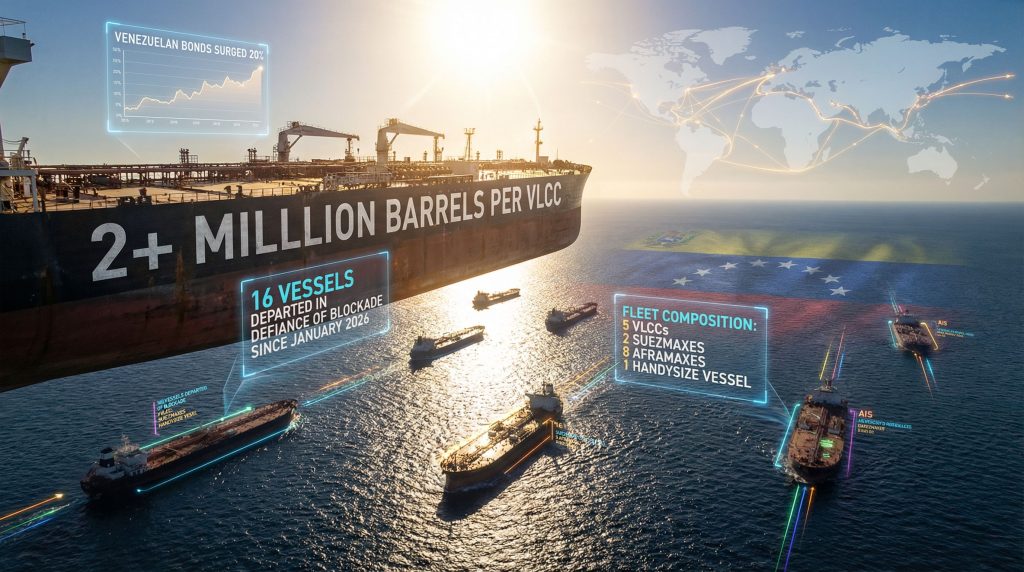
Recent developments in Venezuelan waters illustrate the scale and coordination involved in sanctions evasion operations. Sixteen tankers departed Venezuela in defiance of US blockade measures since January 2026, with the fleet composition including 5 VLCCs, 2 Suezmaxes, 8 Aframaxes, and 1 handysize vessel. Critically, 13 of the 16 vessels carried partial or full cargo loads, demonstrating organised operational planning rather than speculative positioning.
When big ASX news breaks, our subscribers know first
What Drives Tanker Fleet Defiance of International Sanctions?
Economic Incentives Behind Shadow Fleet Operations
The financial mathematics of sanctions evasion create powerful incentives for vessel operators willing to accept enforcement risks. Venezuelan oil exports fund over 90% of the national budget, creating critical revenue streams that justify premium payments for sanctions-busting cargo movements. Venezuelan bonds experienced a 20% surge to 8.5 cents on the dollar following recent political developments, reflecting market expectations of continued export activity despite enforcement measures.
Shadow fleet operations benefit from significant cargo volume advantages that amplify profit margins per successful delivery. Standard VLCC capacity exceeds 2 million barrels per vessel, meaning each successful sanctions-evading voyage can generate substantial revenues even after accounting for risk premiums, specialised insurance costs, and operational complexity.
The vessel tracking challenges faced by enforcement agencies create operational opportunities for shadow fleet operators. December 2025 export tracking showed 827,000 b/d via Kpler data versus 556,000 b/d via Vortexa, representing a 52,000 b/d month-over-month increase according to one source but a 282,000 b/d decline according to another. These significant data divergences indicate either deliberate signal manipulation or vessel-based evasion tactics that complicate enforcement efforts.
Technological Methods for Evading Detection Systems
Modern sanctions evasion relies heavily on AIS (Automatic Identification System) transponder manipulation and coordinated "dark sailing" operations. Vessel tracking services reported no recent location data for sanctioned vessels that had not transmitted positions for at least two weeks, indicating systematic signal disruption rather than isolated technical failures.
The January 2026 Venezuelan flotilla demonstrates sophisticated coordination capabilities:
- Cook Islands-flagged VLCC Bertha – visually confirmed departure January 3, 2026, laden with crude and fuel oil
- Panama-flagged VLCC Veronica III – visually confirmed departure January 3, 2026, laden with crude and fuel oil
- Panama-flagged Suezmax Aquila II – visually confirmed departure January 3, 2026
Ship-to-ship transfer protocols enable cargo movements in international waters beyond direct territorial jurisdiction. According to Argus Media reports, Samir Madani of TankerTrackers.com confirmed that while 12 of the 16 identified tankers remained unaccounted for through electronic tracking, most were believed to have joined organised flotilla operations with visually confirmed vessels.
Flag registry selection demonstrates strategic jurisdiction shopping, with vessels utilising Cook Islands and Panama registrations – offshore jurisdictions offering weaker ownership transparency requirements compared to major maritime nations. This regulatory arbitrage enables beneficial ownership obfuscation through shell company structures.
Which Vessel Categories Enable Large-Scale Sanctions Circumvention?
VLCC and Suezmax Capacity Analysis
Very Large Crude Carriers represent the primary workhorses of shadow fleet operations due to their massive cargo capacity and route flexibility. Five VLCCs comprised 31% of the January 2026 Venezuelan departure fleet, with each vessel capable of transporting over 2 million barrels per voyage. This capacity concentration enables significant export volumes through relatively few vessel movements, reducing detection probabilities per barrel exported.
Two Suezmaxes identified in the active Venezuelan operations provide critical routing flexibility for sanctions evasion networks. Suezmax vessels enable transit through the Suez Canal, offering alternative routing options when traditional VLCC routes face enforcement pressure. However, the OPEC production impact and Yemeni Houthi militant attacks have driven substantial tanker redirection away from the Suez Canal toward Cape of Good Hope routing, affecting vessel class economics for specific trading patterns.
Rhys van Dinther, shipping analyst, noted that while a Gaza ceasefire has been declared alongside the Israel-Hamas truce, most mainstream tanker owners continue preferring the longer Cape route due to ongoing uncertainty. This routing preference directly impacts which vessel classes are economically viable for specific sanctions evasion operations.
Operational Characteristics of Shadow Fleet Vessels
Aframax tankers comprised the majority category with 8 vessels (50%) of the January 2026 Venezuelan departure fleet. These medium-sized tankers offer operational advantages for sanctions evasion through their ability to access smaller ports and engage in coastal trading patterns less susceptible to major shipping route enforcement.
The vessel age and technical specifications of shadow fleet operations remain largely opaque to public tracking systems. While specific engine types, build years, and previous vessel identities are not readily available through commercial tracking services, the coordinated nature of multi-vessel departures suggests organised fleet management with standardised operational procedures.
Flag registry patterns reveal systematic offshore jurisdiction utilisation:
| Jurisdiction | Vessels Identified | Regulatory Characteristics |
|---|---|---|
| Panama | 2 (VLCC + Suezmax) | Common offshore registry with limited ownership transparency |
| Cook Islands | 1 (VLCC) | Offshore jurisdiction with weak beneficial ownership requirements |
The handysize vessel inclusion (1 of 16 total) suggests operational flexibility for specialised cargo handling or regional distribution functions within the broader shadow fleet network. Handysize vessels typically handle 25,000-50,000 deadweight tons, providing capabilities for shallow-water ports or supplementary cargo movements.
How Do Geopolitical Blockades Transform Regional Energy Markets?
Supply Chain Disruption Patterns
Venezuelan production constraints demonstrate how sanctions enforcement creates upstream operational challenges beyond simple export restrictions. Current Venezuelan production reached 934,000 b/d in November 2025 according to OPEC secondary sources, representing substantial decline from historical levels of approximately 3 million b/d in the early 2000s before nationalisation, mismanagement, and sanctions led to output collapse.
Goldman Sachs scenario modelling indicates that a 400,000 b/d Venezuelan production increase by year-end 2026 could push Brent crude lower by $2/barrel to average $58/barrel, while a similar production decline would have opposite price effects. This sensitivity analysis highlights how relatively modest supply changes from sanctioned producers can influence global price formation.
Storage capacity constraints force operational decisions that extend beyond immediate export limitations. The significant divergence in December 2025 export tracking data suggests either undeclared storage accumulation or production disruptions that affect upstream operations. Venezuela's extra-heavy crude extraction requires costly and complex processing infrastructure, making sustained production dependent on "financial and time-investments in oil-processing upgraders and improvements in operational efficiency, power availability, and oil transporting infrastructure."
Market Price Discovery Mechanisms Under Sanctions
Alternative supply source dynamics create regional arbitrage opportunities during sanctions enforcement periods. Furthermore, considering Canada's energy transition challenges, Canadian crude production reached record levels with Alberta oil sands averaging 3.55 million b/d over July-October 2025, representing nearly 6% year-over-year growth. However, heavy sour Canadian grades (WCS and Cold Lake) traded at widest discounts in nearly a year to NYMEX WTI February calendar-month average, reaching $13/barrel discount in Alberta province and $4.50/barrel on a Vancouver basis.
US Gulf of Mexico deepwater production surged to 1.98 million b/d in September 2025, representing seven consecutive months of growth and 375,000+ b/d year-over-year increase. This production expansion coincided with OPEC+ members increasing output by 2.3 million b/d since April 2025 when production cut unwinding began.
Trans Mountain Expansion pipeline utilisation collapsed from 165,000 b/d in Q3 2025 to 85,000 b/d in Q4 2025 due to refinery closures, weak refining margins, and inventory minimisation efforts for tax accounting purposes. Phillips 66 halted crude processing at its 139,000 b/d Los Angeles facility in October 2025, while Valero expects to close its 145,000 b/d Benicia refinery in April 2026.
What Role Do Destination Markets Play in Sanctions Effectiveness?
Asian Import Demand Dynamics
Chinese refinery networks provide critical demand absorption for sanctioned crude volumes, particularly through independent refinery operations with greater operational flexibility than state-controlled facilities. Canadian heavy crude imports from Vancouver reached a record 442,000 b/d in November as overall supply surged on seasonally strong Canadian production.
However, the absence of sanctioned Chinese mega-refiner Yulong following UK and EU sanctions over Russian crude purchases demonstrates how secondary sanctions can affect demand patterns. Yulong previously bought 3-5 heavy Canadian cargoes monthly from an average total of 25, and its absence has pressured heavy Canadian differentials at Vancouver since October.
Strategic petroleum reserve accumulation during discount periods enables importing nations to capitalise on sanctions-related price distortions. UBS concluded that Venezuela will not significantly affect global oil market balances in the next 12 months, but output could rise modestly toward pre-embargo levels if US restrictions ease, positioning Venezuela as a secondary concern relative to broader global supply dynamics.
Alternative Supply Source Substitution
Middle Eastern crude producers benefit from sanctions-related supply gaps through increased market share and route optimisation. Sanctions shifted Indian crude buying from Russian to Middle East Gulf grades in late 2025, coinciding with OPEC+ gradually unwinding production cuts. This Middle East Gulf VLCC trade expansion drew VLCC owners away from Suezmax routes such as West Africa to Europe.
African supply chain adjustments fill market gaps through routing flexibility and grade substitution capabilities. Mexican crude exports averaged just over 350,000 b/d since July, 75,000 b/d less than a year earlier, as more domestic production went to Mexican refineries rather than export markets.
North American production response to global supply disruptions creates complex regional dynamics. Argus Consulting forecasts Canadian crude and condensate production will rise 1.7% in 2026 to a record 4.85 million b/d, while winter diluent requirements reduce refining value during cold-weather operations.
How Do Financial Markets React to Sanctions Enforcement Uncertainty?
Sovereign Debt Market Responses
Venezuelan bond markets demonstrate extreme sensitivity to sanctions enforcement developments and political transitions. Venezuelan bonds surged 20% to 8.5 cents on the dollar following political developments, reflecting market expectations of potential sanctions relief or operational continuity despite enforcement measures.
Credit risk assessment methodologies for sanctioned economies must account for both policy uncertainty and operational disruption probabilities. UBS assessment emphasised that significant Venezuelan output increases would be gradual and require substantial investment, even in scenarios where Western oil firms return to the country.
Currency market impacts from restricted oil revenue flows create additional complexity for sovereign debt pricing. Venezuelan oil exports fund over 90% of the national budget, making currency stability directly dependent on export revenue continuity despite sanctions enforcement.
Energy Commodity Price Formation
Brent crude futures markets showed limited immediate reaction to Venezuelan sanctions enforcement developments, with ICE Brent crude futures broadly unchanged at just under $61/barrel during early London trading following recent political events. In addition, considering how tariffs impact markets, this muted response suggests markets have largely priced in Venezuelan supply disruption risks.
Regional price differential expansion during enforcement periods creates trading opportunities across geographic and quality specifications. Heavy sour Canadian crude discounts reflect combined pressure from rising Canadian supply, stronger US Gulf production, increased OPEC+ output, and refinery utilisation shifts affecting demand patterns.
Freight rate implications vary across tanker vessel classes based on route economics and enforcement risk assessment. Strong VLCC rates create cascade effects on vessel utilisation patterns, drawing owners away from traditional Suezmax routes and subsequently boosting Aframax chartering as Suezmax owners return to traditional route economics.
The next major ASX story will hit our subscribers first
Which Legal Frameworks Enable Maritime Sanctions Enforcement?
International Waters Jurisdiction Challenges
US enforcement authority relies on court-ordered vessel seizures rather than direct military interdiction in international waters. US Secretary of State Marco Rubio confirmed that sanctions enforcement follows legal procedures: "There's a quarantine right now which sanctions oil shipments. Say there's a boat and that boat is under US sanctions. We go get a court order. We will seize it."
Flag state versus port state enforcement authorities create jurisdictional complexity for sanctions implementation. Vessels utilising Cook Islands and Panama flag registrations benefit from offshore jurisdictions with limited enforcement cooperation agreements and weaker beneficial ownership transparency requirements.
UN Security Council resolution implementation mechanisms depend on member state cooperation and domestic legal framework alignment. The effectiveness of multilateral sanctions regimes requires coordinated enforcement across multiple jurisdictions with varying legal standards and political commitments.
Asset Seizure and Recovery Procedures
Court order requirements for vessel detention establish legal foundations for sanctions enforcement but require substantial evidence and procedural compliance. The visual confirmation methodology employed by TankerTrackers.com for identifying specific vessels demonstrates the evidentiary requirements for successful enforcement actions.
International arbitration processes for disputed seizures provide legal recourse mechanisms but can extend resolution timelines significantly. ConocoPhillips holds the largest claim for expropriated Venezuelan assets at $12 billion, with resolution proceeding through US court-ordered auction of PDVSA-owned Citgo Petroleum Corporation.
Compensation mechanisms for affected commercial parties involve complex liability determinations across charter parties, cargo owners, and vessel operators. Elliott Investment Management's affiliate Amber Energy submitted the winning $5.9 billion bid for Citgo in November 2025, representing partial satisfaction of expropriation claims.
What Are the Long-Term Strategic Implications for Global Energy Security?
Supply Chain Resilience Adaptations
Alternative routing development becomes critical for energy importing nations facing sanctions-related supply disruptions. The widespread tanker redirection from Suez Canal to Cape of Good Hope routing demonstrates how geopolitical tensions force infrastructure utilisation changes with lasting operational implications.
Strategic reserve policy adjustments enable importing nations to buffer against sanctions-related supply volatility. The significant divergence in Venezuelan export tracking data highlights the difficulty of accurate supply forecasting during sanctions enforcement periods, necessitating larger strategic buffer stocks.
Infrastructure investment patterns respond to sanctions risk through diversified supply source development and transportation capability enhancement. Trans Mountain Expansion pipeline's 590,000 b/d capacity provides Canadian producers alternative export routes, though Q4 2025 utilisation declined due to downstream refinery constraints.
Market Structure Evolution Scenarios
Shadow fleet capacity expansion trajectories depend on enforcement effectiveness and economic incentives for sanctions evasion. The 16-vessel coordinated departure from Venezuela demonstrates organisational capabilities that could scale with continued sanctions enforcement and attractive risk-adjusted returns.
Technology development for sanctions evasion detection requires continuous advancement in vessel tracking capabilities and signal verification methodologies. The reliance on visual confirmation by tracking services for critical enforcement decisions highlights limitations in purely electronic surveillance systems.
Regulatory harmonisation efforts across maritime jurisdictions face challenges from offshore flag registry competition and beneficial ownership obfuscation. The concentration of identified vessels under Panama and Cook Islands flags reflects systematic jurisdiction shopping for regulatory arbitrage opportunities.
How Can Energy Market Participants Navigate Sanctions Risk?
Due Diligence Frameworks for Commodity Trading
Vessel tracking and verification protocols require multi-source data validation given the significant divergences between commercial tracking services. December 2025 Venezuelan export estimates ranged from 556,000 b/d to 827,000 b/d across different providers, indicating substantial uncertainty in sanctions compliance verification.
Counterparty screening methodologies must account for beneficial ownership complexity and shell company structures used in shadow fleet operations. The Cook Islands and Panama flag registrations of identified vessels demonstrate the challenges of ultimate beneficial ownership determination in offshore jurisdictions.
Documentation requirements for compliance verification extend beyond basic bill of lading and insurance certificates to include vessel tracking history and beneficial ownership disclosure. The two-week signal loss threshold used by commercial tracking services provides a practical standard for sanctions compliance risk assessment.
Risk Management Strategies for Market Exposure
Hedging instruments for sanctions-related price volatility must account for both supply disruption probabilities and enforcement timeline uncertainty. Goldman Sachs scenario modelling of $2/barrel Brent price impact from 400,000 b/d Venezuelan production changes provides quantitative frameworks for risk assessment.
Supply source diversification planning requires understanding of alternative producer capacity and infrastructure constraints. Canadian production growth forecasts of 1.7% in 2026 to reach 4.85 million b/d offer supply source alternatives, though transportation and refinery capacity limitations create bottlenecks.
Force majeure clause structuring in energy contracts should address sanctions enforcement scenarios and vessel detention possibilities. The court-ordered seizure procedures confirmed by US Secretary of State Rubio provide specific legal frameworks that contracts must contemplate.
Frequently Asked Questions About Maritime Sanctions Enforcement
How are sanctioned vessels identified and tracked?
Sanctioned vessel identification relies on multiple complementary methodologies including AIS transponder monitoring, visual confirmation, and commercial satellite tracking services. TankerTrackers.com confirmed 12 of 16 identified tankers remained unaccounted for through electronic tracking, requiring visual confirmation for enforcement purposes. Commercial tracking services like Kpler and Vortexa provide complementary data, though significant divergences in export estimates highlight methodology limitations.
What penalties apply to companies facilitating sanctions evasion?
US sanctions enforcement follows established legal procedures requiring court orders for vessel seizure rather than administrative penalties alone. US enforcement procedures involve obtaining court orders for vessel seizure when sanctions violations are identified, as confirmed by Secretary of State Rubio. Secondary sanctions on entities like sanctioned Chinese mega-refiner Yulong demonstrate how enforcement can extend to foreign companies engaging with sanctioned entities.
How do sanctions affect global oil price formation?
Sanctions impact oil prices through both actual supply disruptions and market uncertainty about future supply availability. Goldman Sachs modelling indicates 400,000 b/d Venezuelan production changes could affect Brent crude by $2/barrel, while ICE Brent futures showed limited immediate reaction at just under $61/barrel to recent Venezuelan political developments. Regional price differentials show more pronounced effects, with Canadian heavy crude discounts reaching $13/barrel in Alberta.
What alternatives exist for sanctioned oil exporters?
Sanctioned exporters utilise sophisticated evasion networks including AIS transponder manipulation, flag registry shopping, and ship-to-ship transfers in international waters. The 16-vessel Venezuelan flotilla using Cook Islands and Panama flags demonstrates coordinated alternative export mechanisms. However, these alternatives involve significant operational costs, legal risks, and reduced market access compared to conventional export channels.
Strategic Outlook for Sanctions-Affected Energy Markets
Policy Evolution Scenarios
Enforcement mechanism strengthening across jurisdictions faces challenges from offshore flag registry competition and beneficial ownership obfuscation. The systematic use of Panama and Cook Islands registrations by shadow fleet operators highlights regulatory arbitrage opportunities that complicate multilateral enforcement efforts.
Diplomatic resolution pathways and sanctions relief conditions depend on political developments and compliance with international demands. However, considering the broader context of US-China trade war impacts and how Trump tariff impact affects global markets, Venezuelan bond price increases to 8.5 cents on the dollar reflect market expectations of potential sanctions modifications, though enforcement mechanisms remain active pending policy changes.
Technology advancement impacts on detection capabilities require continuous investment in vessel tracking and signal verification systems. The reliance on visual confirmation by tracking services for critical enforcement decisions indicates current electronic surveillance limitations that technology development must address.
Market Adaptation Forecasts
Shadow fleet capacity projections through 2030 depend on enforcement effectiveness and economic incentives for sanctions evasion operations. The coordinated 16-vessel departure from Venezuela demonstrates organisational capabilities that could expand with continued attractive risk-adjusted returns and limited enforcement success.
Alternative energy infrastructure development timelines respond to sanctions-related supply uncertainty through diversified sourcing and transportation investments. Canadian production forecasts of 4.85 million b/d by 2026 provide non-sanctioned supply growth, though Trans Mountain pipeline utilisation challenges highlight infrastructure bottlenecks.
Moreover, as Bloomberg reports indicate, geopolitical risk pricing integration in energy markets requires sophisticated modelling of enforcement probabilities and supply disruption scenarios. The significant divergence in Venezuelan export tracking data (271,000 b/d spread between tracking services) demonstrates the uncertainty that market participants must price into trading and investment decisions when tankers defy US blockade in Venezuela.
Disclaimer: This analysis contains forward-looking statements and forecasts that involve uncertainty and risk. Sanctions enforcement, geopolitical developments, and energy market dynamics can change rapidly and may differ materially from projections presented. Market participants should conduct independent due diligence and risk assessment before making investment or trading decisions based on this information.
Ready to Position Yourself Ahead of Complex Energy Market Shifts?
Discovery Alert's proprietary Discovery IQ model delivers real-time alerts on significant ASX mineral discoveries, helping investors identify actionable opportunities across resource sectors affected by global energy market disruptions. Understanding how major mineral discoveries can generate substantial returns during volatile market conditions by exploring Discovery Alert's dedicated discoveries page showcases historic examples of exceptional outcomes during uncertain times.