June 6, 2026
Understanding Shale Basin Economics During Market Disruption
The global energy sector operates within a complex web of geopolitical tensions, supply chain vulnerabilities, and price volatility that can transform operational strategies overnight. When international conflicts disrupt traditional energy corridors, domestic producers face unprecedented opportunities to capitalise on supply gaps through rapid production scaling. This dynamic creates a strategic imperative for energy companies to maintain operational flexibility and capital allocation frameworks capable of responding to crisis-driven market conditions.
Continental Resources to boost U.S. oil output represents a compelling case study in crisis-responsive energy strategy, demonstrating how independent producers navigate the transition from constrained capital deployment to aggressive expansion during geopolitical volatility. The company's diversified operational footprint across multiple shale basins positions it to capitalise on supply disruptions while managing regional production constraints and infrastructure limitations.
Continental Resources' Strategic Assets Across Key U.S. Basins
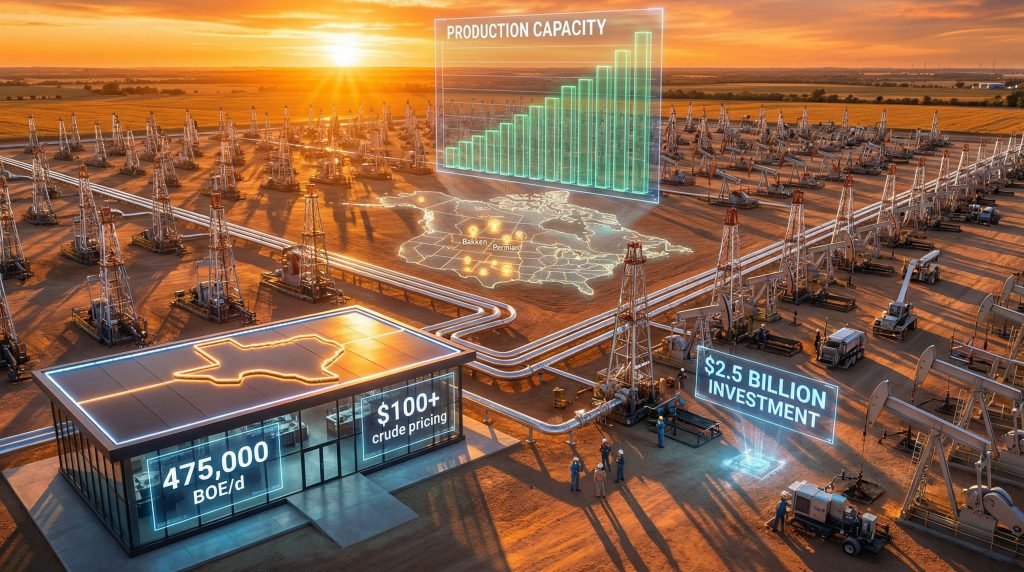
Continental Resources operates a geographically diversified production portfolio generating 475,000 barrels of oil equivalent per day (BOE/d) as of the fourth quarter of 2025. This substantial production capacity spans multiple high-value shale formations, creating operational flexibility during market volatility.
The company's Bakken formation holdings contribute 43% of total production capacity, representing approximately 204,250 BOE/d from North Dakota operations. The Bakken's geological characteristics provide consistent well productivity, though production scaling faces pipeline capacity constraints between North Dakota and Gulf Coast refineries. Weather-related drilling disruptions during winter months also influence production timing, requiring strategic planning for completion schedules.
Permian Basin operations contribute 23% of production capacity, generating approximately 109,250 BOE/d across both the Delaware Basin in New Mexico and the Midland Basin in Texas. This dual-basin approach within the Permian allows Continental to optimise development strategies based on varying geological conditions and regulatory environments. Furthermore, the Permian's superior pipeline infrastructure compared to the Bakken enables more rapid production scaling during favourable price environments.
Continental's multi-basin diversification strategy encompasses operations across North Dakota, Oklahoma, Wyoming, and Texas, reducing concentration risk and providing multiple avenues for capital deployment. The company's recent international expansion into Argentina's Vaca Muerta shale formation adds geographic diversification beyond North American operations, though this represents a smaller percentage of current output.
The Vaca Muerta formation offers significant long-term potential, with the U.S. Energy Information Administration estimating reserves exceeding 16.2 billion barrels of shale oil equivalent. Consequently, this international exposure provides Continental with hedging opportunities against North American regulatory or infrastructure constraints while accessing favourable fiscal terms in Argentina's developing shale sector.
Production Capacity Analysis During Crisis Response
Continental Resources' substantial production baseline of 475,000 BOE/d establishes the company among the largest independent oil producers in North America. This production level generates significant cash flow during elevated price environments, creating financial flexibility for rapid capital reallocation during market opportunities.
The company's operational efficiency improvements have enabled sustained production levels while maintaining capital discipline during lower-price periods. Continental's technical teams have optimised drilling and completion techniques across its major basins, reducing per-barrel production costs and enhancing project economics during volatile pricing cycles.
Continental's capital allocation framework demonstrates sophisticated financial planning capable of supporting sustained production growth during favourable market conditions. However, the US oil production decline in certain regions highlights the importance of strategic positioning. The company's ability to maintain 475,000 BOE/d production while preparing for potential expansion reflects operational readiness for crisis-driven market opportunities.
When big ASX news breaks, our subscribers know first
Price Threshold Economics for Independent Producer Activation
Crisis-Driven Price Dynamics and Investment Triggers
The transition from $60 crude pricing to levels exceeding $100 per barrel fundamentally altered Continental Resources' investment calculus, triggering immediate capital budget increases. This 67% price improvement creates substantially enhanced cash margins, transforming previously marginal projects into highly profitable opportunities.
Prior to geopolitical escalation, crude prices at approximately $60 and below created challenging economics for shale producers, with many operators reducing capital spending to maintenance levels. For instance, global crude glut concerns were forcing oil prices downward, threatening profitability across higher-cost North American shale plays.
The 50% crude price surge over four weeks to more than $100 per barrel following Persian Gulf supply disruptions created immediate incentives for production acceleration. Continental Resources became the first prominent U.S. oil producer to publicly announce plans to ramp up output, demonstrating strategic market positioning during crisis periods.
Crude futures surging 11% above $110 per barrel following escalation announcements further enhanced project economics, providing substantial buffer above typical shale breakeven costs. These oil price rally insights suggest that this pricing level creates significant free cash flow generation opportunities for efficient operators with existing infrastructure capacity.
Capital Budget Flexibility During Market Volatility
Continental Resources had originally budgeted capital spending of $2.5 billion in 2026, representing a 20% reduction compared with 2025 spending levels. This conservative approach reflected challenging market conditions and crude price pressures prior to geopolitical events.
The company's immediate announcement of increased capital budget allocation following price spikes demonstrates sophisticated scenario planning and rapid decision-making capabilities. Moreover, Continental's leadership team maintains pre-established frameworks for capital reallocation during favourable price environments, enabling swift market response.
Dynamic capital reallocation strategies allow Continental to shift from maintenance-level spending to growth-oriented investment based on sustained price improvements. The company's diversified basin portfolio provides multiple deployment options, enabling capital allocation optimisation across different geological and regulatory environments.
| Price Environment | Strategic Focus | Capital Allocation |
|---|---|---|
| Below $60/barrel | Maintenance Mode | Reduced spending, debt reduction |
| $60-80/barrel | Selective Growth | Targeted high-return projects |
| Above $100/barrel | Aggressive Expansion | Maximised production scaling |
Supply Disruption Impact on Domestic Producer Strategies
Persian Gulf Vulnerability and Market Response
The Iranian conflict has crippled supplies from the Persian Gulf, creating global crude shortages that directly benefit North American shale producers. Persian Gulf production represents approximately 28-30 million barrels per day according to International Energy Agency data, accounting for roughly one-third of global crude output.
Significant percentage disruption of Persian Gulf supplies potentially impacts 20-50% of regional output, equivalent to global crude market disruptions of 6-15 million barrels per day. This supply gap magnitude creates pricing pressure that expands the economic viability window for higher-cost shale operators typically operating in the $50-90 cost range per barrel depending on basin characteristics. In addition, understanding OPEC market influence becomes crucial during such disruptions.
The 50% price surge over four weeks demonstrates the market's immediate response to supply disruption concerns. Continental Resources' strategic positioning as the first major producer to announce production increases provides competitive advantages through market perception leadership and supply narrative control.
Continental's announcement timing immediately following geopolitical events signals sophisticated crisis response planning. The company's readiness to commit additional capital suggests confidence in existing well completion backlogs, drilling rig availability, and pipeline capacity to support production increases within acceptable timeframes.
Strategic Positioning During International Crisis Events
Continental Resources achieved first-mover advantage as the initial prominent U.S. oil producer to publicly announce production increases during the crisis. This positioning creates several strategic benefits including market perception leadership and potential influence over investor assessment of other producers' strategic responses.
Harold Hamm's noted political alignment as one of President Trump's most vocal supporters in the oil industry creates potential advantages for policy decisions affecting Continental's operations. This relationship may provide favourable positioning for regulatory relief, strategic petroleum reserve purchasing commitments, or tariff economic implications affecting trade policy support during crisis periods.
The company's decision to maintain strategic ambiguity about specific production increase magnitudes contrasts with typical industry practice of precise guidance. Chief Executive Officer Doug Lawler did not specify production increase levels, providing operational flexibility and competitive intelligence protection during volatile periods.
Continental's competitive positioning during international crisis events demonstrates the importance of maintaining operational readiness and financial flexibility for rapid market response. Furthermore, the company's diversified basin portfolio and established infrastructure provide multiple pathways for production scaling based on market conditions.
Operational Mechanics of Rapid Production Scaling
Technical Infrastructure Requirements for Output Increases
Continental Resources' immediate announcement of capital budget increases following geopolitical events suggests existing operational readiness for production scaling. The company's confidence in rapid deployment indicates available well completion backlogs, drilling rig access, and pipeline capacity sufficient to support meaningful output increases.
Bakken formation production scaling faces specific infrastructure constraints including pipeline capacity limitations between North Dakota and Gulf Coast refineries. Existing pipeline systems operated by Enbridge and TC Energy have defined capacity limits, requiring either debottlenecking projects or new pipeline capacity for sustained production increases beyond current throughput levels.
Drilled-but-uncompleted (DUC) well activation provides the fastest pathway to production increases, typically requiring 30-45 days from completion decision to initial production. During low-price periods preceding the crisis, operators typically reduce completion schedules, creating potential backlogs of constructed wells available for rapid activation during favourable pricing.
Service industry capacity constraints emerge during rapid industry expansion as hydraulic fracturing service companies reduce workforce and equipment during low-price periods. Continental's production scaling plans require coordination with service providers including Baker Hughes, Halliburton, and Schlumberger to secure completion crew availability and manage service cost inflation.
Timeline Analysis for Production Deployment
Continental's immediate capital budget increase announcement suggests management confidence in deploying production increases within timeframes relevant to ongoing geopolitical conflict duration. The company's strategic ambiguity about specific timelines indicates flexibility based on conflict duration and market price sustainability.
Industry precedent from previous supply disruptions provides frameworks for production scaling timelines:
• DUC Well Completion: 2-4 months from activation decision to production startup
• New Well Development: 4-8 months from drilling commencement to production initiation
• Pipeline Infrastructure: 6-12 months for capacity debottlenecking; 18-36 months for new pipeline construction
• Regulatory Approvals: 2-12 weeks for drilling permits across different state jurisdictions
Weather and seasonal factors influence production scaling timelines, particularly in North Dakota Bakken operations where winter conditions can disrupt drilling activities. Continental's timing announcement in early April positions the company for optimal drilling and completion weather conditions through the summer and fall periods.
Supply chain readiness for equipment, materials, and specialised services affects production scaling speed. Continental's established relationships with service providers and equipment suppliers provide advantages in securing resources during industry-wide expansion periods.
Market Scenarios Supporting Sustained Production Growth
Price Sustainability Models for Long-Term Investment
Sustained crude pricing above $80 per barrel represents the threshold for major capital commitments according to industry analysts, though Continental's specific announcement at $100+ pricing provides substantial margin above typical requirements. The company's willingness to increase capital deployment suggests confidence in price sustainability beyond short-term crisis dynamics.
Volatility risk management through hedging strategies becomes critical during crisis-driven price spikes. Continental's decision timing allows the company to implement hedging positions protecting against price declines while maintaining upside exposure during continued geopolitical tensions.
Forward curve analysis influences multi-year development plans as producers evaluate whether current price improvements reflect temporary crisis premiums or sustained market rebalancing. Continental Resources to boost U.S. oil output demonstrates how capital increases suggest optimistic assessment of medium-term price sustainability supporting expanded development programmes.
The company's diversified basin portfolio provides natural hedging against regional price variations and infrastructure constraints. However, considering US–China trade impacts becomes essential as Continental can optimise capital allocation across Bakken, Permian, and other operations based on basin-specific pricing differentials and operational conditions.
Geopolitical Risk Assessment Framework
Conflict duration probability modelling influences Continental's production scaling strategy, as temporary supply disruptions require different capital responses than sustained geopolitical instability. The company's immediate announcement suggests preparation for extended conflict scenarios rather than short-term price spikes.
Alternative supply source development affects long-term market dynamics as other producing regions respond to higher prices. Continental's first-mover advantage provides competitive positioning before Venezuelan, Nigerian, or other constrained producers potentially increase output.
| Conflict Duration | Price Impact | Continental Strategy |
|---|---|---|
| 3-6 months | Sustained $100+ | Aggressive DUC completion |
| 6-12 months | Price volatility | Balanced expansion approach |
| 12+ months | New supply response | Long-term capacity building |
Strategic stockpile management by consuming nations influences demand patterns during supply disruptions. U.S. Strategic Petroleum Reserve drawdown policies and international emergency response protocols affect market dynamics beyond immediate supply disruption impacts.
Financial Performance Impact Under Elevated Pricing
Revenue Enhancement Projections During Crisis Pricing
Continental Resources' 475,000 BOE/d production at current pricing above $100 per barrel generates substantially enhanced cash flow compared to pre-crisis $60 pricing levels. This production volume at elevated prices provides significant financial flexibility for debt reduction, shareholder returns, and accelerated capital deployment.
Cash flow generation improvements at $100+ oil pricing enable Continental to fund production increases through internal cash generation rather than external financing. The company's diversified production portfolio provides stable cash flow streams supporting sustained capital deployment during favourable price environments.
Debt reduction acceleration opportunities emerge during high-price periods as Continental generates excess cash flow beyond operational requirements and planned capital spending. The company's financial flexibility enables strategic balance sheet optimisation while pursuing growth opportunities.
Continental's closely held ownership structure provides strategic advantages during volatile periods as the company avoids public market pressures for quarterly earnings optimisation. This structure enables longer-term strategic decision-making focused on operational optimisation rather than short-term financial metrics.
Capital Efficiency Optimisation During Market Opportunities
Cost per barrel metrics for incremental production additions become increasingly attractive at elevated pricing levels. Continental's established infrastructure and operational experience in major basins provide cost advantages compared to new entrants attempting to capitalise on favourable pricing.
Technology deployment for maximising well productivity enables Continental to optimise capital efficiency during expansion phases. Advanced completion techniques and enhanced oil recovery methods increase ultimate recovery per well, improving project economics during higher-price periods.
Service cost inflation management becomes critical during industry-wide expansion as competition for drilling rigs, completion crews, and specialised equipment increases costs. Continental's established relationships and contracting strategies help mitigate service cost pressures while maintaining project returns.
The company's multi-basin operational flexibility enables capital allocation optimisation based on basin-specific cost structures and infrastructure capacity. Continental can prioritise development in regions offering the best risk-adjusted returns during volatile market conditions.
The next major ASX story will hit our subscribers first
Domestic Energy Security Implications
Strategic Importance of Spare Production Capacity
Continental Resources' rapid production increase announcement demonstrates the strategic value of maintaining spare production capacity during international supply disruptions. U.S. shale producers' ability to respond quickly to geopolitical events enhances national energy security by reducing dependence on potentially unstable international supply sources.
Domestic production security benefits from diversified supply sources across multiple states and geological formations. Continental's operations across North Dakota, Texas, Oklahoma, and Wyoming provide geographic distribution reducing regional concentration risks affecting national energy supplies.
The economic multiplier effects of increased domestic oil activity extend beyond direct production impacts. Expanded drilling and completion operations support employment in rural communities, increase state tax revenues, and stimulate related service industries across major producing regions.
Energy independence benefits become particularly evident during international crises when domestic producers can partially offset foreign supply disruptions. Continental Resources to boost U.S. oil output contributes to national strategic objectives while generating economic benefits for stakeholders.
Long-Term Energy Policy Considerations
Balance between crisis response and sustainable development requires careful policy coordination ensuring rapid production increases maintain environmental compliance standards. Continental's expansion plans must navigate federal, state, and local regulatory requirements while meeting accelerated production timelines.
Environmental compliance during accelerated production scenarios presents operational challenges as companies scale activities while maintaining emissions standards and water management protocols. Continental's established environmental management systems provide frameworks for responsible expansion.
International trade relationship impacts from increased domestic output may influence diplomatic considerations during geopolitical conflicts. Higher U.S. production potentially reduces leverage of traditional oil-exporting nations while strengthening domestic energy policy independence.
Continental's strategic positioning as a responsive domestic producer aligns with broader national energy policy objectives promoting energy security through diversified supply sources and reduced import dependence during international instability.
Strategic Positioning for Market Volatility
Key Takeaways for Energy Market Participants
Crisis-driven production increases require pre-existing infrastructure readiness as demonstrated by Continental Resources' immediate capital deployment announcement. Companies maintaining operational flexibility and financial capacity gain competitive advantages during market disruptions.
Independent producers with financial flexibility achieve superior positioning during geopolitical volatility compared to heavily leveraged competitors. Continental's ability to rapidly increase capital spending reflects strategic balance sheet management enabling opportunistic market response.
Geopolitical events create simultaneous opportunities and operational challenges requiring sophisticated risk management frameworks. Continental's diversified basin portfolio and established operational capabilities provide natural hedging against regional disruptions while enabling rapid scaling.
The company's first-mover advantage in publicly announcing production increases provides competitive positioning benefits including market perception leadership and potential policy alignment advantages during crisis periods.
Forward-Looking Strategic Considerations
Maintaining operational readiness for rapid market response requires ongoing investment in infrastructure, personnel, and supply chain relationships during low-price periods. Continental's ability to quickly announce expansion plans reflects consistent operational preparation for market opportunities.
Balancing short-term opportunities with long-term sustainability goals requires strategic frameworks evaluating crisis-driven expansion against broader energy transition trends. Continental's capital allocation decisions must consider both immediate market opportunities and evolving long-term demand patterns.
Risk management frameworks for navigating volatile energy markets become increasingly important as geopolitical tensions create recurring supply disruption risks. Continental Resources to boost U.S. oil output demonstrates how strategic positioning maintains the value of flexibility for rapid market response while managing operational and financial risks.
Disclaimer: This analysis involves forecasts and speculation about future market conditions, geopolitical events, and operational outcomes. Actual results may vary significantly based on factors including conflict duration, alternative supply responses, regulatory changes, and broader economic conditions. Investment decisions should be based on comprehensive due diligence and professional financial advice.
Want to Capitalise on Energy Market Volatility?
Discovery Alert's proprietary Discovery IQ model delivers real-time alerts on significant mineral and energy discoveries across the ASX, empowering investors to identify actionable opportunities during periods of market disruption and commodity price volatility. Begin your 14-day free trial today to position yourself ahead of market movements and gain immediate access to discovery-driven investment insights.