May 21, 2026
Engineering Advantages of Shallow-Deposit Salt Extraction
Modern salt extraction operations face increasing pressure to optimise capital efficiency while maintaining production capacity. The great atlantic salt project demonstrates how deposit geometry fundamentally reshapes traditional mining economics through accessible shallow-depth extraction methods. Furthermore, this innovative approach to grade and permitting insights showcases the evolution of modern mining practices.
Depth Analysis: Operational Efficiency Through Geological Position
| Operation Type | Depth Range (metres) | Access Method | Infrastructure Requirements |
|---|---|---|---|
| Great Atlantic Salt | ~180 | Decline ramps | Reduced ventilation complexity |
| Traditional lake operations | 300-700 | Vertical shafts | Extensive hoisting systems |
| Solution mining | Variable | Injection wells | Brine processing facilities |
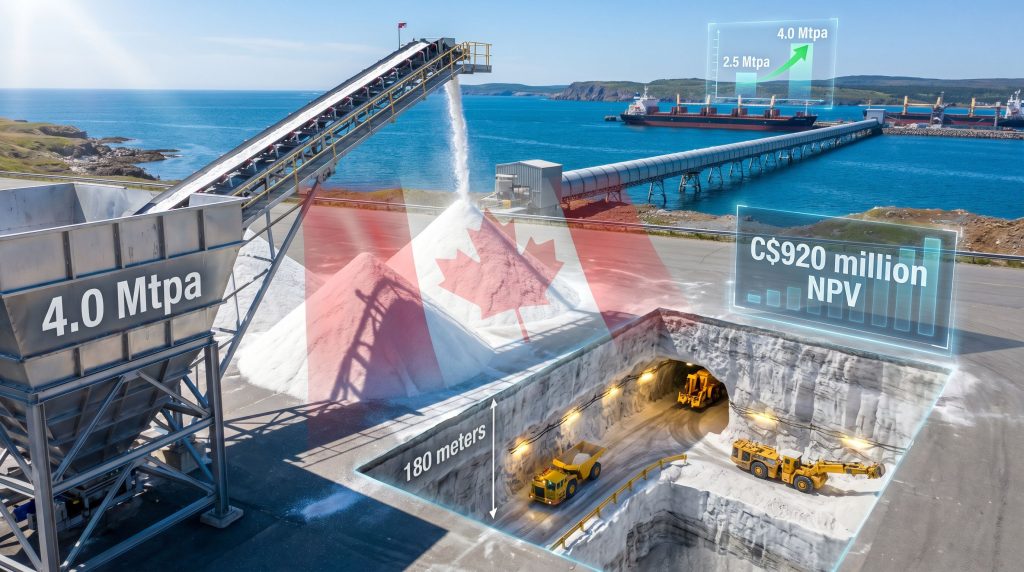
The project's 180-metre depth positioning enables decline ramp access, eliminating the shaft-sinking requirements that characterise legacy North American salt operations. This geological advantage translates directly into reduced initial capital expenditure and simplified operational logistics.
According to the U.S. Geological Survey's 2024 Mineral Commodity Summary, salt mining globally employs both solution mining methods and conventional underground extraction, with cost structures varying significantly based on deposit accessibility and processing requirements.
Conventional vs. Solution Mining: Technical Methodology Comparison
Room-and-pillar extraction methods used at the great atlantic salt project avoid the water consumption and brine discharge considerations inherent in solution mining operations. This dry extraction approach produces no tailings while maintaining continuous material flow from underground workings to surface processing.
The USGS Professional Paper 1802-M confirms that rock salt deposits provide relatively straightforward geological definition compared to stratified mineral deposits, supporting the project's reduced exploration risk profile compared to traditional mining developments. Moreover, this aligns with broader mining industry evolution trends towards more efficient extraction methods.
When big ASX news breaks, our subscribers know first
What Makes the Project's Infrastructure Design Unique?
Integrated mine-to-port logistics systems represent a significant advancement in industrial mineral project design, eliminating multiple material handling stages that traditionally increase operational costs and complexity.
Continuous Material Flow Architecture
• 2-kilometre enclosed conveyor system connecting underground extraction to Turf Point deep-water port
• Direct ship-loading capabilities reducing storage and re-handling requirements
• Weather-protected material transport ensuring operational continuity
• Elimination of intermediate stockpiling minimising dust and environmental exposure
The enclosed conveyor design addresses both operational efficiency and environmental considerations. Modern enclosed systems typically add 40-60% premium over open conveyors but provide critical weatherproofing and dust control capabilities essential for consistent salt handling.
All-Electric Underground Operations: Hydroelectric Integration
Newfoundland's substantial hydroelectric capacity supports the project's fully electric underground equipment strategy. The province's Muskrat Falls facility, commissioned in 2020 with 824 MW capacity, exemplifies the regional renewable energy infrastructure available for industrial operations.
The project's reported 79 tonnes annual Scope 1 emissions represents exceptionally low direct emissions for a 4 million tonne per annum operation. This reflects comprehensive electrification of underground mining equipment including load-haul-dump vehicles, drill carriers, and material handling systems. Additionally, these green production strategies demonstrate the project's commitment to sustainable operations.
Port Interface and Logistics Optimisation
Turf Point's deep-water port positioning provides direct access to Atlantic shipping routes, eliminating the trucking and rail transport typically required for inland mining operations. This integrated approach reduces logistics costs while improving delivery reliability to municipal and industrial customers across Eastern North America.
Production Capacity and Market Positioning Analysis
The great atlantic salt project's phased production strategy targets systematic market penetration through regional import displacement, positioning the operation as North America's first major new salt mine development since 2001.
Nameplate Capacity Scaling Framework
| Development Phase | Annual Capacity (Mtpa) | Timeline | Market Penetration Strategy |
|---|---|---|---|
| Initial operations | 2.5 | 2029 | Regional customer base establishment |
| Full nameplate | 4.0 | 2030 | Import displacement acceleration |
| Future expansion potential | 4.0+ | Post-2030 | Market leadership positioning |
The 4.0 million tonnes per annum target represents approximately 40% of North America's current 8-10 million tonne annual salt import volume, creating substantial opportunity for domestic supply chain optimisation.
Regional Demand Structure: Import Dependency Analysis
Atlantic Canada, Quebec, and the U.S. East Coast corridor consume an estimated 11-16 million tonnes annually, with significant portions sourced from Chilean and Egyptian operations requiring transoceanic shipping. This import dependency creates vulnerability to supply chain disruptions and transportation cost inflation.
The U.S. Geological Survey reports that de-icing applications represent 38% of total U.S. salt consumption, with municipal and government customers maintaining legal obligations for road safety maintenance during winter weather events.
Municipal customers represent exceptionally stable demand characteristics due to legal liability requirements for winter road maintenance, creating contractual security uncommon in commodity markets.
How Do the Project Economics Stack Against Industry Benchmarks?
The 2025 Updated Feasibility Study demonstrates substantial economic optimisation through engineering refinements and production capacity increases compared to the original 2023 study baseline.
Financial Performance Metrics: 2025 UFS Results
• Net Present Value (NPV8%): C$920 million post-tax, representing 66% improvement over 2023 feasibility
• Internal Rate of Return (IRR): 21.3% after-tax return on invested capital
• Payback Period: 4.2 years from commercial production commencement
• Average Annual Free Cash Flow: C$188 million over 24.3-year mine life
• All-In Sustaining Costs (AISC): C$34.90 per tonne FOB Turf Point
The 63% throughput increase from original design parameters, combined with 18% AISC reduction, demonstrates significant operational optimisation achieved through detailed engineering and equipment selection processes. In addition, the integration of ai in mining operations has contributed to these efficiency gains.
Capital Efficiency Analysis: C$589 Million Initial Investment
The project's capital intensity of approximately C$147 per annual tonne of capacity compares favourably to complex mining developments requiring extensive processing infrastructure. Salt extraction's straightforward methodology eliminates metallurgical processing requirements and associated capital expenditure.
Cost Structure Competitive Positioning
At C$34.90 per tonne AISC, the great atlantic salt project positions competitively against imported salt plus transportation costs. Chilean and Egyptian salt operations must absorb transoceanic shipping, port handling, and inland distribution expenses that can exceed C$20-30 per tonne depending on fuel costs and logistics constraints.
What Are the Critical Path Construction Milestones?
Project execution follows a sequential development approach enabling parallel financing and construction activities while maintaining operational flexibility throughout the build process.
Phase 1: Early Works Execution (Currently Underway)
• Site preparation and land clearing under Government of Newfoundland & Labrador approval
• Mine site footprint establishment including access road development
• Utility corridor preparation for electrical infrastructure connection
• Environmental monitoring system installation ensuring compliance continuity
Early works activities represent the first physical construction milestone, demonstrating execution readiness while main project financing reaches closure.
Phase 2: Main Construction (Pending Finance Close)
Underground Development:
• Decline construction and underground access establishment
• Ventilation system installation and commissioning
• Underground electrical infrastructure and equipment staging
Surface Infrastructure:
• Processing facility construction and equipment installation
• Conveyor system fabrication and installation to Turf Point
• Port infrastructure completion and ship-loading system commissioning
Phase 3: Commissioning and Production Ramp-Up
The transition from construction completion to commercial production typically requires 12-18 months for industrial mineral operations, allowing systematic equipment optimisation and workforce training before achieving nameplate capacity.
Why Is Project Financing Structure Critical to Execution?
Atlas Salt's debt-weighted financing strategy through Endeavour Financial aims to minimise equity dilution during construction while leveraging strong project economics for favourable debt terms.
Strategic Partnership Framework: Risk Mitigation Through Collaboration
Sandvik Mining Partnership:
• C$132 million memorandum of understanding for equipment and engineering support
• Proven underground mining equipment technology
• Integrated service and maintenance capabilities throughout mine life
Hatch Engineering Leadership:
• Lead Engineering Partner designation with soft-rock mining expertise
• Track record delivering large-scale underground developments
• Integrated project delivery methodology reducing execution risk
Scotwood Industries Offtake Agreement:
• 1.25-1.5 million tonnes per annum memorandum of understanding
• Largest U.S. distributor of packaged retail de-icing salt
• Revenue security supporting debt financing arrangements
Finance Close Catalysts: Market Re-Rating Potential
Project financing closure typically drives equity re-rating from feasibility-stage valuations (0.2x-0.4x P/NAV) toward construction-stage multiples (0.4x-0.6x P/NAV) according to the Lassonde Curve development framework.
The debt-weighted structure minimises shareholder dilution while positioning for potential re-rating upon construction milestone achievement and first production approach. Consequently, the implementation of data-driven mining operations will further enhance project efficiency and investor confidence.
The next major ASX story will hit our subscribers first
How Does the Project Address North America's Salt Supply Gap?
North America's salt supply infrastructure has experienced minimal capacity additions for over two decades, creating structural import dependency that the great atlantic salt project is positioned to address through domestic production.
Supply Gap Quantification: 25-Year Development Drought
According to industry analysis, no major new salt mines have commenced operations in North America since 2001, while regional consumption has continued expanding with population growth and infrastructure development requirements.
Import Dependency Structure:
• 8-10 million tonnes annually imported from Chile and Egypt
• Transoceanic shipping vulnerable to fuel cost inflation and supply chain disruptions
• Regional consumption estimated at 11-16 million tonnes across Atlantic Canada, Quebec, and U.S. East Coast
Customer Base Characteristics: Demand Stability Analysis
Municipal and government customers represent the core market segment, with legal obligations to maintain road de-icing salt supplies for public safety liability purposes. This contractual framework creates demand stability distinct from discretionary industrial commodity markets.
Winter severity impacts annual consumption volumes, with harsh weather events driving increased demand and temporary pricing spikes. The 2013-2014 North American winter exemplified extreme weather effects on salt demand and supply chain stress.
Market Displacement Strategy: Regional Focus
The project's Atlantic Canadian location provides strategic access to import-dependent markets while reducing transportation costs compared to western North American operations. Direct shipping access through Turf Point eliminates inland transportation requirements common to lake-based salt mines.
What Operational Risks Remain During Development?
Despite the project's reduced geological and metallurgical risk profile compared to traditional mining developments, execution risks typical of underground construction and market development remain relevant.
Construction and Technical Execution Risks:
• Underground development complexity including ground control and water management
• Equipment delivery coordination for specialised underground mining machinery
• Workforce availability in rural Newfoundland requiring skilled mining personnel
• Weather-related construction delays affecting surface infrastructure installation timing
Market and Commercial Development Risks:
• Salt pricing volatility during cold weather events affecting revenue projections
• Competition from established import channels requiring customer conversion efforts
• Offtake agreement conversion from memorandums of understanding to binding contracts
• Transportation cost inflation affecting competitive positioning against imports
Financing and Capital Market Risks:
• Project finance closure timing impacting construction schedule adherence
• Interest rate environment affecting debt financing terms and project economics
• Construction cost inflation requiring contingency management and scope optimisation
How Does Environmental Performance Compare to Industry Standards?
The great atlantic salt project's environmental profile reflects modern mining design principles emphasising minimal ecological impact through technological optimisation and renewable energy integration.
Sustainability Metrics: Zero-Waste Extraction
• Zero tailings production through dry salt extraction methodology
• No chemical processing requirements eliminating reagent consumption and waste streams
• Minimal water usage compared to solution mining operations requiring brine processing
• 79 tonnes annual Scope 1 emissions versus typical underground mining operations
The project's Scope 1 emissions equivalent to approximately four residential households represents exceptional performance for a 4 million tonne per annum industrial operation, achieved through comprehensive electrification and hydroelectric power integration.
Renewable Energy Integration: Newfoundland Hydroelectric Grid
Newfoundland's hydroelectric capacity provides clean energy for all underground operations, eliminating diesel-powered equipment typically required in remote mining locations. This renewable energy integration supports ESG-focused investment criteria while reducing operational costs compared to fossil fuel alternatives.
Environmental Assessment Status: Regulatory Compliance
The project maintains approved environmental assessment status from Newfoundland & Labrador regulatory authorities, confirming compliance with provincial environmental standards for underground mining operations.
What Should Investors Monitor Through 2030?
Key development indicators provide investors with measurable milestones for tracking execution progress and investment thesis validation through the construction and commissioning phases.
Primary Catalyst Timeline: Finance and Construction Milestones
- Project finance closure – Primary catalyst enabling construction acceleration and equity re-rating
- Early works progression – Execution capability demonstration and timeline adherence
- Offtake agreement finalisation – Revenue security confirmation through binding contracts
- Construction milestone achievement – Underground development and surface infrastructure progress
- Equipment delivery and installation – Sandvik partnership execution and commissioning preparation
Market Context Monitoring: External Factors
• North American winter severity impacting salt demand and pricing dynamics
• Import cost inflation affecting competitive positioning and market penetration opportunities
• Regional infrastructure development supporting distribution network expansion
• Regulatory framework evolution influencing permitting and operational requirements
Financial Performance Tracking: Economic Validation
• Construction cost management relative to C$589 million budget allocation
• Timeline adherence toward 2030 commercial production target
• Market development progress including customer base expansion beyond initial offtake agreements
Industry Development Context: Competitive Landscape
The absence of new North American salt mine developments since 2001 provides the great atlantic salt project with limited direct competition during market entry, while import dependency continues supporting domestic supply opportunities.
FAQ Section
What distinguishes the Great Atlantic Salt Project from existing salt operations?
The project combines shallow-deposit access through decline ramps, integrated port logistics via 2-kilometre enclosed conveyor, all-electric operations powered by hydroelectricity, and strategic positioning to serve import-dependent Eastern North American markets.
When will commercial production commence at full capacity?
Initial production at 2.5 million tonnes per annum is targeted for 2029, with full nameplate capacity of 4.0 million tonnes per annum expected by 2030 following construction completion and commissioning.
How does the project's cost structure compare to imported salt?
All-in sustaining costs of C$34.90 per tonne FOB Turf Point, combined with proximity to major consumption centres, positions the project competitively against Chilean and Egyptian imports plus transoceanic shipping and inland transportation costs.
What are the primary development risks investors should consider?
Key risks include securing project financing, executing underground construction on schedule, converting memorandums of understanding to binding offtake contracts, and managing construction costs within the C$589 million budget parameters.
How significant is North America's salt supply gap for market opportunity?
North America imports 8-10 million tonnes annually with no new mines developed since 2001, creating structural supply constraints that domestic projects like the great atlantic salt project can address through import displacement.
What makes municipal customers particularly attractive for salt producers?
Municipal and government customers maintain legal obligations for winter road maintenance, creating contractual demand stability and liability-driven purchasing requirements distinct from discretionary industrial commodity markets.
How does the project's environmental performance support ESG investment criteria?
Zero tailings production, minimal water consumption, 79 tonnes annual Scope 1 emissions, and renewable hydroelectric power integration create an environmental profile supporting ESG-focused investment mandates while reducing regulatory risk.
This analysis is based on publicly available information and company disclosures. Investors should conduct their own due diligence and consider consulting with qualified financial advisors before making investment decisions. Forward-looking statements involve inherent risks and uncertainties.
Ready to Capitalise on Major Mining Developments?
Discovery Alert's proprietary Discovery IQ model delivers instant notifications on significant ASX mineral discoveries, empowering subscribers to identify actionable opportunities ahead of the broader market. Explore why historic discoveries generate substantial returns and begin your 14-day free trial today to position yourself ahead of market movements.