June 23, 2026
When Safety Enforcement Collides With Peak Energy Demand
Every few years, a single industrial incident in China produces a commodity price reaction that reverberates far beyond its geographic origin. The Shanxi coal mine disaster's impact on steel, power, and chemicals illustrates precisely how this transmission works. China's coal supply architecture is so geographically concentrated that a regulatory response to a disaster in one province can simultaneously squeeze the inputs for steel mills, power generators, and chemical plants across an entire nation. Understanding how that cascade unfolds is essential for anyone tracking industrial commodity markets in 2026.
When big ASX news breaks, our subscribers know first
Shanxi's Irreplaceable Role in China's Coal Supply Chain
The Numbers Behind the Dominance
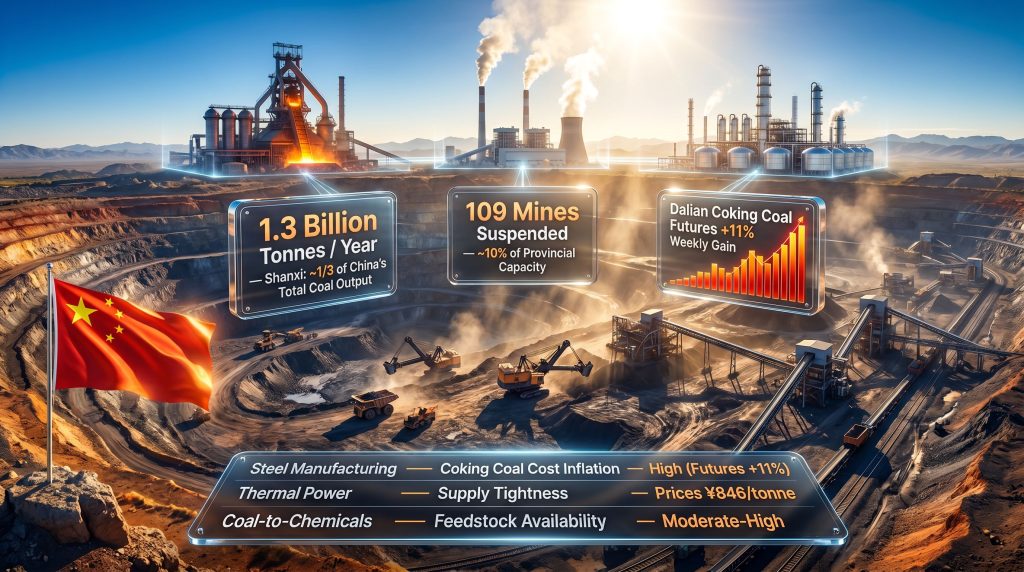
Few resource dependencies in the global economy are as pronounced as China's reliance on a single province for its primary industrial fuel. Shanxi Province generates approximately 1.3 billion tonnes of coal annually, a figure that represents roughly one-third of China's total national output. In April 2026 alone, the province produced 107 million tonnes, making it the country's highest-output coal region for the month.
However, raw volume tells only part of the story. Shanxi's geological character is what makes it genuinely irreplaceable. The province sits atop some of the world's most extensive coking coal reserves, a specific grade of coal with low sulphur content and high carbon density that is chemically required for blast furnace steelmaking. This is not a commodity that can be easily sourced elsewhere on short notice.
Beyond coking coal, Shanxi is China's leading producer of coal-bed methane (CBM), a natural gas analogue extracted directly from coal seams during or around the mining process. CBM functions as a domestic substitute for conventional piped gas, and its production is intrinsically linked to coal mining activity levels. This dual dependency means Shanxi disruptions propagate through two separate energy markets simultaneously.
Why Geographic Concentration Becomes Systemic Risk
China's industrial planners have long recognised the structural exposure created by this concentration. Steel production, thermal power generation, and the expanding coal-to-chemicals sector all draw from the same upstream geography. When a single province accounts for this proportion of supply, any interruption functions less like a localised event and more like a system-wide shock.
Furthermore, the China steel and iron ore market already faced considerable headwinds heading into 2026, meaning this additional supply-side pressure arrives at a particularly sensitive moment. This is precisely the vulnerability that the late May 2026 disaster has exposed.
The Explosion, the Death Toll, and the Regulatory Cascade
Scale of the Incident
An explosion at a coking coal mine in Shanxi Province killed at least 82 workers, making it the deadliest coal mining disaster in China since 2009. The incident immediately drew national attention and triggered a response from central government authorities, who deployed inspection teams to review safety protocols across all major coal-producing regions.
What made the subsequent investigation particularly significant was the nature of the safety violations uncovered. Reports from early probe stages described the discovery of hidden tunnels and fake doors within the mine, suggesting deliberate concealment of non-compliant infrastructure from regulators. This finding has elevated the political stakes of the enforcement response, making a quick return to business-as-usual politically difficult for local authorities.
Operational Fallout: Mines Suspended Across the Province
The immediate operational consequences have been substantial:
- At least 109 mines across Shanxi were suspended pending safety reviews, representing approximately 10% of the province's total operational capacity, according to analysis from Jefferies Financial Group
- A nationwide wave of self-inspections was triggered across the broader Chinese coal sector
- Industry analysis points to an approximate 8% decline in Shanxi's May output as a direct result of the halts
The duration of these suspensions is the critical variable. Analysts at the China Coal Transportation and Distribution Association have noted that blanket production restrictions are unlikely to be sustained through the summer peak demand period, suggesting the base-case disruption window could be as short as one to two weeks. However, the discovery of deliberate safety violations introduces a wildcard that could extend enforcement timelines considerably.
Coking Coal: The Steel Industry's Non-Negotiable Input
Why Metallurgical Coal Cannot Be Substituted
To understand the Shanxi coal mine disaster's impact on steel, it is necessary to understand the chemistry of steelmaking. In a conventional blast furnace, coking coal is transformed into coke, a porous carbon material that serves two functions: it acts as the fuel source and as the chemical reducing agent that strips oxygen from iron ore to produce liquid iron. No commercially viable alternative exists at scale for this specific application.
This non-substitutability is what drives the outsized market reaction whenever Shanxi coking coal supply is perceived to be at risk. Unlike thermal coal, where supply can be partially redirected from multiple geographic sources, coking coal of sufficient quality is a far scarcer commodity. Considering the iron ore market impacts already in play, the added pressure on steelmaking inputs compounds existing cost challenges for producers.
Market Reaction: Futures Pricing and the Import Buffer
Dalian coking coal futures recorded an 11% weekly gain in the immediate aftermath of the disaster, representing the most pronounced commodity price reaction across all affected markets. This rapid repricing reflects how efficiently futures markets incorporate perceived supply risk into forward pricing.
| Commodity | Market Reaction | Primary Driver |
|---|---|---|
| Coking Coal (Dalian Futures) | +11% weekly gain | Direct supply disruption, mine suspensions |
| Thermal Coal (CCTD Benchmark) | ¥833 to ¥846 per tonne | Indirect pressure, broader inspection activity |
| Guangdong Spot Power Price | +40% within the week | Record demand spike, early seasonal peak |
| Steel Production Input Costs | Upward pressure | Higher coking coal feedstock pricing |
Two import channels are expected to partially offset the domestic shortfall. Mongolia, China's largest overseas supplier of coking coal, is positioned to accelerate shipments across the northern land border, a route that offers relatively short lead times compared to seaborne alternatives. Russian coking coal provides a secondary buffer, though both channels face logistical constraints that limit the speed and scale of substitution.
Power Generation: A Demand Shock Meets a Supply Constraint
Record Electricity Consumption Arrives Early
The timing of the Shanxi disaster could not have been more problematic from an energy security standpoint. In the same week as the explosion, power consumption in southern China hit a seasonal record high approximately one month earlier than typical summer peak timelines. The spot power price index in Guangdong Province, China's largest economic region, surged 40% within a single week.
The driver behind this early demand spike is the 2026 El Niño weather pattern, which has pushed heat and humidity levels across southern China well above historical norms for late May. Cooling loads on the electricity grid have arrived ahead of schedule, compressing the window during which authorities might otherwise have allowed extended mine suspensions without energy security consequences.
Climate Compounding: Flooding, Mudslides, and Logistics Constraints
The weather dynamic introduces a second layer of complexity beyond demand. Flooding events and elevated mudslide risk, also attributed to El Niño conditions, are directly constraining coal logistics and mine access in affected regions. This creates a situation where:
- Supply is reduced by regulatory enforcement
- Demand is elevated by unseasonable heat
- Logistics infrastructure is simultaneously compromised by flooding
- Mudslide risk introduces further operational uncertainty for mining operations
Each of these factors would be manageable in isolation. Their simultaneous occurrence, however, represents a multi-variable stress event of the kind that typically produces sharp, non-linear price responses in commodity markets.
The Shanxi situation illustrates a structural reality that commodity markets periodically rediscover: when a supply shock, a demand shock, and a logistics constraint arrive within the same narrow time window, the compounding effect on prices can significantly exceed what any single variable would produce independently.
The Coal-to-Chemicals Sector: Strategic Vulnerability at Scale
A Domestic Energy Security Strategy Built on Shanxi Feedstock
China's coal-to-chemicals industry represents one of the more ambitious industrial diversification strategies in modern energy history. The sector converts domestic coal into chemical feedstocks including methanol, ammonia, synthetic fuels, and olefins, with the explicit strategic objective of reducing dependence on hydrocarbon imports from geopolitically sensitive supply regions.
The strategic logic is sound in principle: replace imported oil and gas with domestically abundant coal. The vulnerability, now exposed, is that the feedstock for this supposedly diversified supply chain originates disproportionately from the same geographic concentration it was designed to hedge. Analysis from SDIC Futures Co. identifies disrupted Shanxi coal supply as a meaningful near-term risk to operational continuity across the coal-to-chemicals sector.
The CBM Transmission Channel Into Gas Markets
The coal-bed methane dimension of this crisis is less widely understood but carries material implications for domestic gas pricing. CBM extraction in Shanxi is a co-product of coal mining activity: as coal seams are mined, methane trapped within the coal matrix is released and captured. When mining activity falls, CBM output falls with it.
This reduction in CBM supply tightens the domestic gas substitute market and exerts indirect upward pressure on conventional natural gas prices. Analysis from Chinese energy consultancy JLC has identified this as a secondary but meaningful transmission channel from the coal disruption into gas markets. In addition, the broader LNG supply outlook suggests that regional gas markets were already navigating supply-demand imbalances before this disruption materialised.
The LNG Paradox: A Counterintuitive Offset
One of the less obvious dynamics in this situation is the partially offsetting effect on LNG demand in the transport sector. Liquefied natural gas is widely used as a haulage fuel for the heavy trucks that transport coal from Shanxi mines to power plants, steel mills, and chemical facilities across China. Fewer coal movements from suspended mines directly reduces the volume of LNG consumed in coal transport logistics.
This creates a paradox: the same supply disruption that tightens the gas substitute market through lower CBM output simultaneously reduces gas demand through lower coal transport volumes. The net effect on gas markets depends on which transmission channel dominates, and that balance may shift as the duration of disruptions becomes clearer.
The next major ASX story will hit our subscribers first
Scenario Analysis: Duration Determines the Damage
How Different Outcomes Reshape the Impact Profile
The range of plausible outcomes is wide, and the distinction between a brief inspection cycle and an extended enforcement period is consequential for markets:
| Scenario | Duration | Coking Coal Price Trajectory | Key Risk Factor |
|---|---|---|---|
| Base Case: Brief Inspection Window | 1 to 2 weeks | Partial retracement of 11% spike | Low: Normal enforcement cycle |
| Extended Enforcement | 4 to 6 weeks | Sustained elevated pricing | Moderate: Political pressure, scope creep |
| Structural Safety Overhaul | Multi-month | Structural cost inflation for steelmakers | High: Systemic violations require infrastructure upgrades |
The hidden tunnels and fake doors reported during initial investigations are a significant complicating factor. If early findings indicate that deliberate concealment of non-compliant infrastructure was widespread across Shanxi operations, the political calculus shifts. Authorities face pressure to demonstrate accountability through sustained enforcement rather than a rapid return to production normalcy.
Global Market Implications: Beyond China's Borders
Seaborne Coal Markets and Asian Steel Competition
China's scale in coal consumption means that even domestically contained supply disruptions generate observable signals in international markets. A material increase in Chinese coking coal import demand from Mongolia and Russia would reduce supply availability for other major Asian buyers, including steelmakers in Japan, South Korea, and India. The global crude steel outlook suggests that global producers were already navigating a challenging pricing environment, meaning any additional cost pressure from Chinese import competition would be acutely felt.
Australian coking coal exporters, who already supply significant volumes to Asian markets, could see incremental demand support if Chinese import requirements accelerate. Similarly, if thermal coal supply remains constrained domestically, Australian and Indonesian thermal coal export prices could find support from any increase in Chinese import activity.
For markets where Indian steel price trends are a key consideration, sustained cost inflation for Chinese steelmakers would affect the competitiveness of Chinese steel exports, which remain a significant factor in global flat steel pricing dynamics.
Key Takeaways for Market Participants
The Shanxi coal mine disaster's impact on steel, power, and chemical sectors delivers several analytically important conclusions:
- Geographic concentration risk is not theoretical. When one province supplies a third of national coal output, its regulatory status is a permanent market variable, not a background consideration.
- Coking coal is the highest-sensitivity transmission channel, given its non-substitutability in steelmaking and Shanxi's dominant position as the domestic source.
- The timing of this disruption materially worsens its impact. An early summer heat wave, record power demand, and concurrent flooding have transformed a manageable safety enforcement cycle into a genuine multi-sector stress event.
- The coal-to-chemicals sector carries an underappreciated structural irony: a strategy designed to reduce energy supply vulnerability is itself exposed to the concentrated supply chain it was intended to replace.
- Duration is the key variable. A two-week disruption is an absorptable price spike. A multi-month structural enforcement campaign would represent a more fundamental repricing of Chinese industrial input costs.
This article contains analysis and forward-looking assessments based on publicly available market data and industry commentary. Commodity price movements, scenario outcomes, and market impacts discussed are subject to significant uncertainty. Nothing in this article constitutes financial or investment advice. Readers should conduct their own due diligence before making any investment decisions.
Want To Capitalise on the Next Major Commodity Discovery Before the Market Moves?
When supply shocks like the Shanxi disaster ripple through coking coal, steel, and energy markets, the investors best positioned to act are those receiving real-time intelligence — Discovery Alert's proprietary Discovery IQ model instantly identifies significant ASX mineral discoveries across 30-plus commodities, delivering actionable alerts the moment opportunities emerge. Explore historic discoveries and their market returns, then begin your 14-day free trial at Discovery Alert to ensure you're ahead of the next major market move.