August 24, 2026
The Geology That Drives a US$16.4 Billion Decision
Not every major energy acquisition begins with a boardroom strategy document. Some begin millions of years below the surface, in the kind of rock formation that produces gas so efficiently, at such scale, and with such consistency, that it fundamentally reshapes what an integrated energy company believes its future looks like. The Montney Formation in western Canada is precisely that kind of geological asset, and it sits at the centre of the Shell acquisition of ARC Resources, one of the most significant upstream transactions in North America in over a decade.
Understanding why Shell committed approximately US$16.4 billion to this deal requires looking beyond the headline numbers. It requires understanding what the Montney actually is, why the LNG supply outlook is tightening global competition for feedstock, and how a transaction of this scale reshapes both a company's balance sheet and an entire basin's competitive hierarchy.
When big ASX news breaks, our subscribers know first
The Montney Formation: A Geological Asset Unlike Most Others
The Montney is a siltstone and fine-grained sandstone formation spanning roughly 130,000 square kilometres across northeastern British Columbia and northwestern Alberta. Unlike many North American shale plays, it is technically a hybrid reservoir, part tight gas sand, part shale, exhibiting characteristics that produce both dry gas and significant natural gas liquids (NGLs) depending on depth and geographic location.
Several geological attributes make the Montney exceptional among North American unconventional plays:
- Reservoir quality: High porosity relative to typical shale, allowing for strong initial production rates without requiring the same hydraulic fracture intensity as plays like the Marcellus or Haynesville.
- Liquids richness: In many areas, the formation produces condensate and NGLs alongside dry gas, meaningfully improving per-well economics and netbacks.
- Low water handling requirements: Compared to basins like the Permian or DJ, the Montney generates substantially less produced water, reducing operating costs and environmental liability.
- Stacked pay zones: The formation is vertically thick in many areas, allowing operators to develop multiple benches from a single surface location, improving capital efficiency.
- Carbon intensity: Montney gas carries a relatively lower carbon intensity profile compared to many alternative global LNG feedstock sources, a factor increasingly weighted by institutional investors and portfolio carbon accounting frameworks.
These characteristics collectively explain why the basin has attracted increasing international capital, and why the Shell acquisition of ARC Resources represents a deliberate bet on Montney geology as a long-duration supply asset. Furthermore, the commodity price impact on upstream investment decisions has only reinforced the appeal of low-breakeven formations like the Montney.
Full Financial Architecture of the Shell-ARC Transaction
The transaction is structured as a plan of arrangement under Canadian corporate law, a mechanism commonly used in cross-border M&A that requires both shareholder approval and court sanction. The financial terms are detailed below:
| Transaction Component | Detail |
|---|---|
| Enterprise Value | ~US$16.4 billion |
| Equity Value | US$13.6 billion |
| Assumed Net Debt | US$2.8 billion |
| Price Per ARC Share | CAD $32.80 |
| Cash Component | 25% (CAD $8.20 per share) |
| Shell Shares Component | 75% (0.40247 Shell shares per ARC share) |
| Cash Funding | US$3.4 billion |
| Shell Shares Issued | |
| Premium to 30-Day VWAP | 20% |
| Premium to April 24 Closing Price | 27% |
| Termination Fee | CAD $600 million |
The 75% share-based component is notable. By issuing approximately 228 million new Shell shares rather than deploying pure cash, Shell preserves balance sheet flexibility while still offering ARC shareholders meaningful exposure to the combined entity's upside. For long-term institutional holders of ARC, receiving Shell shares provides ongoing participation in the Montney's production growth trajectory through a larger, more liquid vehicle.
Shell temporarily suspended its US$3 billion share repurchase program between June 12 and July 14, 2026, a standard capital management measure during large-scale equity issuance periods to prevent technical conflicts between buyback activity and new share issuance across its UK and Netherlands trading programs.
This is Shell's largest acquisition since the BG Group transaction in 2016, which carried a total value of approximately US$53 billion and transformed Shell's global LNG portfolio. The ARC deal is structurally different — smaller in absolute terms but more focused, targeting a specific basin with direct feedstock linkage to an operational LNG export facility. You can read the full Shell-ARC acquisition details on Shell's official newsroom.
How Shell's Operational Scale Transforms After Closing
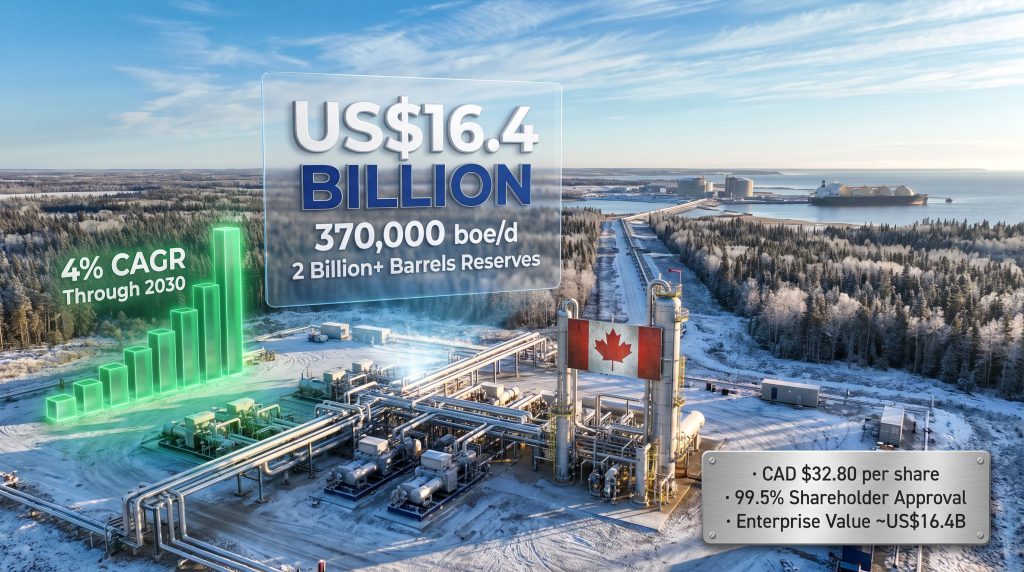
The production uplift from this transaction is substantial by any measure. Adding approximately 370,000 barrels of oil equivalent per day to Shell's output materially changes its upstream profile, particularly within the Integrated Gas segment. Simultaneously, the deal is expected to expand Shell's proved plus probable reserves by more than 2 billion barrels.
The acreage arithmetic is equally compelling:
- ARC Resources controlled approximately 1.5 million net acres in the Montney prior to the transaction.
- Shell's existing Montney position covered approximately 440,000 net acres.
- The combined footprint creates one of the single largest contiguous acreage positions in the entire basin, rivalling or exceeding any other operator's Montney exposure.
This consolidation elevates Shell to the position of second-largest Montney producer, shifting the basin's competitive hierarchy in a significant way. Scale matters enormously in unconventional development: larger contiguous acreage blocks allow for longer horizontal well laterals, more efficient pad drilling programmes, shared infrastructure, and lower per-unit operating costs.
LNG Canada: The Downstream Anchor That Makes This Math Work
Shell holds a 40% ownership stake in LNG Canada, the country's first large-scale LNG export facility, located in Kitimat, British Columbia. Phase 1 of the project has a nameplate capacity of approximately 14 million tonnes per annum (mtpa), with Phase 2 potentially doubling that figure.
The strategic logic connecting upstream Montney acreage to downstream LNG export capacity is direct and powerful. ARC Resources' production base provides a large, reliable, low-cost feedstock stream that can flow west through the Coastal GasLink pipeline system directly to Kitimat. By vertically integrating its upstream supply with its LNG export position, Shell improves:
- Supply cost certainty for LNG Canada, reducing exposure to spot gas price volatility.
- Margin capture across the full value chain, from wellhead to LNG cargo.
- Long-term contract competitiveness, since lower feedstock costs translate to more competitive LNG pricing for Asian buyers.
- Infrastructure utilisation rates, maximising throughput efficiency at LNG Canada.
Global LNG demand growth projections, particularly from markets in Japan, South Korea, China, and India, underpin the thesis that large-scale, low-cost North American LNG supply will be commercially valuable well into the 2040s. The Shell acquisition of ARC Resources is, consequently, as much a bet on that long-range demand trajectory as it is a near-term production growth story. In addition, Canada's energy transition dynamics have made domestically sourced, lower-carbon-intensity gas increasingly attractive to international buyers seeking credible supply alternatives.
Regulatory Clearances and the Final Court Step
As of mid-July 2026, the transaction had progressed through multiple regulatory frameworks with no material obstacles encountered:
| Regulatory Body / Requirement | Status |
|---|---|
| Canada Competition Act | Approved |
| Canada Transportation Act | Approved |
| U.S. Hart-Scott-Rodino Antitrust Act | Approved |
| Alberta Securities Commission (Share Repurchase Exemptive Relief) | Granted |
| Court of King's Bench of Alberta Review | Scheduled July 15, 2026 |
| ARC Shareholder Vote (≥66% required) | Passed at ~99.5% approval |
| Toronto Stock Exchange Delisting (Post-Close) | Pending |
The Alberta Securities Commission's exemptive relief addressed a technical but important condition: Shell's ongoing share repurchase activity in the UK and Netherlands markets required a formal carve-out to operate concurrently with the transaction's equity issuance mechanics. This type of relief is relatively routine in large cross-border deals involving dual-listed acquirers.
The Court of King's Bench of Alberta review, scheduled for July 15, 2026, represents the final formal gateway before closing. Under Canadian corporate law, a plan of arrangement requires judicial approval to ensure procedural fairness, proper shareholder treatment, and regulatory alignment. However, while court refusals at this stage of a well-structured transaction are historically rare, the review process provides a meaningful independent check on the arrangement's integrity.
The next major ASX story will hit our subscribers first
The 99.5% Shareholder Vote: What Near-Unanimity Actually Signals
The shareholder meeting held on July 14, 2026 produced a result that went far beyond the 66.67% minimum threshold required under Canadian corporate law. With approximately 99.5% of votes cast in favour of the plan of arrangement, the result reflects several converging factors:
- The 20% premium to the 30-day VWAP was viewed as fair relative to precedent Canadian energy M&A transactions.
- The 27% premium to the April 24 closing price offered immediate, tangible value recognition.
- The mixed consideration structure (25% cash, 75% Shell shares) preserved shareholder participation in the Montney's long-term upside through a global supermajor vehicle.
- Institutional holders evaluating the deal through a total return lens would have recognised Shell's 2027 free cash flow accretion guidance as a credible catalyst.
Following deal completion, ARC's common shares will be delisted from the Toronto Stock Exchange. Canadian shareholders receiving Shell shares as consideration will need to assess foreign equity holding implications, including currency exposure (CAD to USD/GBP) and any applicable cross-border tax treatment under the Canada-UK tax treaty framework. For further context on how North American investment trends are evolving, the broader capital flows into Canadian resource plays remain a key indicator of future M&A activity.
Capital Allocation Strategy and the Path to 4% Production CAGR
Shell has indicated publicly that the ARC acquisition is expected to lift its production compound annual growth rate to approximately 4% through 2030, measured against 2025 output levels. That is a meaningful growth commitment for a company of Shell's scale, and the Montney's development runway provides the volume necessary to support it.
The transaction is also guided to be accretive to free cash flow per share from 2027 onwards, implying that integration costs and initial capital expenditure requirements will be absorbed within the first full year of ownership. The Montney's relatively low development breakeven costs, estimated by various analysts at below US$2.00 per mcf in the core fairway, support that timeline.
Comparing the two largest acquisitions in Shell's recent history illuminates the evolution in its strategic thinking:
| Dimension | BG Group (2016) | ARC Resources (2026) |
|---|---|---|
| Deal Value | ~US$53 billion | ~US$16.4 billion |
| Primary Asset Type | Global LNG + deepwater | Montney shale gas + liquids |
| Strategic Focus | LNG portfolio diversification | North American gas supply consolidation |
| Payment Structure | Cash + shares | 25% cash / 75% shares |
| Market Context | Oil price downturn | Energy transition + LNG demand growth |
What This Deal Signals for the Canadian Energy Sector
The Shell acquisition of ARC Resources does not exist in isolation. It arrives at a moment when several structural forces are converging in Canadian upstream energy. Resource export challenges observed in comparable energy-exporting economies demonstrate just how critical export infrastructure is to realising the full value of upstream assets.
- LNG Canada Phase 2 development discussions are creating upstream demand pull for large-scale, reliable Montney gas supply.
- Independent Canadian producers with significant Montney acreage are increasingly attractive to international supermajors seeking low-cost, low-carbon-intensity feedstock.
- TSX index implications of ARC's delisting are non-trivial: as a significant component of Canadian energy indices, its removal will require passive fund rebalancing and may reduce the TSX's overall upstream representation.
The Investment Canada Act framework governs foreign acquisitions of Canadian businesses above defined net benefit thresholds. Transactions of this scale require federal review, and Shell's existing Canadian presence through LNG Canada and prior Montney operations would likely have been a meaningful factor in demonstrating net benefit to Canada criteria.
Investors and industry analysts watching Montney M&A activity should note that Shell's transaction may function as a price discovery event for other independent producers in the basin, effectively setting a market reference point for how international buyers value Montney acreage at scale.
According to reporting by The Guardian, the deal represents a significant strategic pivot for Shell as it seeks to consolidate its position in lower-carbon-intensity gas production ahead of an anticipated surge in global LNG demand.
Key Milestones and What to Watch Before Closing
With the shareholder vote completed and multi-jurisdictional regulatory approvals secured, the remaining pathway to closing is narrow but not without steps:
- Court of King's Bench of Alberta approval (scheduled July 15, 2026).
- Satisfaction of any remaining customary closing conditions.
- Final share consideration issuance and cash transfer settlement.
- ARC Resources common share delisting from the Toronto Stock Exchange.
- Integration of ARC operations into Shell's Integrated Gas business segment.
The transaction is targeted for completion during the second half of 2026. For investors in both companies, the critical variables to monitor post-close include Montney drilling cadence under Shell's capital allocation framework, LNG Canada throughput utilisation trends, and the pace at which the combined upstream position achieves the free cash flow accretion milestones Shell has publicly committed to.
The scale, geological quality, and LNG export linkage embedded in the Shell acquisition of ARC Resources position it as one of the defining upstream transactions of the current energy cycle, with implications that extend well beyond two companies and a single Canadian basin.
This article is intended for informational purposes only and does not constitute financial or investment advice. All projections, production estimates, and financial guidance referenced herein are based on publicly available company disclosures and analyst commentary. Readers should conduct independent due diligence before making investment decisions. Further coverage of upstream regulatory developments and North American M&A activity is available at worldoil.com.
Want to Track the Next Major Resource Discovery Before the Market Does?
While Shell's US$16.4 billion Montney acquisition demonstrates the transformative value of significant resource discoveries, Discovery Alert's proprietary Discovery IQ model delivers real-time alerts on ASX mineral discoveries the moment they are announced — explore historic discovery returns on Discovery Alert's discoveries page to see how early positioning in major finds has generated exceptional outcomes, then begin a 14-day free trial at Discovery Alert to ensure the next significant discovery doesn't pass unnoticed.