August 13, 2026
When Geography Becomes Liability: The Hidden Risk Architecture of Cross-Border Mining
Most commodity investors spend considerable energy analysing price cycles, reserve grades, and cost curves. Far fewer allocate equivalent attention to what might be called jurisdictional topology — the structural map of risk that emerges when a company's upstream and downstream assets sit in different countries with fundamentally different geopolitical relationships. When that topology includes a jurisdiction subject to evolving US foreign policy, the resulting risk profile is not merely elevated. It becomes asymmetric in ways that conventional hedging cannot address.
This is the reality that Sherritt International's Q2 2026 results have placed in sharp relief. The Sherritt Cuba disruptions and losses reported for the period ending June 30, 2026, represent more than a difficult quarter. They document the sequential collapse of an integrated production model under the weight of sanctions-driven operational constraints, and they offer investors, supply chain strategists, and market analysts a rare case study in how geopolitical risk propagates through a vertically integrated mining business.
When big ASX news breaks, our subscribers know first
Understanding Sherritt's Integrated Production Architecture
To appreciate how damaging the Cuba disruptions have been, it is essential to first understand how Sherritt's business was designed to function. The company operates what is, in structural terms, a transcontinental production chain. Ore is extracted and processed at the Moa Joint Venture in eastern Cuba, where nickel and cobalt are captured in the form of mixed sulphide precipitates. These intermediate materials are then shipped to Sherritt's refinery at Fort Saskatchewan in Alberta, Canada, where they are refined into finished nickel and cobalt metal for sale into global markets.
This model carries inherent elegance: laterite ore bodies in Cuba, which are rich in nickel and cobalt but require specific processing chemistry, feed a Canadian refinery with decades of operating expertise in handling exactly this type of feedstock. The two assets are, in operational terms, inseparable. Without Cuban mixed sulphides, the Alberta refinery has nothing to process. Without the Alberta refinery, Cuban production has nowhere meaningful to go.
Beyond metals, Sherritt also operates:
- The Fort Site fertiliser plant in Canada, which produces ammonium sulphate as a co-product of the refining process
- The Energas power generation and natural gas joint venture in Cuba, which historically contributed meaningfully to group earnings
- Legacy oil and gas assets in Spain, which carry environmental rehabilitation obligations that continue to generate accounting charges
This diversified but geographically concentrated structure created a business that was simultaneously complex and brittle. The fertiliser operation provided a partial buffer when metals output declined, but it could not compensate for a near-total cessation of upstream Cuban production.
The Mechanics of a Supply Chain Unravelling
The Q2 2026 production data tells the story of a cascade failure with unusual clarity. What began as fuel supply difficulties at the Moa mine site in Cuba progressively stripped out each layer of operational resilience until the refinery itself was forced to halt.
The sequential breakdown unfolded in five distinct stages:
- Fuel delivery problems constrained ore extraction and slurry processing capacity at Moa, reducing the volume of material entering the hydrometallurgical circuit
- Procurement difficulties for reagents and other input commodities compounded throughput losses, preventing any operational recovery
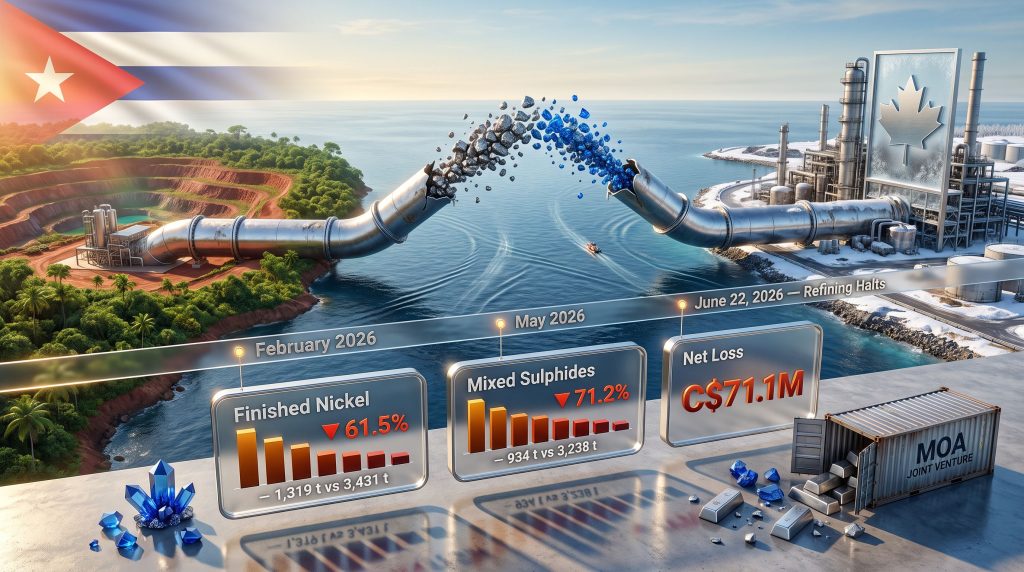
- Mixed sulphide production collapsed from 3,238 tonnes in Q2 2025 to just 934 tonnes in Q2 2026, a year-on-year decline of approximately 71%
- The Alberta refinery drew down its existing inventory of mixed sulphide feed material to sustain some level of production, but without replenishment this buffer was finite
- On June 22, 2026, the inventory was fully exhausted and metals refining activity at the Alberta facility ceased entirely
Key operational insight: The gap between production volumes and sales volumes in Q2 2026 is explained entirely by inventory drawdown. Sherritt sold 1,720 tonnes of finished nickel and 167 tonnes of cobalt during the quarter despite producing only 1,319 tonnes and 135 tonnes respectively. Once the stockpile was gone, this bridge disappeared.
Production Comparison: The Scale of the Output Collapse
| Production Metric | Q2 2026 | Q2 2025 | Year-on-Year Change |
|---|---|---|---|
| Mixed Sulphides Produced | 934 t | 3,238 t | ▼ 71.2% |
| Finished Nickel (Attributable) | 1,319 t | 3,431 t | ▼ 61.5% |
| Finished Cobalt (Attributable) | 135 t | 389 t | ▼ 65.3% |
| Finished Nickel Sales | 1,720 t | — | Drawn from prior inventory |
| Finished Cobalt Sales | 167 t | — | Drawn from prior inventory |
Decoding the Financial Loss Structure
Sherritt's headline net loss from continuing operations of C$71.1 million (C$0.10 per share) for Q2 2026 demands careful decomposition before investors can assess what it actually reveals about core business health.
The adjusted net loss of C$24.8 million (C$0.04 per share) strips out the most significant distorting item: a C$38.6 million environmental rehabilitation charge related to legacy oil and gas assets in Spain. This charge is contractually obligated and non-cash in nature, bearing no relationship to Cuban mining or Canadian refining operations. Its inclusion in headline figures illustrates a broader challenge facing multi-jurisdictional mining companies: historical liabilities in geographically unrelated segments can dramatically inflate reported losses in periods when core operations are already under pressure.
Key Financial Metrics: Q2 2026
| Financial Metric | Q2 2026 | Notes |
|---|---|---|
| Net Loss (Continuing Operations) | C$71.1 million | Includes Spain legacy charges |
| Adjusted Net Loss | C$24.8 million | Excludes Spain O&G rehabilitation |
| Loss Per Share (Net) | C$0.10 | |
| Loss Per Share (Adjusted) | C$0.04 | |
| Available Liquidity (Canada) | C$80 million | End of June 2026 |
The C$80 million in available Canadian liquidity at the end of June 2026 is a figure that deserves close attention. With refining operations suspended and no near-term timeline confirmed for restart, this liquidity represents the primary operational runway available to management. How long that runway extends depends heavily on the fertiliser operation's ability to generate revenue, ongoing cost reduction efforts, and the trajectory of regulatory negotiations.
The Fertiliser Operation as a Partial Revenue Bridge
With metals production sharply curtailed, management deliberately pivoted toward maximising output from the Fort Site fertiliser plant. Sherritt sold 52,328 tonnes of fertiliser during Q2 2026, providing a revenue stream that partially offset the collapse in nickel and cobalt income. For context, the company produced 65,207 tonnes of fertiliser in Q2 2025, indicating that fertiliser throughput also experienced some compression, though far less severe than the metals segment.
This operational pivot is strategically significant. Ammonium sulphate fertiliser production at Fort Site is a co-process that shares infrastructure with refinery operations. The ability to sustain fertiliser output while metals refining was suspended reflects a degree of operational modularity that management has leveraged as a liquidity preservation tool. However, a planned acid plant maintenance shutdown during Q3 2026 is expected to affect fertiliser output continuity, creating an additional headwind for the September quarter.
The Sanctions Architecture and Its Operational Consequences
A US executive order issued in May 2026 targeting commercial activity in Cuba prompted Sherritt to suspend its direct participation in the Moa Joint Venture and the Energas power operation. This decision was driven by compliance obligations rather than purely operational considerations. Furthermore, US policy shifts on resource assets have demonstrated repeatedly that sanctions regimes can reshape the commercial viability of entire production systems almost overnight.
The distinction between suspending participation and permanently exiting a joint venture is legally and strategically significant. Suspension preserves the right to re-engage once regulatory conditions change, whereas exit would likely trigger asset write-downs, contractual consequences, and the permanent loss of Sherritt's upstream supply relationship with Cuba. Management has been explicit that any restart of mining and refining operations is contingent on US government approval.
The Timeline of Escalating Pressure
| Period | Key Development |
|---|---|
| February 2026 | Sherritt publicly warns that fuel delivery problems could force an operational pause at Moa |
| May 2026 | US executive order expands Cuba sanctions; Sherritt suspends direct JV participation |
| June 22, 2026 | Alberta refinery mixed sulphide inventory depleted; metals refining halts entirely |
| End of June 2026 | Available Canadian liquidity stands at C$80 million |
| August 2026 | Q2 results disclosed; first reported losses attributed directly to Cuba disruptions |
What this timeline reveals is that the eventual shutdown was not a sudden event. Sherritt provided advance warning as early as February 2026 that fuel supply problems could force a production pause. The subsequent escalation from warning to suspension to full refinery halt unfolded over approximately four months, during which time management was simultaneously engaging with stakeholders and pursuing strategic options.
Laterite Nickel and the Geology Behind Moa's Strategic Importance
One aspect of the Sherritt situation that receives insufficient attention in mainstream coverage is the geological character of the Moa deposit itself. Unlike the sulphide nickel deposits that dominate Canadian and Australian production, Moa is a laterite nickel-cobalt deposit formed through the deep weathering of ultramafic rocks over geological timescales.
Laterite deposits are fundamentally different from sulphide ores in several important respects:
- They are surface or near-surface deposits, making them amenable to open-pit extraction without the energy and capital costs of underground mining
- They are processed using high-pressure acid leaching (HPAL) or, in Moa's case, a sulphuric acid atmospheric leach followed by sulphide precipitation to produce mixed sulphide intermediates
- Laterite ores tend to carry lower nickel grades than sulphide deposits but often contain more consistent cobalt co-product
- The cobalt content of laterite-sourced mixed sulphides is particularly valuable because it is captured alongside nickel in a single processing step, reducing co-product recovery costs
The Moa deposit's laterite character also explains why the Alberta refinery was purpose-built for Cuban feedstock. The chemistry of Moa's mixed sulphide intermediates is specific enough that substituting alternative feed sources would require significant process modifications. This feedstock specificity amplifies the disruption caused by Cuban supply loss: the Alberta facility cannot simply switch to processing ore from another jurisdiction without substantial capital investment.
The next major ASX story will hit our subscribers first
Three Scenarios for the Path Forward
With operations suspended and liquidity finite, the range of outcomes facing Sherritt is wide. The following scenario framework captures the key pathways available to management.
Scenario 1: Negotiated Restart Under US Government Approval
This is management's stated preferred outcome. Sherritt's interim President and CEO Peter Hancock has communicated that the company is working to advance stakeholder engagement and strategic initiatives necessary to prepare for a restart, subject to US government approval. A negotiated pathway would require either a specific authorisation or a change in the regulatory treatment of Sherritt's Cuban operations.
Historical precedent for sanctions-related operational suspensions in extractive industries suggests that resolution timelines are highly variable, ranging from weeks to years depending on the political context and the nature of the sanctions regime. For Sherritt, the clock on C$80 million of liquidity is the primary constraint on how long this pathway can remain viable without supplementary capital.
Scenario 2: Recapitalisation and Restructured Joint Venture Arrangements
If direct participation in Cuban joint ventures remains legally restricted for an extended period, Sherritt may need to explore structural alternatives. These could include arrangements where Cuban operational management is conducted by a non-US-exposed party, with Sherritt retaining an economic interest through a restructured ownership mechanism. Pursuing this pathway in parallel with regulatory engagement would represent a prudent risk management posture, though the legal complexity of such arrangements should not be underestimated.
Capital markets access for a company with suspended operations and a C$80 million liquidity position is inherently constrained. Any recapitalisation would likely come at a material cost to existing shareholders, raising questions about equity dilution and debt covenant management.
Scenario 3: Prolonged Suspension and Asset Impairment Risk
If neither regulatory approval nor a structural restructuring can be achieved within a timeframe supported by available liquidity, the risk of asset impairment becomes material. At some threshold, suspended production transitions from a recoverable operational disruption to a structural impairment of asset carrying value. This threshold is not a fixed point — it is determined by the interaction of remaining liquidity, ongoing fixed costs, and management's assessment of the probability and timeline of restart.
Credit markets and equity investors are likely already pricing meaningful probability weight onto this scenario, which explains why the Sherritt Cuba disruptions and losses reported for Q2 2026 carry implications well beyond a single difficult quarter.
Why the Global Cobalt Market Should Be Paying Attention
Sherritt's Moa Joint Venture occupies a unique position in the global critical minerals landscape. It is one of very few laterite nickel-cobalt operations in the Western Hemisphere, and its attributable cobalt output, while not enormous in absolute terms, sits within a global supply picture already defined by dangerous concentration risk. Indeed, the battery supply chain risks associated with such supply concentration have become increasingly difficult for procurement strategists to ignore.
The Democratic Republic of Congo accounts for roughly 70% of global cobalt supply, a concentration that creates structural vulnerability for battery manufacturers, electric vehicle producers, and defence supply chains seeking geographic diversification. Western Hemisphere cobalt production sources, of which Moa is among the most established, carry an implicit strategic premium in procurement strategies designed to reduce DRC dependency.
A prolonged suspension of Moa cobalt output removes a meaningful diversification source from the market at a time when:
- Battery demand for cobalt remains substantial across certain cathode chemistries, particularly NMC formulations used in automotive applications
- Cobalt recycling infrastructure, while growing, remains insufficient to substitute meaningfully for primary mine supply at current volumes
- Alternative laterite cobalt development projects face long lead times before reaching production at commercial scale
For nickel markets, the closure of Alberta refining capacity removes a North American processing node from a supply ecosystem where Chinese processing dominance is already a structural concern. The availability of refined nickel from non-Chinese sources carries material relevance for Western battery supply chain strategies. Consequently, the broader context of critical minerals demand driven by the energy transition makes Moa's suspended output particularly consequential.
What Sherritt's Crisis Teaches About Integrated Mining Risk
The Sherritt Cuba disruptions and losses of Q2 2026 constitute a textbook case in the asymmetric nature of sovereign policy risk for cross-border mining operations. Furthermore, the broader implications for mining geopolitical risk assessment are substantial, reinforcing the need for investors and analysts to treat jurisdictional exposure as a primary variable rather than a secondary consideration. Several strategic lessons emerge from the analysis:
- Single-feed refinery dependencies represent a structural concentration risk that should be explicitly stress-tested in any integrated mining investment thesis
- Inventory buffers provide temporal insulation, not structural protection — as demonstrated by the precise date on which the Alberta refinery's feedstock was exhausted
- Adjusted earnings metrics require multi-dimensional scrutiny in companies where legacy obligations in unrelated geographies can distort headline loss figures in the same reporting period as core operational disruptions
- Geopolitical risk is not a background variable for companies operating in jurisdictions subject to US sanctions pressure — it functions as a primary operational constraint that overrides conventional commercial logic
- Operational pivots toward lower-risk revenue streams, such as the fertiliser production prioritisation at Fort Site, can provide partial liquidity support during disruption but cannot substitute for the core revenue-generating activity
Investor consideration: The C$80 million liquidity figure at end-June 2026 is not simply a balance sheet line item. It is the functional boundary condition that determines how much time management has to achieve a regulatory or structural resolution before operational decisions of a more permanent character become unavoidable. Investors evaluating Sherritt should model liquidity burn scenarios against a range of restart timeline assumptions to understand the asymmetry of outcomes at different probability weights.
Disclaimer: This article is intended for informational purposes only and does not constitute financial advice. All financial metrics, production figures, and operational data referenced are sourced from publicly available company disclosures. Forward-looking statements and scenario projections involve uncertainty and should not be relied upon as predictions of future outcomes. Readers should conduct their own due diligence before making investment decisions.
Want to Stay Ahead of Significant ASX Mineral Discoveries Before the Broader Market Does?
Discovery Alert's proprietary Discovery IQ model delivers real-time alerts on high-potential ASX mineral discoveries — instantly translating complex data across 30+ commodities into clear, actionable insights for both traders and long-term investors. Start your 14-day free trial today and explore the historic returns that major mineral discoveries have generated to understand why early positioning can make all the difference.