August 13, 2026
The Hidden Physics of Aluminium Smelting That Makes Energy Policy So Complicated
Most industrial facilities can tolerate power fluctuations, ramp down production overnight, or pause operations during peak demand periods without catastrophic consequences. Aluminium smelters cannot. The electrochemical reduction process at the heart of aluminium production, known as the Hall-Héroult process, requires a continuous, uninterrupted electrical current flowing through molten cryolite baths at temperatures exceeding 960 degrees Celsius.
If power drops unexpectedly, the molten bath solidifies, the carbon lining fractures, and the cell must be rebuilt at enormous cost. A single potline shutdown can take months to recover from and write off tens of millions of dollars in equipment.
This technical reality is not merely an engineering curiosity. It is the foundational reason why governments everywhere, when confronted with aluminium smelter economics, eventually reach the same conclusion: these facilities cannot be treated like ordinary energy consumers. They require bespoke arrangements, long-term pricing certainty, and guaranteed supply continuity. Understanding this constraint reframes the entire debate around the Tomago Aluminium government funding and renewable energy deal announced in August 2026.
When big ASX news breaks, our subscribers know first
What Tomago Aluminium Actually Represents in Australia's Industrial Landscape
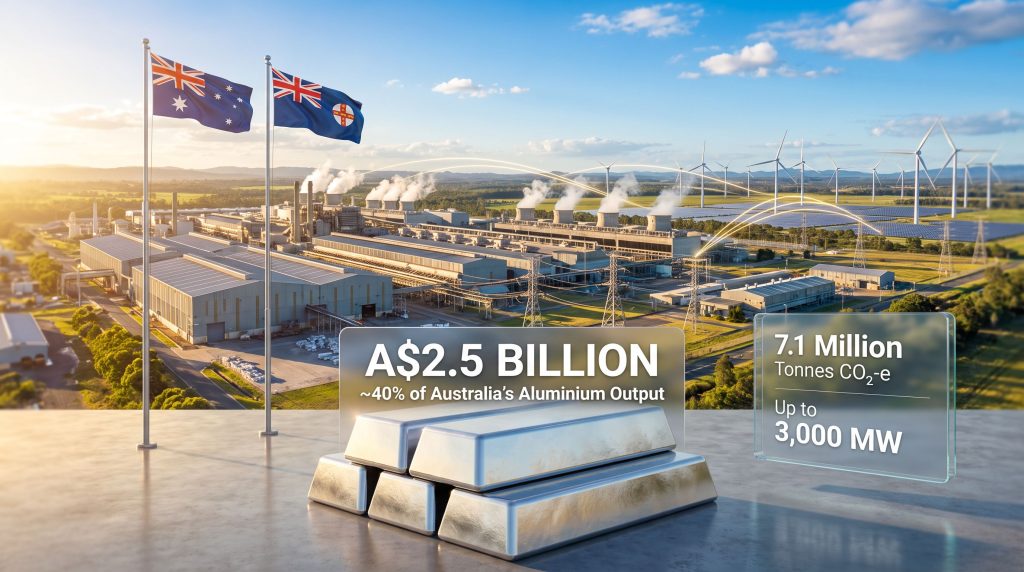
Situated approximately 13 kilometres west of Newcastle in the Hunter Valley, Tomago Aluminium is not simply a large factory. It is one of the most energy-intensive single facilities in the Southern Hemisphere, consuming electricity at a scale that rivals entire regional grids. The smelter produces up to 590,000 tonnes of aluminium per year, representing close to 40% of Australia's total national output. No other single industrial site in Australia carries this proportion of a commodity's national production.
The facility is structured as a joint venture among three major international partners:
| Joint Venture Partner | Ownership Stake |
|---|---|
| Rio Tinto | 51.55% |
| Gove Aluminium Finance | 36.05% |
| Norsk Hydro | 12.40% |
Rio Tinto's majority position gives it effective operational control, while Norsk Hydro's presence is particularly significant from a market positioning standpoint. Hydro is one of the world's leading producers of low-carbon and recycled aluminium, supplying automotive manufacturers, packaging companies, and construction firms that increasingly require verified green aluminium certificates for their own ESG reporting.
Tomago's eventual transition to renewable electricity could allow it to participate in this premium market segment, which commands price differentials of up to 20% above standard aluminium on certain European exchanges. Furthermore, this prospect sits alongside broader momentum in Australia's green metals push, which is reshaping how the country's industrial assets are valued globally.
Breaking Down the A$2.5 Billion Funding Architecture
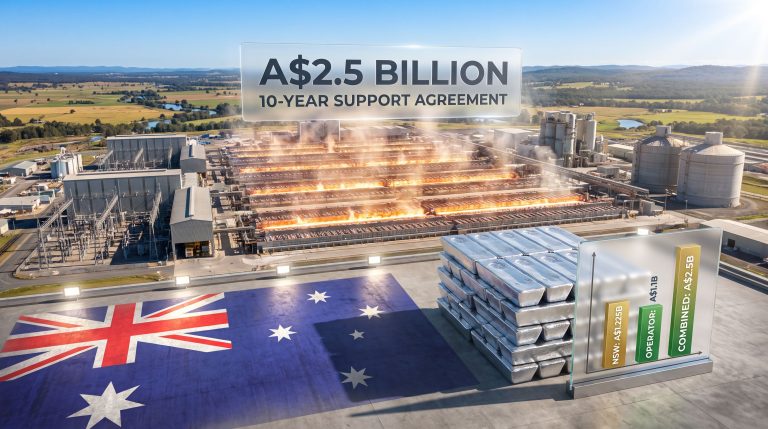
The Tomago Aluminium government funding and renewable energy deal draws on a combined A$2.5 billion in public investment, with private co-investment lifting the total programme value to approximately A$3.6 billion. The structure is carefully delineated between two tiers of government and the private joint venture.
| Funding Source | Contribution | Disbursement Period |
|---|---|---|
| Australian Federal Government | ~A$1.275 billion | From 2029 |
| NSW State Government | A$1.225 billion (capped) | 2029 to 2039 |
| Tomago Aluminium Owners | A$1.1 billion (private) | Ongoing |
| Total Combined Investment | ~A$3.6 billion | Multi-decade |
The NSW Government's contribution is explicitly capped at A$1.225 billion, disbursed over a ten-year window commencing in 2029. This cap matters because it creates a defined fiscal ceiling, preventing open-ended subsidy obligations that have historically plagued industrial assistance programmes in other jurisdictions.
The private co-investment of A$1.1 billion is a critical structural element often overlooked in public commentary. It demonstrates that the joint venture owners are not simply extracting public funds but are making a substantial long-term commercial commitment to the facility's future. Within that private contribution, A$100 million is specifically earmarked for decarbonisation initiatives, including a demand-response programme designed to help stabilise New South Wales electricity networks during peak stress periods.
Why the 50:50 Federal-State Cost-Sharing Model Was Chosen
The equal cost-sharing structure between Canberra and Sydney reflects a deliberate policy design rather than a negotiated compromise. Aluminium smelters create both national strategic value, through export earnings and sovereign manufacturing capability, and concentrated regional economic impact that falls squarely within state jurisdiction.
Splitting the cost acknowledges both dimensions. It also provides political insulation, ensuring neither level of government bears the full burden of public scrutiny for what will inevitably be characterised by critics as a corporate subsidy. According to reporting on the taxpayer-funded deal, questions remain about how long public contributions will ultimately be required to sustain operations at this scale.
The December 2028 Cliff Edge: Why Timing Drives Everything
Tomago's existing electricity contract, which is linked to coal-fired generation, expires on 31 December 2028. This date functions as the structural trigger for the entire policy intervention. Without a replacement arrangement, the smelter would face wholesale electricity prices in a grid that is progressively losing its baseload coal capacity, prices that would almost certainly render operations uneconomic at current production volumes.
The transition timeline agreed under the new arrangement unfolds in three distinct phases:
- December 2028: The existing coal-linked electricity contract reaches its end date.
- January 2029: A new ten-year power purchase arrangement commences, providing below-market price certainty for the smelter's enormous energy demand.
- 2033 onwards: Tomago targets 100% renewable electricity sourcing, completing the facility's decarbonisation of its operational power supply.
The 2029-to-2033 bridging period is arguably the most technically demanding phase. Operating on renewable energy alone, without sufficient firming capacity, would expose the smelter to exactly the kind of supply interruption risk that its Hall-Héroult process cannot tolerate. The deal's provision for up to 3,000 MW of new renewable and firming capacity in New South Wales is therefore not peripheral — it is the technical prerequisite that makes the 2033 renewable milestone achievable.
Aluminium smelting requires continuous, uninterrupted high-voltage power. Unlike most industrial consumers, smelters cannot simply reduce output during grid shortfalls. Firming capacity, whether from batteries, pumped hydro, or gas peaking plants, is not optional infrastructure in any credible renewable transition plan for facilities of this type.
Emissions Reduction at Scale: The Decarbonisation Mathematics
The environmental case for the Tomago Aluminium government funding and renewable energy deal rests on numbers that are difficult to contextualise without industry benchmarks. The smelter's current emissions footprint, tied to coal-linked electricity, is substantial. The projected annual emissions reduction following the 2033 full-renewable transition is estimated at 7.1 million tonnes of CO₂-equivalent per year.
| Metric | Figure |
|---|---|
| Annual aluminium production capacity | Up to 590,000 tonnes |
| Share of Australia's national output | ~40% |
| Projected annual emissions reduction post-2033 | 7.1 million tonnes CO₂-e |
| Contribution to NSW grid decarbonisation | More than 10% |
| New renewable and firming capacity supported | Up to 3,000 MW |
| Private decarbonisation investment | A$100 million |
The 10% NSW grid decarbonisation figure deserves particular attention. A single industrial facility's energy transition, if executed successfully, would contribute meaningfully to the state's clean energy targets. This is partly because Tomago's electricity consumption is so enormous that replacing it with renewable sources effectively forces the construction of substantial new generation and storage infrastructure that benefits the broader grid.
The Employment and Regional Economic Case
Beyond the energy and emissions dimensions, the Hunter Valley's economic dependency on Tomago creates a social policy imperative that governments cannot easily dismiss. The employment footprint extends well beyond the smelter fence line:
- Approximately 1,000 direct full-time employees at the facility.
- Around 200 on-site contractors providing specialist services.
- An estimated 5,000 indirect jobs supported across the Hunter region through supply chains, services, and economic multiplier effects.
- More than 1,000 direct positions formally secured through the government funding agreement.
The Hunter region has navigated the structural decline of coal mining over recent decades, and the aluminium sector represents one of the few remaining anchors of high-wage, skilled industrial employment in the area. The loss of Tomago, without replacement industry, would create a regional economic shock comparable in scale to colliery closures that reshaped communities across the previous generation.
The next major ASX story will hit our subscribers first
Tomago vs. Boyne: Australia's Emerging Aluminium Policy Template
The Tomago agreement did not emerge in isolation. In March 2026, a structurally similar arrangement was concluded for the Boyne aluminium smelter at Gladstone in Queensland. The sequential nature of these two deals, separated by five months and covering the country's two largest aluminium facilities, strongly suggests a coordinated federal industrial strategy rather than a series of reactive interventions. Rio Tinto's Gladstone repowering initiative had already begun signalling this directional shift well before the Tomago announcement.
| Feature | Tomago Aluminium (NSW) | Boyne Smelter (QLD) |
|---|---|---|
| Location | ~13km west of Newcastle | Gladstone, Queensland |
| Annual production capacity | Up to 590,000 tonnes | ~550,000 tonnes (est.) |
| Government deal announced | August 2026 | March 2026 |
| Primary operator | Rio Tinto joint venture | Rio Tinto joint venture |
| National output contribution | ~40% | Significant contributor |
Rio Tinto's role in both facilities is notable. The company is simultaneously navigating a global green aluminium strategy, driven by regulatory pressure from European carbon border adjustment mechanisms, and managing legacy assets in regions where renewable infrastructure is still maturing. The Australian government deals provide the energy cost certainty that makes long-term investment in both smelters rational from Rio Tinto's capital allocation perspective.
The Green Aluminium Premium: Why This Deal Has Export Market Implications
A dimension of the Tomago deal that receives insufficient attention in domestic commentary is its potential impact on Australia's position in global aluminium trade flows. The European Union's Carbon Border Adjustment Mechanism, which imposes carbon costs on imported goods including aluminium, is progressively tightening. Aluminium produced using coal-fired electricity will attract substantial border carbon charges when exported to European markets. Aluminium produced from renewable electricity will not.
Once Tomago completes its renewable transition in 2033, its production could qualify as certified low-carbon aluminium, opening access to premium markets and avoiding future carbon tariff exposure. This is a long-term commercial asset embedded within what appears on the surface to be an energy subsidy agreement.
However, Tomago is not alone in pursuing this strategic repositioning. The low-carbon aluminium venture between Alcoa, Ignis, and EQT reflects a similar logic, demonstrating that green certification is increasingly becoming a commercial imperative across the sector. Consequently, the competitive landscape for premium aluminium is intensifying rapidly.
Norsk Hydro's 12.4% stake positions the joint venture to leverage established European green aluminium certification frameworks that Hydro has helped develop. This is industry-specific knowledge that fundamentally changes how the A$3.6 billion combined investment should be evaluated. It is not purely a cost to be subsidised — it is, in part, a market repositioning exercise with meaningful long-term revenue implications.
Risks and Watchpoints: What Could Derail the Timeline
No multi-decade industrial and energy transition programme is without execution risk. Several factors could complicate or delay the pathway to Tomago's 2033 renewable milestone:
- Renewable project approval delays: The up to 3,000 MW of new generation and firming capacity required must navigate New South Wales' planning and environmental approval systems. Large-scale renewable projects in the state have historically encountered community opposition and regulatory delays.
- Firming infrastructure costs: Battery storage and pumped hydro projects capable of providing smelter-grade supply continuity represent some of the most capital-intensive components of the energy transition. Cost overruns in this segment could affect the economic viability of the below-market pricing arrangement.
- Policy continuity risk: The ten-year disbursement window spans multiple electoral cycles at both federal and state levels. Changes in government priorities, fiscal constraints, or energy policy direction could create uncertainty around funding delivery.
- Aluminium price cycles: Global aluminium prices are notoriously cyclical, influenced by China industrial demand trends, energy costs in other major producing regions, and broader macroeconomic conditions. A sustained period of low prices could test the commercial rationale for continued smelter operation regardless of energy cost arrangements.
In addition, the emergence of green metal pricing dynamics adds another layer of complexity. As premium pricing for verified low-carbon metals becomes more mainstream, the financial calculus around long-term smelter investment will need to be continuously reassessed against evolving market benchmarks.
Frequently Asked Questions: Tomago Aluminium Government Funding and Renewable Energy Deal
What is the total value of the Tomago Aluminium government funding package?
The public funding commitment totals A$2.5 billion, split between the Australian federal government and the NSW state government on an approximately 50:50 basis. When combined with the private co-investment of A$1.1 billion from the smelter's owners, the total programme value reaches approximately A$3.6 billion. Full details of the announced bailout arrangement have been reported extensively in the financial press.
When does Tomago Aluminium's current electricity contract expire?
The existing coal-linked power contract expires on 31 December 2028. The new ten-year power purchase arrangement begins immediately after, from January 2029.
Will Tomago Aluminium run entirely on renewable energy?
The agreement targets 100% renewable electricity sourcing from 2033 onwards, following a transition period during which new generation and firming capacity is built out across New South Wales.
How many jobs does the Tomago Aluminium smelter support?
The facility directly employs approximately 1,000 full-time workers and around 200 contractors. An estimated 5,000 additional indirect jobs are supported across the broader Hunter region through supply chains and economic activity.
Who owns Tomago Aluminium?
The smelter is owned through a joint venture comprising Rio Tinto (51.55%), Gove Aluminium Finance (36.05%), and Norsk Hydro (12.40%).
How much new renewable energy capacity will the deal support in NSW?
The agreement is expected to catalyse the development of up to 3,000 MW of new renewable electricity generation and firming capacity across New South Wales.
What is a power purchase arrangement and how does it apply here?
A power purchase arrangement is a long-term contract between an electricity buyer and a supplier that fixes pricing and supply terms over an agreed period. In Tomago's case, the ten-year arrangement provides below-market price certainty essential for the smelter's continuous high-voltage operations, insulating the facility from volatile wholesale electricity market pricing during the renewable energy transition.
How does the Tomago deal compare to the Boyne smelter agreement?
Both deals share a broadly similar structural logic, involving government energy cost support to bridge the transition from coal-era contracts to renewable power. The Boyne arrangement was finalised in March 2026 for the Gladstone, Queensland smelter, and the Tomago Aluminium government funding and renewable energy deal followed in August 2026. The sequential timing suggests a deliberate federal policy approach to securing Australia's two largest aluminium production facilities through the energy transition simultaneously.
Key Takeaways: The Tomago Aluminium Deal at a Glance
- A combined A$2.5 billion in public investment secures Tomago Aluminium's operational continuity beyond the December 2028 contract expiry.
- The 50:50 federal-NSW funding split reflects both the national strategic value and the concentrated regional economic impact of the facility.
- Full transition to 100% renewable electricity is targeted for 2033, with projected annual emissions reductions of 7.1 million tonnes CO₂-equivalent.
- The deal is expected to catalyse up to 3,000 MW of new renewable and firming capacity across New South Wales.
- Private co-investment of A$1.1 billion, including A$100 million in decarbonisation initiatives, demonstrates genuine commercial commitment from the joint venture owners.
- Tomago's future as a renewable-powered smelter carries significant export market implications, particularly as European carbon border mechanisms tighten against high-emissions aluminium producers.
- The Tomago arrangement follows a structurally similar deal for the Boyne smelter in Queensland, pointing toward a replicable policy framework for electrointensive manufacturing across Australia.
This article contains forward-looking statements and projections based on publicly available information and announced agreements as of August 2026. Actual outcomes regarding emissions reductions, renewable capacity development, and employment figures may differ materially from projections depending on execution timelines, market conditions, and policy continuity. Nothing in this article constitutes financial or investment advice.
Want To Capitalise on the Mining and Resources Stories Reshaping Australia's Industrial Future?
Discovery Alert's proprietary Discovery IQ model scans ASX announcements in real time, delivering actionable alerts on significant mineral discoveries — from the commodities powering green aluminium to the next potentially transformative find — so investors can act ahead of the broader market. Explore historic discoveries and their returns to understand the opportunity, then begin your 14-day free trial today.