
May 13, 2026
Mining operations worldwide grapple with the delicate balance between workforce management and operational continuity, yet few have mastered the art of preemptive labor relations. The copper mining sector, characterised by volatile commodity cycles and high-stakes production schedules, traditionally sees labor negotiations as reactive exercises conducted under pressure. However, a different paradigm is emerging where anticipatory collective bargaining becomes a strategic tool for risk mitigation and operational excellence. Furthermore, the Sierra Gorda collective bargaining agreement 2026 exemplifies how proactive workforce engagement can transform potential disruptions into competitive advantages.
Understanding Chile's Mining Labor Relations Landscape
Chile's mining sector operates within a unique labor relations framework where high unionisation rates intersect with complex operational demands. The country's position as the world's largest copper producer creates an environment where labor stability directly impacts global supply chains. Within this context, mining companies must navigate sophisticated workforce structures whilst maintaining production continuity across multi-year commodity cycles.
The regulatory environment in Chile supports collective bargaining through established frameworks that encourage dialogue between management and organised labor. This system creates opportunities for companies to develop long-term relationships with union representatives, moving beyond traditional adversarial models toward collaborative engagement strategies.
Moreover, understanding these dynamics provides valuable mining job interview insights for professionals entering the sector, particularly regarding labor relations complexities.
Strategic Approach to Anticipatory Negotiations
Sierra Gorda's approach to collective bargaining demonstrates how anticipatory negotiations can transform labor relations from a potential operational risk into a competitive advantage. The Sierra Gorda collective bargaining agreement 2026 represents a comprehensive framework that extends through 2029, providing unprecedented operational certainty in a volatile industry.
The negotiation process, conducted between December 2025 and March 2026, exemplifies strategic timing that allows all parties to engage without the pressure of impending contract expirations. This four-month window enabled thorough discussion of complex workforce issues whilst maintaining normal operational rhythms.
Key elements of this anticipatory approach include:
• Early engagement initiation – Beginning discussions well before contract expiration dates
• Voluntary participation frameworks – Creating collaborative rather than mandatory negotiation environments
• Multi-stakeholder coordination – Managing relationships across diverse union structures
• Long-term perspective alignment – Focusing on sustainable rather than short-term solutions
High Unionisation Rate Impact Analysis
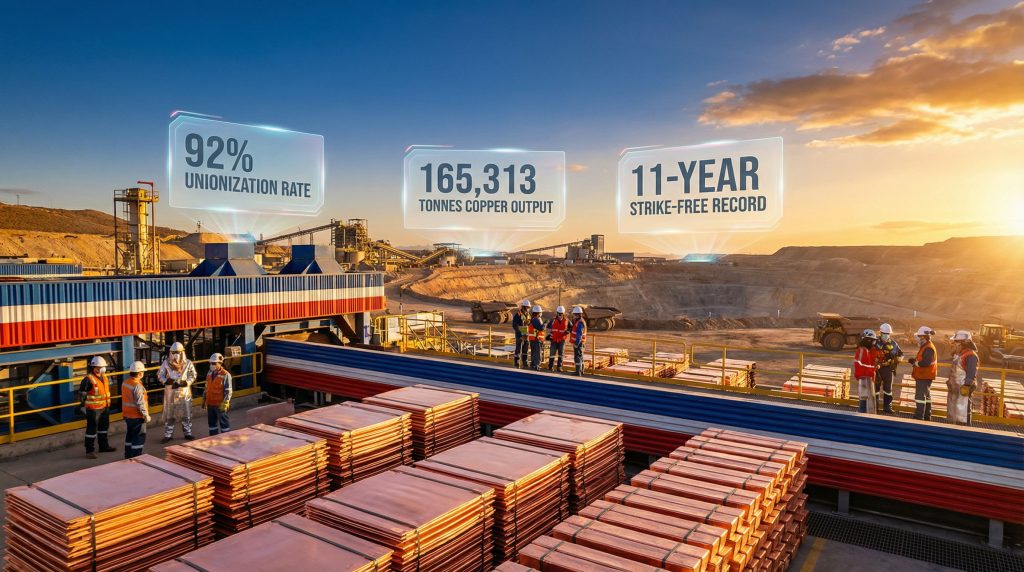
Sierra Gorda maintains a 92% unionisation rate across its workforce, significantly exceeding industry averages in many mining jurisdictions. This high level of union participation creates both challenges and opportunities for operational management. Rather than viewing extensive unionisation as a constraint, the company has developed systems to leverage collective representation as a communication and coordination mechanism.
However, these dynamics also reflect broader women mining challenges within traditional union structures that often require specific attention to ensure inclusive representation.
The workforce structure encompasses three distinct union organisations:
Union Distribution Analysis:
| Union Category | Membership | Workforce Percentage | Operational Focus |
|---|---|---|---|
| Sindicato N°1 | 562 workers | 31.3% | Core operations |
| Sindicato N°2 | 614 workers | 34.2% | Production support |
| Supervisors Union | 466 workers | 25.9% | Management oversight |
This segmented union structure allows for specialised representation across different operational domains whilst maintaining coordinated bargaining processes. The largest contingent (34.2%) represents production support functions, reflecting the complex auxiliary systems required for modern copper extraction operations.
When big ASX news breaks, our subscribers know first
Economic Framework for Labor Stability
Production Continuity Metrics
The economic impact of labor stability extends far beyond wage and benefit negotiations. Sierra Gorda's 11-year strike-free operational record has enabled consistent production output despite significant commodity price volatility and sectoral labor disputes affecting competitor operations.
2025 Production Performance:
• Copper output: 165,313 tonnes (3.1% of national production)
• Molybdenum production: 4,222 tonnes (9.7% of national output)
• Employment scale: 1,796 direct employees plus 3,248 contractors
These production metrics demonstrate the tangible benefits of sustained labor relations. The molybdenum production share (9.7%) significantly exceeds the copper market share (3.1%), indicating specialised operational capabilities that require stable, experienced workforce retention.
Furthermore, this stability directly addresses common investment risk signals that concern institutional investors in the mining sector.
The absence of production disruptions has allowed Sierra Gorda to maintain customer relationships and supply contracts without the uncertainty premiums often associated with labor-volatile operations. This reliability becomes particularly valuable during periods of tight global copper markets when consistent supply sources command premium pricing.
Regional Economic Integration
As the primary private sector employer in Sierra Gorda commune, the operation's workforce of over 5,000 total personnel (combining direct employees and contractors) creates substantial regional economic dependencies. This employment scale generates cascading effects throughout local service industries, housing markets, and retail sectors.
The 1.81:1 ratio of contractor to direct employees reflects modern mining operational models where specialised services are outsourced whilst maintaining core operational control. In addition, this structure creates additional employment opportunities across engineering, maintenance, transportation, and support services that extend the operation's economic footprint beyond direct mining activities.
Strategic Framework Implementation
Core Components of Anticipatory Bargaining
The Sierra Gorda collective bargaining agreement 2026 establishes several replicable elements for other mining operations seeking to implement similar frameworks:
Timeline Optimisation Strategy:
- Pre-negotiation planning phase (6-9 months before expiration)
- Active negotiation window (3-4 months duration)
- Implementation and integration period (1-2 months post-agreement)
- Long-term contract horizon (3-year agreement periods)
Multi-Union Coordination Approach:
The successful management of three distinct union entities requires sophisticated stakeholder engagement strategies. Each union represents different operational segments with varying priorities and concerns.
Consequently, these approaches align with broader industry evolution trends toward more collaborative management models.
• Core operations focus (Sindicato N°1) – Primary production processes and equipment operation
• Production support emphasis (Sindicato N°2) – Maintenance, logistics, and auxiliary systems
• Management oversight responsibility (Supervisors Union) – Coordination between operational levels
This segmented representation allows for targeted discussions addressing specific workforce concerns whilst maintaining overall operational coherence.
Risk Mitigation Through Voluntary Engagement
The voluntary nature of Sierra Gorda's early engagement process distinguishes it from mandatory bargaining requirements. This approach creates collaborative rather than adversarial dynamics, enabling both management and union representatives to focus on long-term sustainability rather than short-term negotiating advantages.
Moreover, this framework supports essential workforce well-being insights that contribute to overall operational success.
Key risk categories addressed through this framework include:
• Market volatility exposure – Early agreements provide cost certainty during commodity price fluctuations
• Operational disruption prevention – Strike avoidance maintains production schedules and customer commitments
• Workforce stability enhancement – Long-term agreements reduce recruitment and training costs
• Supply chain reliability – Predictable operations support downstream planning and investment decisions
Industry Benchmarking and Comparative Analysis
Strike Avoidance Value Quantification
Sierra Gorda's 11-year strike-free record provides quantifiable competitive advantages that extend beyond immediate operational considerations. During this period, the global mining sector experienced numerous high-profile labor disputes that resulted in production losses measured in millions of tonnes and billions of dollars in lost revenue.
Recent developments at Chile's copper mining operations demonstrate the ongoing challenges faced across the sector when negotiations become contentious.
The absence of emergency production ramp-ups or post-strike recovery operations has allowed Sierra Gorda to:
• Maintain consistent equipment utilisation rates
• Preserve specialised workforce expertise and experience
• Avoid emergency staffing and overtime premium costs
• Sustain customer confidence and long-term contract relationships
Adaptability Across Different Operational Contexts
The replicability of Sierra Gorda's model depends on several operational and regulatory factors that vary across mining jurisdictions:
Scale Adaptation Considerations:
- Smaller operations may consolidate multiple union structures into fewer representative bodies
- Larger operations might require additional specialisation within union organisational frameworks
- Different commodity focuses (underground vs. open-pit, precious metals vs. base metals) necessitate modified workforce structures
Regulatory Environment Factors:
- Labour law frameworks vary significantly across mining jurisdictions
- Collective bargaining requirements and limitations differ between countries
- Government policy toward labour relations affects negotiation dynamics and outcomes
Market Positioning and Investment Implications
Investor Confidence Correlation
The Sierra Gorda collective bargaining agreement 2026 provides three-year operational certainty that directly impacts investment risk assessments. Capital markets increasingly factor ESG (Environmental, Social, Governance) considerations into mining sector valuations, with labour relations stability representing a critical social performance indicator.
Early settlement strategies communicate several positive signals to institutional investors:
• Management competence – Proactive stakeholder engagement demonstrates operational sophistication
• Risk profile reduction – Labour certainty reduces contingency cost estimates in project valuations
• Operational transparency – Public disclosure of labour agreements provides market confidence
• Long-term sustainability – Multi-year agreements suggest stable business model foundations
Supply Chain Reliability Enhancement
Mining customers increasingly value supply reliability over price competitiveness, particularly for specialised products like molybdenum where Sierra Gorda represents 9.7% of national production. Long-term labour agreements enable the operation to make firm delivery commitments and pricing structures that provide mutual benefits to suppliers and customers.
This reliability premium becomes particularly valuable during periods of market tightness when consistent supply sources command enhanced pricing and preferred customer relationships. For instance, recent Chilean mining sector developments highlight the premium placed on operational continuity.
Future Outlook and Strategic Implications
Long-Term Agreement Precedents
The 2026-2029 agreement timeline establishes precedents for extended labour contract periods in Chilean mining operations. Traditional annual or biennial negotiation cycles create recurring operational uncertainty that can impact investment decisions and long-term planning capabilities.
Three-year agreement horizons provide several strategic advantages:
• Investment planning clarity – Capital allocation decisions can incorporate known labour cost structures
• Operational continuity – Multi-year workforce stability supports efficiency improvements and training investments
• Market positioning – Long-term agreements enable strategic customer relationship development
• Risk management – Extended contract periods reduce negotiation frequency and associated disruption potential
Integration with Evolving ESG Frameworks
Mining sector ESG evaluation increasingly emphasises social performance metrics, including labour relations quality and workforce engagement levels. Sierra Gorda's proactive approach to collective bargaining aligns with institutional investor requirements for responsible mining practices and stakeholder engagement.
The 92% unionisation rate and collaborative negotiation outcomes demonstrate commitment to worker representation and participatory management approaches that support ESG investment criteria.
The next major ASX story will hit our subscribers first
Risk Management and Contingency Considerations
External Market Volatility Factors
Whilst labour stability provides operational certainty, external market forces continue to impact mining operations regardless of workforce agreements. Commodity price volatility, regulatory changes, and global economic conditions can affect the sustainability of labour agreements and operational viability.
Key vulnerability areas include:
- Severe commodity price downturns that impact operational economics
- Regulatory changes affecting mining operations or labour relations frameworks
- Global economic disruptions affecting demand for copper and molybdenum
- Environmental or safety incidents that could impact operational continuity
Implementation Requirements for Other Operations
Mining companies seeking to implement similar anticipatory bargaining frameworks should consider several prerequisite capabilities:
Organisational Requirements:
- Dedicated labour relations expertise – Specialised personnel capable of managing complex multi-union negotiations
- Financial planning sophistication – Systems to model long-term labour cost implications and operational scenarios
- Communication infrastructure – Formal and informal channels for ongoing workforce engagement beyond negotiation periods
- Management commitment – Executive-level support for collaborative rather than adversarial labour relations approaches
Implementation Timeline:
- Preparation phase: 6-12 months of stakeholder assessment and strategy development
- Initial engagement: 2-3 months of preliminary discussions and framework establishment
- Active negotiation: 3-4 months of detailed agreement development
- Integration and monitoring: Ongoing implementation and performance tracking systems
The success of anticipatory collective bargaining ultimately depends on genuine commitment to collaborative stakeholder engagement rather than tactical negotiation advantages. Organisations must view labour relations as strategic operational capabilities rather than necessary administrative functions.
Mining operations that successfully implement these frameworks position themselves for enhanced operational stability, improved investor relations, and competitive advantages in increasingly ESG-conscious capital markets. The Sierra Gorda collective bargaining agreement 2026 demonstrates that proactive labour relations can transform potential operational risks into sustainable competitive advantages.
Disclaimer: This analysis is based on publicly available information and industry observations. Mining investments involve significant risks including commodity price volatility, operational challenges, and regulatory changes. Investors should conduct thorough due diligence and consult qualified financial advisors before making investment decisions. Labour relations outcomes may vary significantly across different operations and regulatory environments.
Ready to Capitalise on Stable Mining Operations?
Discovery Alert's proprietary Discovery IQ model delivers real-time alerts on significant ASX mineral discoveries, instantly empowering subscribers to identify actionable opportunities in companies with strong operational fundamentals like those demonstrated by successful labour relations strategies. Begin your 14-day free trial today and secure your market-leading advantage by staying ahead of major mineral discoveries that could generate substantial returns.