
June 21, 2026
Why Acquiring a Permitted, Past-Producing Silver Mine Is a Fundamentally Different Business Than Building One
In the capital-constrained environment that has defined junior mining since 2022, the distance between a blank piece of ground and a producing mine has never felt longer. Environmental assessments, community consultation processes, concession negotiations, and infrastructure construction routinely consume a decade and hundreds of millions of dollars before a single ounce reaches a smelter. Against that backdrop, a fully permitted, past-producing underground mine with an operational flotation plant, 62.5 kilometres of existing underground development, and a dry stack tailings facility represents something genuinely rare: a compressed pathway to cash flow.
This is the strategic logic underpinning the Sierra Madre Del Toro silver mine acquisition, a transaction that closed in June 2026 and positions Sierra Madre Gold and Silver as a dual-asset underground silver operator in Mexico. However, understanding why this deal matters requires situating it within broader dynamics that are reshaping how capital flows into Mexican precious metals, and how junior miners are rethinking the risk-return equation in one of the world's most productive silver jurisdictions.
When big ASX news breaks, our subscribers know first
Mexico's Silver Sector: Production Dominance Meets Structural Reform
Mexico supplies approximately 25% of global silver production, a share of the market that makes it the world's leading silver-producing nation by a meaningful margin. Zacatecas, the state where Del Toro is located, sits at the heart of this production story, with a geological endowment that has supported continuous mining activity since the colonial era. The state's silver belts are characterised by polymetallic mineralisation, meaning silver typically occurs alongside gold, lead, and zinc — a feature that adds revenue diversification for operators and complexity for metallurgists.
The broader Mexican mining sector has experienced significant regulatory disruption since the 2023 Federal Mining Law reform, which compressed maximum concession terms from 50 years to 30 years while layering on stricter environmental and social licence requirements. By early 2026, approximately 160 projects across the country remained stalled pending environmental permit approvals, creating a two-tier market in which fully permitted assets command a structural premium that is both logical and quantifiable.
The Sheinbaum administration has moved to address this bottleneck, clearing 100 of 175 pending environmental permits and unlocking an estimated US$11 billion in project pipeline value. Zacatecas specifically reduced its local permit backlog from 25 pending approvals to just five within a single year, according to state economy officials. This is the regulatory context in which Del Toro's full permit status transforms from a background feature into a material competitive advantage.
Furthermore, permitting risk in mining is one of the most commonly underestimated challenges facing junior operators, making Del Toro's existing approvals all the more valuable to Sierra Madre's timeline.
The two-tier market created by Mexico's 2023 mining law reform is not a temporary phenomenon. Fully permitted assets now carry a scarcity premium that could persist for years as new projects navigate an approval environment that remains meaningfully more demanding than the pre-reform baseline.
Mexico also holds top-15 global production positions across 19 minerals, 12 of which the United States classifies as critical. The overlap between Mexican mineral supply and US critical mineral demand creates a geopolitical dimension to investment in Mexican silver that extends well beyond the precious metals trade. Del Toro's polymetallic profile, which includes lead and zinc alongside silver and gold, positions it within this critical mineral conversation in ways that a pure silver asset would not.
Projections presented at the Mexico Mining Forum PDAC 2026 suggest a comprehensive critical minerals policy framework could attract up to US$43 billion in investment by 2030 and generate 500,000 jobs across the sector. Whether that projection materialises depends on regulatory consistency and broader trade dynamics, but the directional signal is clear.
Del Toro Silver Mine: What 62.5 Kilometres of Underground Development Actually Means
The Physical Asset: Infrastructure That Took a Decade to Build
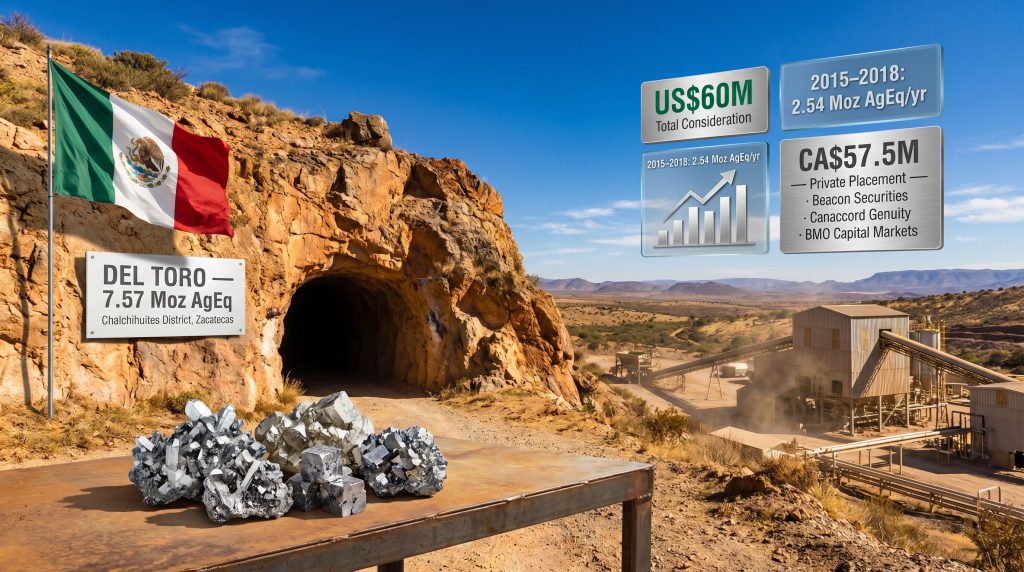
Del Toro is located in the Chalchihuites District of Zacatecas, a historically productive silver corridor that remains substantially under-drilled relative to its geological footprint. The property encompasses 70 mining concessions covering 2,129 hectares, with underground mining activity concentrated across three centres: Perseverancia, San Juan, and Dolores.
The significance of 62.5 kilometres of existing underground development is often underappreciated by investors unfamiliar with underground mining economics. Each metre of underground development — including access drives, raises, declines, and ore passes — represents substantial capital expenditure and often years of excavation work. A new operator inheriting this infrastructure at acquisition cost, rather than construction cost, receives an implicit subsidy that does not appear on the balance sheet but is real in every operational sense.
The processing infrastructure compounds this advantage:
| Infrastructure Component | Specification |
|---|---|
| Flotation circuit capacity | 3,000 tonnes per day |
| Milling configuration | Three mills |
| Processing capability | Sulphide and oxide concentration |
| Tailings facility | Dry stack, designed for 12 years at 2,000tpd |
The dry stack tailings configuration is worth examining separately. Conventional wet tailings facilities create ongoing environmental liability and are increasingly scrutinised under Mexico's tightening regulatory framework. A dry stack facility, which filters and stacks tailings at a much lower moisture content, substantially reduces the risk of tailings dam failure and aligns more readily with modern environmental standards. For a new operator, inheriting a dry stack facility designed for 12 years of operation at 2,000tpd removes an entire category of permitting and construction risk.
Historical Production and the Distinction That Underpins the Restart Thesis
Del Toro operated commercially from 2013 to 2019 under First Majestic Silver, producing an average of 2.54 million ounces of silver equivalent per year during its peak years from 2015 to 2018. The mine ceased operations in 2019 due to operational economics — specifically the cost structure relative to prevailing silver prices at that time — not because the resource was depleted or the geology failed to perform.
This distinction is critical for understanding the restart investment thesis. A mine closed for geological reasons presents a fundamentally different risk profile than one closed for economic reasons that have since changed. With silver prices materially higher in 2025 and 2026 than in 2019, the economic rationale that drove closure has partially reversed, and the resource base remains intact. Silver's dual role as both a precious and industrial metal further supports the case for sustained price strength.
Mineral Resources: A Starting Point, Not a Ceiling
Historical measured and indicated resources, as compiled in First Majestic's March 2025 regulatory filings, present the following picture:
| Resource Category | Tonnage | Silver Grade | Gold Grade | Lead | Zinc | Total AgEq |
|---|---|---|---|---|---|---|
| Measured + Indicated | 592,000t | 201 g/t Ag | 0.43 g/t Au | 3.90% | 4.27% | 7.57 Moz AgEq |
A silver grade of 201 grams per tonne places Del Toro's measured and indicated resource in the high-grade category by global standards. For context, the global average grade for silver mines is typically in the range of 100 to 150 g/t Ag, meaning Del Toro's resource carries a grade premium that has direct implications for processing costs per ounce of recovered metal.
The lead and zinc grades, at 3.90% and 4.27% respectively, are also meaningful. In a polymetallic mine, base metal byproduct credits can substantially reduce the net cost of silver production, effectively subsidising the per-ounce economics. Operators model this as a co-product or byproduct credit, and at current lead and zinc prices, these grades generate real revenue that offsets processing and overhead costs.
The 7.57 Moz AgEq current resource is explicitly framed as a starting point. Sierra Madre's planned 30,000-metre drill programme is designed to expand this figure toward the 100 Moz AgEq threshold embedded in the deal's contingent payment structure. That threshold, which triggers a US$10 million milestone payment if demonstrated in a NI 43-101 technical report within 48 months of closing, implies Sierra Madre believes the geological potential substantially exceeds the current resource estimate.
How the Sierra Madre Del Toro Silver Mine Acquisition Was Structured
A Three-Layer Consideration Model That Aligns Both Parties
The transaction was signed on December 17, 2025, with First Majestic transferring its 100%-owned Mexican subsidiary holding the Del Toro asset to Sierra Madre. Total consideration of up to US$60 million was structured across three distinct layers:
Layer 1 – Closing Payments
- US$20 million in cash paid to First Majestic at closing
- 10,870,000 Sierra Madre common shares issued at a deemed price of CA$1.30 per share
Layer 2 – Deferred Payment (Within 18 Months)
- US$10 million payable in cash or Sierra Madre shares at prevailing market price
- Share-based payment subject to a cap of 10,575,385 common shares
Layer 3 – Performance-Contingent Milestone Payments
- US$10 million upon filing a NI 43-101 technical report within 48 months demonstrating at least 100 Moz AgEq in mineral resources
- US$10 million upon achieving commercial production of at least 4,000 tpd for 30 consecutive days within 60 months of closing
The milestone-linked architecture does something structurally elegant: it keeps First Majestic economically invested in Sierra Madre's success long after the closing date. With a 24.77% equity stake and up to US$30 million in deferred and contingent receipts, the vendor retains meaningful upside participation without needing to operate the asset.
Financing: How CA$57.5 Million Was Assembled in Two Tranches
The acquisition was funded through a brokered private placement of subscription receipts, raising CA$57.5 million in gross proceeds, inclusive of full exercise of the agents' overallotment option. Both tranches closed in January 2026, providing the capital certainty needed to proceed with the COFECE antitrust clearance process.
The syndicate assembled for the placement reflects the transaction's credibility in institutional markets:
- Lead agent and sole bookrunner: Beacon Securities
- Co-agents: Canaccord Genuity, BMO Capital Markets, VSA Capital
Net proceeds funded the US$20 million closing payment, with the remainder allocated to Del Toro exploration and working capital. The choice of subscription receipts as the financing instrument is notable: these structures release proceeds only upon satisfaction of specified conditions — in this case, closing of the acquisition — providing investors with a degree of protection against deal failure.
COFECE and the Antitrust Timeline: A Reference Data Point for Future M&A
Mexican antitrust clearance from COFECE was granted on May 22, 2026, the final regulatory prerequisite before closing. Shareholder approval was also secured prior to the COFECE decision, reflecting strong institutional support for the transaction. The period from deal announcement in December 2025 to COFECE clearance in May 2026 establishes an approximately five-month reference timeline for comparable cross-border mining transactions seeking Mexican antitrust approval — a useful data point for acquirers modelling transaction timelines in the sector.
First Majestic's Post-Transaction Position
Following closing, First Majestic holds 62,433,076 Sierra Madre common shares, representing approximately 24.77% of issued shares on a non-diluted basis, reduced from 26.18% prior to closing due to dilution from the concurrent financing. The shares are subject to a four-month statutory hold, with release structured across four equal tranches of 25% between December 2026 and June 2028. The staggered release schedule limits the potential for abrupt market-side selling pressure and signals an expectation that First Majestic will remain a long-term aligned holder through a portion of Sierra Madre's operational ramp-up.
Sierra Madre's Operational Blueprint: Applying the La Guitarra Playbook
The La Guitarra Precedent and What Grade Reconciliation Reveals
Understanding Sierra Madre's approach to Del Toro requires first understanding what happened at La Guitarra. Sierra Madre's first acquisition from First Majestic, completed in 2023 for approximately US$44.89 million, gave the company a high-grade underground silver-gold mine in Temascaltepec in the State of Mexico. La Guitarra covered more than 39,000 hectares and had been idle since 2018.
The operational results at La Guitarra's Nazareno mining centre provide a genuinely instructive data point for Del Toro investors. Grade reconciliation at Nazareno demonstrated silver grades 40% above the 2023 resource model and gold grades 30% higher than modelled estimates. This level of outperformance against a resource model is unusual and carries two possible interpretations:
- The original resource estimation methodology was conservative, undersampling high-grade zones or applying aggressive discount factors to account for geological uncertainty.
- The geological continuity at depth and along strike is better than the resource model assumed, meaning the in-situ grade distribution favours the operator more than the model predicted.
Either interpretation is constructive for Del Toro, where the existing resource estimate similarly reflects a historical dataset that has not been updated since First Majestic's ownership. In addition, interpreting drill results at depth requires careful geological judgement, and if the Chalchihuites District mineralisation exhibits similar grade continuity characteristics to La Guitarra, the current 201 g/t Ag measured and indicated grade may understate what actual mining encounters will deliver.
Del Toro Restart Roadmap
Sierra Madre has articulated a phased restart approach at Del Toro that prioritises resource expansion before committing to full operational ramp-up:
| Phase | Activity | Target Timing |
|---|---|---|
| Near-term | 30,000m resource expansion drill programme | Post-closing (2026-2027) |
| Medium-term | Updated NI 43-101 mineral resource estimate | Within 48 months of closing |
| Mine restart initiation | Infrastructure commissioning and ramp-up | Around mid-2027 |
| First commercial production | Initial output commencement | Around mid-2028 |
| Production milestone | 4,000 tpd for 30 consecutive days | Within 60 months of closing |
The decision to drill before restarting production reflects a measured approach to capital allocation. Completing a definitive feasibility study and adding ounces to the resource base before committing to full operational expenditure improves the mine's financial profile, supports potential project financing, and creates the conditions needed to achieve the 100 Moz AgEq milestone that triggers the first contingent payment.
Why the Chalchihuites District Warrants Attention Beyond Del Toro's Current Resource
The Chalchihuites District is characterised by mining geologists as a large, under-explored silver belt. The property's 2,129-hectare concession package provides a substantial footprint within this belt, and the existing 62.5 km of underground development provides immediate drill platforms that substantially reduce the cost of testing resource extensions. In practical terms, underground drill programmes can access mineralised zones at depth and along strike without the need for surface drilling infrastructure or slope stability management, reducing both cost per metre and mobilisation time.
The polymetallic nature of the Chalchihuites mineralisation — with silver, gold, lead, and zinc co-occurring in the same geological setting — also suggests that the district's economic potential extends beyond the current resource categories. Lead and zinc in particular are on the US critical minerals list, adding a dimension to the asset's strategic profile that pure silver mines in the region do not share.
The next major ASX story will hit our subscribers first
Broader Silver Mining Activity in Mexico: A Sector Accelerating Around Del Toro
Institutional Capital Re-Entering the Mexican Silver Trade
The Sierra Madre Del Toro silver mine acquisition is not occurring in isolation. Across Zacatecas, Guanajuato, and Durango, capital deployment into silver mining assets accelerated meaningfully in the first half of 2026:
- Guanajuato Silver Company launched what it described as a record 75,000-metre drill programme for 2026, spanning five producing underground mines across Guanajuato and Durango states.
- Sinda Ltd., backed by The Electrum Group, filed with the SEC in June 2026 for a NYSE IPO targeting up to US$100 million to advance a pre-production silver-gold project in Guanajuato, signalling that institutional capital markets are reopening to early-stage Mexican precious metals exposure.
- Multi-million dollar M&A transactions, including the Del Toro deal itself, reflect a structural re-rating of Mexican silver assets at the portfolio level.
The convergence of record drill programmes, institutional IPO filings, and large-scale M&A in a compressed timeframe suggests that sophisticated capital is reaching a consensus view on Mexican silver's risk-adjusted return profile. That consensus is being formed against a backdrop of improving regulatory conditions, elevated silver prices relative to the 2019 trough, and growing US strategic interest in Mexican mineral supply chains.
The USMCA Dimension and Cross-Border Capital Flows
USMCA trade framework negotiations proceeding in 2026 add a policy context to the investment calculus for cross-border mining capital. Mexico's position as both the world's largest silver producer and a top-15 producer across 12 US-classified critical minerals creates a structural argument for deeper integration of Mexican mining into North American supply chains. Consequently, for investors, this translates into a geopolitical tailwind that operates independently of silver price movements and adds a non-commodity floor to the investment thesis for well-positioned Mexican silver operators.
Disclaimer: This article contains forward-looking statements and projections regarding mineral resources, production timelines, investment flows, and regulatory outcomes. These statements involve known and unknown risks and uncertainties. Actual results may differ materially from those projected. Nothing in this article constitutes financial or investment advice. Investors should conduct their own due diligence and consult a qualified financial adviser before making investment decisions.
Want To Stay Ahead of the Next Major Silver Discovery on the ASX?
Discovery Alert's proprietary Discovery IQ model delivers real-time alerts on significant ASX mineral discoveries — instantly turning complex mineral data into actionable opportunities for both traders and long-term investors. Explore historic discoveries and their returns on Discovery Alert's dedicated discoveries page, or begin your 14-day free trial today to position yourself ahead of the broader market.